

Fraud Moves Fast: Why Real-Time Fraud Prevention Is Now Non-Negotiable
.svg)
Fraud does not wait for investigations. It happens in seconds — and must be stopped in seconds.
Introduction
Fraud has shifted from slow, detectable schemes to fast-moving, technology-enabled attacks. Criminal networks exploit real-time payments, digital wallets, and instant onboarding processes to move funds before traditional controls can react.
For banks and fintechs, this creates a critical challenge. Detecting fraud after the transaction has already settled is no longer enough. By then, funds may already be dispersed across multiple accounts, jurisdictions, or platforms.
This is why real-time fraud prevention has become a core requirement for financial institutions. Instead of identifying suspicious activity after it occurs, modern systems intervene before or during the transaction itself.
In high-growth financial ecosystems such as the Philippines, where digital payments and instant transfers are accelerating rapidly, the ability to stop fraud in real time is no longer optional. It is essential for protecting customers, maintaining trust, and meeting regulatory expectations.

The Shift from Detection to Prevention
Traditional fraud systems were designed to detect suspicious activity after transactions were completed. These systems relied on batch processing, manual reviews, and periodic monitoring.
While effective in slower payment environments, this approach has clear limitations today.
Real-time payments settle instantly. Once funds leave an account, recovery becomes difficult. Fraudsters exploit this speed by:
- Rapidly transferring funds across accounts
- Splitting transactions to avoid detection
- Using mule networks to disperse funds
- Exploiting newly opened accounts
This evolution requires a shift from fraud detection to fraud prevention.
Real-time fraud prevention systems analyse transactions before they are executed, allowing institutions to block or step-up authentication when risk is identified.
Why Real-Time Fraud Prevention Matters in the Philippines
The Philippines has experienced rapid adoption of digital financial services. Mobile banking, QR payments, e-wallets, and instant transfer systems have expanded financial access.
While these innovations improve convenience, they also increase fraud exposure.
Common fraud scenarios include:
- Account takeover attacks
- Social engineering scams
- Mule account activity
- Fraudulent onboarding
- Rapid fund movement through wallets
- Cross-border scam networks
These scenarios unfold quickly. Funds may be moved through multiple layers within minutes.
Real-time fraud prevention allows financial institutions to detect suspicious behaviour immediately and intervene before funds are lost.
What Real-Time Fraud Prevention Actually Does
Real-time fraud prevention systems evaluate transactions as they occur. They analyse multiple signals simultaneously to determine risk.
These signals may include:
- Transaction amount and velocity
- Customer behaviour patterns
- Device information
- Location anomalies
- Account history
- Network relationships
- Known fraud typologies
Based on these factors, the system assigns a risk score.
If risk exceeds a threshold, the system can:
- Block the transaction
- Trigger step-up authentication
- Flag for manual review
- Limit transaction value
- Temporarily restrict account activity
This proactive approach helps stop fraud before funds leave the institution.
Behavioural Analytics in Real-Time Fraud Prevention
One of the most powerful capabilities in modern fraud prevention is behavioural analytics.
Instead of relying solely on rules, behavioural models learn normal customer activity patterns. When behaviour deviates significantly, the system flags the transaction.
Examples include:
- Sudden high-value transfers from low-activity accounts
- Transactions from unusual locations
- Rapid transfers to new beneficiaries
- Multiple transactions within short timeframes
- Unusual device usage
Behavioural analytics improves detection accuracy while reducing false positives.
AI and Machine Learning in Fraud Prevention
Artificial intelligence plays a central role in real-time fraud prevention.
Machine learning models analyse historical transaction data to identify patterns associated with fraud. These models continuously improve as new data becomes available.
AI-driven systems can:
- Detect emerging fraud patterns
- Reduce false positives
- Identify coordinated attacks
- Adapt to evolving tactics
- Improve risk scoring accuracy
By combining AI with real-time processing, institutions can respond to fraud dynamically.
Network and Relationship Analysis
Fraud rarely occurs in isolation. Fraudsters often operate in networks.
Real-time fraud prevention systems use network analysis to identify relationships between accounts, devices, and beneficiaries.
This helps detect:
- Mule account networks
- Coordinated scam operations
- Shared device usage
- Linked suspicious accounts
- Rapid fund dispersion patterns
Network intelligence significantly improves fraud detection.
Reducing False Positives in Real-Time Environments
Blocking legitimate transactions can frustrate customers and impact business operations. Therefore, real-time fraud prevention systems must balance sensitivity with accuracy.
Modern platforms achieve this through:
- Multi-factor risk scoring
- Behavioural analytics
- Context-aware decisioning
- Adaptive thresholds
These capabilities reduce unnecessary transaction declines while maintaining strong fraud protection.
Integration with AML Monitoring
Fraud and money laundering are increasingly interconnected. Fraud proceeds often flow through laundering networks.
Real-time fraud prevention systems integrate with AML monitoring platforms to provide a unified risk view.
This integration enables:
- Shared intelligence between fraud and AML
- Unified risk scoring
- Faster investigation workflows
- Improved detection of laundering activity
Combining fraud and AML controls strengthens overall financial crime prevention.
Real-Time Decisioning Architecture
Real-time fraud prevention requires high-performance architecture.
Systems must:
- Process transactions instantly
- Evaluate risk in milliseconds
- Access multiple data sources
- Deliver decisions without delay
Modern platforms use:
- In-memory processing
- Distributed analytics
- Cloud-native infrastructure
- Low-latency decision engines
These technologies enable real-time intervention.
The Role of Automation
Automation is critical in real-time fraud prevention. Manual intervention is not feasible at transaction speed.
Automated workflows can:
- Block suspicious transactions
- Trigger alerts
- Initiate authentication steps
- Notify investigators
- Update risk profiles
Automation ensures consistent and immediate responses.

How Tookitaki Enables Real-Time Fraud Prevention
Tookitaki’s FinCense platform integrates real-time fraud prevention within its Trust Layer architecture.
The platform combines:
- Real-time transaction monitoring
- AI-driven behavioural analytics
- Network-based detection
- Integrated AML and fraud intelligence
- Risk-based decisioning
This unified approach allows banks and fintechs to detect and prevent fraud before funds move.
FinCense also leverages intelligence from the AFC Ecosystem to stay updated with emerging fraud typologies.
Operational Benefits for Banks and Fintechs
Implementing real-time fraud prevention delivers measurable benefits:
- Reduced fraud losses
- Faster response times
- Improved customer protection
- Lower operational costs
- Reduced investigation workload
- Enhanced compliance posture
These benefits are particularly important in high-volume payment environments.
Regulatory Expectations
Regulators increasingly expect institutions to implement proactive fraud controls.
Financial institutions must demonstrate:
- Real-time monitoring capabilities
- Risk-based decisioning
- Strong governance frameworks
- Customer protection measures
- Incident response processes
Real-time fraud prevention software helps meet these expectations.
The Future of Real-Time Fraud Prevention
Fraud prevention will continue evolving as payment ecosystems become faster and more interconnected.
Future capabilities may include:
- Predictive fraud detection
- Cross-institution intelligence sharing
- AI-driven adaptive controls
- Real-time customer behaviour profiling
- Integrated fraud and AML risk management
Institutions that adopt real-time fraud prevention today will be better prepared for future threats.
Conclusion
Fraud has become faster, more sophisticated, and harder to detect using traditional methods. Financial institutions must move from reactive detection to proactive prevention.
Real-time fraud prevention enables banks and fintechs to analyse transactions instantly, identify suspicious activity, and stop fraud before funds are lost.
By combining behavioural analytics, AI-driven detection, and real-time decisioning, modern platforms provide strong protection without disrupting legitimate transactions.
In fast-moving digital payment ecosystems like the Philippines, real-time fraud prevention is no longer a competitive advantage. It is a necessity.
Stopping fraud before it happens is now the foundation of financial trust.
Experience the most intelligent AML and fraud prevention platform
Experience the most intelligent AML and fraud prevention platform
Experience the most intelligent AML and fraud prevention platform
Top AML Scenarios in ASEAN
The Role of AML Software in Compliance
The Role of AML Software in Compliance
Talk to an Expert
Our Thought Leadership Guides

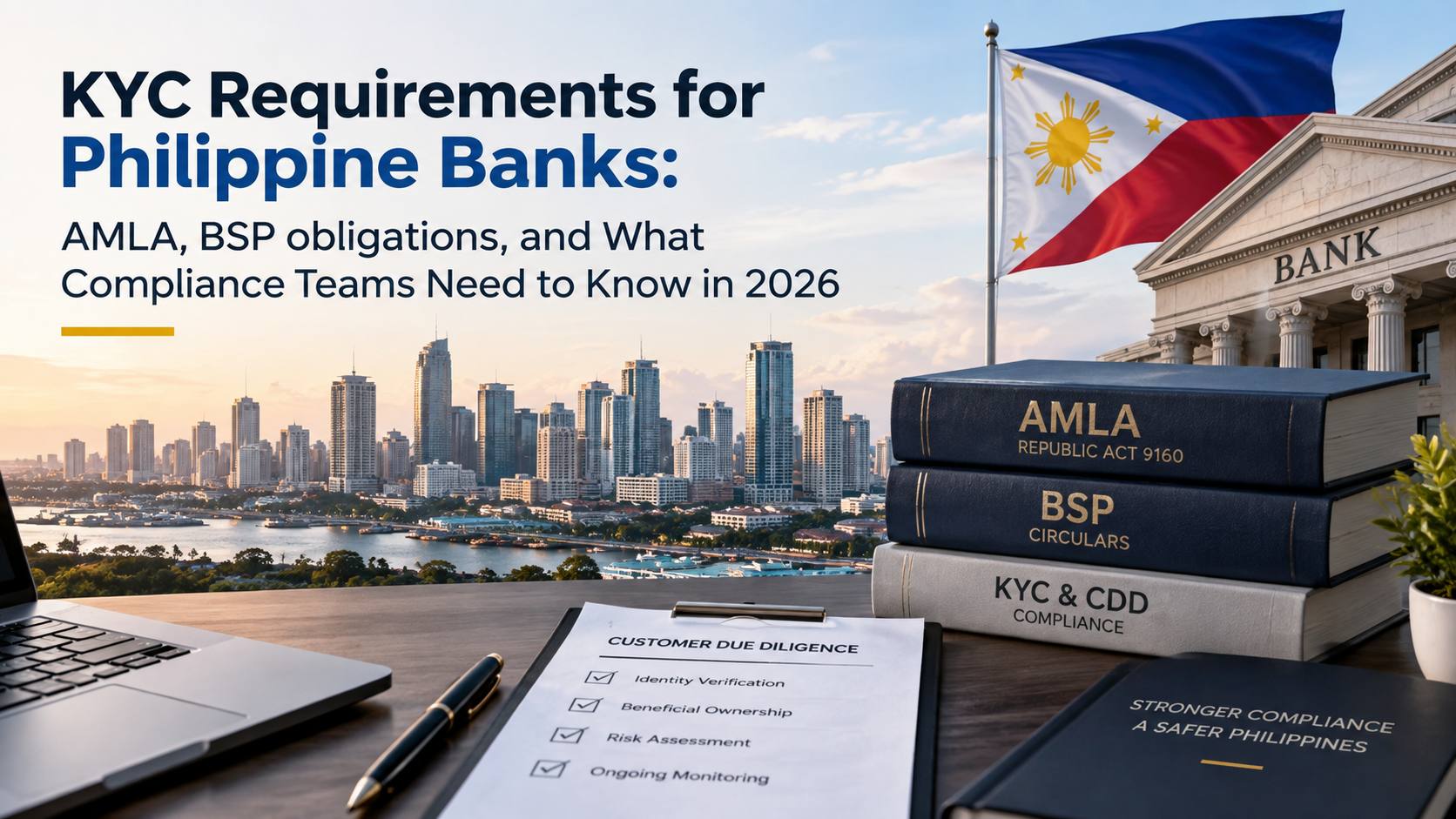
KYC Requirements for Philippine Banks: AMLA, BSP obligations, and What Compliance Teams Need to Know in 2026
The Philippines was removed from the FATF list of jurisdictions under increased monitoring in February 2025. This guide explains current AMLA and BSP KYC/CDD requirements for banks, including beneficial ownership, digital onboarding, reporting and record retention.

KYC Requirements for Philippine Banks: AMLA, BSP obligations, and What Compliance Teams Need to Know in 2026
The Philippines was removed from the FATF list of jurisdictions under increased monitoring in February 2025. This guide explains current AMLA and BSP KYC/CDD requirements for banks, including beneficial ownership, digital onboarding, reporting and record retention.