

AML Compliance for Remittance and Money Transfer Companies: An APAC Guide
.svg)
It is a Thursday afternoon. Your firm is processing remittances on the Singapore–Philippines corridor — six thousand transactions before the weekend. You are licensed under MAS as a Major Payment Institution and registered as a Remittance and Transfer Company with the BSP in Manila. MAS published updated PSN02 guidance last month. This morning, the BSP examination schedule landed in your inbox. Two regulators. Two compliance programmes. One compliance team of four people. That is the daily operating reality for most APAC-licensed remittance operators, and it is the starting point for every AML programme design conversation.
This guide covers what money transfer AML compliance APAC-wide actually requires — by jurisdiction, by obligation, and by what good operational execution looks like.

Why Remittance Companies Carry Higher AML Risk
FATF has consistently identified remittance and money transfer as a high-risk sector. Not because remittance operators are bad actors, but because of the transaction patterns that characterise the business.
Remittance is cash-intensive in many corridors. Some jurisdictions allow senders to pay in cash at agent locations with limited identification requirements. High-volume, low-value transactions create conditions where structuring — the practice of breaking amounts to stay below reporting thresholds — is easier to conceal than in lower-volume banking environments. A customer sending MYR 500 twice a week looks almost identical to a customer structuring around MYR 25,000 CTR thresholds.
FATF Recommendation 16 — the Travel Rule — applies specifically to wire transfers. Remittance companies are wire transfer originators. They must collect, transmit, and retain originator and beneficiary information with every qualifying transfer. This is not the same obligation as KYC. It is a data transmission requirement that sits on top of the CDD framework.
The cross-border nature of remittance creates bilateral exposure. A transfer from Singapore to Manila passes through both MAS and BSP oversight. A compliance failure — a missed STR, an inadequate CDD record, a Travel Rule data gap — does not stay in one jurisdiction. Both regulators can examine the same transaction.
The APAC corridors under heaviest examination scrutiny are among the highest-volume remittance corridors in the world: Singapore–Philippines, Malaysia–Bangladesh, Australia–India, and Philippines–Middle East. High volume does not reduce examiner focus. It increases it.
APAC Regulatory Obligations by Jurisdiction
Singapore (MAS)
Cross-border money transfer above SGD 3 million per month requires a Major Payment Institution licence under the Payment Services Act. The MAS PSA AML obligations for payment institutions are set out in PSN02, which covers CDD, ongoing monitoring, and STR and CTR filing requirements.
The FATF Travel Rule applies at SGD 1,500. For every transfer at or above that threshold, the MPS must transmit originator name, account number, and address or national identity number — plus beneficiary name and account number — to the receiving institution with the payment. The obligation to transmit sits with the sender regardless of whether the beneficiary institution can receive the data in structured form.
STR filing must occur within five business days of the determination that the transaction is suspicious. MAS examiners in 2024 specifically cited STR quality — not volume — as an examination focus area. An STR that describes the suspicious transaction in one sentence without analysis of the pattern does not meet the standard.
Australia (AUSTRAC)
All remittance dealers must register with AUSTRAC before commencing operations. Unregistered remittance dealing is a criminal offence under the AML/CTF Act 2006. This is not a technicality — AUSTRAC has prosecuted unlicensed remittance dealing, and its enforcement record includes actions against informal value transfer networks operating in parallel to registered dealers.
Registered remittance dealers carry the same AML/CTF programme obligations as banks under Chapter 16 of the AML/CTF Rules, without the same IT infrastructure to support them. Threshold Transaction Reports apply to cash transactions above AUD 10,000. Suspicious Matter Reports must be filed for qualifying transactions without a fixed deadline, but AUSTRAC expects prompt filing — delays beyond a few days are examined.
Malaysia (BNM)
Remittance operators require a Money Services Business licence under the MSB Act 2011. The AMLATFPUAA framework applies — the same statutory framework as banks — imposing CDD, ongoing monitoring, and STR and CTR obligations.
CTR threshold is MYR 25,000 for cash transactions. STR filing is required within three business days of the determination. BNM's most recent national risk assessment specifically identifies hawala-style informal remittance networks operating alongside licensed MSBs as a risk vector. That finding has translated directly into elevated examination scrutiny for licensed operators, who face more frequent and detailed examinations as regulators attempt to map the boundary between formal and informal channels.
Philippines (BSP)
Remittance operators require a Remittance and Transfer Company licence from the BSP. The AML programme obligations are set by AMLA and BSP Circular 950 — the same framework that governs banks, applied in full to RTCs.
CTR threshold is PHP 500,000. STR filing is required within five business days. The Philippines exited the FATF grey list in January 2023, but exit has not reduced examination pressure — BSP has increased examination frequency for RTCs since 2023, consistent with post-grey-list monitoring by both the BSP and AMLC.
New Zealand (DIA)
Remittance operators are Phase 2 reporting entities under the AML/CFT Act 2009, supervised by the Department of Internal Affairs. The same CDD, ongoing monitoring, and SAR and PTR obligations that apply to banks apply in full to remittance operators. The DIA's supervisory approach includes sector-wide audits and thematic reviews — it does not reserve examination resources only for larger entities.
The FATF Travel Rule in Practice for APAC Remittance Operators
FATF Recommendation 16 requires the originating institution to transmit originator and beneficiary information with every wire transfer above the applicable threshold. Across APAC, the operative thresholds are SGD 1,500 under MAS, AUD 1,000 under AUSTRAC, and USD 1,000 equivalent as the FATF baseline for jurisdictions without a lower domestic threshold.
The data that must travel with the payment: originator name, account number, address or national identity number; beneficiary name and beneficiary account number. These fields must populate the payment message — they cannot be retained on file at the sending institution and supplied only on request.
The operational problem is well-documented. Many beneficiary institutions in the corridors where APAC remittance volumes are highest — particularly in developing-market corridors — do not have systems capable of receiving structured Travel Rule data. The sending institution's obligation does not dissolve because the receiving institution lacks the infrastructure. Compliance requires transmitting the data within whatever message structure the payment uses: MT103 field population for SWIFT transactions, or the equivalent structured fields in ISO 20022 message formats.
Travel Rule technology solutions — TRISA, VerifyVASP, and Sygna Bridge are the most widely deployed in APAC for virtual asset transfers — are increasingly being applied to fiat remittance payment flows as well. For most APAC remittance operators on real-time domestic rails, the Travel Rule data obligation sits inside the payment message design, not in a separate data transmission layer.

Transaction Monitoring Requirements Specific to Remittance
High-volume, low-value transaction environments cannot be monitored with the dollar-threshold rules designed for retail banking. A rule that fires above USD 5,000 will miss the dominant remittance pattern entirely — hundreds of transactions at USD 200 to USD 500 per customer per month — and generate alert noise on the routine flows that constitute most of the business.
For an overview of how automated transaction monitoring works, the underlying detection logic matters more than the threshold level. Remittance monitoring is a typology problem, not a threshold problem.
Velocity monitoring is the primary detection method for mule accounts in remittance networks. The pattern is not a single large transfer — it is twenty transactions in forty-eight hours across multiple corridors from the same account or beneficial owner. A system calibrated only to flag high-value single transactions will not detect this.
Corridor-specific scenario calibration is not optional. The Singapore–Philippines corridor has different fraud typologies from the Malaysia–Bangladesh corridor. Monitoring scenarios applied generically across all corridors without tuning for the specific patterns in each one will produce both false positives on legitimate traffic and false negatives on actual suspicious activity.
Round-number structuring is the simplest pattern and the one most often missed by single-threshold rules. Transactions consistently placed just below the CTR threshold — MYR 24,500, AUD 9,800, PHP 499,000 — are a textbook structuring indicator. A rule with a single threshold at the CTR level will not catch this. The detection logic must look at the cluster of transactions below the threshold, not just the individual transaction value.
Beneficiary account reuse is a mule indicator: multiple unrelated customers sending to the same unfamiliar beneficiary account. This pattern requires a system capable of cross-customer analysis, not just single-customer transaction review. Rules-based systems that process each customer's alerts in isolation cannot detect it.
For remittance operators evaluating their technology choices, the same detection architecture issues apply as those covered in TM for payment companies and e-wallets — the product and customer profiles are different, but the architectural requirements for cross-customer scenario coverage are the same.
What Good Looks Like for a Multi-Jurisdiction Remittance Operator
A compliance officer managing two or three APAC licences simultaneously with a small team is not running a bank compliance programme at reduced scale. The operational structure is different.
A single TM platform across all jurisdictions is operationally necessary, not aspirational. Compliance officers in multi-jurisdiction firms who reconcile alerts from separate system instances — one per market — spend time on logistics that should go into analysis. The same transaction, flagged differently in two systems because the rule calibrations differ, creates reconciliation work that multiplies with volume.
Pre-settlement processing on real-time rails is required where payment is irrevocable on settlement. On PayNow, DuitNow, NPP, and InstaPay, a payment that clears cannot be recalled. Batch monitoring that runs after settlement has already processed the payment before the alert fires. The monitoring must run against the payment instruction before settlement, not the settled record.
Travel Rule data workflow integrated into the payment process eliminates the manual population of originator and beneficiary data as a separate step. When Travel Rule data handling is separated from payment processing and managed by different team members, the data quality degrades and the audit trail becomes inconsistent.
STR and CTR filing workflows built per jurisdiction address the material operational differences between regulatory regimes: different templates, different filing portals, different time windows, different field requirements. A case management system that requires the analyst to manually navigate those differences for each jurisdiction adds material risk. The workflows should enforce the right template for the jurisdiction of the filing, triggered by the currency of the transaction.
Selecting the right platform requires working through a structured evaluation. The Transaction Monitoring Software Buyer's Guide covers the criteria relevant to multi-jurisdiction operators, including how to assess vendor coverage across APAC regulatory regimes.
FinCense for APAC Remittance Operators
FinCense is deployed at remittance and payment operators across APAC — not only at banks. The platform is configured for the transaction patterns, corridor structures, and regulatory filing requirements that remittance operators encounter, not adapted from a banking deployment.
The scenario library includes more than fifty financial crime typologies covering the patterns most prevalent in remittance: mule account networks identified by cross-customer beneficiary account reuse, APP scam indicators in outbound payment flows, velocity structuring across corridors, and cross-border layering patterns. These are pre-built scenarios, not configurations that require the compliance team to write detection logic from scratch.
Pre-settlement processing is available across PayNow, DuitNow, NPP, InstaPay, and FAST — covering the real-time rails in Singapore, Malaysia, Australia, and the Philippines where irrevocable payment risk requires monitoring before settlement, not after.
Multi-jurisdiction STR and CTR filing workflows are built into the case management interface. Filing to AUSTRAC, BNM, AMLC, or MAS FIU from a single case triggers the correct jurisdiction-specific template, with the applicable time window displayed for the analyst at the case level.
In production deployments, FinCense has reduced false positive rates by up to 50% compared to legacy rules-based systems. For a remittance operator managing three hundred thousand transactions per month with a compliance team of four, a 50% reduction in false positive volume is not a performance metric — it is the difference between a workable alert queue and one that structurally cannot be cleared before the next batch arrives.
Book a demo to see FinCense configured for APAC remittance compliance — with corridor-specific scenarios already calibrated and multi-jurisdiction filing workflows built in.
For the full vendor evaluation framework, see the Transaction Monitoring Software Buyer's Guide.
Experience the most intelligent AML and fraud prevention platform
Experience the most intelligent AML and fraud prevention platform
Experience the most intelligent AML and fraud prevention platform
Top AML Scenarios in ASEAN
The Role of AML Software in Compliance
The Role of AML Software in Compliance
Talk to an Expert
Our Thought Leadership Guides

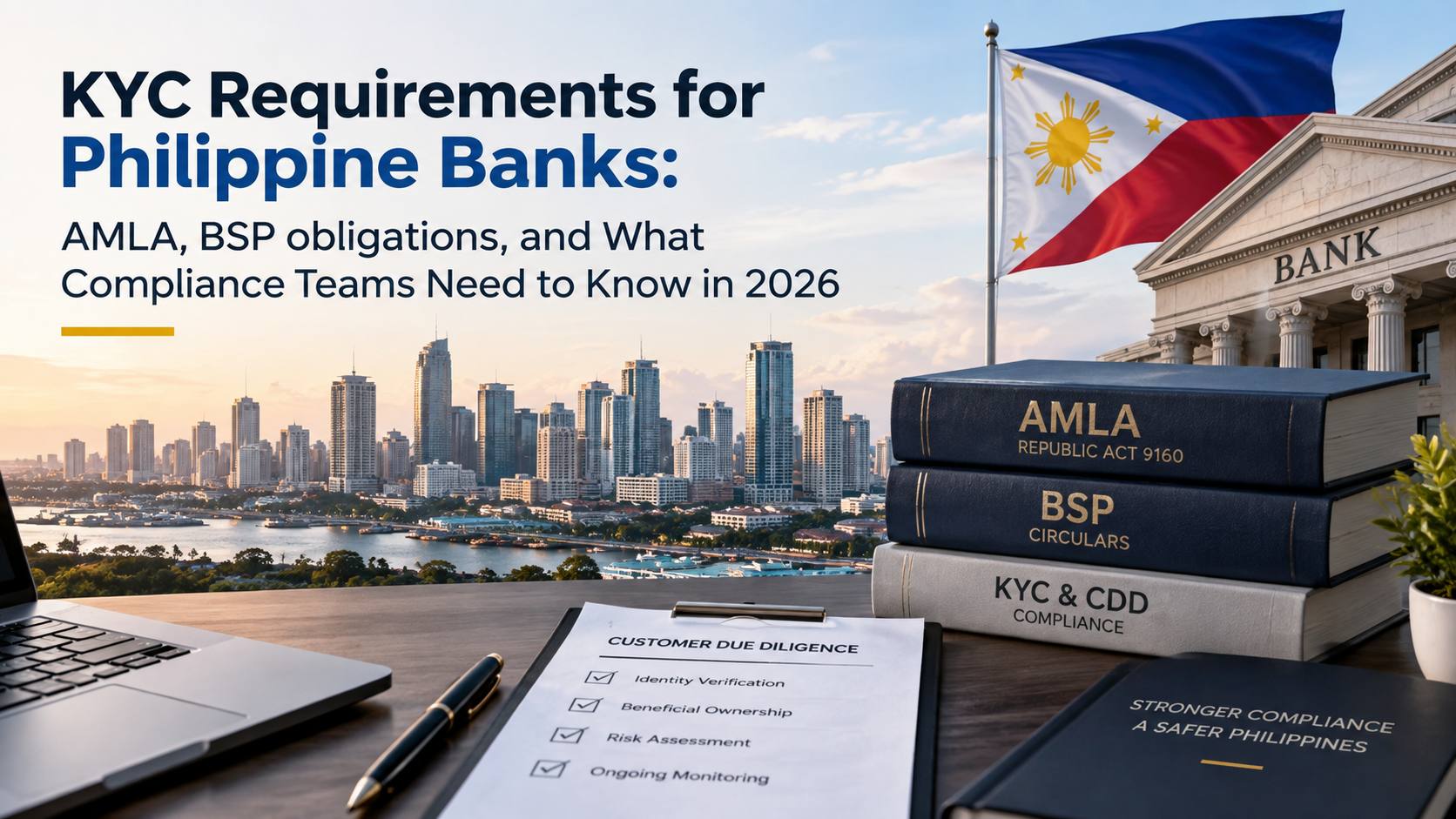
KYC Requirements for Philippine Banks: AMLA, BSP obligations, and What Compliance Teams Need to Know in 2026
The Philippines was removed from the FATF list of jurisdictions under increased monitoring in February 2025. This guide explains current AMLA and BSP KYC/CDD requirements for banks, including beneficial ownership, digital onboarding, reporting and record retention.
KYC Requirements for Philippine Banks: AMLA, BSP obligations, and What Compliance Teams Need to Know in 2026
The Philippines was removed from the FATF list of jurisdictions under increased monitoring in February 2025. This guide explains current AMLA and BSP KYC/CDD requirements for banks, including beneficial ownership, digital onboarding, reporting and record retention.