

Transaction Monitoring in Malaysia: BNM Requirements and Best Practices
.svg)
Bank Negara Malaysia shifted from prescriptive to risk-based supervision several years ago. For transaction monitoring, that shift has specific consequences. Institutions that run static threshold-only systems — rules set at go-live and unchanged since — are increasingly out of step with what BNM examiners expect to see.
Malaysia's FATF Mutual Evaluation, conducted in 2021 and published in 2022, rated the country as partially compliant or non-compliant across several technical recommendations, including Recommendation 10 (customer due diligence) and Recommendation 16 (wire transfers). The evaluation flagged weaknesses in ongoing monitoring and STR quality at reporting institutions. BNM's supervisory response has been direct: examinations since 2022 have placed transaction monitoring programmes under considerably more scrutiny than before the assessment.
This article covers what BNM specifically requires from a transaction monitoring programme, the reporting thresholds institutions must meet, what examiners look for in practice, and where FinCense addresses the framework.
For background on Malaysia's full AML/CFT regulatory framework, see our overview of Malaysia's AML/CFT obligations under AMLATFPUAA and the BNM Policy Document.

Malaysia's AML/CFT Regulatory Framework — the TM Foundation
Transaction monitoring in Malaysia sits on two legal instruments.
AMLATFPUAA 2001 (as amended) is the primary legislation. The Anti-Money Laundering, Anti-Terrorism Financing and Proceeds of Unlawful Activities Act 2001 establishes the obligations of Reporting Institutions — who they are, what they must do, and what penalties apply when they fail. The 2014 and 2020 amendments expanded the predicate offence list, brought Designated Non-Financial Businesses and Professions (DNFBPs) into scope, and raised maximum penalties to MYR 3 million per offence.
BNM's AML/CFT/CPF/TFS Policy Document (2023) is the operational standard. This is where BNM translates the Act's obligations into programme requirements — including the specific requirements for transaction monitoring systems, alert investigation processes, and calibration governance. When a BNM examiner cites a deficiency, the reference is almost always to the Policy Document, not to the Act itself.
Reporting Institutions under AMLATFPUAA cover a wide range of entities: licensed banks, Islamic banks, development financial institutions, insurance companies, capital market intermediaries, money services businesses, e-money issuers, digital banks, and — since the Phase 2 expansion in 2020 — lawyers, accountants, and real estate agents.
BNM supervises financial institutions. The Securities Commission supervises capital market intermediaries. The Companies Commission oversees designated company service providers. Each supervisor applies the AMLATFPUAA framework to its regulated population. For BNM-supervised institutions, the Policy Document is the day-to-day compliance standard.
What BNM's Policy Document Requires for Transaction Monitoring
Section 14 of the Policy Document covers ongoing monitoring and record-keeping. The requirements are specific.
Automated systems are mandatory. Institutions must implement an automated transaction monitoring system adequate for the nature, scale, and complexity of their business. Manual review of sampled transactions does not satisfy this requirement. The system must be capable of detecting patterns across the full transaction population, not a sample.
Calibration must reflect the institution's own risk profile. This is the element that static threshold systems most commonly fail on. BNM does not prescribe specific thresholds. It requires that the thresholds and scenarios in use reflect the institution's customer risk assessment — the output of the enterprise-wide risk assessment, not the vendor's default configuration. A rural cooperative bank and a digital bank processing international remittances have materially different customer risk profiles. The same rule library cannot serve both, and BNM's Policy Document makes clear that it is the institution's responsibility to demonstrate that calibration is appropriate to their specific population.
Monitoring must be continuous. BNM's ongoing monitoring language mirrors FATF Recommendation 10 — monitoring must operate across the full course of the customer relationship, not as a periodic batch process that reviews a subset of transactions once a month. For real-time payment channels, this has practical implications: batch processing that catches a transaction two days after settlement is not equivalent to monitoring at the point of transaction.
Every alert must be assessed and documented. BNM expects a documented investigation workflow. Each alert must be assessed, the assessment must be recorded, and the disposition — whether the alert is closed with rationale or escalated to STR review — must be traceable. An alert queue that shows "reviewed" with no supporting investigation record does not satisfy the Policy Document's requirements.
Calibration must be reviewed periodically. At minimum, BNM expects annual calibration reviews. Reviews are also required when the customer base or product profile changes materially — new product launch, significant customer segment growth, entry into a new geographic market. The review and any resulting threshold adjustments must be documented with dated sign-off from a senior compliance officer.
Section 11 of the Policy Document, which covers customer due diligence, is directly relevant to transaction monitoring design. The CDD risk classification assigned to each customer — standard, medium, or high risk — should determine the intensity of monitoring applied to that customer's transactions. An institution that applies identical monitoring rules to all customers regardless of CDD risk classification is not meeting the risk-based requirement.

Reporting Thresholds and STR Obligations
Cash Transaction Reports (CTRs). Transactions in cash or cash equivalents above MYR 25,000 must be reported to BNM's Financial Intelligence and Enforcement Department (FIED) within 3 business days of the transaction.
Suspicious Transaction Reports (STRs). There is no threshold for STR filings. The obligation is triggered by suspicion — when a compliance officer, having reviewed available information, determines that a transaction or pattern of transactions is suspicious. Once that determination is made, the STR must be filed with BNM/FIED within 3 business days.
The 3-business-day clock on STR filings is a common source of examination findings. Where the investigation workflow requires multiple sequential sign-offs before filing, the clock can expire before the report reaches the MLRO. Institutions whose internal escalation processes consistently result in filings on day 3 or later are at risk.
Tipping off prohibition. Institutions must not inform the customer — directly or indirectly — that an STR has been or will be filed. This prohibition extends to staff below compliance officer level and applies during the alert investigation process, not only at the point of filing.
Record retention. All transaction records and CDD documentation must be retained for 6 years from the end of the business relationship. BNM examiners reviewing a programme may request records from any point within that 6-year window. Institutions whose systems do not retain complete alert investigation records for the full retention period will be unable to demonstrate compliance for the period not covered.
Digital Banks and E-Money Issuers — Specific TM Considerations
BNM issued the Digital Bank licensing framework in 2022. Five digital banks have been licensed under that framework. They are subject to the same AMLATFPUAA obligations as conventional licensed banks — including the full Policy Document requirements for transaction monitoring systems, calibration, alert investigation, and reporting.
The assumption that digital banks operate under a lighter compliance perimeter than conventional banks is incorrect. BNM's licensing documentation is explicit: digital banks must meet equivalent standards, adapted for their operating model and customer base.
E-money issuers licensed under the Financial Services Act 2013 have tiered account structures. Tier 1 accounts carry a MYR 5,000 cumulative balance limit and are treated as lower-risk. That lower-risk designation reduces CDD intensity — it does not eliminate transaction monitoring obligations. E-money issuers must monitor for anomalies within the Tier 1 population, including patterns that would not be unusual in isolation but become suspicious in aggregate.
BNM's financial crime risk assessments have specifically identified typologies associated with digital banking and e-wallet channels:
- Mule account layering through e-wallets, where proceeds move through multiple accounts in rapid succession before withdrawal
- Rapid in-out velocity patterns — high-value inflows immediately followed by bulk transfers or withdrawals, with no plausible commercial purpose
- Account takeover followed by bulk transfers, where the transaction pattern changes sharply after a suspected credential compromise
These typologies require specific monitoring rules. Generic monitoring scenarios designed for conventional banking products will not detect them reliably.
BNM has signalled through its 2025 e-money AML/CFT exposure draft that CDD and monitoring requirements for e-money issuers will be tightened if enacted — with specific requirements for transaction monitoring aligned to each institution's customer risk assessment rather than applied at the product level. Institutions that currently apply product-level defaults should treat this as a forward indicator of examination direction.
For BNM's specific KYC and CDD requirements for digital banks and e-money issuers, see our guide to BNM's digital bank and e-money KYC requirements.
Six Criteria for an Effective TM Programme Under BNM
These criteria are derived from BNM's Policy Document requirements and recurring examination findings.
1. Risk-based calibration. Alert thresholds and scenarios must reflect the institution's specific customer risk profile — the output of the enterprise-wide risk assessment, reviewed and updated when the population changes. Vendor defaults are a starting point, not a destination. BNM's examination record shows that institutions running unmodified vendor configurations are routinely cited.
2. Coverage of Malaysian financial crime typologies. BNM's financial crime risk assessments identify specific patterns relevant to the Malaysian market: cross-border trade-based money laundering, corporate account structuring, e-wallet mule networks, and instant payment fraud. These typologies must be in the active rule library, not on a watch list for future implementation.
3. Pre-settlement screening for instant payments. Malaysia's Real-time Retail Payments Platform — RPP, operating as DuitNow — processes irrevocable instant payments. Batch monitoring that reviews DuitNow transactions after settlement cannot intercept a suspicious payment. Pre-settlement evaluation logic, equivalent to what Singapore's PayNow and Australia's NPP require, is necessary for institutions with material DuitNow volumes.
4. Alert quality over alert volume. BNM examination findings have consistently cited alert investigation backlogs — queues with unreviewed alerts older than 30 days — as evidence of inadequate programme maintenance. A system that generates high alert volumes at low accuracy does not demonstrate active monitoring. It demonstrates an overwhelmed compliance function. Reducing false positive rates is not a nice-to-have; it is a programme governance requirement.
5. Explainable alert logic. Compliance analysts must understand why an alert was raised in order to make a quality investigation decision. A model that outputs a suspicion score without an explanation of which behaviours contributed to it puts the analyst in the position of making a filing decision based on a number rather than evidence. BNM examiners reviewing investigation records will ask the analyst what they found and why they made their disposition decision. "The system flagged it" is not an answer.
6. Documented calibration. BNM expects evidence that thresholds are reviewed and adjusted over time. A rule set deployed at system go-live and unchanged for two or three years — with no documentation of reviews, no record of what was considered and rejected, and no sign-off from senior compliance — is a finding in waiting. The documentation requirement exists regardless of whether the thresholds themselves are appropriate.
For a broader overview of how transaction monitoring works and what an effective programme requires, see our introduction to transaction monitoring.
Common BNM Examination Findings in Transaction Monitoring
Based on publicly available supervisory guidance and BNM examination themes, the following findings recur across reporting institutions:
Alert investigation backlogs. Queues with alerts unreviewed for more than 30 days are treated as a red flag. BNM examiners will ask how long the backlog has existed and what steps the compliance function took to address it.
Insufficient typology coverage for digital banking products. Institutions with e-wallet or digital banking products that apply conventional banking monitoring rules without product-specific scenarios are consistently cited for typology gaps.
No evidence of calibration review. Institutions that cannot produce documentation of when thresholds were last reviewed, what data informed the review, and who approved the outcome have a governance failure regardless of whether their thresholds happen to be appropriate.
STR filing delays. Investigation workflows with multiple sequential sign-offs that consistently result in filings on day 3 or later — or that have produced late filings — generate findings. BNM treats the 3-business-day requirement as a firm deadline, not a target.
Inadequate alert disposition documentation. An examiner reviewing a closed alert needs to understand the analyst's rationale. A disposition record that shows the alert was reviewed without documenting what was found, what was considered, and why the decision was made does not meet the Policy Document standard.
How FinCense Addresses the BNM Framework
FinCense is pre-configured with BNM-aligned typologies. The rule library includes DuitNow-specific scenarios — pre-settlement screening logic for instant payments — and e-wallet fraud patterns documented in BNM's financial crime risk assessments.
Alert thresholds are calibrated to each institution's customer risk assessment during implementation. Generic vendor defaults are not applied. The calibration rationale is documented and retained for examination review.
CTR and STR workflows are built into the case management module, with filing deadline tracking. Compliance officers see the filing deadline at the point of alert escalation, not after the 3-business-day window has passed.
In production deployments, FinCense has reduced false positive rates by up to 50% compared to legacy rule-based systems. For a compliance team managing 300 daily alerts, that reduction represents approximately 150 fewer dead-end investigations per day — which directly addresses the backlog problem that BNM examination findings most commonly cite.
Audit trail exports are structured for BNM examination review. Every alert record includes the rule or scenario that triggered it, the investigation timeline, the analyst's documented rationale, and the disposition outcome.
Taking the Next Step
For the complete vendor evaluation framework — including the seven questions to ask any transaction monitoring vendor — see our Transaction Monitoring Software Buyer's Guide.
Book a demo to see FinCense running against BNM-specific Malaysian financial crime scenarios, including DuitNow pre-settlement screening and e-wallet mule detection.
Experience the most intelligent AML and fraud prevention platform
Experience the most intelligent AML and fraud prevention platform
Experience the most intelligent AML and fraud prevention platform
Top AML Scenarios in ASEAN
The Role of AML Software in Compliance
The Role of AML Software in Compliance
Talk to an Expert
Our Thought Leadership Guides

KYC Requirements for Philippine Banks: AMLA, BSP obligations, and What Compliance Teams Need to Know in 2026
The Philippines was removed from the FATF list of jurisdictions under increased monitoring in February 2025. This guide explains current AMLA and BSP KYC/CDD requirements for banks, including beneficial ownership, digital onboarding, reporting and record retention.
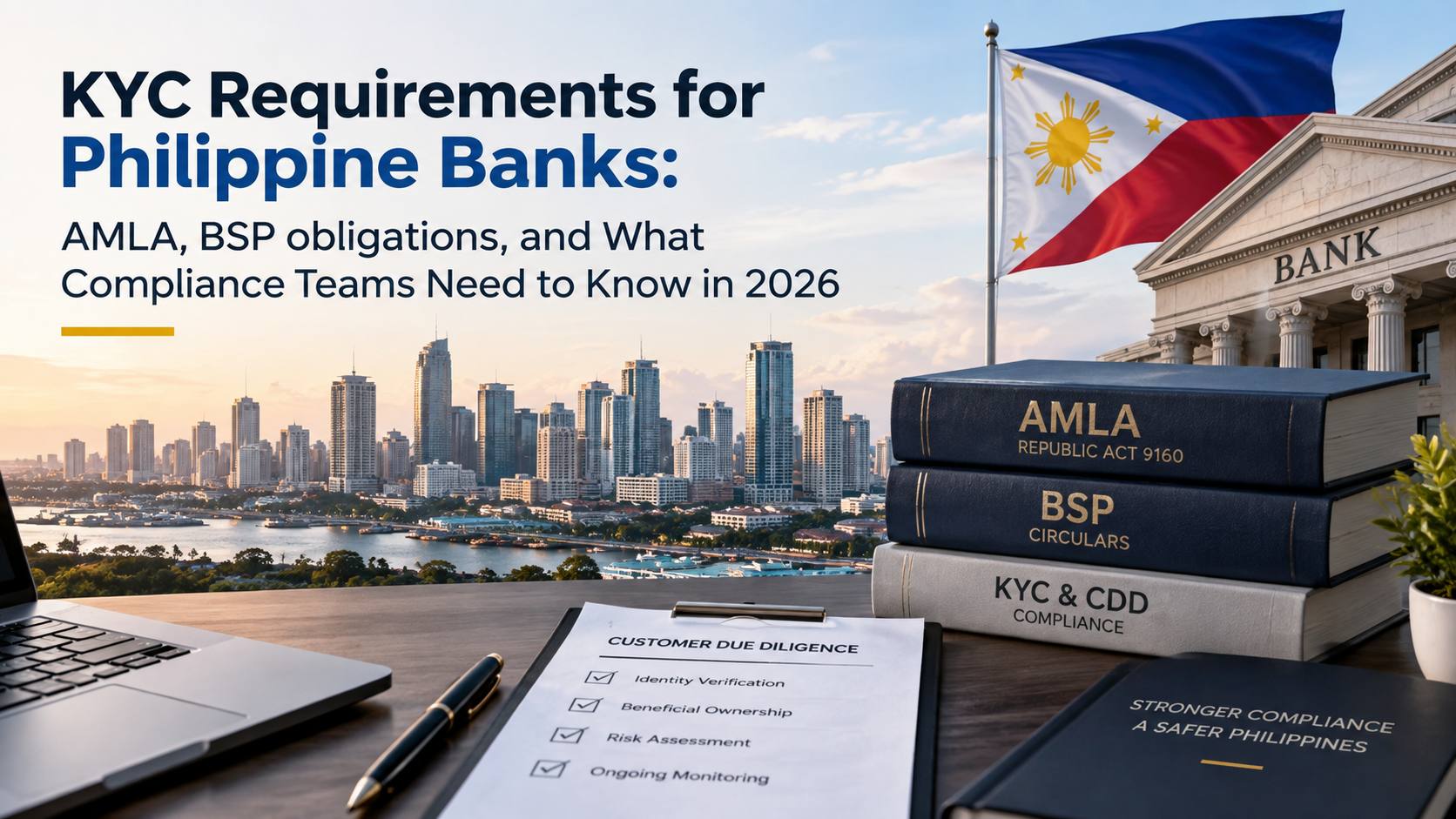
KYC Requirements for Philippine Banks: AMLA, BSP obligations, and What Compliance Teams Need to Know in 2026
The Philippines was removed from the FATF list of jurisdictions under increased monitoring in February 2025. This guide explains current AMLA and BSP KYC/CDD requirements for banks, including beneficial ownership, digital onboarding, reporting and record retention.