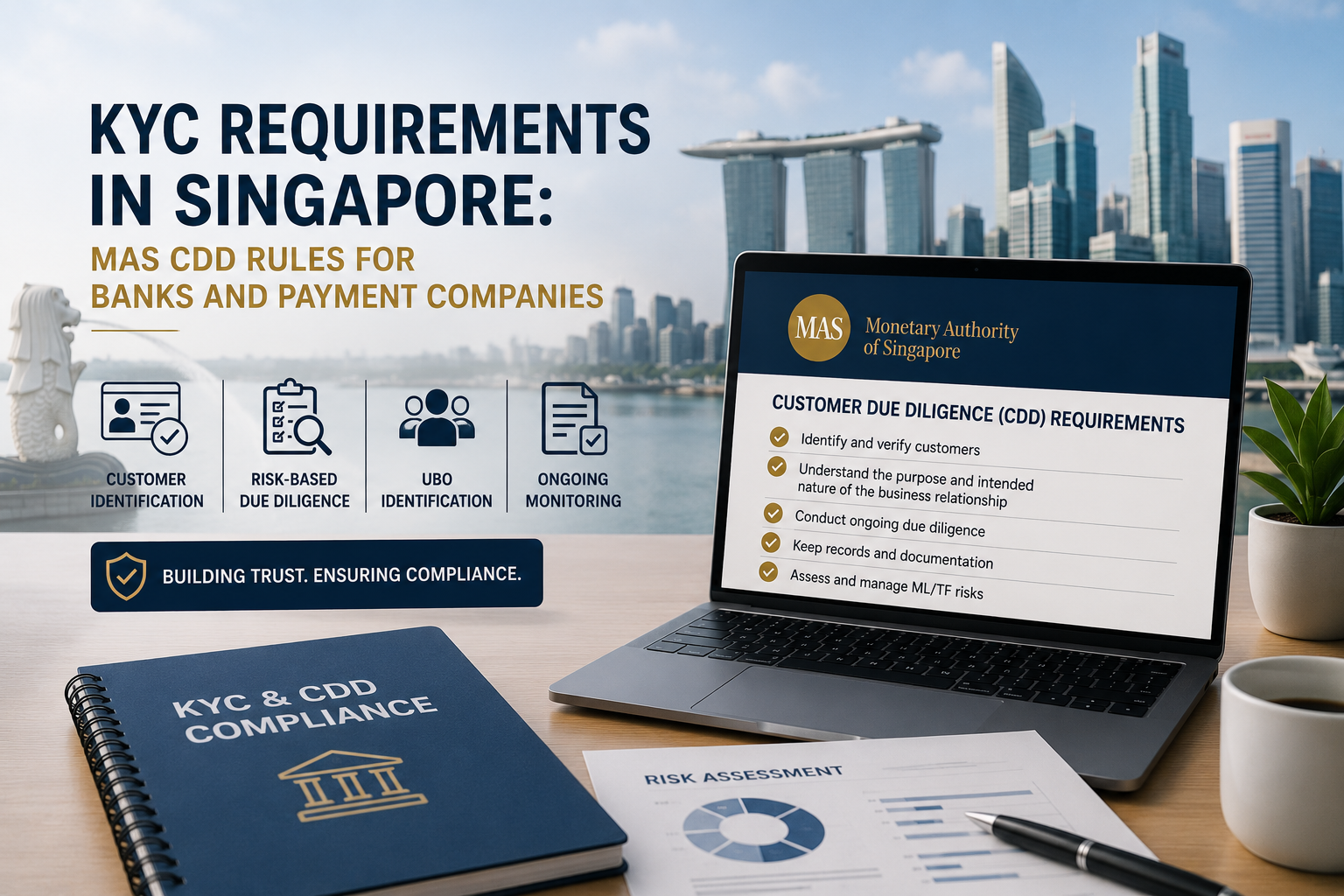
Payment Services Act Singapore: AML Obligations for Licensed Payment Institutions
.svg)
The MAS approval letter arrives. The Major Payment Institution licence is granted. The founders celebrate. The press release goes out.
Then the compliance team sits down.
The PSA licence covers seven categories of payment service activity, and the AML/CFT obligations attached to each are substantive. Unlike MAS Notice 626 for banks, which has years of published guidance, examination findings, and industry interpretation built around it, the PSA AML framework is less documented. The notices exist. The obligations are real. But the compliance team at a newly licensed MPI often has to build from scratch, without the institutional knowledge that banks have accumulated since 2002.
This guide covers what the Payment Services Act requires from licensed payment institutions in Singapore, specifically on AML/CFT. It is written for compliance officers, MLROs, and legal teams at standard payment institutions (SPIs) and major payment institutions (MPIs) who know what the PSA is but need to understand their specific obligations in detail.

The PSA Framework: Scope and Licence Tiers
The Payment Services Act 2019 (PSA) came into force on 28 January 2020 and was substantially amended by the Payment Services (Amendment) Act 2021 (PS(A)A 2021), which extended regulatory coverage to previously unregulated services and introduced stricter obligations for digital payment token providers.
The PSA regulates seven categories of payment service:
- Account issuance services
- Domestic money transfer services
- Cross-border money transfer services
- Merchant acquisition services
- E-money issuance services
- Digital payment token (DPT) services
- Money-changing services
A firm does not need to offer all seven to be licensed. Many MPIs hold licences for two or three categories — a cross-border remittance operator with an e-money issuance component is common. Each service category the firm is licensed for carries AML/CFT obligations independently.
Two Licence Tiers, Different AML Exposure
The PSA creates two licence tiers that determine the depth of AML obligations.
Standard Payment Institutions (SPIs) are subject to monthly transaction thresholds: SGD 3 million per month across all regulated services, or SGD 1.5 million per month for any single regulated service. At these volumes, SPIs can apply simplified CDD in some circumstances and face lighter ongoing monitoring requirements.
Major Payment Institutions (MPIs) exceed those thresholds. MPIs face the full suite of AML/CFT obligations under MAS Notice PSN01 (or PSN02 for DPT services). MAS expects MPI-level controls to be equivalent in standard to those at licensed banks — the fact that a firm is a payment institution rather than a bank does not reduce the expectation.
One important clarification on scope: the PSA exempts certain intra-group transfers and specific corporate treasury services from its regulated activities. Whether a firm's particular activity falls within an exemption requires analysis of the specific transaction flows — MAS has not published a comprehensive list, and several firms have sought clarification through the licensing process itself.
MAS Notice PSN01: The Core AML Obligations
MAS Notice PSN01 — "Prevention of Money Laundering and Countering the Financing of Terrorism — Holders of a Standard Payment Institution Licence or a Major Payment Institution Licence (Non-DPT Services)" — was issued under section 103 of the PSA and took effect when the Act commenced in January 2020.
PSN01 applies to payment institutions providing any of the seven regulated services except DPT services (which fall under PSN02, covered below). Its structure mirrors MAS Notice 626 for banks, adapted for the payment context.
The four core obligation areas under PSN01 are:
1. Customer Due Diligence (CDD)
Payment institutions must identify and verify customers, understand the nature and purpose of the business relationship, and conduct ongoing monitoring. The CDD threshold for occasional transactions is SGD 1,500 — lower than the SGD 5,000 threshold that applies to banks under Notice 626. This difference reflects the higher anonymity risk in payment services, where customer relationships are typically shorter and account history shallower than in traditional banking.
Enhanced due diligence (EDD) is required for:
- Any transaction above SGD 5,000
- Cross-border transfers to or from jurisdictions on the FATF grey or black list
- Customers who present higher-risk indicators under the institution's risk assessment
Simplified CDD is available only for SPI-tier products with capped e-money balances — the maximum cap for simplified CDD to apply is SGD 5,000 in stored value.
2. Ongoing Monitoring
PSN01 requires payment institutions to monitor transactions for unusual or suspicious patterns. The monitoring standard is explicitly equivalent to that imposed on banks under Notice 626. There is no licence-tier carve-out for MPIs: a major payment institution must run monitoring that meets bank-grade expectations.
In practice, this is where many payment institutions fall short. [Transaction monitoring in the MAS context](/compliance-hub/transaction-monitoring-singapore-mas-requirements) requires calibrated alert logic, documented investigation workflows, and audit trails that MAS can review. Payment institutions often have none of these at the point of licence grant — they have the licence, but not the infrastructure.
3. Suspicious Transaction Reporting (STR)
STR obligations do not come from the PSA itself — they come from the Corruption, Drug Trafficking and Other Serious Crimes (Confiscation of Benefits) Act (CDSA). Section 39 of the CDSA requires any person who knows or has reasonable grounds to suspect that property represents proceeds of drug trafficking or other serious crimes to file a report with the Suspicious Transaction Reporting Office (STRO).
The practical timeline is one business day from the point at which suspicion forms. That formation date matters: MAS examination findings have treated cases where the suspicion formation date was left blank or set to the date of filing (rather than the date of the underlying discovery) as incomplete reports — even where the filing itself was technically made within the window.
4. Record-Keeping
CDD documents and transaction records must be retained for five years from the date the transaction was conducted or the business relationship ended. MAS can request records going back up to five years in the course of an examination.
One PSN01 Obligation Per Service
PSN01 contains a provision that compliance teams at multi-service payment institutions sometimes miss: a firm licensed to provide both cross-border money transfer services and e-money issuance services must comply with PSN01 separately for each service. CDD performed for a customer under the cross-border transfer service does not automatically satisfy CDD requirements for the same customer's e-money transactions. The records, processes, and monitoring must address each licensed service independently.
MAS Notice PSN02: DPT Service Providers
MAS Notice PSN02 — "Prevention of Money Laundering and Countering the Financing of Terrorism — Holders of a Standard Payment Institution Licence or Major Payment Institution Licence Carrying on Digital Payment Token Service" — applies to firms licensed to offer DPT services: crypto exchanges, digital asset custodians, and related providers.
PSN02 carries higher-risk obligations than PSN01, reflecting MAS's view that DPT services present specific money laundering and terrorism financing risks not present in traditional payment services.
The additional obligations under PSN02 include:
Travel Rule compliance: PSN02 implements FATF Recommendation 16 for virtual assets. Licensed DPT service providers must collect, verify, and transmit originator and beneficiary information for DPT transfers above SGD 1,500. For transfers to or from unhosted wallets (wallets not held at a licensed provider), enhanced procedures apply. MAS has not mandated a specific technical standard for travel rule compliance, but expects firms to use an approved solution with documented coverage for the counterparty jurisdictions they transact with.
Blockchain-specific monitoring: Alert logic for DPT transactions must address blockchain-native risk indicators — rapid multi-hop transfers across wallets, use of mixing or tumbling services, high-velocity micro-transactions consistent with layering, and activity consistent with known illicit addresses. Standard bank transaction monitoring typologies do not map cleanly to on-chain behaviour, and PSN02 examiners expect DPT-specific rule sets.
Heightened examination intensity post-2022: Following the collapse of FTX in November 2022 and MAS's subsequent review of licensed DPT providers, MAS substantially increased the frequency and depth of PSN02 examinations. Several DPT licence holders received remediation requirements in 2023 and 2024. STR filing quality and travel rule implementation were the two most commonly cited deficiencies.

CDD Under the PSA: What the Thresholds Mean in Practice
The SGD 1,500 occasional transaction threshold in PSN01 is one of the more misunderstood elements of the PSA framework.
Under Notice 626, banks do not need to apply full CDD to occasional transactions below SGD 5,000. Payment institutions under PSN01 must apply CDD at SGD 1,500. That is not a minor administrative difference. In a remittance business processing hundreds of transactions daily, a significant proportion of transactions will fall between SGD 1,500 and SGD 5,000. Each of those requires customer identification and verification under PSN01 — which requires a technology and process infrastructure that can handle that volume.
In examination, MAS specifically checks whether SGD 1,500 thresholds are being applied in practice — not just whether the institution's CDD policy says they should be. The gap between policy and operational execution is a recurring finding.
For KYC processes at licensed payment institutions, the relevant question is not just whether the institution can identify a customer, but whether the identification is being triggered at the correct transaction threshold, documented correctly, and linked to the transaction monitoring record.
Transaction Monitoring: Where Payment Institutions Fall Short
MAS's 2024 supervisory expectations document specifically noted that transaction monitoring at payment institutions is "less mature" than at banks. This is both a diagnostic and a warning — MAS has signalled that payment institution TM controls are now an examination priority.
Three factors make transaction monitoring operationally harder for payment institutions than for banks:
Shorter customer history: Banks accumulate years of transaction history per customer before alerts are calibrated. Many payment institution customers have been active for months. Baseline behaviour is harder to establish, which means both that unusual patterns are harder to identify and that alert false positive rates tend to be higher.
Faster transaction cycles: Payment transactions settle in minutes or seconds. A structuring pattern that would take weeks to manifest in a bank account can appear and disappear in a payment institution in 48 hours. Monitoring rules must be configured to detect compressed timescales.
Higher cross-border exposure: Cross-border money transfer services, by definition, move funds across jurisdictions — often to markets with weaker AML frameworks. Alert rules for cross-border transfers need jurisdiction-specific calibration, not a single global threshold.
The full MAS transaction monitoring framework covers how these factors should be addressed in a Singapore-compliant monitoring programme.
What MAS Examines at PSA-Licensed Firms
Based on published MAS supervisory findings and the 2024 expectations document, PSA examinations focus on five areas:
CDD threshold application: Are SGD 1,500 triggers actually running in production? Examiners test this by pulling a sample of transactions in the SGD 1,500–5,000 range and checking whether CDD was conducted and documented.
Travel rule compliance for cross-border transfers: For MPI-licensed firms providing cross-border money transfer services, examiners check whether FATF Recommendation 16 originator/beneficiary information is being collected, verified, and transmitted — and whether the institution has procedures for counterparties who cannot receive travel rule data.
STR filing quality: MAS does not measure STR performance primarily by volume. Examiners look at the narrative content of individual STR filings — specifically whether the filing documents the basis for suspicion, the investigation steps taken, and the transaction evidence reviewed. Filings that state "suspicious activity detected" without specifying what made the activity suspicious are treated as incomplete, regardless of whether they were filed on time.
Alert calibration for payment-specific typologies: Generic bank-derived alert rules applied without adaptation are a common finding. Examiners look for rules that address mule account patterns in remittance flows (rapid inbound/outbound cycling with no retention), sub-threshold structuring designed to avoid PSN01 CDD triggers, and rapid account turnover in payment accounts.
PS(A)A 2021 compliance: The 2021 amendment extended PSA coverage to previously unregulated services and increased MAS supervisory powers, including the ability to impose restrictions on MPI licence holders mid-licence. Firms that were operating before the amendment took effect and were brought within scope had a transition period — but that period has elapsed. Any firm that believes its legacy service structure still falls outside the PSA framework should obtain current legal advice.
The 2021 Amendment: What Changed
The Payment Services (Amendment) Act 2021 made three changes relevant to AML compliance:
First, it extended the PSA's regulated activity definitions to capture services previously argued to be outside scope — in particular, certain token-based payment services and digital representation of fiat currency.
Second, it introduced new obligations for DPT service providers, bringing Singapore into alignment with FATF's revised Recommendation 15 on virtual assets. This is the legislative foundation for PSN02 and its enhanced requirements.
Third, it expanded MAS's supervisory toolkit. Under the amended Act, MAS can impose conditions on MPI licences that restrict specific product lines or transaction types while an investigation or remediation is ongoing. This is a more targeted instrument than suspension, and MAS has used it in at least two disclosed cases since 2022.
Building Compliance Infrastructure That Meets PSA Expectations
A PSA licence is not a compliance programme. The licence grants permission to operate; the AML/CFT framework is built after that.
For newly licensed MPIs and SPIs, the gap between what MAS requires and what most firms have at licence grant is significant. PSN01 requires calibrated transaction monitoring, documented CDD at SGD 1,500 thresholds, investigation workflows that leave auditable records, and STR filings with substantive narrative content. These are not features that come pre-configured — they require technology, process design, and trained personnel.
If you are building or evaluating a transaction monitoring programme for a Singapore-licensed payment institution, the Transaction Monitoring Software Buyer's Guide covers what to look for in a system designed for payment services risk — including alert calibration for remittance typologies, travel rule integration, and MAS-examination-ready documentation.
For compliance teams at payment institutions assessing whether their current controls meet MAS's 2024 supervisory expectations, Tookitaki works with licensed payment institutions in Singapore to implement AML/CFT programmes built for PSN01 and PSN02 requirements. Book a demo to see how FinCense addresses payment-specific transaction monitoring and STR documentation.
Experience the most intelligent AML and fraud prevention platform
Experience the most intelligent AML and fraud prevention platform
Experience the most intelligent AML and fraud prevention platform
Top AML Scenarios in ASEAN
The Role of AML Software in Compliance
The Role of AML Software in Compliance