AI-Powered Fraud Detection That Learns and Adapts


Detect complex fraud patterns using device data, behavioral signals, and community-sourced typologies — all integrated seamlessly with your existing systems.
.svg)
Helping Compliance and Fraud Teams Do More With Less
50%+ Reduction in Fraud Alert Volume

60% Reduction in False Positives

Faster Onboarding of New Scenarios

50%+ Reduction in Fraud Alert Volume
60% Reduction in False Positives
Faster Onboarding of New Scenarios
Designed to Detect Complex Fraud With Context
Tookitaki’s Smart Screening module combines advanced AI with real-time architecture to deliver faster, more accurate compliance decisions without the manual overhead.



Smarter Fraud Detection for a Safer Financial Ecosystem
Tookitaki helps institutions detect suspicious behaviors early, reduce false positives, and gain context-rich alerts — powered by federated AI and device intelligence.
Hard-to-Detect Behaviors?
.svg)
Identify high-risk patterns like account takeovers, money mules, or multi-device access
Alert Fatigue?

Cut through the noise with prioritized, contextual alerts — reducing false positives and speeding up investigations.
Slow to Adapt?

Deploy new fraud typologies without long dev cycles using Tookitaki’s AFC Ecosystem.
Hard-to-Detect Behaviors?
Identify high-risk patterns like account takeovers, money mules, or multi-device access
Alert Fatigue?

Cut through the noise with prioritized, contextual alerts — reducing false positives and speeding up investigations.
Slow to Adapt?

Deploy new fraud typologies without long dev cycles using Tookitaki’s AFC Ecosystem.
Why Tookitaki Is Different in Fraud Detection
Most systems rely on static rules. Tookitaki learns from shared intelligence, adapts to your context, and delivers high-quality alerts with full transparency.
Community-Sourced Scenarios via AFC Ecosystem
Gain access to evolving fraud typologies from other FIs without data sharing.

Multi-Layered Behavioral Risk Modeling
Device, profile, and transaction behavior combine to score alerts more accurately.

Explainable AI Alerts
Each alert is backed with clear logic, risk factors, and supporting data — helping investigators act fast.

Flexible Deployment
Integrate via APIs or SDK, hosted on Tookitaki-managed cloud or your infrastructure.

No-Code Scenario Deployment
Launch new fraud patterns in hours, not weeks — without depending on engineering

Partners Who Trust Us


.webp)


.png)


.svg)

.png)




.svg)



Trusted by Industry Leaders
Discover detailed insights into our technology, real-world use cases, and customer success stories.

Compliance Office of a Singapore Bank
The area of AML requires constant vigilance and continual enhancement. The use of RegTech such as Tookitaki’s FinCense enables us to augment our ability to identify actionable alerts and minimise false positives. These sharpen the accuracy and effectiveness of our AML risk management.
50%
~45%

Digital Bank Client
For a new business like ours, Tookitaki's FinCense has been a perfect partner to help us effectively manage our compliance needs.
100%
50%

Payment Services Client
FinCense's ability to detect AML and fraud risk accurately in real time allows us to maintain the performance of the system at scale. It has been a game-changer for us.
70%
90%

E-Wallet Client
Tookitaki helped us simplify our compliance operations by providing us with a single platform that effectively manages all fraud and AML processes.
90%
50%
Our Thought Leadership Guides
H1 2026 FinCrime Landscape Report | Malaysia
The H1 2026 Financial Crime Landscape in Malaysia report examines two major financial crime threats: money mule networks and account takeover attacks. It highlights how criminal syndicates are exploiting digital onboarding, instant payment rails, e-wallets, SIM-swap fraud, compromised credentials, and corporate payment platforms to move illicit funds quickly across institutions and channels.
Developed by experts from the AFC Ecosystem, the report presents practical scenarios, transaction-level red flags, KYC/CDD risk indicators, and key recommendations for financial institutions. It also underlines the need for stronger behavioural detection, cross-channel visibility, enhanced authentication, and faster controls to identify coordinated criminal activity before funds are fragmented and dispersed.
Download the report to explore the full scenarios, red flags, and recommendations for strengthening financial crime controls in Malaysia.

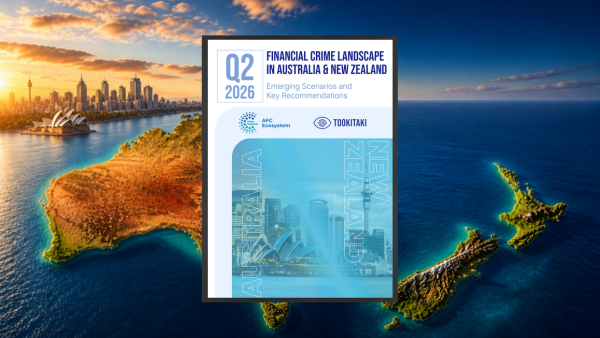
Q2 2026 FinCrime Landscape Report | ANZ
Financial crime across Australia and New Zealand is becoming harder to detect as illicit activity increasingly blends into ordinary financial behaviour and moves across fragmented digital and cross-border financial channels.
This report focuses on two key themes shaping the ANZ financial crime landscape in Q2 2026: online sexual exploitation of children (OSEC)-related financial flows and cross-border transaction laundering. These typologies exploit low-value remittances, digital banks, e-wallets, payment gateways, shell corporations, correspondent banking relationships, and fraudulent non-profit organisations to disguise the movement and origin of illicit funds.
Inside the report, you will find practical scenarios, transaction-level red flags, KYC/CDD indicators, and recommendations to help financial institutions identify behavioural patterns, strengthen due diligence, improve cross-border monitoring, and move beyond isolated rule-based alerts towards connected, pattern-based intelligence.
Download the report to explore the emerging financial crime scenarios shaping Australia and New Zealand in Q2 2026.
H1 2026 FinCrime Landscape Report | Philippines
The H1 2026 Financial Crime Landscape in the Philippines report examines two major cyber-enabled financial crime threats: money mule networks and romance scams. It highlights how fraud syndicates are exploiting digital onboarding, instant payment rails, e-wallets, shell companies, and social platforms to move illicit funds quickly across institutions.
Developed by experts from the AFC Ecosystem in collaboration with ABCOMP, the report presents practical scenarios, transaction-level red flags, KYC/CDD risk indicators, and key recommendations for financial institutions. It also underlines the importance of stronger behavioural detection, cross-institution collaboration, and faster response mechanisms to close visibility gaps in the fight against organised financial crime.
Download the report to explore the full scenarios, red flags, and recommendations for strengthening financial crime controls in the Philippines.
.webp)
H1 2026 FinCrime Landscape Report | Malaysia
The H1 2026 Financial Crime Landscape in Malaysia report examines two major financial crime threats: money mule networks and account takeover attacks. It highlights how criminal syndicates are exploiting digital onboarding, instant payment rails, e-wallets, SIM-swap fraud, compromised credentials, and corporate payment platforms to move illicit funds quickly across institutions and channels.
Developed by experts from the AFC Ecosystem, the report presents practical scenarios, transaction-level red flags, KYC/CDD risk indicators, and key recommendations for financial institutions. It also underlines the need for stronger behavioural detection, cross-channel visibility, enhanced authentication, and faster controls to identify coordinated criminal activity before funds are fragmented and dispersed.
Download the report to explore the full scenarios, red flags, and recommendations for strengthening financial crime controls in Malaysia.
Q2 2026 FinCrime Landscape Report | ANZ
Financial crime across Australia and New Zealand is becoming harder to detect as illicit activity increasingly blends into ordinary financial behaviour and moves across fragmented digital and cross-border financial channels.
This report focuses on two key themes shaping the ANZ financial crime landscape in Q2 2026: online sexual exploitation of children (OSEC)-related financial flows and cross-border transaction laundering. These typologies exploit low-value remittances, digital banks, e-wallets, payment gateways, shell corporations, correspondent banking relationships, and fraudulent non-profit organisations to disguise the movement and origin of illicit funds.
Inside the report, you will find practical scenarios, transaction-level red flags, KYC/CDD indicators, and recommendations to help financial institutions identify behavioural patterns, strengthen due diligence, improve cross-border monitoring, and move beyond isolated rule-based alerts towards connected, pattern-based intelligence.
Download the report to explore the emerging financial crime scenarios shaping Australia and New Zealand in Q2 2026.
H1 2026 FinCrime Landscape Report | Philippines
The H1 2026 Financial Crime Landscape in the Philippines report examines two major cyber-enabled financial crime threats: money mule networks and romance scams. It highlights how fraud syndicates are exploiting digital onboarding, instant payment rails, e-wallets, shell companies, and social platforms to move illicit funds quickly across institutions.
Developed by experts from the AFC Ecosystem in collaboration with ABCOMP, the report presents practical scenarios, transaction-level red flags, KYC/CDD risk indicators, and key recommendations for financial institutions. It also underlines the importance of stronger behavioural detection, cross-institution collaboration, and faster response mechanisms to close visibility gaps in the fight against organised financial crime.
Download the report to explore the full scenarios, red flags, and recommendations for strengthening financial crime controls in the Philippines.