The Scam Pretended to Be the Safeguard: Inside Hong Kong’s Money Safe Impersonation Fraud

Anti-scam controls are designed to make customers harder to deceive. But criminals can adapt by impersonating the very safeguards customers have been told to trust.
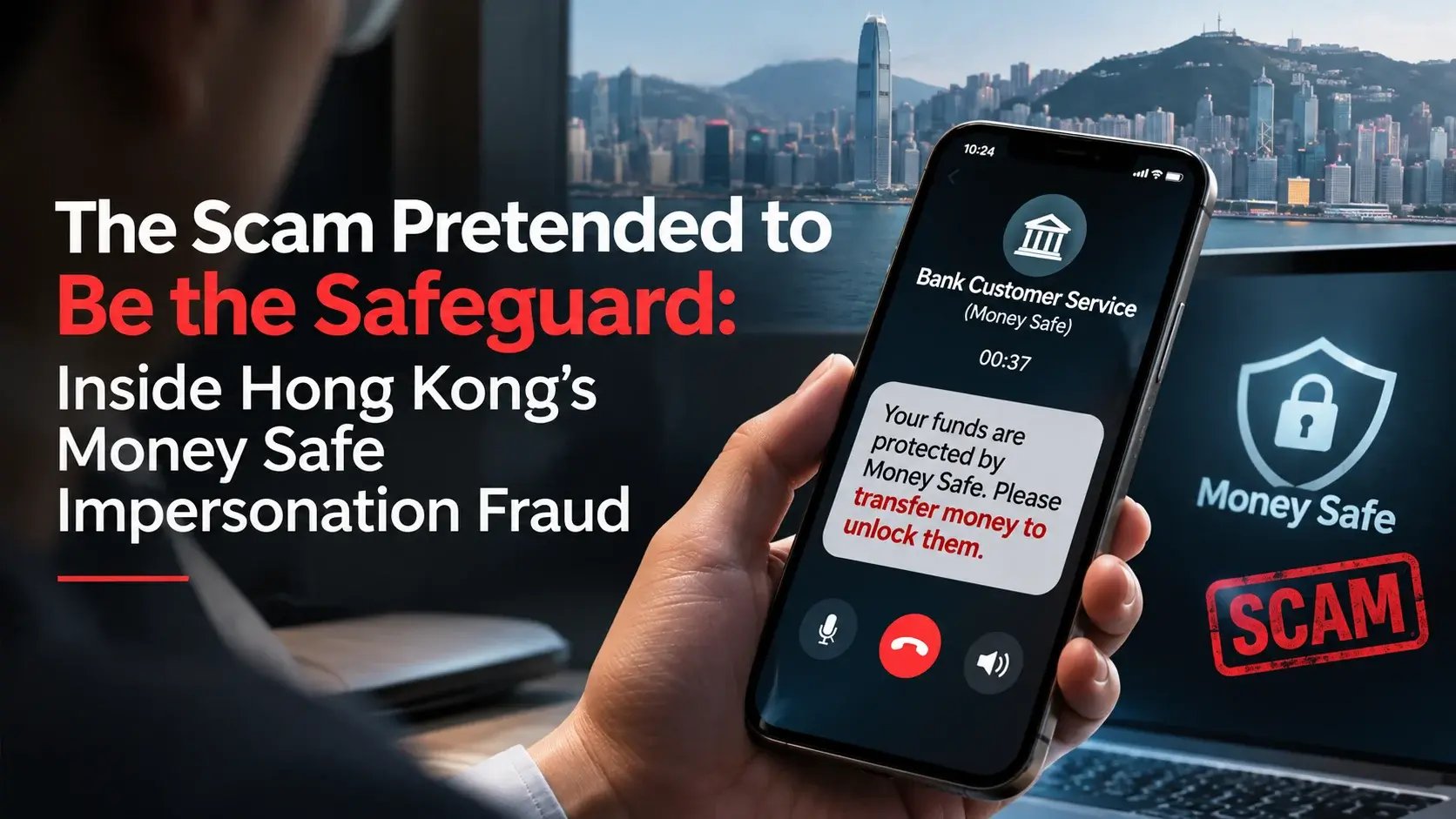
That is the warning behind a recent Hong Kong Monetary Authority alert involving fraudsters posing as customer service representatives of financial institutions under the guise of Money Safe.
Victims are reportedly told that they need to transfer money to “unlock” funds supposedly protected by the service. The HKMA has made clear that the approach is fraudulent: it does not contact members of the public to request fund transfers for personal financial matters, and releasing Money Safe protection requires no payment or fee.
The case highlights an important financial crime shift. Criminals are not only impersonating banks, regulators or customer-service staff. They are beginning to weaponise the language of fraud prevention itself.
For financial institutions, that means awareness of a legitimate security control can become part of the social-engineering attack.

What Is Money Safe?
Money Safe is an anti-scam service introduced by the HKMA and retail banks in Hong Kong for individual customers.
Customers can choose to protect deposits held in their own bank accounts so those funds cannot be transferred or withdrawn while the protection is active. When customers want access to the protected money, they generally need to approach their bank, which conducts a face-to-face anti-scam verification before releasing the protection.
The purpose is straightforward: introduce friction at the moment a customer wants to move protected funds, creating an opportunity to reconsider whether they may be acting under manipulation.
The impersonation scam reverses that logic.
Instead of trying to bypass Money Safe directly, fraudsters allegedly use its name to create a fabricated problem. The victim is told that funds are locked and that another transfer is required to regain access.
A protection mechanism intended to interrupt a scam therefore becomes the narrative used to initiate one.
When Fraudsters Impersonate the Control, Not Just the Institution
Traditional impersonation scams often rely on authority.
A fraudster may pretend to represent a bank, government agency, law-enforcement body or another trusted organisation. The aim is to convince the victim that an urgent financial action is legitimate.
The Money Safe warning adds another layer.
The criminal does not simply impersonate the institution. They invoke a specific anti-scam service associated with that institution.
That can make the story more convincing because the victim may already recognise the name Money Safe from legitimate banking communications or public-awareness campaigns.
The scam therefore exploits something valuable: trust created by the protection mechanism itself.
For banks, this changes the threat model. As customers become more familiar with anti-scam tools, criminals can incorporate the terminology, processes and branding of those tools into future social-engineering scripts.
Financial crime controls therefore need to evolve alongside the controls being impersonated.
An Authorised Payment Can Still Be a Scam
The eventual transfer may still be initiated and authenticated by the customer.
There may be no compromised password, stolen device or unauthorised login. The victim may make the payment willingly because they believe it is necessary to release their own money.
That makes the distinction between authorisation and legitimacy increasingly important.
Institutions should therefore look beyond whether the transaction passed authentication. A sudden transfer to an unfamiliar beneficiary, particularly after a customer has been told their funds are locked or restricted, can provide important context.
The receiving account may reveal more. If it is collecting money from multiple unrelated individuals or rapidly moving incoming funds onwards, the wider pattern may indicate possible scam collection or mule activity.
What Banks and Payment Firms Should Watch
Security-control impersonation scams can create signals even when the customer authorises the payment.
Relevant indicators include unexpected transfers described as release fees, verification charges or payments required to “unlock” protected funds, particularly where the legitimate service requires no such payment.
Other signals may include first-time transfers to unfamiliar beneficiaries, unusual urgency, sudden changes in transaction behaviour, repeated attempts to transfer funds after fraud warnings, or beneficiary accounts linked to earlier scam complaints.
On the receiving side, accounts collecting money from multiple unrelated customers before quickly dispersing it may warrant closer examination.
No single indicator proves fraud. The stronger signal emerges when institutions connect customer behaviour, beneficiary activity, transaction context and current scam intelligence.
That context matters even more when criminals are deliberately imitating legitimate banking processes.
Why Financial Crime Intelligence Needs to Move With the Scam
The Money Safe case illustrates why financial crime is a network problem.
A new scam script can emerge outside an institution before its own customers encounter it. One bank may receive the first complaint. Another may see payments flowing to a suspicious beneficiary. A third may recognise a similar impersonation technique.
Viewed separately, each institution sees only part of the threat.
Tookitaki is the intelligence ecosystem, with the AFC Ecosystem bringing together typology intelligence, risk patterns and emerging threat insights from the financial crime community.
A typology such as anti-scam control impersonation can therefore become more than a public warning. It can inform how institutions assess customer behaviour, transaction context and beneficiary risk.
FinCense turns that intelligence into control, helping institutions translate emerging typologies and risk patterns into deployable financial crime controls.
The objective is simple: identify threats sooner, adapt faster and respond with greater confidence.
The Bigger Lesson: Criminals Learn From Anti-Scam Defences Too
The Money Safe warning reveals a broader reality about modern scam prevention.
Every new security control can change criminal behaviour.
A safeguard may close one route, but criminals can study the language around that safeguard and turn it into the next social-engineering story.
Money Safe itself is designed to prevent protected funds from being moved without anti-scam verification. It does not require customers to make a payment to release those funds.
Yet fraudsters are allegedly using the service’s name to convince victims that exactly such a payment is necessary.
For financial institutions, the lesson is clear: effective controls are not enough on their own. Institutions also need to understand how criminals are talking about those controls, impersonating them and turning customer awareness into another attack surface.
The safeguard may remain secure. The story built around it can still become the scam.
Experience the most intelligent AML and fraud prevention platform
Experience the most intelligent AML and fraud prevention platform
Experience the most intelligent AML and fraud prevention platform
Top AML Scenarios in ASEAN
The Role of AML Software in Compliance
The Role of AML Software in Compliance