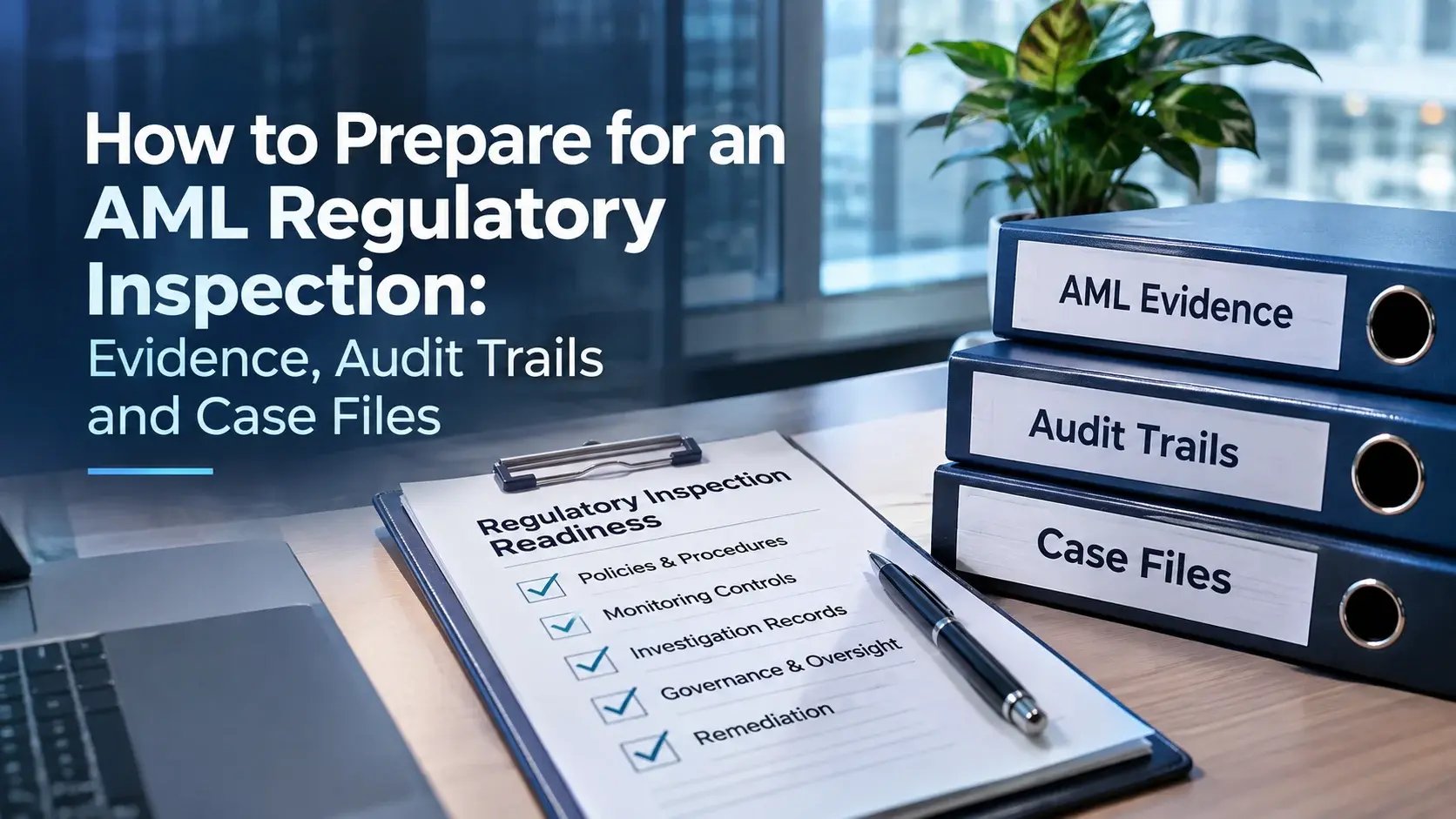
How to Prepare for an AML Regulatory Inspection: Evidence, Audit Trails and Case Files

Your AML controls may be working. But when regulators ask for proof, can your institution produce it?
A regulatory inspection does not stop at reviewing compliance policies. Regulators may examine how suspicious transactions were detected, why alerts were closed, whether investigations were properly documented and how identified weaknesses were addressed.
For banks and financial institutions, gaps in audit trails, incomplete case files or missing evidence can raise serious questions about the effectiveness of anti-money laundering (AML) controls.
Across Australia, Singapore, the Philippines, Indonesia and Malaysia, regulators expect financial institutions to demonstrate that AML compliance is embedded in daily operations, not just documented in policies.
This guide outlines six practical steps to prepare for an AML regulatory inspection, strengthen evidence management and ensure investigation records can withstand supervisory scrutiny.

What Do Regulators Look for During an AML Inspection?
An AML regulatory inspection assesses whether an institution's financial crime controls are appropriately designed, implemented and operating effectively.
Although supervisory approaches differ across jurisdictions, inspections commonly focus on three areas:
- Compliance documentation: AML policies, risk assessments, customer due diligence procedures and governance records.
- Control effectiveness: Evidence that transaction monitoring, screening, investigations and reporting processes operate as intended.
- Decision traceability: Records explaining how suspicious activity was identified, investigated, escalated and resolved.
Regulators may examine selected customer relationships, transaction histories or investigation files to determine whether documented procedures match actual practices.
The central question is straightforward: Can your institution demonstrate that its AML controls are working as intended?
How to Prepare for an AML Regulatory Inspection: Six Essential Steps
1. Organise Your AML Compliance Evidence
Inspection readiness begins with maintaining accurate, accessible and up-to-date compliance records.
Institutions should ensure that essential documentation is properly organised, approved and available to authorised personnel.
Key records include:
- AML policies, procedures and enterprise-wide risk assessments
- Customer due diligence (CDD) and enhanced due diligence (EDD) documentation
- Customer risk ratings and supporting assessments
- Transaction monitoring and screening procedures
- Compliance training and governance records
- Internal audit findings and remediation reports
Documentation should demonstrate how controls operate in practice.
For example, when transaction monitoring thresholds are adjusted, institutions should retain the reasons for the changes, supporting test results and relevant approvals.
2. Maintain Complete and Traceable Audit Trails
An audit trail records the sequence of activities, decisions and changes throughout an AML process.
During a regulatory inspection, examiners may request evidence showing how an alert progressed from detection to resolution.
A reliable audit trail should capture when an alert was generated, which monitoring scenario triggered it, who investigated it and what decisions followed.
It should also record changes to customer risk ratings, escalation actions, approvals and case closure decisions.
Consider a customer whose transactions suddenly increase in frequency and value. The institution should be able to demonstrate why the activity triggered an alert, how the investigator assessed the transactions and why the case was escalated or closed.
Without this information, demonstrating the effectiveness of monitoring controls becomes difficult.
Every significant AML decision should be traceable, explainable and supported by evidence.
3. Build Investigation-Ready Case Files
Investigation case files are critical evidence during regulatory inspections.
A well-documented case should explain what happened, why the activity was considered unusual and how the institution responded.
Each case file should contain relevant customer information, transaction histories, monitoring triggers, investigation findings, supporting documents and decision rationale.
Where applicable, records should also capture escalation history, supervisory approvals and suspicious transaction reporting decisions.
For example, when multiple accounts receive funds and rapidly transfer them onward, investigators should document the transaction patterns, relationships between accounts and indicators suggesting possible money mule activity.
A complete case file enables regulators and internal reviewers to reconstruct an investigation without relying on individual employees' recollections.
4. Test Transaction Monitoring and Screening Controls
Having monitoring systems in place does not automatically demonstrate that they are effective.
Institutions should regularly assess whether transaction monitoring scenarios, screening rules and alert thresholds remain appropriate for their financial crime risks.
Testing should examine detection performance, emerging typologies, false positives and potential control gaps.
For instance, a scenario designed to detect unusually large transfers may overlook laundering activity involving numerous smaller transactions across connected accounts.
Compliance teams should document testing methodologies, scenario changes, threshold recommendations, validation results and approvals.
Maintaining this evidence demonstrates that controls are actively reviewed and adapted as criminal behaviour evolves.
5. Review Governance and Remediation Records
Regulatory inspections may also examine how institutions oversee AML risks and respond to identified weaknesses.
Relevant evidence includes management committee discussions, compliance reports, audit findings, corrective action plans and records of completed remediation.
If an internal review identifies inconsistent alert documentation, the institution should demonstrate how it addressed the issue and whether subsequent testing confirmed improvement.
Unresolved deficiencies, repeated control failures and incomplete remediation records can raise concerns about governance effectiveness.
Institutions should therefore maintain clear accountability for corrective actions and evidence supporting their completion.
6. Conduct an Internal Inspection Readiness Review
Waiting until an inspection notice arrives can leave insufficient time to identify documentation gaps.
Instead, institutions should periodically conduct internal readiness assessments using samples of customer accounts, monitoring alerts and completed investigations.
Compliance teams should attempt to reconstruct each case using existing records.
They should verify whether the original alert, investigation rationale, supporting evidence, approvals and final decisions can be retrieved.
Any deficiencies should be documented, prioritised and assigned for remediation.
This approach helps identify weaknesses before they become supervisory findings.
AML Regulatory Inspection Expectations Across APAC
While core AML compliance principles are similar, institutions must account for local regulatory requirements.
Australia: AUSTRAC requires reporting entities to maintain risk-based AML/CTF programs and supporting records demonstrating compliance with customer due diligence, reporting and monitoring obligations.
Singapore: The Monetary Authority of Singapore (MAS) requires robust AML/CFT controls. Applicable notices, including MAS Notice 626 for banks, address risk assessments, customer due diligence, record-keeping, suspicious transaction reporting and independent audit arrangements.
Philippines: The Anti-Money Laundering Council (AMLC) and supervising authorities, including the Bangko Sentral ng Pilipinas (BSP), oversee AML compliance. Covered institutions must maintain records supporting customer identification, transaction reconstruction and regulatory reporting.
Indonesia: The Financial Services Authority (OJK) supervises AML/CFT controls in regulated financial services, while PPATK serves as the financial intelligence unit. Regulatory requirements address risk assessments, customer monitoring, internal controls and reporting.
Malaysia: Bank Negara Malaysia (BNM) establishes AML/CFT requirements for relevant financial institutions, including risk-based assessments, customer due diligence, governance, record-keeping and independent assurance.
Institutions operating across multiple markets should maintain consistent evidence-management standards while accommodating jurisdiction-specific obligations.
How Tookitaki Supports Inspection-Ready Financial Crime Controls
Financial crime is a network problem. Criminal networks adapt across institutions and markets, while individual organisations often rely primarily on threats observed within their own environments.
Tookitaki is the intelligence ecosystem, helping financial institutions identify emerging threats sooner and adapt their controls with greater confidence.
Its Anti-Financial Crime (AFC) Ecosystem brings together typology intelligence, risk patterns and emerging threat insights from the financial crime community.
Tookitaki's FinCense platform turns this intelligence into operational controls, helping institutions test scenarios, recommend thresholds, simulate impact and adapt detection strategies.
FinCense also supports transaction monitoring, alert investigations and case management workflows, helping teams maintain structured investigation records and consistent decision-making processes.
By connecting emerging financial crime intelligence with operational controls, institutions can strengthen their ability to demonstrate how risks are identified, investigated and managed.
Conclusion: Make Inspection Readiness an Ongoing Practice
Preparing for an AML regulatory inspection should not begin when a supervisory notice arrives.
Financial institutions need reliable evidence, traceable audit trails, complete case files and documented proof that their controls are regularly reviewed and improved.
Embedding these practices into everyday compliance operations helps institutions approach regulatory scrutiny with greater confidence while strengthening their response to emerging financial crime threats.
Discover how Tookitaki and FinCense can help your institution turn financial crime intelligence into stronger, more adaptive controls. Talk to our team.
Experience the most intelligent AML and fraud prevention platform
Experience the most intelligent AML and fraud prevention platform
Experience the most intelligent AML and fraud prevention platform
Top AML Scenarios in ASEAN
The Role of AML Software in Compliance
The Role of AML Software in Compliance