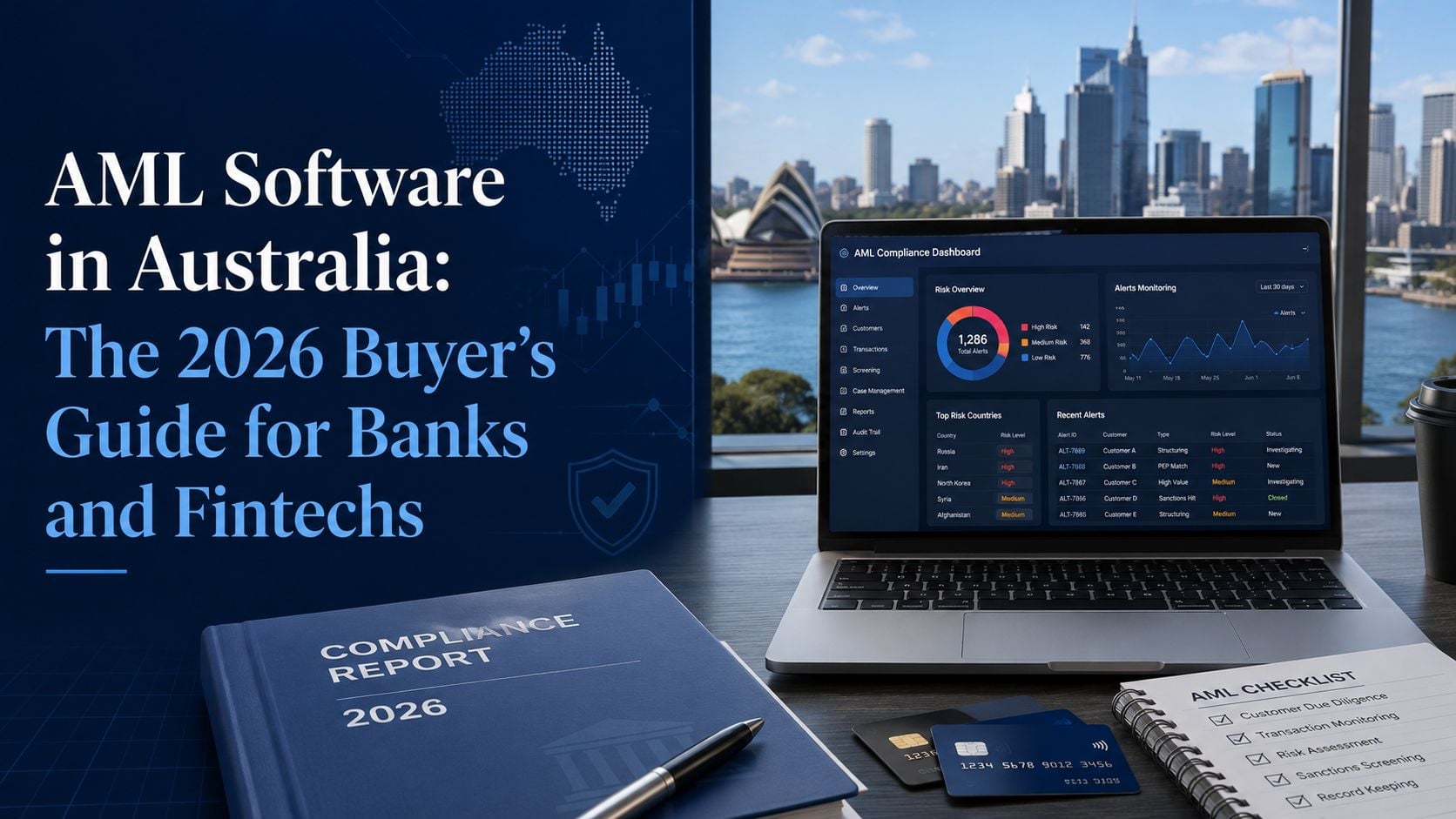
Building Trust with Tech: Why Choosing the Right AML Platform Matters in Australia
In an era of instant payments and complex laundering schemes, an AML platform is no longer optional — it’s essential.
Australia’s financial landscape is undergoing rapid transformation. Real-time payments, cross-border remittances, and digital banking innovations are reshaping how money moves — and how criminals exploit the system. To keep up, financial institutions need more than spreadsheets or patchwork tools. They need a modern, adaptive AML platform that combines detection, investigation, and reporting into one seamless system.

What Is an AML Platform?
An AML platform is an end-to-end software solution designed to help financial institutions detect, prevent, and report money laundering and terrorism financing. Unlike standalone tools, a true platform integrates multiple compliance functions:
- Transaction monitoring
- Customer onboarding and KYC/CDD
- Sanctions and PEP screening
- Case management and investigation
- Regulatory reporting
By centralising these tasks, AML platforms reduce silos, improve efficiency, and deliver better visibility across customer and transaction lifecycles.
Why AML Platforms Are Essential in Australia
1. AUSTRAC’s Higher Expectations
AUSTRAC’s enforcement actions show regulators are scrutinising systems, not just processes. Firms must prove their AML platforms are effective, adaptive, and transparent.
2. Instant Payments Risk
With the New Payments Platform (NPP), funds move instantly — and so must monitoring. AML platforms built for batch processing are already outdated.
3. Complex Laundering Typologies
Australia faces risks from trade-based laundering, mule accounts, and organised crime syndicates. An effective platform must detect both known and emerging patterns.
4. Cost and Efficiency Pressures
With compliance costs surging, platforms that reduce false positives and investigation time are now a strategic necessity.

Key Features of a Modern AML Platform
1. Real-Time Transaction Monitoring
Catches suspicious activity in milliseconds across payment rails, including NPP and cross-border transfers.
2. AI-Powered Detection
Machine learning models adapt to new laundering techniques, cutting down on false positives and missed alerts.
3. Integrated Onboarding and Screening
Seamlessly connects KYC/CDD checks, sanctions screening, and risk scoring at account opening.
4. Case Management Workflows
Centralised dashboards, task assignments, and automated escalation paths.
5. Regulatory Reporting Tools
In-built generation of Suspicious Matter Reports (SMRs), Threshold Transaction Reports (TTRs), and audit-ready logs.
6. Explainability
Glass-box AI ensures every alert can be explained to regulators — no black-box risk.
How AML Platforms Support Different Sectors in Australia
- Banks & Credit Unions: Scale monitoring across millions of daily transactions.
- Fintechs: Launch compliance programmes fast, with modular features that grow as they scale.
- Remittance Providers: Manage corridor-specific risks and high-volume cross-border flows.
- Crypto Exchanges: Detect illicit wallet flows, layering, and cash-out attempts.
Advanced Capabilities to Look For
- Federated Intelligence Sharing: Access to global typologies through compliance networks like the AFC Ecosystem.
- Simulation Mode: Test new detection rules against historical data before deploying.
- Cross-Channel Risk Visibility: Covering traditional banking, wallets, trade finance, and crypto in one view.
- AI Copilots: Tools like FinMate that provide investigators with case summaries and recommendations.
Spotlight: Tookitaki’s FinCense AML Platform
FinCense, Tookitaki’s end-to-end AML platform, is designed for Australia’s evolving compliance needs:
- Real-time monitoring for NPP and cross-border transactions.
- Agentic AI detection that adapts to new laundering methods with minimal false positives.
- Federated learning from the AFC Ecosystem — sharing global insights while protecting local data.
- FinMate AI copilot to support investigators with summaries, recommendations, and regulator-ready reports.
- Full AUSTRAC compliance with explainable alerts, SMR/TTR reporting, and detailed audit trails.
With FinCense, compliance teams can reduce workload, build trust with regulators, and stay ahead of emerging threats.
Conclusion: Future-Proof Compliance with the Right AML Platform
For Australian institutions, adopting a modern AML platform is no longer about ticking boxes — it’s about survival in a high-speed, high-risk financial environment.
Pro tip: When choosing an AML platform, don’t just evaluate features. Assess the vendor’s track record, adaptability, and ability to evolve with the regulatory and criminal landscape.
Experience the most intelligent AML and fraud prevention platform
Top AML Scenarios in ASEAN
The Role of AML Software in Compliance
The Role of AML Software in Compliance


We’ve received your details and our team will be in touch shortly.
Ready to Streamline Your Anti-Financial Crime Compliance?
Our Thought Leadership Guides
What Makes the Best AML Software? A Singapore Perspective
“Best” isn’t about brand—it’s about fit, foresight, and future readiness.
When compliance teams search for the “best AML software,” they often face a sea of comparisons and vendor rankings. But in reality, what defines the best tool for one institution may fall short for another. In Singapore’s dynamic financial ecosystem, the definition of “best” is evolving.
This blog explores what truly makes AML software best-in-class—not by comparing products, but by unpacking the real-world needs, risks, and expectations shaping compliance today.

The New AML Challenge: Scale, Speed, and Sophistication
Singapore’s status as a global financial hub brings increasing complexity:
- More digital payments
- More cross-border flows
- More fintech integration
- More complex money laundering typologies
Regulators like MAS are raising the bar on detection effectiveness, timeliness of reporting, and technological governance. Meanwhile, fraudsters continue to adapt faster than many internal systems.
In this environment, the best AML software is not the one with the longest feature list—it’s the one that evolves with your institution’s risk.
What “Best” Really Means in AML Software
1. Local Regulatory Fit
AML software must align with MAS regulations—from risk-based assessments to STR formats and AI auditability. A tool not tuned to Singapore’s AML Notices or thematic reviews will create gaps, even if it’s globally recognised.
2. Real-World Scenario Coverage
The best solutions include coverage for real, contextual typologies such as:
- Shell company misuse
- Utility-based layering scams
- Dormant account mule networks
- Round-tripping via fintech platforms
Bonus points if these scenarios come from a network of shared intelligence.
3. AI You Can Explain
The best AML platforms use AI that’s not just powerful—but also understandable. Compliance teams should be able to explain detection decisions to auditors, regulators, and internal stakeholders.
4. Unified View Across Risk
Modern compliance risk doesn't sit in silos. The best software unifies alerts, customer profiles, transactions, device intelligence, and behavioural risk signals—across both fraud and AML workflows.
5. Automation That Actually Works
From auto-generating STRs to summarising case narratives, top AML tools reduce manual work without sacrificing oversight. Automation should support investigators, not replace them.
6. Speed to Deploy, Speed to Detect
The best tools integrate quickly, scale with your transaction volume, and adapt fast to new typologies. In a live environment like Singapore, detection lag can mean regulatory risk.
The Danger of Chasing Global Rankings
Many institutions fall into the trap of selecting tools based on brand recognition or analyst reports. While useful, these often prioritise global market size over local relevance.
A top-ranked solution may not:
- Support MAS-specific STR formats
- Detect local mule account typologies
- Allow configuration without vendor dependence
- Offer support in your timezone or regulatory context
The best AML software for Singapore is one that understands Singapore.
The Role of Community and Collaboration
No tool can solve financial crime alone. The best AML platforms today are:
- Collaborative: Sharing anonymised risk signals across institutions
- Community-driven: Updated with new scenarios and typologies from peers
- Connected: Integrated with ecosystems like MAS’ regulatory sandbox or industry groups
This allows banks to move faster on emerging threats like pig-butchering scams, cross-border laundering, or terror finance alerts.

Case in Point: A Smarter Approach to Typology Detection
Imagine your institution receives a surge in transactions through remittance corridors tied to high-risk jurisdictions. A traditional system may miss this if it’s below a certain threshold.
But a scenario-based system—especially one built from real cases—flags:
- Round dollar amounts at unusual intervals
- Back-to-back remittances to different names in the same region
- Senders with low prior activity suddenly transacting at volume
The “best” software is the one that catches this before damage is done.
A Checklist for Singaporean Institutions
If you’re evaluating AML tools, ask:
- Can this detect known local risks and unknown emerging ones?
- Does it support real-time and batch monitoring across channels?
- Can compliance teams tune thresholds without engineering help?
- Does the vendor offer localised support and regulatory alignment?
- How well does it integrate with fraud tools, case managers, and reporting systems?
If the answer isn’t a confident “yes” across these areas, it might not be your best choice—no matter its global rating.
Final Thoughts: Build for Your Risk, Not the Leaderboard
Tookitaki’s FinCense platform embodies these principles—offering MAS-aligned features, community-driven scenarios, explainable AI, and unified fraud and AML coverage tailored to Asia’s compliance landscape.
There’s no universal best AML software.
But for institutions in Singapore, the best choice will always be one that:
- Supports your regulators
- Reflects your risk
- Grows with your customers
- Learns from your industry
- Protects your reputation
Because when it comes to financial crime, it’s not about the software that looks best on paper—it’s about the one that works best in practice.

AML Case Management Software: A Practical Guide for Banks and Fintechs
Financial institutions today face an uncomfortable reality. Detecting suspicious activity is no longer the hardest part of AML. Managing, investigating, documenting, and closing alerts at scale is. This is where AML case management software plays a critical role.
As alert volumes rise and regulatory expectations tighten, banks and fintechs need more than rule engines and dashboards. They need a structured, auditable, and efficient way to move from alert to closure. This guide explains what AML case management software is, why it matters, and how modern, AI-enabled platforms are reshaping investigations.

What Is AML Case Management?
AML case management refers to the process and technology used to manage alerts, investigations, evidence, and regulatory outcomes once suspicious activity has been detected.
In simple terms:
- Transaction monitoring flags alerts
- Case management turns alerts into investigations
- Investigations lead to decisions, documentation, and reporting
A case management system provides investigators with a central workspace to:
- Review alerts
- Gather and assess evidence
- Collaborate with other teams
- Document findings
- Prepare regulatory reports such as STRs or SARs
Without a robust case management layer, even the best detection systems quickly become operational bottlenecks.
Why AML Case Management Matters More Than Ever
Alert volumes are increasing
Real-time payments, digital wallets, and cross-border transactions have dramatically increased alert volumes. Manual investigation processes simply do not scale.
Investigators are under pressure
Compliance teams face growing workloads, tight deadlines, and intense regulatory scrutiny. Inefficient workflows lead to:
- Alert backlogs
- Investigator fatigue
- Inconsistent decision-making
Regulators expect stronger documentation
Supervisors increasingly expect:
- Clear audit trails
- Consistent investigation logic
- Explainable decisions supported by evidence
AML case management software sits at the centre of these challenges, acting as the operational backbone of compliance teams.
Core Capabilities of AML Case Management Software
A modern AML case management platform typically includes the following capabilities:
Case creation and prioritisation
Alerts are automatically converted into cases, enriched with customer, transaction, and risk context. Risk-based prioritisation helps investigators focus on the most critical cases first.
Investigation workflows
Structured workflows guide investigators through each stage of the investigation, reducing variability and missed steps.
Evidence management
Documents, transaction records, screenshots, and notes are stored centrally within each case, ensuring nothing is lost or fragmented across systems.
Collaboration and escalation
Cases often require input from multiple teams. Case management software enables collaboration, escalation, and approvals within a controlled environment.
Audit trails and traceability
Every action taken on a case is logged, creating a defensible audit trail for internal reviews and regulatory examinations.
How AI Is Transforming AML Case Management
Traditional case management systems focused primarily on task tracking. Modern platforms are moving much further by embedding intelligence directly into investigations.
Assisted investigations
AI can surface relevant transactions, related parties, and historical patterns, reducing manual data gathering.
Smart workflows
Automation helps route cases, trigger actions, and apply consistent investigation steps based on risk level.
Faster alert closure
By reducing repetitive tasks and guiding investigators, AI-enabled case management significantly improves closure times without compromising quality.
The result is not fewer controls, but better, faster, and more consistent investigations.
Regulatory Expectations and Audit Readiness
From an examiner’s perspective, a strong AML programme is not just about detecting suspicious activity. It is about how decisions are made and documented.
AML case management software supports regulatory expectations by enabling:
- Consistent investigation logic
- Complete documentation of decisions
- Easy retrieval of historical cases
- Clear linkage between alerts, evidence, and outcomes
This is especially important during regulatory reviews, where institutions must demonstrate not only what decisions were made, but why.

How Banks and Fintechs Use AML Case Management in Practice
In a typical investigation flow:
- An alert is generated by the monitoring system
- A case is created and assigned automatically
- The investigator reviews contextual data and risk indicators
- Evidence is gathered and assessed within the case
- A decision is made, documented, and approved
- Regulatory reports are prepared if required
- The case is closed with a complete audit trail
Case management software ensures this process is repeatable, defensible, and scalable, even as volumes grow.
How Modern AML Platforms Approach Case Management
Modern AML platforms are increasingly embedding case management directly into their compliance architecture. Rather than treating investigations as a separate, manual process, leading solutions integrate case management with transaction monitoring and screening to create a continuous investigation workflow.
For example, Tookitaki’s FinCense platform integrates case management with transaction monitoring and screening, enabling investigators to move seamlessly from alert generation to investigation, documentation, and closure within a single workflow. This integrated approach helps institutions improve investigation efficiency while maintaining strong audit trails and regulatory readiness.
Choosing the Right AML Case Management Software
When evaluating AML case management solutions, institutions should look beyond basic task tracking.
Key considerations include:
- Seamless integration with transaction monitoring and screening systems
- Support for risk-based workflows
- Strong audit and reporting capabilities
- AI-assisted investigation features
- Flexibility to adapt to local regulatory requirements
The goal is not just operational efficiency, but long-term compliance resilience.
Final Thoughts
AML case management software is no longer a supporting tool. It is a core pillar of modern AML operations.
As financial crime grows more complex, institutions that invest in intelligent, well-structured case management are better positioned to:
- Reduce operational strain
- Improve investigation quality
- Meet regulatory expectations with confidence
In the broader AML ecosystem, case management is where detection becomes decision-making — and where compliance teams either struggle or succeed.

From Firefighting to Foresight: Rethinking Transaction Fraud Prevention in Singapore
Fraudsters are playing a smarter game, shouldn’t your defences be smarter too?
Transaction fraud in Singapore is no longer just a security issue—it’s a strategic challenge. As payment ecosystems evolve, fraudsters are exploiting digital rails, behavioural loopholes, and siloed detection systems to slip through unnoticed.
In this blog, we explore why traditional fraud prevention methods are falling short, what a next-gen transaction fraud prevention framework looks like, and how Singapore’s financial institutions can future-proof their defences.

Why Transaction Fraud is Escalating in Singapore
Singapore has one of the most advanced digital banking infrastructures in the world. But with innovation comes risk.
Key Drivers of Fraud Risk:
- Real-time payments: PayNow and FAST leave little time for fraud detection.
- Cross-border flows: Illicit funds are moved via remittance corridors and fintech platforms.
- Proliferation of fintech apps: Fraudsters exploit weak KYC and transaction monitoring in niche apps.
- Evolving scam tactics: Social engineering, deepfake impersonation, and phishing are on the rise.
The result? Singaporean banks are experiencing a surge in mule account activity, identity theft, and layered fraud involving multiple platforms.
What is Transaction Fraud Prevention?
Transaction fraud prevention refers to systems, strategies, and intelligence tools used by financial institutions to:
- Detect fraudulent transactions
- Stop or flag suspicious activity in real time
- Reduce customer losses
- Comply with regulatory expectations
The key is prevention, not just detection. This means acting before money is moved or damage is done.
Traditional Fraud Prevention: Where It Falls Short
Legacy fraud prevention frameworks often rely on:
- Static rule-based thresholds
- After-the-fact detection
- Manual reviews for high-value alerts
- Limited visibility across products or platforms
The problem? Fraud today is fast, adaptive, and complex. These outdated approaches miss subtle patterns, overwhelm investigators, and delay intervention.
A New Framework for Transaction Fraud Prevention
Next-gen fraud prevention combines speed, context, intelligence, and collaboration.
Core Elements:
1. Real-Time Transaction Monitoring
Every transaction is assessed for risk as it happens—across all payment channels.
2. Behavioural Risk Models
Fraud detection engines compare current actions against baseline behaviour for each customer.
3. AI-Powered Risk Scoring
Advanced machine learning models assign dynamic risk scores that influence real-time decisions.
4. Federated Typology Sharing
Institutions access fraud scenarios shared by peer banks and regulators without exposing sensitive data.
5. Graph-Based Network Detection
Analysts visualise connections between mule accounts, devices, locations, and beneficiaries.
6. Integrated Case Management
Suspicious transactions are directly escalated into investigation pipelines with enriched context.
Real-World Examples of Preventable Fraud
✅ Utility Scam Layering
Scammers use stolen accounts to pay fake utility bills, then request chargebacks to mask laundering. These can be caught through layered transaction patterns.
✅ Deepfake CEO Voice Scam
A finance team almost transfers SGD 500,000 after receiving a video call from a “CFO.” Behavioural anomalies and device risk profiling can flag this in real-time.
✅ Organised Mule Account Chains
Funds pass through 8–10 sleeper accounts before exiting the system. Graph analytics expose these as coordinated rather than isolated events.
The Singapore Edge: Localising Fraud Prevention
Fraud patterns in Singapore have unique characteristics:
- Local scam syndicates often use SingPass and SMS spoofing
- Elderly victims targeted through impersonation scams
- Fintech apps used for layering due to fewer controls
A good fraud prevention system should reflect:
- MAS typologies and alerts
- Red flags derived from real scam cases
- Adaptability to local payment systems like FAST, PayNow, GIRO

How Tookitaki Enables Smart Transaction Fraud Prevention
Tookitaki’s FinCense platform offers an integrated fraud and AML prevention suite that:
- Monitors transactions in real-time using adaptive AI and federated learning
- Supports scenario-based detection built from 1,200+ community-contributed typologies
- Surfaces network-level risk signals using graph analytics
- Auto-generates case summaries for faster STR filing and reporting
- Reduces false positives while increasing true fraud detection rates
With FinCense, banks are moving from passive alerts to proactive intervention.
Evaluating Transaction Fraud Prevention Software: Key Questions
- Can it monitor all transaction types in real time?
- Does it allow dynamic threshold tuning based on risk?
- Can it integrate with existing AML or case management tools?
- Does it use real-world scenarios, not just abstract rules?
- Can it support regulatory audits with explainable decisions?
Best Practices for Proactive Fraud Prevention
- Combine fraud and AML views for holistic oversight
- Use shared typologies to learn from others’ incidents
- Deploy AI responsibly, ensuring interpretability
- Flag anomalies early, even if not yet confirmed as fraud
- Engage fraud operations teams in model tuning and validation
Looking Ahead: Future of Transaction Fraud Prevention
The future of fraud prevention is:
- Predictive: Using AI to simulate fraud before it happens
- Collaborative: Sharing signals across banks and fintechs
- Contextual: Understanding customer intent, not just rules
- Embedded: Integrated into every step of the payment journey
As Singapore’s financial sector continues to grow in scale and complexity, fraud prevention must keep pace—not just in technology, but in mindset.
Final Thoughts: Don’t Just Detect—Disrupt
Transaction fraud prevention is no longer just about stopping bad transactions. It’s about disrupting fraud networks, protecting customer trust, and reducing operational cost.
With the right strategy and systems in place, Singapore’s financial institutions can lead the region in smarter, safer finance.
Because when money moves fast, protection must move faster.

What Makes the Best AML Software? A Singapore Perspective
“Best” isn’t about brand—it’s about fit, foresight, and future readiness.
When compliance teams search for the “best AML software,” they often face a sea of comparisons and vendor rankings. But in reality, what defines the best tool for one institution may fall short for another. In Singapore’s dynamic financial ecosystem, the definition of “best” is evolving.
This blog explores what truly makes AML software best-in-class—not by comparing products, but by unpacking the real-world needs, risks, and expectations shaping compliance today.

The New AML Challenge: Scale, Speed, and Sophistication
Singapore’s status as a global financial hub brings increasing complexity:
- More digital payments
- More cross-border flows
- More fintech integration
- More complex money laundering typologies
Regulators like MAS are raising the bar on detection effectiveness, timeliness of reporting, and technological governance. Meanwhile, fraudsters continue to adapt faster than many internal systems.
In this environment, the best AML software is not the one with the longest feature list—it’s the one that evolves with your institution’s risk.
What “Best” Really Means in AML Software
1. Local Regulatory Fit
AML software must align with MAS regulations—from risk-based assessments to STR formats and AI auditability. A tool not tuned to Singapore’s AML Notices or thematic reviews will create gaps, even if it’s globally recognised.
2. Real-World Scenario Coverage
The best solutions include coverage for real, contextual typologies such as:
- Shell company misuse
- Utility-based layering scams
- Dormant account mule networks
- Round-tripping via fintech platforms
Bonus points if these scenarios come from a network of shared intelligence.
3. AI You Can Explain
The best AML platforms use AI that’s not just powerful—but also understandable. Compliance teams should be able to explain detection decisions to auditors, regulators, and internal stakeholders.
4. Unified View Across Risk
Modern compliance risk doesn't sit in silos. The best software unifies alerts, customer profiles, transactions, device intelligence, and behavioural risk signals—across both fraud and AML workflows.
5. Automation That Actually Works
From auto-generating STRs to summarising case narratives, top AML tools reduce manual work without sacrificing oversight. Automation should support investigators, not replace them.
6. Speed to Deploy, Speed to Detect
The best tools integrate quickly, scale with your transaction volume, and adapt fast to new typologies. In a live environment like Singapore, detection lag can mean regulatory risk.
The Danger of Chasing Global Rankings
Many institutions fall into the trap of selecting tools based on brand recognition or analyst reports. While useful, these often prioritise global market size over local relevance.
A top-ranked solution may not:
- Support MAS-specific STR formats
- Detect local mule account typologies
- Allow configuration without vendor dependence
- Offer support in your timezone or regulatory context
The best AML software for Singapore is one that understands Singapore.
The Role of Community and Collaboration
No tool can solve financial crime alone. The best AML platforms today are:
- Collaborative: Sharing anonymised risk signals across institutions
- Community-driven: Updated with new scenarios and typologies from peers
- Connected: Integrated with ecosystems like MAS’ regulatory sandbox or industry groups
This allows banks to move faster on emerging threats like pig-butchering scams, cross-border laundering, or terror finance alerts.

Case in Point: A Smarter Approach to Typology Detection
Imagine your institution receives a surge in transactions through remittance corridors tied to high-risk jurisdictions. A traditional system may miss this if it’s below a certain threshold.
But a scenario-based system—especially one built from real cases—flags:
- Round dollar amounts at unusual intervals
- Back-to-back remittances to different names in the same region
- Senders with low prior activity suddenly transacting at volume
The “best” software is the one that catches this before damage is done.
A Checklist for Singaporean Institutions
If you’re evaluating AML tools, ask:
- Can this detect known local risks and unknown emerging ones?
- Does it support real-time and batch monitoring across channels?
- Can compliance teams tune thresholds without engineering help?
- Does the vendor offer localised support and regulatory alignment?
- How well does it integrate with fraud tools, case managers, and reporting systems?
If the answer isn’t a confident “yes” across these areas, it might not be your best choice—no matter its global rating.
Final Thoughts: Build for Your Risk, Not the Leaderboard
Tookitaki’s FinCense platform embodies these principles—offering MAS-aligned features, community-driven scenarios, explainable AI, and unified fraud and AML coverage tailored to Asia’s compliance landscape.
There’s no universal best AML software.
But for institutions in Singapore, the best choice will always be one that:
- Supports your regulators
- Reflects your risk
- Grows with your customers
- Learns from your industry
- Protects your reputation
Because when it comes to financial crime, it’s not about the software that looks best on paper—it’s about the one that works best in practice.

AML Case Management Software: A Practical Guide for Banks and Fintechs
Financial institutions today face an uncomfortable reality. Detecting suspicious activity is no longer the hardest part of AML. Managing, investigating, documenting, and closing alerts at scale is. This is where AML case management software plays a critical role.
As alert volumes rise and regulatory expectations tighten, banks and fintechs need more than rule engines and dashboards. They need a structured, auditable, and efficient way to move from alert to closure. This guide explains what AML case management software is, why it matters, and how modern, AI-enabled platforms are reshaping investigations.

What Is AML Case Management?
AML case management refers to the process and technology used to manage alerts, investigations, evidence, and regulatory outcomes once suspicious activity has been detected.
In simple terms:
- Transaction monitoring flags alerts
- Case management turns alerts into investigations
- Investigations lead to decisions, documentation, and reporting
A case management system provides investigators with a central workspace to:
- Review alerts
- Gather and assess evidence
- Collaborate with other teams
- Document findings
- Prepare regulatory reports such as STRs or SARs
Without a robust case management layer, even the best detection systems quickly become operational bottlenecks.
Why AML Case Management Matters More Than Ever
Alert volumes are increasing
Real-time payments, digital wallets, and cross-border transactions have dramatically increased alert volumes. Manual investigation processes simply do not scale.
Investigators are under pressure
Compliance teams face growing workloads, tight deadlines, and intense regulatory scrutiny. Inefficient workflows lead to:
- Alert backlogs
- Investigator fatigue
- Inconsistent decision-making
Regulators expect stronger documentation
Supervisors increasingly expect:
- Clear audit trails
- Consistent investigation logic
- Explainable decisions supported by evidence
AML case management software sits at the centre of these challenges, acting as the operational backbone of compliance teams.
Core Capabilities of AML Case Management Software
A modern AML case management platform typically includes the following capabilities:
Case creation and prioritisation
Alerts are automatically converted into cases, enriched with customer, transaction, and risk context. Risk-based prioritisation helps investigators focus on the most critical cases first.
Investigation workflows
Structured workflows guide investigators through each stage of the investigation, reducing variability and missed steps.
Evidence management
Documents, transaction records, screenshots, and notes are stored centrally within each case, ensuring nothing is lost or fragmented across systems.
Collaboration and escalation
Cases often require input from multiple teams. Case management software enables collaboration, escalation, and approvals within a controlled environment.
Audit trails and traceability
Every action taken on a case is logged, creating a defensible audit trail for internal reviews and regulatory examinations.
How AI Is Transforming AML Case Management
Traditional case management systems focused primarily on task tracking. Modern platforms are moving much further by embedding intelligence directly into investigations.
Assisted investigations
AI can surface relevant transactions, related parties, and historical patterns, reducing manual data gathering.
Smart workflows
Automation helps route cases, trigger actions, and apply consistent investigation steps based on risk level.
Faster alert closure
By reducing repetitive tasks and guiding investigators, AI-enabled case management significantly improves closure times without compromising quality.
The result is not fewer controls, but better, faster, and more consistent investigations.
Regulatory Expectations and Audit Readiness
From an examiner’s perspective, a strong AML programme is not just about detecting suspicious activity. It is about how decisions are made and documented.
AML case management software supports regulatory expectations by enabling:
- Consistent investigation logic
- Complete documentation of decisions
- Easy retrieval of historical cases
- Clear linkage between alerts, evidence, and outcomes
This is especially important during regulatory reviews, where institutions must demonstrate not only what decisions were made, but why.

How Banks and Fintechs Use AML Case Management in Practice
In a typical investigation flow:
- An alert is generated by the monitoring system
- A case is created and assigned automatically
- The investigator reviews contextual data and risk indicators
- Evidence is gathered and assessed within the case
- A decision is made, documented, and approved
- Regulatory reports are prepared if required
- The case is closed with a complete audit trail
Case management software ensures this process is repeatable, defensible, and scalable, even as volumes grow.
How Modern AML Platforms Approach Case Management
Modern AML platforms are increasingly embedding case management directly into their compliance architecture. Rather than treating investigations as a separate, manual process, leading solutions integrate case management with transaction monitoring and screening to create a continuous investigation workflow.
For example, Tookitaki’s FinCense platform integrates case management with transaction monitoring and screening, enabling investigators to move seamlessly from alert generation to investigation, documentation, and closure within a single workflow. This integrated approach helps institutions improve investigation efficiency while maintaining strong audit trails and regulatory readiness.
Choosing the Right AML Case Management Software
When evaluating AML case management solutions, institutions should look beyond basic task tracking.
Key considerations include:
- Seamless integration with transaction monitoring and screening systems
- Support for risk-based workflows
- Strong audit and reporting capabilities
- AI-assisted investigation features
- Flexibility to adapt to local regulatory requirements
The goal is not just operational efficiency, but long-term compliance resilience.
Final Thoughts
AML case management software is no longer a supporting tool. It is a core pillar of modern AML operations.
As financial crime grows more complex, institutions that invest in intelligent, well-structured case management are better positioned to:
- Reduce operational strain
- Improve investigation quality
- Meet regulatory expectations with confidence
In the broader AML ecosystem, case management is where detection becomes decision-making — and where compliance teams either struggle or succeed.

From Firefighting to Foresight: Rethinking Transaction Fraud Prevention in Singapore
Fraudsters are playing a smarter game, shouldn’t your defences be smarter too?
Transaction fraud in Singapore is no longer just a security issue—it’s a strategic challenge. As payment ecosystems evolve, fraudsters are exploiting digital rails, behavioural loopholes, and siloed detection systems to slip through unnoticed.
In this blog, we explore why traditional fraud prevention methods are falling short, what a next-gen transaction fraud prevention framework looks like, and how Singapore’s financial institutions can future-proof their defences.

Why Transaction Fraud is Escalating in Singapore
Singapore has one of the most advanced digital banking infrastructures in the world. But with innovation comes risk.
Key Drivers of Fraud Risk:
- Real-time payments: PayNow and FAST leave little time for fraud detection.
- Cross-border flows: Illicit funds are moved via remittance corridors and fintech platforms.
- Proliferation of fintech apps: Fraudsters exploit weak KYC and transaction monitoring in niche apps.
- Evolving scam tactics: Social engineering, deepfake impersonation, and phishing are on the rise.
The result? Singaporean banks are experiencing a surge in mule account activity, identity theft, and layered fraud involving multiple platforms.
What is Transaction Fraud Prevention?
Transaction fraud prevention refers to systems, strategies, and intelligence tools used by financial institutions to:
- Detect fraudulent transactions
- Stop or flag suspicious activity in real time
- Reduce customer losses
- Comply with regulatory expectations
The key is prevention, not just detection. This means acting before money is moved or damage is done.
Traditional Fraud Prevention: Where It Falls Short
Legacy fraud prevention frameworks often rely on:
- Static rule-based thresholds
- After-the-fact detection
- Manual reviews for high-value alerts
- Limited visibility across products or platforms
The problem? Fraud today is fast, adaptive, and complex. These outdated approaches miss subtle patterns, overwhelm investigators, and delay intervention.
A New Framework for Transaction Fraud Prevention
Next-gen fraud prevention combines speed, context, intelligence, and collaboration.
Core Elements:
1. Real-Time Transaction Monitoring
Every transaction is assessed for risk as it happens—across all payment channels.
2. Behavioural Risk Models
Fraud detection engines compare current actions against baseline behaviour for each customer.
3. AI-Powered Risk Scoring
Advanced machine learning models assign dynamic risk scores that influence real-time decisions.
4. Federated Typology Sharing
Institutions access fraud scenarios shared by peer banks and regulators without exposing sensitive data.
5. Graph-Based Network Detection
Analysts visualise connections between mule accounts, devices, locations, and beneficiaries.
6. Integrated Case Management
Suspicious transactions are directly escalated into investigation pipelines with enriched context.
Real-World Examples of Preventable Fraud
✅ Utility Scam Layering
Scammers use stolen accounts to pay fake utility bills, then request chargebacks to mask laundering. These can be caught through layered transaction patterns.
✅ Deepfake CEO Voice Scam
A finance team almost transfers SGD 500,000 after receiving a video call from a “CFO.” Behavioural anomalies and device risk profiling can flag this in real-time.
✅ Organised Mule Account Chains
Funds pass through 8–10 sleeper accounts before exiting the system. Graph analytics expose these as coordinated rather than isolated events.
The Singapore Edge: Localising Fraud Prevention
Fraud patterns in Singapore have unique characteristics:
- Local scam syndicates often use SingPass and SMS spoofing
- Elderly victims targeted through impersonation scams
- Fintech apps used for layering due to fewer controls
A good fraud prevention system should reflect:
- MAS typologies and alerts
- Red flags derived from real scam cases
- Adaptability to local payment systems like FAST, PayNow, GIRO

How Tookitaki Enables Smart Transaction Fraud Prevention
Tookitaki’s FinCense platform offers an integrated fraud and AML prevention suite that:
- Monitors transactions in real-time using adaptive AI and federated learning
- Supports scenario-based detection built from 1,200+ community-contributed typologies
- Surfaces network-level risk signals using graph analytics
- Auto-generates case summaries for faster STR filing and reporting
- Reduces false positives while increasing true fraud detection rates
With FinCense, banks are moving from passive alerts to proactive intervention.
Evaluating Transaction Fraud Prevention Software: Key Questions
- Can it monitor all transaction types in real time?
- Does it allow dynamic threshold tuning based on risk?
- Can it integrate with existing AML or case management tools?
- Does it use real-world scenarios, not just abstract rules?
- Can it support regulatory audits with explainable decisions?
Best Practices for Proactive Fraud Prevention
- Combine fraud and AML views for holistic oversight
- Use shared typologies to learn from others’ incidents
- Deploy AI responsibly, ensuring interpretability
- Flag anomalies early, even if not yet confirmed as fraud
- Engage fraud operations teams in model tuning and validation
Looking Ahead: Future of Transaction Fraud Prevention
The future of fraud prevention is:
- Predictive: Using AI to simulate fraud before it happens
- Collaborative: Sharing signals across banks and fintechs
- Contextual: Understanding customer intent, not just rules
- Embedded: Integrated into every step of the payment journey
As Singapore’s financial sector continues to grow in scale and complexity, fraud prevention must keep pace—not just in technology, but in mindset.
Final Thoughts: Don’t Just Detect—Disrupt
Transaction fraud prevention is no longer just about stopping bad transactions. It’s about disrupting fraud networks, protecting customer trust, and reducing operational cost.
With the right strategy and systems in place, Singapore’s financial institutions can lead the region in smarter, safer finance.
Because when money moves fast, protection must move faster.