

Bendigo’s AML Wake-Up Call for Australian Banks
.svg)
When Australian regulators translate AML failures into capital penalties, it signals more than enforcement. It signals a fundamental shift in how financial crime risk is priced, governed, and punished.
The recent action against Bendigo and Adelaide Bank marks a decisive turning point in Australia’s regulatory posture. Weak anti-money laundering controls are no longer viewed as back-office compliance shortcomings. They are now being treated as prudential risks with direct balance-sheet consequences.
This is not just another enforcement headline. It is a clear warning to the entire financial sector.

What happened at Bendigo Bank
Following an independent review, regulators identified significant and persistent deficiencies in Bendigo Bank’s financial crime control framework. What stood out was not only the severity of the gaps, but their duration.
Key weaknesses remained unresolved for more than six years, spanning from 2019 to 2025. These were not confined to a single branch, product, or customer segment. They were assessed as systemic, affecting governance, oversight, and the effectiveness of AML controls across the institution.
In response, regulators acted in coordination:
- Australian Prudential Regulation Authority (APRA) imposed a AUD 50 million operational risk capital add-on, effective January 2026.
- AUSTRAC commenced a formal enforcement investigation into potential breaches of Australia’s AML/CTF legislation.
The framing matters. This was not positioned as punishment for an isolated incident. Regulators explicitly pointed to long-standing control failures and prolonged exposure to financial crime risk.
Why this is not just another AML penalty
This case stands apart from past enforcement actions for one critical reason.
Capital was used as the lever.
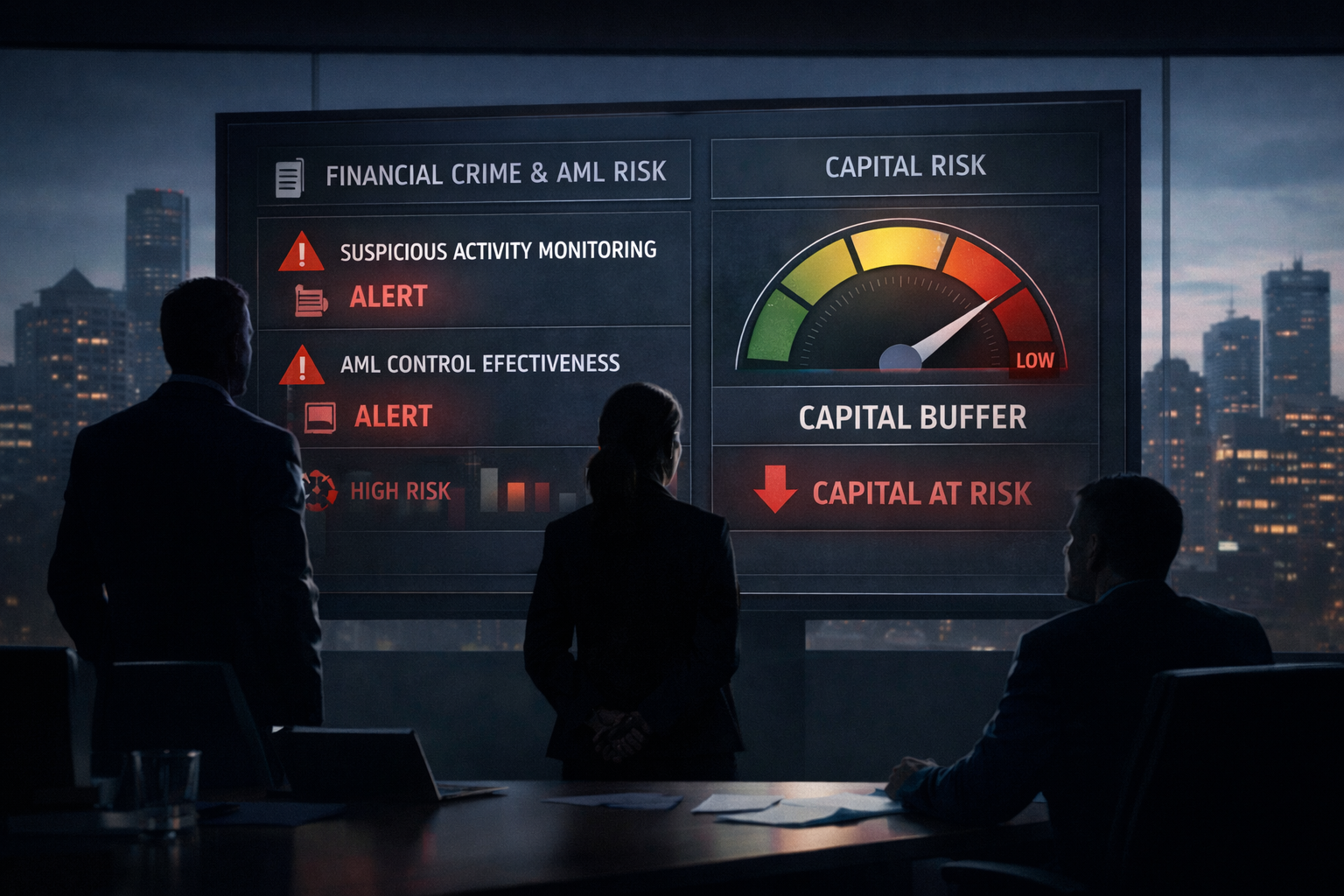
A capital add-on is fundamentally different from a fine or enforceable undertaking. By requiring additional capital to be held, APRA is signalling that deficiencies in financial crime controls materially increase an institution’s operational risk profile.
Until those risks are demonstrably addressed, they must be absorbed on the balance sheet.
The consequences are tangible:
- Reduced capital flexibility
- Pressure on return on equity
- Constraints on growth and strategic initiatives
- Prolonged supervisory scrutiny
The underlying message is unambiguous.
AML weaknesses now come with a measurable capital cost.
AML failures are now viewed as prudential risk
This case also signals a shift in how regulators define the problem.
The findings were not limited to missed alerts or procedural non-compliance. Regulators highlighted broader, structural weaknesses, including:
- Ineffective transaction monitoring
- Inadequate customer risk assessment and limited beneficial ownership visibility
- Weak escalation from branch-level operations
- Fragmented oversight between frontline teams and central compliance
- Governance gaps that allowed weaknesses to persist undetected
These are not execution errors.
They are risk management failures.
This explains the joint involvement of APRA and AUSTRAC. Financial crime controls are now firmly embedded within expectations around enterprise risk management, institutional resilience, and safety and soundness.
Six years of exposure is a governance failure
Perhaps the most troubling aspect of the Bendigo case is duration.
When material AML weaknesses persist across multiple years, audit cycles, and regulatory engagements, the issue is no longer technology alone. It becomes a question of:
- Risk culture
- Accountability
- Board oversight
- Management prioritisation
Australian regulators have made it increasingly clear that financial crime risk cannot be fully delegated to second-line functions. Boards and senior executives are expected to understand AML risk in operational and strategic terms, not just policy language.
This reflects a broader global trend. Prolonged AML failures are now widely treated as indicators of governance weakness, not just compliance gaps.
Why joint APRA–AUSTRAC action matters
The coordinated response itself is a signal.
APRA’s mandate centres on institutional stability and resilience. AUSTRAC’s mandate focuses on financial intelligence and the disruption of serious and organised crime. When both regulators act together, it reflects a shared conclusion: financial crime control failures have crossed into systemic risk territory.
This convergence is becoming increasingly common internationally. Regulators are no longer willing to separate AML compliance from prudential supervision when weaknesses are persistent, enterprise-wide, and inadequately addressed.
For Australian institutions, this means AML maturity is now inseparable from broader risk and capital considerations.
The hidden cost of delayed remediation
The Bendigo case also exposes an uncomfortable truth.
Delayed remediation is expensive.
When control weaknesses are allowed to persist, institutions often face:
- Large-scale, multi-year transformation programs
- Significant technology modernisation costs
- Extensive retraining and cultural change initiatives
- Capital locked up until regulators are satisfied
- Sustained supervisory and reputational pressure
What could have been incremental improvements years earlier can escalate into a full institutional overhaul when left unresolved.
In this context, capital add-ons act not just as penalties, but as forcing mechanisms to ensure sustained executive and board-level focus.
What this means for Australian banks and fintechs
This case should prompt serious reflection across the sector.
Several lessons are already clear:
- Static, rules-based monitoring struggles to keep pace with evolving typologies
- Siloed fraud and AML functions miss cross-channel risk patterns
- Documented controls are insufficient if they are not effective in practice
- Regulators are increasingly focused on outcomes, not frameworks
Importantly, this applies beyond major banks. Regional institutions, mutuals, and digitally expanding fintechs are firmly within scope. Scale is no longer a mitigating factor.
Where technology must step in before capital is at risk
Cases like Bendigo expose a widening gap between regulatory expectations and how financial crime controls are still implemented in many institutions. Legacy systems, fragmented monitoring, and periodic reviews are increasingly misaligned with the realities of modern financial crime.
At Tookitaki, financial crime prevention is approached as a continuous intelligence challenge, rather than a static compliance obligation. The emphasis is on adaptability, explainability, and real-time risk visibility, enabling institutions to surface emerging threats before they escalate into supervisory or capital issues.
By combining real-time transaction monitoring with collaborative, scenario-driven intelligence, institutions can reduce blind spots and demonstrate sustained control effectiveness. In an environment where regulators are increasingly focused on whether controls actually work, this ability is becoming central to maintaining regulatory confidence.
Many of the weaknesses highlighted in this case mirror patterns seen across recent regulatory reviews. Institutions that address them early are far better positioned to avoid capital shocks later.
From compliance posture to risk ownership
The clearest takeaway from the Bendigo case is the need for a mindset shift.
Financial crime risk can no longer be treated as a downstream compliance concern. It must be owned as a core institutional risk, alongside credit, liquidity, and operational resilience.
Institutions that proactively modernise their AML capabilities and strengthen governance will be better placed to avoid prolonged remediation, capital constraints, and reputational damage.
A turning point for trust and resilience
The action against Bendigo Bank is not about one institution. It reflects a broader regulatory recalibration.
AML failures are now capital risks.
In Australia’s evolving regulatory landscape, AML is no longer a cost of doing business.
It is a measure of institutional resilience, governance strength, and trustworthiness.
Those that adapt early will navigate this shift with confidence. Those that do not may find that the cost of getting AML wrong is far higher than expected.
Experience the most intelligent AML and fraud prevention platform
Experience the most intelligent AML and fraud prevention platform
Experience the most intelligent AML and fraud prevention platform
Top AML Scenarios in ASEAN
The Role of AML Software in Compliance
Talk to an Expert
Our Thought Leadership Guides

Reducing False Alerts and Improving AML Detection Rates with Tookitaki's FinCense
False positives overwhelm AML compliance teams while genuine financial crime goes undetected. Tookitaki addresses this two ways: an Alert Prioritization AI Agent that works on top of any legacy system, and FinCense Transaction Monitoring with scenario-based detection and automated threshold tuning.

AML Compliance for Digital Banks in Malaysia: Meeting BNM's Requirements with FinCense
Malaysia's digital banks face BNM's 2023 AML/CFT Policy Document, FATF's updated recommendations, and mounting pressure on eKYC and transaction monitoring standards. Here is how FinCense addresses these requirements.


Living Under the STR Clock: The Growing Pressure on AML Investigators
AML investigators face increasing pressure to make Suspicious Transaction Report decisions under tight timelines and growing alert volumes. Explore the challenges behind STR reporting and the shift toward intelligence-led investigations.

