

AML Compliance for Tier 2 Banks: What Smaller Institutions Need to Get Right
.svg)
AUSTRAC publishes its examination priorities for the year. The CCO at a regional Australian bank reads the list. Calibrated alert thresholds. Documentation of alert dispositions. EDD for high-risk customers. Periodic re-screening for PEPs.
The list looks the same as last year. And the year before.
The difference is that her team is 8 people — not 80. The obligation does not scale down with the headcount.
This is the operating reality for AML compliance at Tier 2 banks across Australia, Singapore, and Malaysia. Regional banks, digital banks, foreign bank branches, credit unions with banking licences — institutions that are fully regulated, fully examined, and fully liable, but are not Commonwealth Bank, DBS, or Maybank. The same rules apply. The resources do not.
This article covers where Tier 2 AML programmes most commonly fail examination, what "proportionate" compliance actually requires in practice, and how mid-size institutions build programmes that hold up without the 50-person compliance team.

The Regulatory Reality: Same Obligations, Different Resources
AUSTRAC, MAS, and BNM do not operate two-tier AML standards. The AML/CTF Act 2006 applies to every reporting entity in Australia regardless of asset size. MAS Notice 626 applies to every bank licensed in Singapore. BNM's AML/CFT Policy Document applies to every licensed institution in Malaysia.
The only concession regulators make is proportionality. A risk-based approach means the scale of an AML programme should reflect the scale of the risk — the volume and nature of transactions, the customer risk profile, the jurisdictions involved. But the programme must exist, be effective, and produce documentation that survives examination.
Proportionality is not a waiver.
Westpac's AUD 1.3 billion penalty in 2020 was for a major bank. But AUSTRAC has also pursued civil penalty orders against smaller ADIs and credit unions for the same category of failures: uncalibrated monitoring thresholds, inadequate EDD, insufficient transaction reporting. The regulator's methodology does not change based on the institution's size. The fine may differ; the finding does not.
For Tier 2 banks in Singapore, MAS has been direct: digital banks licensed under the 2020 digital banking framework should reach AML maturity equivalent to established banks within 2–3 years of licensing. "We are new" has a shelf life. For Tier 2 institutions in Malaysia, BNM's Policy Document draws no distinction between Maybank and a smaller licensed Islamic bank on the core obligations for CDD, transaction monitoring, and suspicious transaction reporting.
Five Gaps Where Tier 2 Banks Fail Examination
Gap 1: Default Threshold Settings on Transaction Monitoring
The most common finding across AUSTRAC and MAS examinations of smaller institutions is transaction monitoring software running on vendor-default alert thresholds.
Default thresholds are calibrated for a generic customer population. A regional Australian bank with 80% SME customers needs different alert logic than a consumer retail bank. A digital bank in Singapore whose customers are predominantly salaried individuals transferring payroll needs different parameters than a trade finance operation. When the thresholds do not reflect the institution's actual customer base, two things happen: analysts receive alerts that are irrelevant to real risk, and the transactions that represent genuine risk pass without triggering review.
AUSTRAC's published guidance on transaction monitoring is explicit on this point. MAS expects institutions to document their threshold calibration rationale and demonstrate that calibration is reviewed periodically against the institution's current risk profile. An undated configuration file from the vendor implementation three years ago does not meet that standard.
See our transaction monitoring software buyer's guide for the evaluation criteria that matter when institutions are selecting a platform — threshold configurability is one of five criteria that directly affect examination outcomes.
Gap 2: Alert Backlogs from High False Positive Rates
A Tier 2 bank running a legacy rules-only transaction monitoring system at a 97% false positive rate and processing 200 alerts per day needs 2–3 full-time analysts to do nothing except clear the alert queue. For a compliance team of 8, that is 25–37% of total capacity consumed by alert triage before a single investigation has started.
The consequence is not just inefficiency. It is a programme that cannot function as designed. Analysts clearing high-volume, low-quality alert queues develop pattern fatigue. Genuine risk signals get the same 30-second review as the 97% of alerts that will be closed as false positives. EDD interviews do not happen because there is no analyst capacity to conduct them. Examination preparation is squeezed into the two weeks before the examiner arrives.
False positive rates are not a fixed cost of running a transaction monitoring programme. Legacy rules-only systems produce high false positive rates because they apply static thresholds to dynamic customer behaviour. Typology-driven, behaviour-based detection — which incorporates how a customer's transaction patterns change over time, not just whether a single transaction crosses a threshold — consistently produces lower false positive rates. The technology gap between rule-based and behaviour-based monitoring is the single largest source of operational inefficiency for Tier 2 compliance teams.
For background on how transaction monitoring works and why the architecture matters, see what is transaction monitoring.
Gap 3: Inconsistent EDD Application
Large banks have EDD workflows automated into their CRM and compliance systems. When a customer's risk rating changes, the system triggers an EDD task, assigns it to an analyst, and tracks completion. The process is not dependent on an individual's memory.
Tier 2 banks frequently run manual EDD processes. PEP screening happens at onboarding. Periodic re-screening often does not — or it happens for some customers and not others, depending on which analyst handles the review. Corporate customers with complex beneficial ownership structures receive initial CDD at onboarding; the review when the ultimate beneficial owner changes is missed because there is no system trigger.
BNM's Policy Document, MAS Notice 626, and AUSTRAC's rules all require EDD to be applied to high-risk customers on an ongoing basis, not just at the point of relationship establishment. "Ongoing" is not annual if the customer's risk profile changes quarterly. An examination finding in this area typically cites specific customer accounts where EDD was not conducted after a risk rating change — not a policy gap, but an execution gap.
Gap 4: Inadequate Documentation of Alert Dispositions
Alert closed. No SAR filed. No written rationale recorded.
In a team under sustained volume pressure, documentation shortcuts are predictable. An analyst who closes 40 alerts in a day and writes a full rationale for 15 of them is not cutting corners deliberately — the queue does not allow otherwise.
AUSTRAC and MAS treat undocumented alert closures as programme failures. Not because the disposition decision was necessarily wrong, but because there is no evidence that a human reviewed the alert and made a considered decision. From an examination standpoint, an alert with no documented rationale is indistinguishable from an alert that was never reviewed. The regulator cannot distinguish between "reviewed and correctly closed" and "bypassed."
This is a systems problem, not a people problem. Alert documentation should be generated as part of the disposition workflow, not as a separate manual step. Every alert closure should require a rationale field — even if the rationale is a structured selection from a drop-down of standard reasons. The documentation burden should be close to zero per alert for straightforward dispositions.
Gap 5: No Model Validation for ML-Based Detection
Tier 2 banks that have moved to AI-augmented transaction monitoring frequently lack the model governance infrastructure to validate that detection models are performing correctly over time.
A model trained on transaction data from 2022 that has never been retrained is not performing at specification in 2026. Customer behaviour shifts. Payment methods change. New typologies emerge. Without periodic model validation — testing whether the model's detection performance against current transaction patterns matches its baseline specification — the institution cannot make the assertion that its monitoring programme is effective.
MAS has flagged model governance as an emerging examination area. For Tier 2 banks, the challenge is that model validation at large banks is done by internal quant teams with the expertise to run performance tests, backtesting, and drift analysis. A 10-person compliance team at a regional bank does not have that capability in-house.
The answer is not to avoid AI-augmented monitoring. It is to select platforms where model validation documentation is generated automatically, and where retraining and recalibration is a vendor-supported function, not a requirement to build internal data science capability.

What "Proportionate" AML Compliance Actually Means
Proportionality is frequently misread as a licence to do less. It is not. It is permission to concentrate compliance resources where the actual risk is — rather than spreading equal effort across all customers regardless of their risk profile.
For a Tier 2 bank, proportionate compliance means three things in practice.
Automate the process work. Alert generation, threshold calibration triggers, EDD workflow initiation, documentation of alert dispositions — none of these should require analyst decision-making at each step. Every manual step is a point where volume pressure leads to shortcuts, and shortcuts are what examination findings are made of.
Free analyst capacity for work that requires judgement. Complex alert investigations, EDD interviews, SAR filing decisions, examination preparation — these require an experienced analyst's attention and cannot be automated. A team of 8 can do this work well, but only if they are not consuming 3–4 hours per day clearing a backlog of 200 low-quality alerts.
The arithmetic is specific: at a 97% false positive rate on 200 daily alerts, an analyst spends approximately 2.5 minutes on each alert just to clear the queue — that is 500 analyst-minutes, or roughly 8.3 hours, across a team. At a 50% false positive rate on the same 200 alerts, 100 alerts require substantive review. The remaining 100 are flagged for quick closure. Total review time drops to approximately 4–5 hours — returning 3–4 hours of analyst capacity daily for investigation and EDD work. At a 10-person team, that is 30–40% of daily compliance capacity returned to meaningful work.
Build documentation in, not on. Every compliance workflow should generate examination-ready records as a byproduct of normal operation, not as a separate documentation task.
Technology Requirements Specific to Tier 2
The enterprise transaction monitoring systems built for Tier 1 banks assume implementation resources that Tier 2 banks do not have. Multi-month professional services engagements, dedicated data engineering teams, internal model governance functions — these are not realistic for a regional bank with a 5-person technology team and a compliance budget that was set before the current regulatory environment.
Four technology requirements are specific to Tier 2:
Integration simplicity. Many Tier 2 banks run legacy core banking platforms. Cloud-native transaction monitoring platforms with standard API connectivity can connect to core banking data in weeks, not months, without requiring a custom integration project.
Compliance-configurable thresholds. Compliance staff should be able to adjust alert thresholds and add detection scenarios without vendor involvement. Calibration is a compliance function. If it requires a professional services engagement every time a threshold needs updating, calibration will not happen at the frequency regulators expect.
Predictable pricing. Per-transaction pricing models become unpredictable as transaction volumes grow. Tier 2 banks should look for flat-fee or tiered pricing that is budget-predictable against their transaction volume — one less variable in a constrained budget environment.
Exam-ready documentation, automatically. Alert audit trails, calibration records, and model validation documentation should be outputs of the platform's standard operation, not custom report builds. If producing the documentation package for an examination requires a week of manual compilation, the documentation package will always be incomplete.
For a structured framework on evaluating transaction monitoring vendors against these criteria, see the TM Software Buyer's Guide.
APAC-Specific Regulatory Context for Tier 2
Australia. AUSTRAC's risk-based approach explicitly accommodates proportionality — but AUSTRAC has examined and found against credit unions and smaller ADIs for the same monitoring failures as major banks. The AUSTRAC transaction monitoring requirements cover the specific obligations that apply to all reporting entities, regardless of size.
Singapore. MAS Notice 626 applies to all banks licensed in Singapore. For digital banks — which are structurally Tier 2 in Singapore's context — MAS has set explicit expectations that AML maturity should reach equivalence with established banks within 2–3 years of licensing. The MAS transaction monitoring requirements article covers the specific MAS standards in detail.
Malaysia. BNM's AML/CFT Policy Document applies to all licensed institutions. Smaller licensed banks, Islamic banks, and regionally focused institutions have the same CDD, monitoring, and reporting obligations as the major domestic banks. BNM's examination methodology does not grade on institution size.
What an Examination-Ready Tier 2 AML Programme Looks Like
Six elements characterise programmes that hold up to examination at Tier 2 institutions:
- A written AML/CTF programme, Board-approved and reviewed annually
- Transaction monitoring thresholds documented and calibrated against the institution's own customer risk assessment — with a dated record of when calibration was last reviewed and by whom
- An alert investigation workflow that generates a written rationale for every closed alert, including a structured reason code for dispositions that do not result in SAR filing
- EDD workflows triggered automatically by risk rating changes, not by analyst memory
- Annual model validation or rule-set review with documented outcomes, even where the outcome is "no changes required"
- Staff training records, including dates, completion rates, and assessment outcomes by employee
None of these six elements require a large compliance team. They require systems configured to produce the right outputs and workflows designed to generate documentation as a byproduct of normal operation.
How Tookitaki FinCense Fits the Tier 2 Context
Tookitaki's FinCense AML suite is deployed across institution sizes, including Tier 2 banks, digital banks, and licensed challengers in Australia, Singapore, and Malaysia.
FinCense is cloud-native with standard API connectivity, which reduces integration time for institutions that do not have dedicated implementation teams. Compliance staff can configure alert thresholds and detection scenarios without vendor support — calibration happens on the institution's schedule, not when a professional services engagement can be arranged.
APAC-specific typologies and pre-built documentation for AUSTRAC, MAS Notice 626, and BNM's Policy Document are included in the platform. These are not professional services add-ons; they are part of the standard deployment.
In production deployments, FinCense has reduced false positive rates by up to 50% compared to legacy rule-based systems. At a 10-person compliance team processing 200 daily alerts, that returns approximately 3–4 hours of analyst capacity per day — enough to run substantive investigations, keep EDD current, and arrive at examination with documentation that was built during normal operations, not assembled in a panic the week before.
See FinCense in a Tier 2 Bank Context
If your institution is carrying the same AML obligations as the major banks with a fraction of the compliance resources, the question is not whether you need a programme that works — it is whether your current programme will hold up when the examiner arrives.
Book a demo to see FinCense configured for a Tier 2 bank: realistic transaction volumes, a compliance team of fewer than 20, and the documentation outputs that AUSTRAC, MAS, and BNM expect.
If you are still evaluating options, the TM Software Buyer's Guide provides a structured framework for comparing platforms on the criteria that matter most for smaller compliance teams.
Experience the most intelligent AML and fraud prevention platform
Experience the most intelligent AML and fraud prevention platform
Experience the most intelligent AML and fraud prevention platform
Top AML Scenarios in ASEAN
The Role of AML Software in Compliance
The Role of AML Software in Compliance
Talk to an Expert
Our Thought Leadership Guides

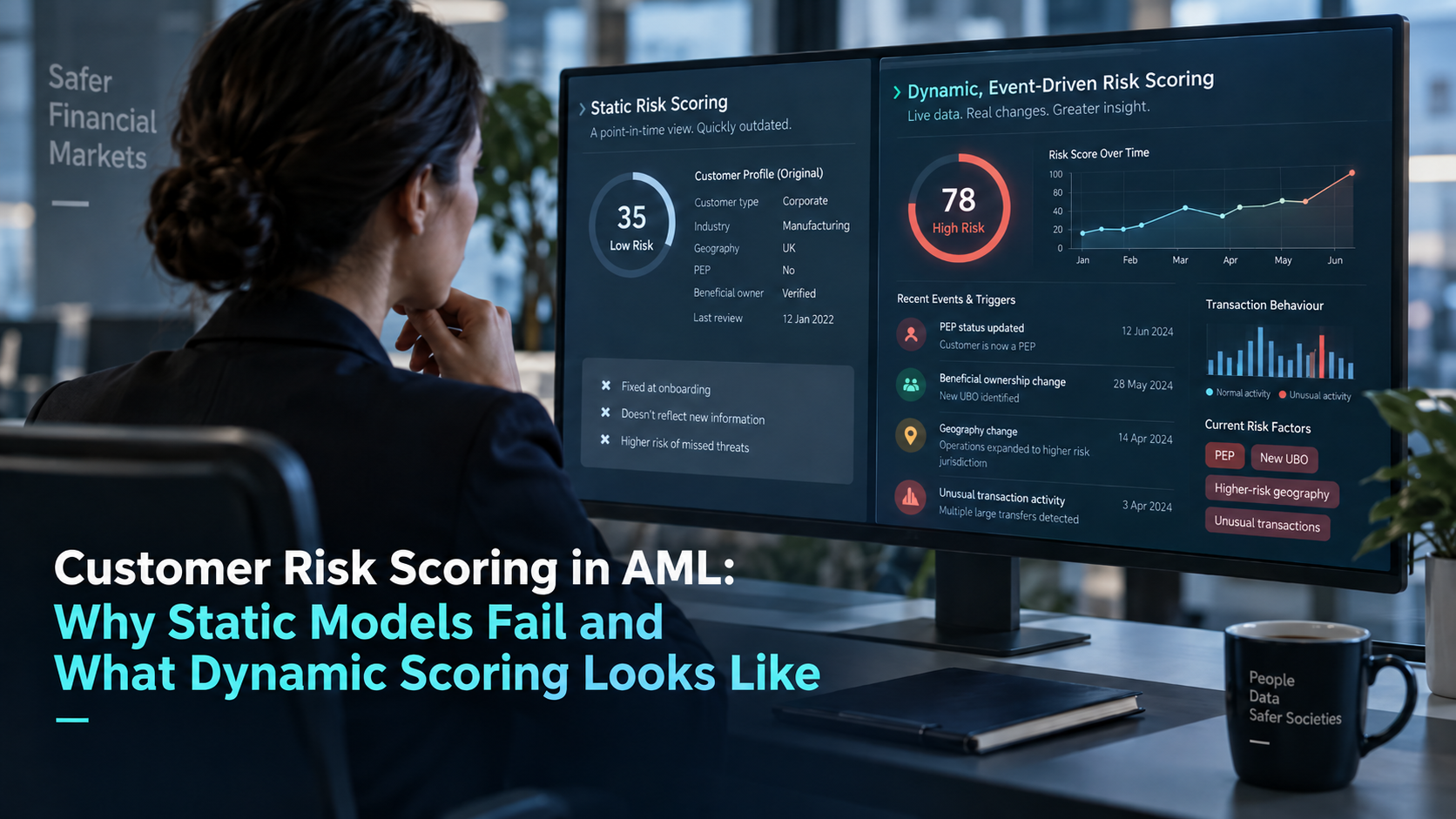
Customer Risk Scoring in AML: Why Static Models Fail and What Dynamic Scoring Looks Like
Customer risk assessments must remain current as customer circumstances and behaviour change. Learn where static AML risk models fall short and how event-driven, explainable scoring can strengthen ongoing due diligence.
Customer Risk Scoring in AML: Why Static Models Fail and What Dynamic Scoring Looks Like
Customer risk assessments must remain current as customer circumstances and behaviour change. Learn where static AML risk models fall short and how event-driven, explainable scoring can strengthen ongoing due diligence.