

Inside the Parañaque Scam Factory: What 48 Arrests Reveal About the Industrialisation of Online Fraud
.svg)
On 20 April 2026, Philippine media reported that the National Bureau of Investigation had arrested 48 individuals after raiding an alleged online scamming hub in Parañaque City. The timing matters. This is not an old case being revisited. It is a fresh reminder that scam operations across Southeast Asia are still active, organised, and scaling fast.
When authorities entered the site, they did not just uncover another isolated scam. They walked into something far more structured — an operation that looked less like opportunistic fraud and more like a production line.
Dozens of individuals. Multiple devices. Coordinated activity. A setup that resembled a call centre more than a loose group of fraudsters.
For compliance teams, this is not just another headline. It is a signal. Modern scam networks are becoming more industrialised, and the financial trails they leave behind are becoming harder to detect with static, siloed controls.

What Actually Happened in Parañaque
The raid exposed an online scamming hub operating at scale. Investigators found individuals actively engaged in defrauding victims, likely through a mix of social engineering tactics — investment scams, impersonation schemes, and possibly romance or job scams.
What stood out was not just the activity itself, but the structure:
- Multiple operators working simultaneously
- Dedicated systems and devices
- Coordinated workflows
- A controlled environment, almost like a call centre
This was not a loose group of fraudsters. It was organised, repeatable, and designed for volume.
That distinction matters.
Because once fraud becomes structured like this, it stops being unpredictable and starts becoming scalable.
The Shift from Scams to Scam Infrastructure
For years, fraud has often been viewed as a series of isolated incidents. A phishing email here. A social engineering case there.
That lens no longer holds.
What the Parañaque case reveals is something deeper: the rise of scam infrastructure.
These are not individuals improvising. These are networks designed with:
- Recruitment pipelines
- Scripted engagement models
- Operational roles and hierarchies
- Performance-driven execution
In many ways, these setups mirror legitimate businesses — except the product being “sold” is deception.
And like any efficient system, they optimise over time.
They test what works. They refine messaging. They reuse successful playbooks. They scale quickly.
For financial institutions, this changes the challenge entirely.
You are no longer detecting one-off fraud. You are up against systems that are constantly learning and adapting.
Why This Matters for Financial Institutions
At first glance, a physical raid in the Philippines may feel distant to a bank in Singapore or a fintech in Australia.
But the financial footprint of such operations is rarely local.
Scam proceeds move quickly — often across borders, across institutions, and across channels.
A typical flow might look like this:
- Victim transfers funds via online banking or wallet
- Funds are routed through mule accounts
- Split into smaller transactions
- Moved across jurisdictions
- Layered further to obscure origin
By the time the money surfaces in a financial institution’s system, it often appears routine.
That is the real risk.
Not at the point of the scam, but at the point where illicit funds blend into legitimate financial flows.
The Hidden Complexity Behind “Simple” Scams
It is easy to dismiss scams as basic manipulation.
But cases like this show how layered they have become.
Behind a single victim interaction, there may be:
- A recruitment network sourcing operators
- A technical setup managing communication channels
- A financial layer handling fund movement
- A supervisory layer coordinating activity
Each layer introduces its own signals.
But those signals are rarely obvious in isolation.
A transaction might look normal.
A customer profile might appear clean.
A payment pattern may not trigger any threshold.
Yet, when viewed together, they form a pattern.
This is the daily reality for compliance teams — connecting weak, fragmented signals into something meaningful.

Where Traditional Detection Starts to Break Down
Most financial institutions still rely, at least in part, on rule-based monitoring.
And rules do have their place.
But against structured scam operations, they begin to show limitations:
- Static thresholds struggle against evolving behaviour
- Isolated alerts fail to capture network patterns
- Manual tuning cannot keep pace with changing typologies
In the Parañaque case, individual transactions may not have appeared suspicious.
What made them risky was the context — the coordination, the repetition, the connections.
This is where traditional systems fall short.
They are built to detect anomalies, not ecosystems.
The Role of Mule Networks in Scaling Fraud
No large-scale scam operation works without one critical component: money mules.
These accounts absorb, move, and disguise illicit funds.
And they are becoming increasingly sophisticated.
Some are unwitting — recruited through job offers or incentives.
Others are complicit — knowingly participating in exchange for a share.
Either way, they create a buffer between fraudsters and the financial system.
In operations like the Parañaque hub, mule networks likely operate in parallel:
- Receiving funds from multiple victims
- Redistributing across accounts
- Moving funds rapidly across borders
From a compliance perspective, mule activity often appears as:
- High-velocity transactions
- Rapid inflows and outflows
- Accounts with little genuine economic activity
But again, these signals are rarely conclusive on their own.
The Cross-Border Reality
Modern fraud rarely stays within one jurisdiction.
A scam initiated in one country can impact victims in another, with funds routed through multiple regions.
This creates three persistent challenges:
- Fragmented visibility
No single institution sees the full transaction chain - Jurisdictional differences
Regulatory expectations and data access vary - Delayed intervention
By the time alerts are triggered, funds have already moved
The Parañaque case reinforces a simple truth: financial crime is global, even when it appears local.
What Compliance Teams Should Be Looking For
Rather than focusing on isolated red flags, institutions need to identify patterns of behaviour.
Indicators aligned with operations like this include:
- Clusters of accounts exhibiting similar transaction flows
- Repeated low-to-mid value transfers across multiple beneficiaries
- Rapid movement of funds with minimal retention
- Shared identifiers such as devices, IPs, or contact details
- Activity inconsistent with stated customer profiles
Individually, these may not trigger concern.
Collectively, they signal coordination.
Moving from Detection to Understanding
There is a broader shift underway in financial crime prevention.
From generating alerts…
To understanding behaviour.
It is no longer enough to flag transactions.
Teams need to ask:
- Why is this activity happening?
- How is it connected to other behaviour?
- What broader typology does it resemble?
This shift is not easy.
Because understanding requires context — and context requires intelligence beyond internal data.
The Role of Collaborative Intelligence
Cases like the Parañaque scam hub highlight a structural gap.
No single institution has full visibility.
Fraud patterns are distributed across:
- Banks
- Fintech platforms
- Payment processors
- Geographies
Which means detection cannot rely on isolated systems.
Collaborative intelligence becomes critical.
By sharing typologies, behavioural patterns, and risk signals without exposing sensitive data institutions can:
- Detect emerging threats earlier
- Improve accuracy
- Reduce false positives
This is where community-driven intelligence models are gaining traction.
Where Technology Needs to Evolve
To keep pace with structured fraud operations, detection systems need to evolve in three ways:
1. From rules to adaptive intelligence
Systems must continuously learn from emerging patterns
2. From transactions to networks
Detection must capture relationships, not just events
3. From alerts to actionable insights
Outputs must support faster, clearer investigation decisions
This is not about replacing existing systems overnight.
It is about enhancing them to reflect how fraud actually operates today.
The Cost of Getting This Wrong
The impact of missing these signals goes beyond financial loss.
There are broader consequences:
- Increased regulatory scrutiny
- Reputational damage
- Erosion of customer trust
In fast-growing digital markets, trust is not easily rebuilt once lost.
And fraud, left unchecked, directly undermines it.
A More Grounded Way Forward
The Parañaque case is not an anomaly. It is part of a pattern.
Fraud is becoming:
- More organised
- More scalable
- More adaptive
And increasingly embedded within legitimate financial systems.
Responding to this requires a shift:
From reactive to proactive
From siloed to collaborative
From static to adaptive
For compliance teams, this is not about chasing every new scam.
It is about building the capability to recognise patterns — even as they evolve.
Conclusion: Beyond the Raid
The arrest of 48 individuals is a meaningful enforcement action.
But it is not the end of the story.
Operations like these rarely disappear. They adapt, relocate, and re-emerge.
For financial institutions, the real question is not whether such scams exist.
It is whether their systems can detect the financial signals these operations inevitably leave behind.
Because while enforcement can shut down a physical hub, the financial trails continue to move.
And that is where the real battle is being fought.
Experience the most intelligent AML and fraud prevention platform
Experience the most intelligent AML and fraud prevention platform
Experience the most intelligent AML and fraud prevention platform
Top AML Scenarios in ASEAN
The Role of AML Software in Compliance
The Role of AML Software in Compliance
Talk to an Expert
Our Thought Leadership Guides

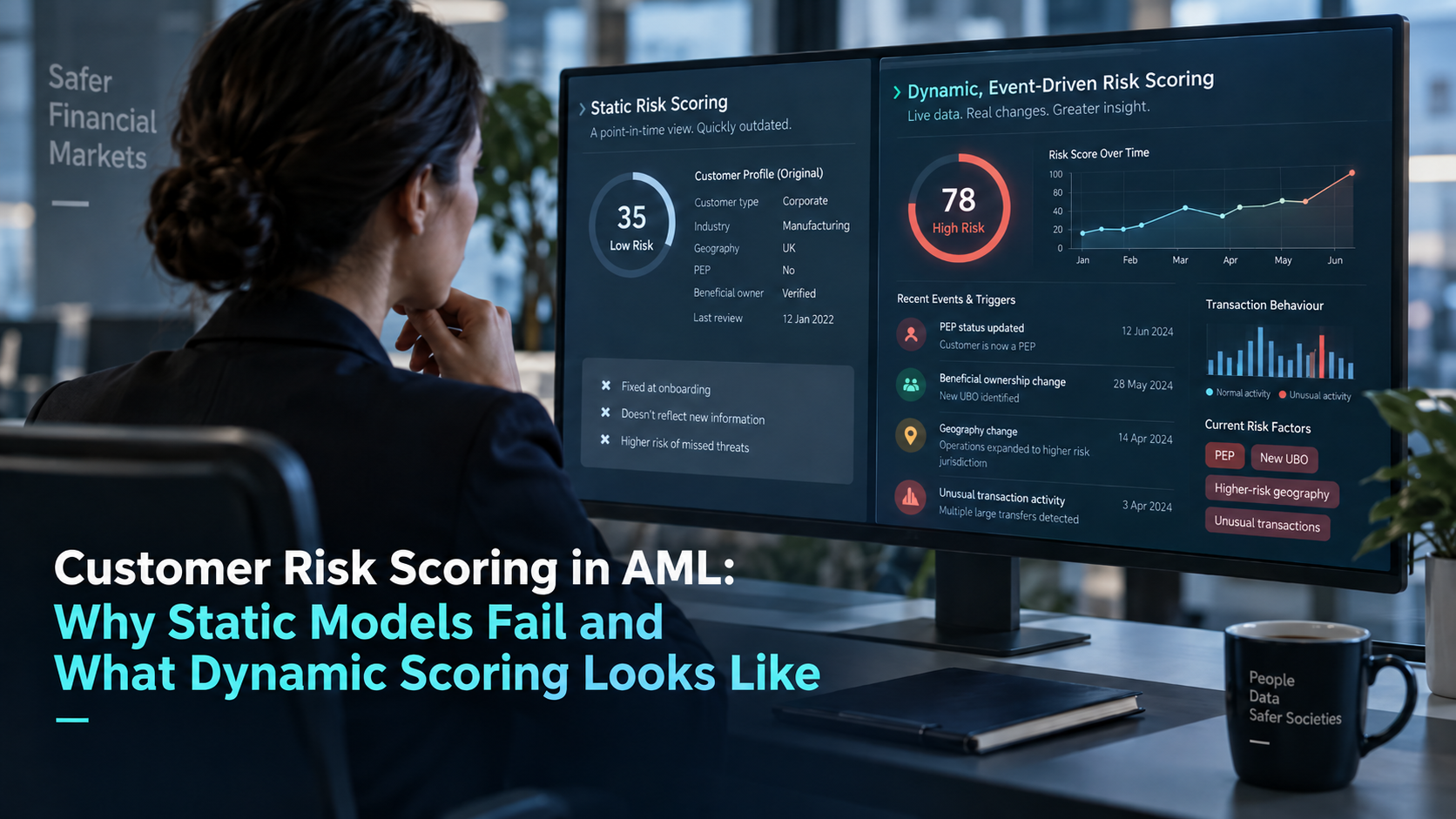
Customer Risk Scoring in AML: Why Static Models Fail and What Dynamic Scoring Looks Like
Customer risk assessments must remain current as customer circumstances and behaviour change. Learn where static AML risk models fall short and how event-driven, explainable scoring can strengthen ongoing due diligence.
Customer Risk Scoring in AML: Why Static Models Fail and What Dynamic Scoring Looks Like
Customer risk assessments must remain current as customer circumstances and behaviour change. Learn where static AML risk models fall short and how event-driven, explainable scoring can strengthen ongoing due diligence.