

AML Compliance in New Zealand: Meeting RBNZ and FIU Requirements with FinCense
.svg)
New Zealand's financial sector operates under one of the more structurally complex AML/CFT frameworks in the Asia-Pacific region. Where most comparable jurisdictions have a single primary AML supervisor, New Zealand has three — the Reserve Bank of New Zealand (RBNZ), the Financial Markets Authority (FMA), and the Department of Internal Affairs (DIA) — each supervising a distinct segment of the financial industry under the same legislation. For reporting institutions, this means compliance obligations that are governed by a single Act but assessed through three separate supervisory lenses.
The Anti-Money Laundering and Countering Financing of Terrorism (AML/CFT) Act 2009 is the primary statute. It sets a risk-based compliance framework that applies to banks, non-bank deposit takers, financial advisers, fund managers, payment service providers, money changers, and an expanding set of designated non-financial businesses and professions. The Act has been extended in two phases since 2009, steadily broadening the universe of reporting entities and raising the baseline compliance expectations across all of them.
For financial institutions operating under RBNZ or FMA supervision — and for the growing fintech sector navigating DIA oversight — meeting these obligations requires a monitoring programme that is risk-based by design, auditable on demand, and capable of generating the Suspicious Transaction Reports (STRs) that the NZ Police Financial Intelligence Unit expects.

What the AML/CFT Act Requires from Reporting Institutions
A documented AML/CFT programme. Every reporting entity must have a written AML/CFT programme that sets out its policies, procedures, and controls for detecting and managing money laundering and terrorism financing risk. The programme must be reviewed regularly and updated when the institution's risk profile changes. Supervisors assess the programme as part of their examination process — a programme that exists on paper without being operationally embedded does not meet the standard.
A risk assessment. The AML/CFT programme must be grounded in a documented risk assessment that identifies and evaluates the institution's specific ML/TF risks — by customer type, product, delivery channel, and geographic exposure. The risk assessment drives the monitoring approach: under the Act's risk-based framework, institutions are expected to apply proportionate controls, not uniform ones. An assessment that classifies all customers at the same risk level regardless of their profile and behaviour does not satisfy this requirement.
Customer due diligence. Standard CDD applies at onboarding for all customers. Enhanced CDD is required for higher-risk customers, including politically exposed persons, customers from high-risk jurisdictions, and those with complex ownership structures. Simplified CDD is available for demonstrably lower-risk categories. Ongoing monitoring must maintain the customer's risk profile and detect changes in behaviour that indicate elevated risk.
Suspicious Transaction Reports. There is no minimum value threshold for STR filing. The obligation arises when a reporting entity has a suspicion — based on reasonable grounds — that a transaction relates to a money laundering or terrorism financing offence. STRs are filed with the NZ Police Financial Intelligence Unit through the goAML platform. Supervisors assess both STR volume and quality; investigation narratives must document the specific indicators of suspicion and the steps taken to investigate.
Cash Transaction Reports. Transactions involving cash of NZD 10,000 or more must be reported to the FIU as Cash Transaction Reports (CTRs) within two working days.
Record keeping. All transaction records, CDD documents, and investigation files must be retained for a minimum of five years from the date of the transaction or the end of the business relationship.
Annual AML/CFT report. Each reporting entity must file an annual report with its supervisor covering the operation of its AML/CFT programme during the year. The report is a supervisory tool — it informs the supervisor's assessment of the institution's compliance posture and may trigger an examination.
New Zealand's Three Supervisors: What Each Expects
RBNZ supervises banks, non-bank deposit takers, and life insurers. RBNZ's AML/CFT supervision programme focuses on institutions with the highest systemic risk exposure — those handling the largest transaction volumes and operating the most complex correspondent banking relationships.
FMA supervises financial advisers, discretionary investment management services, brokers, fund managers, and derivatives issuers. The FMA's examination focus reflects the specific risks of the investment and capital markets context: complex beneficial ownership structures, offshore-sourced funds, and investment vehicles that can obscure the origin of capital.
DIA supervises a broader sector that includes non-deposit-taking lenders, remittance service providers, foreign exchange dealers, and a growing set of digital asset businesses and payment service providers. The DIA's regulated sector is large and heterogeneous — compliance maturity varies considerably, and DIA examiners assess programme quality against what is reasonable for the entity's size and risk profile.

The AML Risk Landscape in New Zealand
Property-linked financial flows. New Zealand's property sector has historically been identified as a significant ML risk vector, and its financial dimension — mortgage transactions, settlement flows, and the involvement of professional intermediaries — creates specific monitoring requirements for the banks and advisers that facilitate property transactions.
Pacific remittance corridors. New Zealand has significant remittance flows to Pacific Island nations — Samoa, Tonga, Fiji, and Vanuatu in particular. These corridors carry elevated ML/TF risk given the limited AML/CFT infrastructure in some recipient jurisdictions, and FATF's grey list dynamics mean that correspondent relationships in these corridors require enhanced due diligence.
Growing fintech exposure. New Zealand's fintech sector — digital lending, payment platforms, crypto exchanges, and buy-now-pay-later providers — has expanded rapidly. Most of these entities fall under DIA supervision and face the same CDD, monitoring, and STR obligations as traditional reporting entities, without the compliance infrastructure that established banks have built over decades.
Mule account exploitation. Scam proceeds — from investment fraud, phishing, and romance scams — increasingly flow through New Zealand bank accounts before being transferred offshore. Mule account detection requires network-level analysis across account relationships, not per-account threshold rules that only flag individual accounts after the damage is done.
How Tookitaki's FinCense Supports NZ Reporting Institutions
AFC Ecosystem: community intelligence for evolving typologies. FinCense's detection is powered by Tookitaki's Anti Financial Crime (AFC) Ecosystem — a federated intelligence network of 30+ financial institutions across APAC that share financial crime patterns without exchanging customer data. When a new mule network structure emerges in the NZ market, or a Pacific remittance corridor typology is identified at another member institution, that intelligence flows to every institution in the network automatically. The typology library is continuously updated, reflecting current financial crime patterns rather than the static rules written at the time the system was last configured. For NZ institutions whose risk assessments flag Pacific corridor risk or property-linked flows as elevated, AFC Ecosystem coverage includes typologies validated specifically for those vectors.
Transaction monitoring built for the Act's risk-based requirements. FinCense's transaction monitoring module uses scenario-based detection where each scenario encodes the full behavioural pattern of a known financial crime typology, not a surface-level threshold rule. This matters for NZ compliance because the Act's risk-based framework expects monitoring to reflect the institution's specific risk profile, not a one-size-fits-all rule set. Automated Threshold Tuning recommends optimal thresholds for distinct customer segments within the institution's portfolio — a high-volume business customer has a genuinely different normal transaction profile from a retail customer, and monitoring calibrated accordingly generates fewer false positives while maintaining coverage across both. False positive volumes are reduced by up to 70% compared to legacy rule-based systems.
Name and transaction screening. FinCense's screening module uses natural language processing and machine learning to match customer and transaction data against sanctions lists, PEP databases, and adverse media sources. Fuzzy matching handles name variants, transliterations, and partial matches that exact-string matching misses, reducing the false positive volumes that make manual review unmanageable at scale, while maintaining the coverage required by the Act's enhanced CDD obligations for PEPs and high-risk jurisdictions. For institutions processing Pacific remittance flows, real-time transaction screening ensures every leg of a cross-border transfer i.e. originator, beneficiary, and intermediary is screened against designated lists before settlement.
goAML-compatible case management. FinCense's integrated case management connects alert, investigation, and STR report generation in a single environment. AI-generated investigation notes surface the specific indicators of suspicion for each case, improving the quality and completeness of STR narratives filed with the NZ Police FIU through goAML. Investigation timelines are shortened; the risk of missing filing deadlines is reduced; and the quality of reports reaching the FIU improves, directly addressing the narrative quality dimension that supervisors assess.
Unified AML and fraud detection. For NZ institutions facing both AML obligations and fraud risks, particularly scam-related flows moving through accounts, FinCense provides unified detection across both on a single engine and shared data layer. The cross-typology view closes the gap between separate fraud and AML systems that financial crime networks exploit. For more on how unified fraud and AML detection works, see our FRAML guide.
New Zealand's AML/CFT regulatory environment will continue to evolve, with ongoing supervisory focus on programme quality, risk assessment rigour, and STR filing standards across all three supervised sectors. Institutions that build their AML programme on a platform aligned to the Act's risk-based framework — and updated continuously through community intelligence as typologies evolve — are positioned for current examination cycles and the regulatory trajectory ahead.
For a broader comparison of AML platform options for financial institutions, see our AML platforms buyer's guide.
To see how FinCense is deployed for institutions under RBNZ, FMA, or DIA supervision and how it supports NZ AML/CFT Act compliance, book a demo with our team.
Experience the most intelligent AML and fraud prevention platform
Experience the most intelligent AML and fraud prevention platform
Experience the most intelligent AML and fraud prevention platform
Top AML Scenarios in ASEAN
The Role of AML Software in Compliance
The Role of AML Software in Compliance
Talk to an Expert
Our Thought Leadership Guides

KYC Requirements for Philippine Banks: AMLA, BSP obligations, and What Compliance Teams Need to Know in 2026
The Philippines was removed from the FATF list of jurisdictions under increased monitoring in February 2025. This guide explains current AMLA and BSP KYC/CDD requirements for banks, including beneficial ownership, digital onboarding, reporting and record retention.
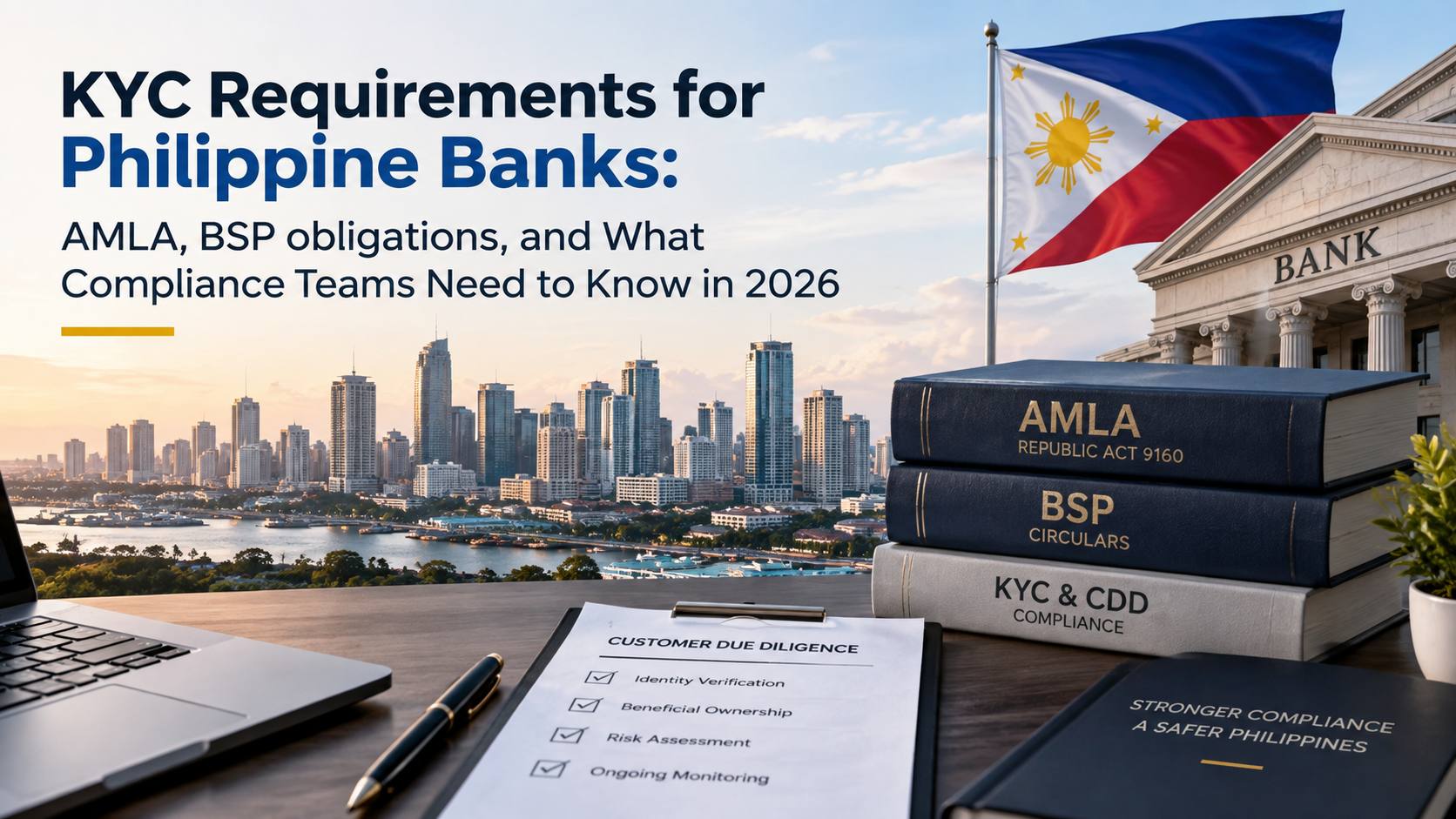
KYC Requirements for Philippine Banks: AMLA, BSP obligations, and What Compliance Teams Need to Know in 2026
The Philippines was removed from the FATF list of jurisdictions under increased monitoring in February 2025. This guide explains current AMLA and BSP KYC/CDD requirements for banks, including beneficial ownership, digital onboarding, reporting and record retention.