

AML Compliance Tools: How to Build a Technology Stack that Holds up Under Examination
.svg)
Most compliance technology programmes did not start as programmes. They started as purchases. A transaction monitoring system bought in 2018 to satisfy one regulatory requirement. A sanctions screening tool added in 2021 when a new payment corridor opened. Case management handled through a combination of the TM system's built-in workflow and two spreadsheets that everyone calls the master tracker. Customer risk scoring done on a quarterly batch export to a separate analytics tool.
None of these purchases were wrong at the time. The problem is that they were made independently, and they do not work together. Investigators open three systems to build the picture for a single alert. A customer whose risk score changes this week will not have their existing alerts reprioritised until someone notices. The audit trail for an STR filed last October is split across the case management workflow, the TM alert record, and an email chain.
When a regulator examines this programme, what they see is not a deliberate technology strategy. They see a series of disconnected decisions that happened to accumulate into something that resembles a compliance programme.
This guide covers what a complete AML/CFT technology stack looks like, how the layers need to connect, and the questions that expose where the gaps are.

The four layers of a complete AML compliance stack
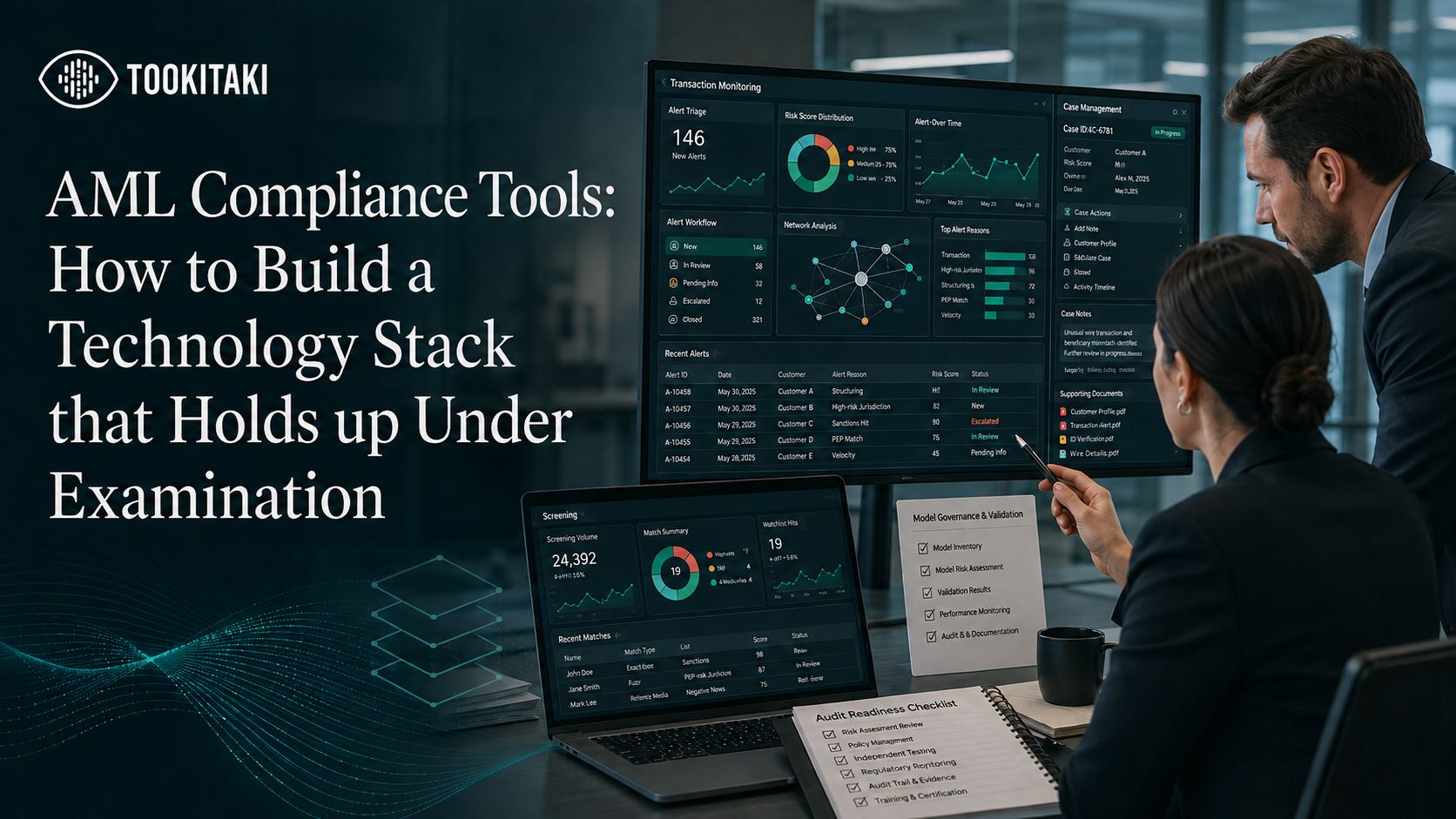
A complete AML/CFT technology programme has four functional layers. Each layer addresses a distinct compliance requirement, and each needs to pass data to the others.
Layer 1: Detection — transaction monitoring and customer risk scoring
Transaction monitoring analyses customer activity against calibrated rules and machine learning models. It generates alerts when behaviour crosses defined thresholds. Customer risk scoring assigns a dynamic risk rating to each customer based on profile characteristics, transaction behaviour, and CDD information. The two need to share data: a customer whose risk score rises from medium to high should have their active transaction monitoring alerts automatically reprioritised, not sit in the same queue as low-risk customers' alerts.
In practice, many institutions run these as separate systems. The result is that risk score information is visible in one place and transaction alerts visible in another, and the investigator has to reconcile them manually. This is not a minor inconvenience — it is a systematic gap in how risk information flows through the programme.
Layer 2: Sanctions and PEP screening
Screening checks customers, counterparties, and transactions against government-issued sanctions lists and politically exposed person databases. It needs to run at three points: at onboarding, at payment initiation, and on a periodic basis as watchlists update. An institution that screens at onboarding but not at payment initiation is not meeting MAS, BNM, or AUSTRAC real-time screening requirements for payment providers.
Screening results also need to feed into the same investigation environment as transaction monitoring alerts. An institution where a screening hit generates a record in the screening system and a transaction monitoring alert generates a record in the TM system, with no shared view, requires investigators to search two places for the same customer's history every time they open a case.
Layer 3: Case management and investigation
Case management is where the output of detection and screening is turned into documented investigation decisions and, where warranted, suspicious matter reports. The critical function of case management is not workflow routing — it is evidence consolidation. An investigator opening a case should see the transaction alert evidence, the customer's risk history, any related screening hits, and prior cases involving the same customer or connected entities, assembled in one record.
When case management is disconnected from detection and screening, the information assembly happens manually. Experienced analysts develop shortcuts. Documentation becomes thinner under volume pressure. The audit trail that regulators expect — evidence frozen at alert creation, decision recorded with specific reasoning, STR linked to the investigation record — becomes hard to reconstruct.
Layer 4: Model governance and audit trail
This layer is the one most often treated as an afterthought, and the one that creates the most regulatory exposure. Regulators across APAC now ask not only whether an AML programme generates alerts but how the models behind it are governed. Can the institution show what model version was active when a given STR was filed? Is there a documented process for testing a new model against the current production model before it goes live? Is the approval decision for each model version retained in an auditable record?
Without a governance layer, the other three layers produce outputs that cannot be fully defended. An alert generated by a model whose approval history is undocumented is an alert with a fragile audit trail.
Why disconnected tools create compliance gaps
The gap created by a patchwork stack is not theoretical. It shows up in specific ways during regulatory examination and in operational practice.
Risk signals do not travel. In an integrated stack, a customer risk score change updates the priority of that customer's alerts automatically. In a disconnected stack, the risk score sits in one system and the alert queue sits in another. The investigator reviewing a low-priority alert from last Tuesday has no way to know the customer was reclassified to high risk on Monday unless they check both systems.
Investigation evidence is fragmented. When a suspicious matter report is filed from a case management system that does not natively receive data from the transaction monitoring system, the underlying alert evidence is either re-entered manually (introducing the possibility of inconsistency) or referenced by pointer (leaving a gap in the case record). Neither satisfies the requirement for a complete, immutable record of the evidence that existed at the time the STR was filed.
Integration costs compound over time. Point solutions require integration work at purchase, re-integration when either system upgrades, and ongoing maintenance of the data pipelines between them. The total cost of maintaining integrations between four separate AML tools over a five-year period regularly exceeds the cost of a platform that covers the same functions natively. This is not always visible at procurement time because integration costs are categorised as IT spend, not compliance spend.
Regulatory examinations expose the seams. An examiner asking to see the evidence behind a specific STR will follow the chain from the filing, to the case record, to the alert, to the underlying transaction data, to the model that generated the alert. If any link in that chain requires switching systems or manually reconstructing a record, the examination finds a gap.
Assessing your current stack
Five questions expose where a compliance technology stack has gaps:
1. When a customer's risk score changes, does that automatically reprioritise their open alerts?
If the answer requires a manual step — an investigator checking the risk scoring system and updating a field in the TM system — that is a gap. Risk signals need to propagate automatically.
2. Can an investigator open a single record that shows the customer's TM alerts, screening hits, and risk history together?
If the answer is no, investigators are assembling case context manually from multiple systems. The time spent on that assembly is time not spent on assessment, and the quality of documentation suffers proportionally.
3. Is there a documented approval record for every model version that has run in production?
For each model, that record should include the training dataset, the validation results, the shadow testing comparison against the previous production model, and the identity of the person who approved promotion. If this record does not exist or is incomplete, the institution cannot answer the question a regulator will ask: on what basis was this model approved to run on live data?
4. How long does it take to add a new detection scenario for an emerging typology?
If the answer is measured in months and requires a vendor engagement, the institution is slower to respond to new financial crime patterns than regulators expect. Scenario configuration should be something the compliance team can do through the platform's interface, not something that requires a professional services engagement each time.
5. Is the STR narrative connected to the investigation record, or is it written separately?
A suspicious matter report that is written from memory or from notes rather than directly from the case record introduces inconsistency. The narrative should be produced from the investigation evidence, with the connection between the two preserved in the audit trail.
What an integrated AML compliance stack delivers
An integrated platform addresses the gaps above by design rather than by integration engineering. Detection, screening, case management, and governance share a common data layer. A customer risk score change updates alert priority without a manual step. An investigator's case record contains transaction alerts and screening hits alongside each other. The audit trail from detection to STR filing is a single, uninterrupted record.
Tookitaki’s FinCense is built on this architecture. Transaction monitoring draws on the AFC Ecosystem, a typology library built from the detection patterns of more than 30 financial institutions covering hundreds of typology variants. When a new typology is validated across the network, it becomes available for deployment through Scenario Design Studio without a vendor implementation engagement. Customer risk scoring updates dynamically and feeds prioritisation signals directly into the case management queue.
The alerts are ranked based on their score before they reach investigators, reducing alert handling time by 70 per cent compared with timestamp-ordered queues. Case records are assembled automatically at creation, with transaction evidence, customer history, and related cases consolidated into a single view. STR drafting uses the frozen alert evidence and the investigator's documented reasoning, with the narrative connected to the case record.
Model governance runs on a five-stage lifecycle: alert evidence frozen at creation, analyst feedback feeding the tuning pipeline, shadow testing before any model goes live, production monitoring against the calibrated baseline, and complete version retention for audit. For each model that has run in production, the approval history, dataset snapshot, and shadow testing results are available in the same environment investigators use daily.
For how the case management layer works in detail, see our guide to AML case management software. For how the model governance layer is structured, see our guide to explainable AI and model governance in AML.
Book a demo to see how FinCense handles the full compliance stack for your institution.
Frequently asked questions
What are AML compliance tools?
AML compliance tools are the software systems that financial institutions use to meet their anti-money laundering and counter-financing of terrorism obligations. The four functional categories are: transaction monitoring (detecting suspicious activity patterns), sanctions and PEP screening (checking customers and transactions against watchlists), case management (investigating alerts and filing suspicious matter reports), and model governance (managing the AI and rules-based models that power detection). Most institutions have tools in each category; the question is whether those tools are integrated or operate independently.
What is the difference between AML compliance tools and AML compliance software?
The terms are used interchangeably. Both refer to the technology systems that support AML/CFT programme operations. The distinction that matters operationally is between point solutions — separate tools for each function, integrated by the institution — and platforms — integrated environments where all four functions share a common data layer. Point solutions require ongoing integration maintenance and produce fragmented data; platforms provide a unified view.
What does AML/CFT software need to do to satisfy AUSTRAC, MAS, and BNM requirements?
Across APAC regulators, the common requirements are: transaction monitoring calibrated to the institution's risk profile and customer base, real-time sanctions screening at payment initiation, complete and immutable case records for all alert investigations and STR filings, dynamic customer risk scoring that triggers EDD workflows, and documented model governance with version history and approval records. Regulators increasingly examine not just whether these functions exist but whether their outputs are connected — a transaction monitoring alert without a case record, or a model without a documented approval history, creates examination findings regardless of the individual tool's capabilities.
How many tools does an AML compliance programme typically need?
A complete programme requires coverage across transaction monitoring, screening, case management, and model governance. Whether that is four tools, two tools, or one platform depends on the institution's existing systems and procurement history. The cost question is not how many tools are needed but what the total cost of ownership is — including integration maintenance, upgrade coordination, and the investigator time consumed by working across disconnected systems.
What should I look for when evaluating AML compliance technology?
Start with how the four functions integrate. Ask whether a risk score change automatically reprioritises open alerts, whether investigators can see TM alerts and screening hits in a single case record, and whether the audit trail from alert generation to STR filing is a single connected record or a series of separate entries across multiple systems. For a module-by-module evaluation framework, see our AML software buyer's guide.
Experience the most intelligent AML and fraud prevention platform
Experience the most intelligent AML and fraud prevention platform
Experience the most intelligent AML and fraud prevention platform
Top AML Scenarios in ASEAN
The Role of AML Software in Compliance
The Role of AML Software in Compliance
Talk to an Expert
Our Thought Leadership Guides
KYC Requirements for Philippine Banks: AMLA, BSP obligations, and What Compliance Teams Need to Know in 2026
The Philippines was removed from the FATF list of jurisdictions under increased monitoring in February 2025. This guide explains current AMLA and BSP KYC/CDD requirements for banks, including beneficial ownership, digital onboarding, reporting and record retention.
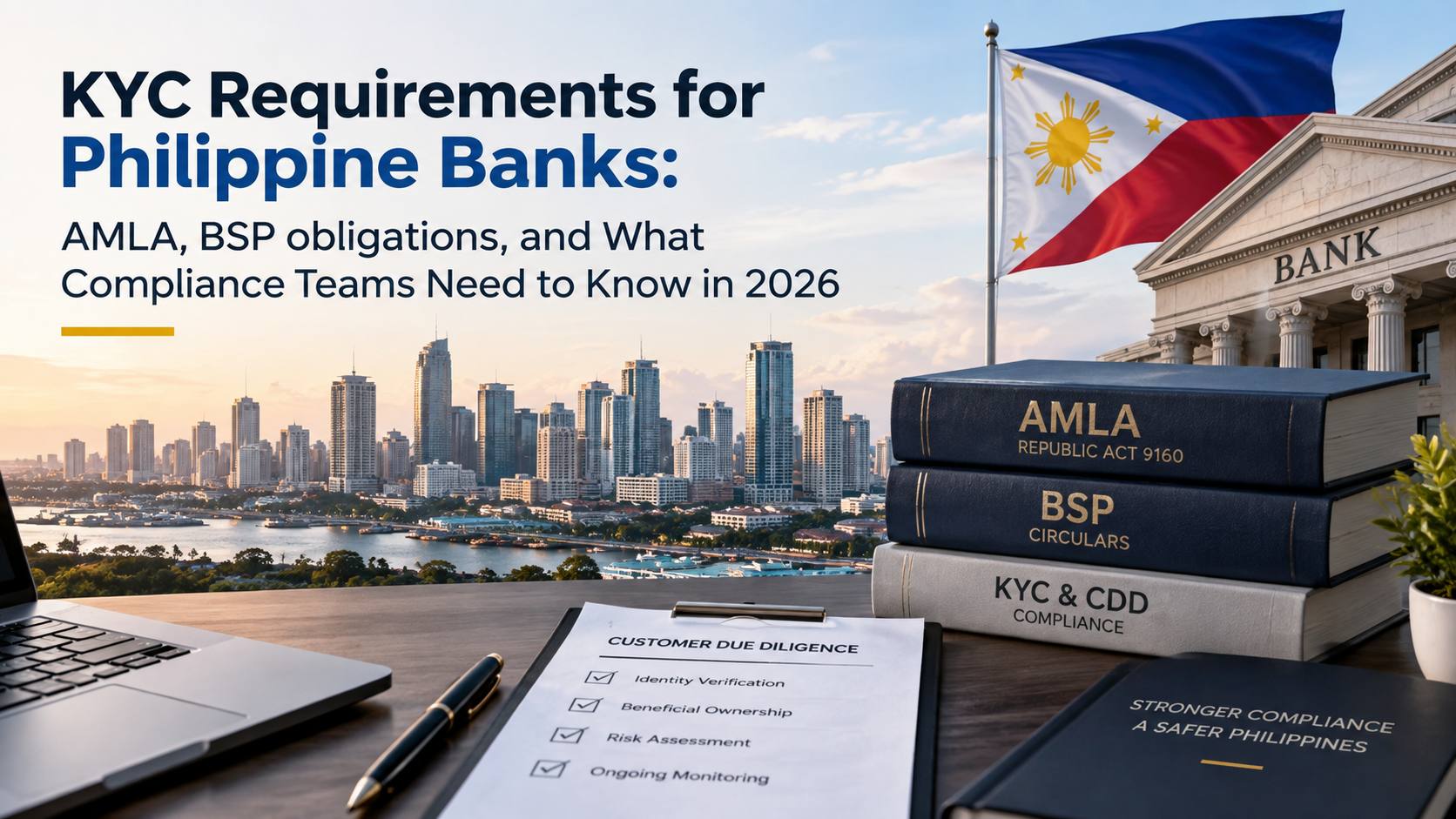
KYC Requirements for Philippine Banks: AMLA, BSP obligations, and What Compliance Teams Need to Know in 2026
The Philippines was removed from the FATF list of jurisdictions under increased monitoring in February 2025. This guide explains current AMLA and BSP KYC/CDD requirements for banks, including beneficial ownership, digital onboarding, reporting and record retention.