

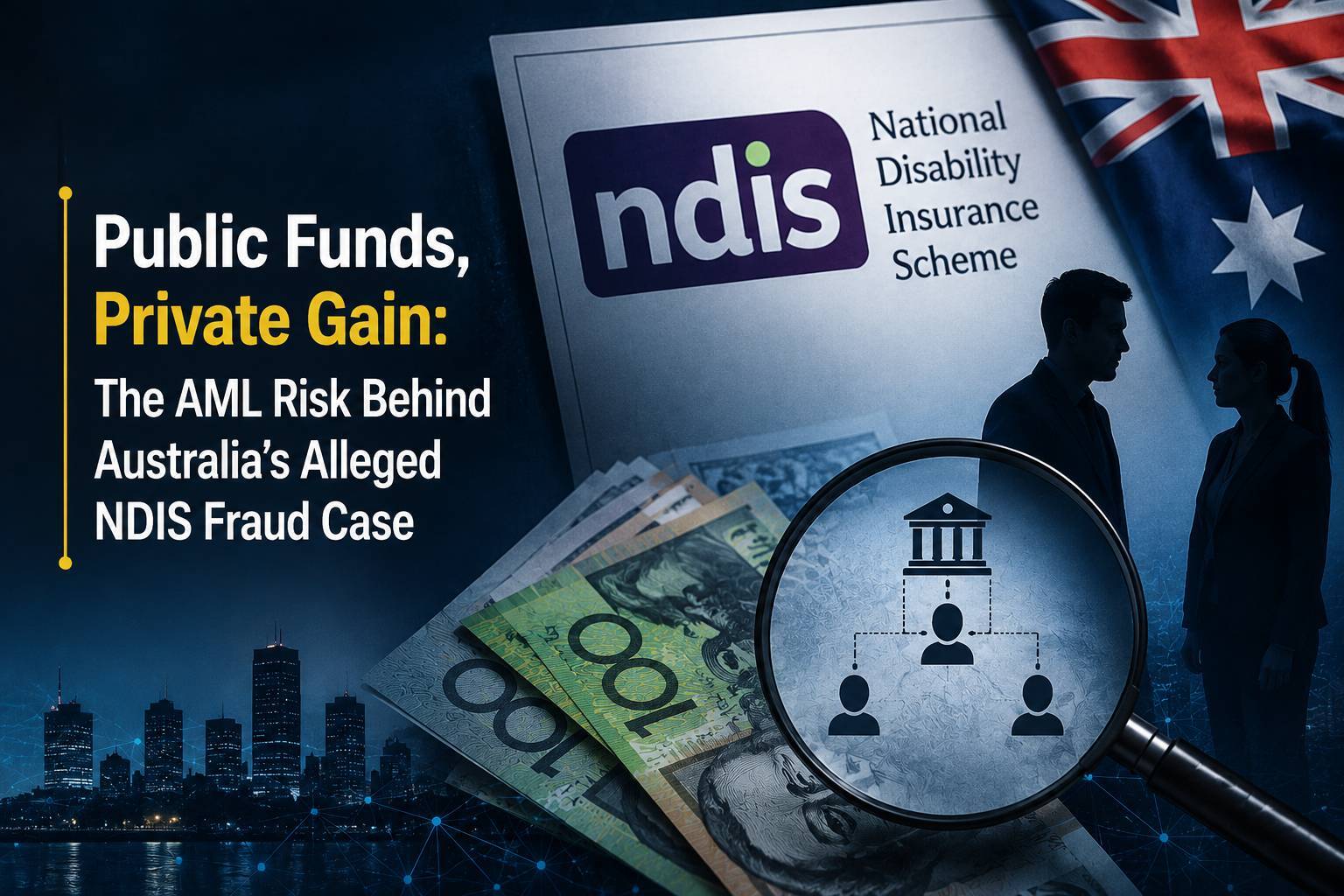
Public Funds, Private Gain: The AML Risk Behind Australia’s Alleged NDIS Fraud Case
.svg)
Public funds can look legitimate when they enter a business account.
But when those funds are allegedly obtained through conflicted referrals, misuse of public-sector access, or provider-linked fraud, the AML risk begins after the money is paid out.
That is the key lesson from Australia’s alleged NDIS fraud and corruption case, where a former Northern Territory public servant was arrested on 28 July 2026 over allegations that she used her government position to refer vulnerable people to an NDIS business she co-owned. Authorities allege the business claimed more than AUD 28 million in NDIA funding since 2019, with about AUD 18 million identified as allegedly suspicious.
At first glance, this may look like a public-sector fraud case. But for banks, payment firms, lenders and compliance teams, the deeper question is what happened after those funds entered the financial system. Were they retained as business revenue, moved to owners or related parties, used for assets or personal expenditure, or layered through connected entities?
That is where public-fund fraud becomes a financial crime monitoring challenge.

What Happened in the Alleged NDIS Fraud Case?
According to the NDIS, investigators from the Australian Government Fraud Fusion Taskforce, assisted by Northern Territory Police, arrested a 39-year-old Lee Point woman on 28 July 2026. She was the second person charged in the investigation and was charged with five offences.
The investigation began in October 2025. Earlier, in February 2026, investigators executed search warrants at a Lee Point home, a Durack business and a Yarrawonga business, seizing documents and electronic devices for forensic examination. A 47-year-old man was charged on 18 February with corruption and abuse of public office offences.
Authorities allege the woman conspired with the man and used her position as a public servant to refer vulnerable people to an NDIS business they co-owned. The ABC also reported that the Darwin woman was charged over allegedly using her public-sector position to defraud millions of dollars from the NDIS.
For financial institutions, the issue is not only the alleged abuse of public office. It is the financial pathway that follows: government funds entering a provider business, possible related-party benefit, movement of proceeds, and the risk that suspicious funds may be disguised through ordinary-looking business activity.
Why This Matters for Australian Financial Institutions
Public-sector fraud creates a particular AML challenge because incoming funds may appear legitimate at first glance. Payments from government agencies, public schemes or approved programmes may not immediately look suspicious because they come from recognised sources.
But legitimacy of source does not always mean legitimacy of entitlement.
In this case, the concern is not that NDIS funding itself is suspicious. The concern is that a provider-linked business allegedly received funds through improper referrals, misuse of protected information, corruption or deception. The NDIS statement says the woman was charged with offences including corruption to influence the performance of her functions, obtaining a benefit by deception, and dishonestly obtaining and using protected agency information to gain a financial benefit.
For banks and compliance teams, this creates a practical monitoring problem. A business account receiving regular government-linked payments may look like a normal provider account. The risk may only become visible when those inflows are compared with the ownership structure, referral patterns, director relationships, transaction behaviour, related-party payments and expenditure.
The AML question is not simply whether the business received funding. It is whether the movement of funds after receipt aligns with a genuine service-provider profile.
How Provider-Linked Fraud Can Become an AML Risk
Provider-linked fraud can create AML risk when funds obtained through suspected deception, conflicts of interest or corruption are moved through the financial system as if they were legitimate business revenue.
A typical risk pathway may begin with a provider business receiving payments from a public scheme. If claims are allegedly inflated, improper or connected to conflicted referrals, the funds may still enter the provider’s bank account in a way that appears routine. From there, proceeds may be used for salaries, director payments, related-party transfers, property purchases, loan repayments, luxury spending, investments or transfers to connected entities.
This is where laundering risk can emerge. The business layer may create a commercial explanation for funds, while the transaction trail may obscure who ultimately benefits.
For financial institutions, the challenge is to test whether the customer’s declared business activity matches the money movement. Payments should be assessed against the size and nature of the provider, the pattern of transfers to directors or related parties, the level of normal operating expenses, the presence of unusual transfers to personal accounts, and any links to public officials, conflicts of interest or adverse media.
These questions matter because public funds can look clean when viewed only as deposits. The risk becomes clearer when institutions examine the full journey of the money.
Corruption, Conflict-of-Interest and Funding-Flow Risk
The alleged NDIS case sits at the intersection of fraud, corruption, vulnerable-person exploitation and AML.
Authorities allege the woman used her government position to refer vulnerable members of the community to a business she co-owned. The Department of Children and Families said the former staff member had resigned and that it had strengthened systems and practices for managing conflicts of interest and overseeing supports for children in care with disability.
This is important for compliance teams because conflicts of interest can create financial crime risk before any suspicious transaction appears. If a public official, employee or insider can influence referrals, approvals, claims or access to protected information, financial institutions may later see only the payment outcome, not the misconduct that allegedly enabled it.
That makes network context critical. A provider may appear legitimate, but its risk profile changes if it is connected to a public official with referral influence, receives unusually high government-linked inflows, or moves funds to owners and related entities in ways that do not match expected business activity.
In corruption-linked cases, the AML risk often sits in the relationship between the payer, the provider, the insider, the beneficiary and the ultimate use of funds.
Red Flags Banks and Compliance Teams Should Monitor
Alleged public-sector fraud and provider-linked claims can generate warning signs across onboarding, transaction monitoring, customer reviews and investigations.
Key red flags may include:
- Provider businesses receiving unusually large or rapidly increasing government-linked payments compared with their size, staffing or operating history
- Public-sector-linked customers, directors or beneficial owners connected to businesses receiving funds from schemes they may influence
- Large transfers from provider accounts to owners, directors, employees or related parties without clear commercial rationale
- Repeated movement of funds from business accounts into personal accounts soon after government-linked payments are received
- Provider accounts showing limited normal operating expenses despite large funding inflows
- Multiple related entities receiving similar payment flows or sharing directors, addresses, devices, accounts or counterparties
- Payments to consultants, subcontractors or connected entities that are not supported by clear service evidence
- Sudden changes in turnover, account activity or business profile after becoming connected to public funding streams
- Adverse media, law-enforcement exposure or regulatory action involving the provider, directors, employees or connected public officials
- Customer explanations that do not adequately support the purpose, end beneficiary or commercial basis of funds
Individually, some of these signals may not prove wrongdoing. Together, they may indicate that public funds are being misused, diverted or laundered through provider-linked structures.
The strongest signal is rarely one transaction. It is the pattern across funding source, ownership, relationships, account behaviour and onward movement.
Why Traditional Monitoring May Miss the Risk
Traditional transaction monitoring may struggle with provider-linked fraud because the incoming payments may appear legitimate. They may come from government or scheme-related sources, be received by a registered business, and appear to match the customer’s stated industry.
If monitoring rules focus mainly on transaction value, simple thresholds or high-risk jurisdictions, they may miss the deeper inconsistency between the provider’s profile and the flow of funds. A business may receive large payments, but those payments may not trigger concern if the account is already classified as a service-provider account.
The risk becomes clearer when institutions connect multiple signals. These include beneficial ownership, director relationships, public-sector exposure, transaction timing, related-party payments, business footprint, adverse media, customer risk scoring and changes in account behaviour.
For example, a provider receiving government-linked payments may not appear suspicious on its own. But if the business is co-owned by a person with public-sector referral influence, receives unusually large funding inflows, and rapidly transfers funds to personal or connected accounts, the risk profile changes.
This is why AML monitoring must go beyond isolated transactions. It needs to understand customers, relationships, conflicts, funding flows and networks.
Why AML, Fraud and KYC Teams Need a Shared View
Provider-linked fraud sits across several control areas. KYC teams may hold ownership and director information. Fraud teams may see unusual claims, complaints or suspected misuse. AML teams may see suspicious fund movement. Relationship teams may hold customer explanations. Screening teams may identify adverse media or public-sector exposure. Investigators may find connections between directors, companies, accounts and beneficiaries.
If these signals remain separate, the institution may only see fragments of the risk. A business may look legitimate at onboarding, incoming payments may look consistent with its industry, and transfers may look like normal business expenses. But when ownership, public-sector links, funding patterns and onward movement are connected, the same activity may indicate a much higher-risk picture.
A shared view helps institutions identify whether a provider account is operating in line with its declared purpose or whether it may be acting as a vehicle for improper claims, related-party enrichment or laundering of fraud proceeds.
For public-sector fraud risks, this connected view is especially important because the alleged misconduct may occur outside the bank, while the laundering indicators appear inside account behaviour.
What This Means for Compliance Teams
For compliance teams in Australia, this case highlights three practical priorities.
First, institutions should strengthen monitoring of provider businesses that receive public funds. This does not mean treating such customers as inherently suspicious, but it does mean understanding whether funding volumes, account behaviour and onward movement align with the customer’s profile.
Second, institutions should pay close attention to public-sector exposure and conflicts of interest. Where directors, beneficial owners or related parties have roles that may influence referrals, approvals, claims or procurement, enhanced due diligence may be required.
Third, institutions should use network-level analysis to detect related-party movement. Shared directors, addresses, accounts, devices, beneficiaries and payment routes can reveal links that are not visible from a single customer file.
The broader message is that fraud against public schemes does not end when funds are paid out. Once suspicious proceeds enter the financial system, they may create AML obligations around detection, escalation, investigation and reporting.
How Tookitaki Helps Financial Institutions Detect These Patterns
Tookitaki helps financial institutions move beyond isolated alerts to a more connected view of fraud, corruption and AML risk.
FinCense brings together customer risk, transaction monitoring, screening, alert management and case investigation so compliance teams can identify suspicious patterns across customers, companies, directors, beneficiaries, counterparties and fund flows.
In provider-linked fraud cases, the risk may appear through a combination of signals: unusual government-linked inflows, rapid related-party transfers, mismatched business profile, public-sector exposure, adverse media, shared ownership, connected entities and unusual movement into personal or asset-holding accounts.
FinCense helps institutions connect these signals, prioritise higher-risk alerts and give investigators a clearer view of the customer and network behind the activity. Through the AFC Ecosystem, Tookitaki also helps institutions stay closer to emerging typologies involving fraud proceeds, corruption-linked flows, mule accounts, shell entities, public-fund misuse and suspicious transaction patterns.
The objective is not to generate more alerts. It is to detect the right risks earlier and provide investigators with the context needed to act.
The Bigger Lesson: Public Funds Still Need a Money Trail
The alleged NDIS fraud case shows how financial crime risk can begin with access, influence and trust.
A government-linked payment may appear legitimate because it comes from an official scheme. A provider business may appear low risk because it operates in a regulated sector. But if claims are allegedly linked to conflicted referrals, misuse of protected information or improper benefit, the financial institution still needs to understand where the money moved next.
For compliance teams, the lesson is clear: public-sector fraud and corruption risks cannot be assessed only at the point of payment. They must be understood through the full financial journey — who controls the business, why the funds were received, how they were used, and who ultimately benefited.
The payment may come from a legitimate public scheme.
But the money trail still needs to make sense.
Experience the most intelligent AML and fraud prevention platform
Experience the most intelligent AML and fraud prevention platform
Experience the most intelligent AML and fraud prevention platform
Top AML Scenarios in ASEAN
The Role of AML Software in Compliance
The Role of AML Software in Compliance
Talk to an Expert
Our Thought Leadership Guides
KYC Requirements for Philippine Banks: AMLA, BSP obligations, and What Compliance Teams Need to Know in 2026
The Philippines was removed from the FATF list of jurisdictions under increased monitoring in February 2025. This guide explains current AMLA and BSP KYC/CDD requirements for banks, including beneficial ownership, digital onboarding, reporting and record retention.
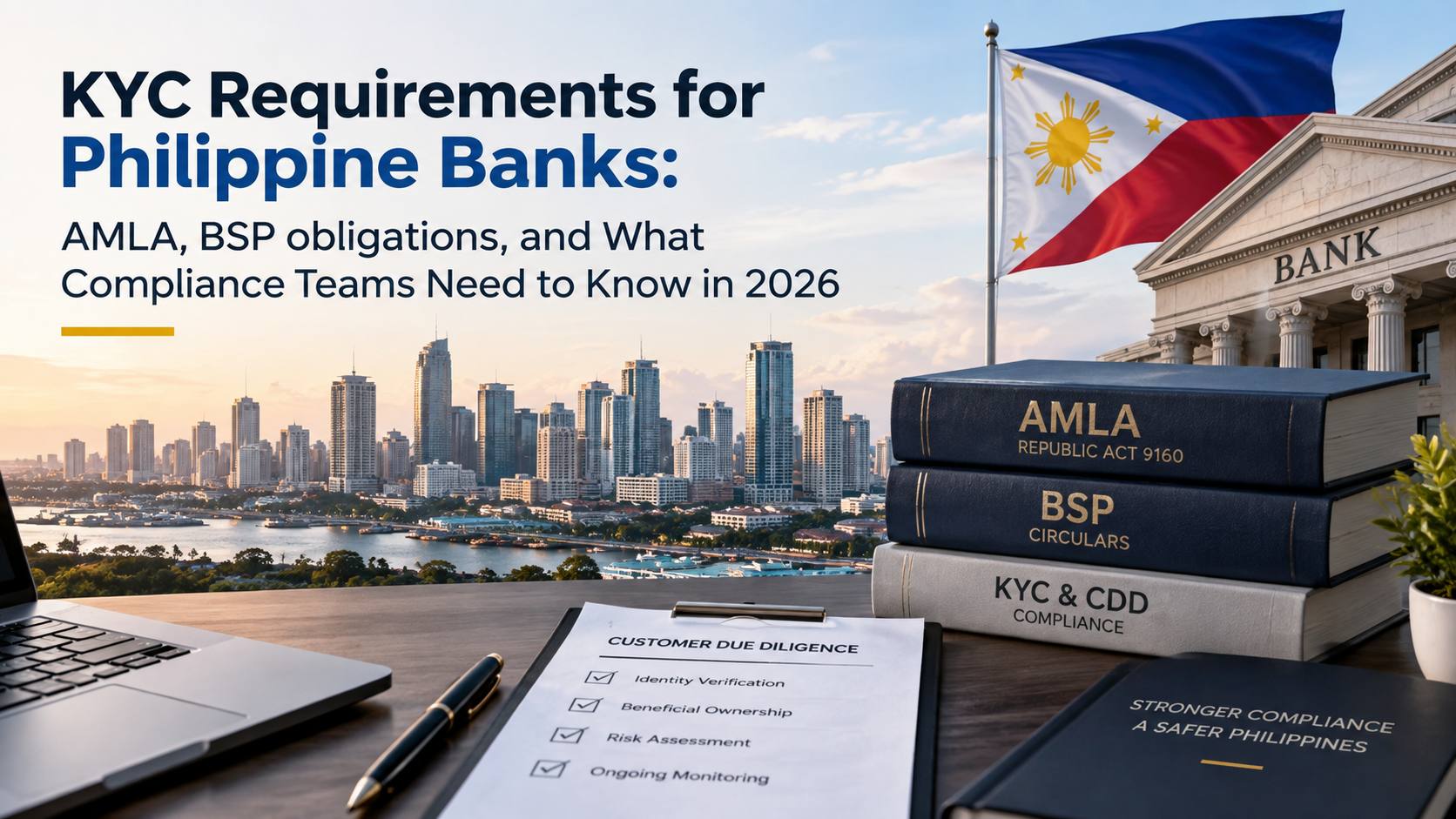
KYC Requirements for Philippine Banks: AMLA, BSP obligations, and What Compliance Teams Need to Know in 2026
The Philippines was removed from the FATF list of jurisdictions under increased monitoring in February 2025. This guide explains current AMLA and BSP KYC/CDD requirements for banks, including beneficial ownership, digital onboarding, reporting and record retention.