

Anti-Money Laundering Software: A Buyer's Guide for Banks and Fintechs
.svg)
The compliance officer who signed off on a new AML system last year probably had a good reason. The demo was clean, the vendor had a reference at a comparable institution, the sales engineer answered every question. Six months later, the operations team is working through 800 alerts per day, dismissing the majority as false positives, and there is an AUSTRAC or MAS examination scheduled for Q3.
What went wrong is rarely the fault of any single vendor. The more common problem is that the procurement team treated anti-money laundering software as a single purchase. In practice, AML compliance technology covers four distinct functions, each with its own evaluation criteria, failure modes, and regulatory expectations. Buying a strong transaction monitoring system while ignoring case management creates a bottleneck downstream. Deploying sophisticated screening while underinvesting in customer risk scoring creates blind spots in the customer portfolio.
This guide covers what each function does, how to evaluate it, and the questions to ask any vendor before signing.

What anti-money laundering software actually covers
AML software is a category, not a product. The four functions within it are:
Transaction monitoring. Analyses transaction patterns against calibrated rules and models to generate alerts when activity exceeds defined risk thresholds. This is where most AML software evaluations begin and end, but transaction monitoring alone is not a complete AML programme.
Sanctions and PEP screening. Checks customers, counterparties, and transactions against government-issued sanctions lists and politically exposed person databases. Screening must happen at onboarding, at payment initiation, and on a periodic basis as lists are updated.
Case management. The investigation layer where analysts review alerts, document their reasoning, and file suspicious matter reports. In most institutions, case management is the bottleneck: detection generates alerts faster than the team can investigate them.
Customer risk scoring. Assigns a dynamic risk rating to each customer based on profile characteristics, transaction behaviour, and CDD information. This determines which customers receive enhanced due diligence, how frequently they are reviewed, and which alerts receive priority investigation.
An institution running all four functions in separate, disconnected systems will encounter specific problems. A high-risk customer flag in the risk scoring system may not automatically elevate the priority of that customer's transaction monitoring alerts. Screening hits may sit in a separate queue from case management records, requiring investigators to reconcile two systems for a single case.
The question a procurement team should answer before evaluating vendors is: are we buying a platform that manages all four functions in an integrated environment, or are we buying point solutions for each? Neither is automatically the right answer. But treating the decision as a single-product purchase when it is actually four will produce gaps regardless of which vendor is chosen.
Transaction monitoring: what to evaluate
Transaction monitoring generates most of the alert volume in an AML programme, and alert volume is the clearest proxy for operational cost. A system generating 1,000 alerts per week with a 5 per cent true positive rate produces 950 false positives for analysts to dismiss. A system generating 400 alerts per week with a 15 per cent true positive rate produces 60 true positives and 340 false positives. The second system is better, but fewer institutions measure it this way.
The five things to evaluate in a transaction monitoring system:
- Detection architecture. Rule-based systems apply fixed thresholds. Machine learning systems identify pattern deviations. Most modern systems combine both. The question is how the ML component learns: does it retrain on the institution's own data, or does it benefit from patterns identified across a broader network of institutions? Systems that train only on a single institution's data have a ceiling on detection coverage.
- False positive rate. Ask vendors for documented false positive rates from production deployments at comparable institutions, not sandbox demonstrations. A 70 per cent false positive reduction is achievable with well-calibrated ML-based monitoring, but the baseline it is measured against matters.
- Typology coverage. How many financial crime typologies does the system support, and how are new typologies validated before they are available in production? A library derived from a single institution's data will not cover patterns that institution has not encountered. Federated networks, where typologies are validated across multiple institutions, provide broader coverage.
- Model governance. Regulators across APAC increasingly examine how AML models are governed. Can the institution demonstrate what model version was active at any point in the past? Is there a documented process for testing a new model against the current production model before it goes live? Champion-challenger testing, where a challenger model runs in shadow mode against the production champion before any promotion, is the standard that AUSTRAC, MAS, and BNM expect to see documented.
- Explainability. An alert that shows a risk score but no explanation leaves investigators guessing and documentation thin. Explainability at three levels — what the model learned overall, what drove this specific alert, and how the alert evidence maps to a financial crime typology in plain language — is what allows investigators to document decisions accurately and allows compliance leadership to defend model choices to regulators.
For a detailed evaluation framework specifically for transaction monitoring software, see our transaction monitoring software buyer's guide.
Sanctions and PEP screening: what to evaluate
Keyword-only screening is the most common failure point in APAC screening programmes. A customer named Ahmad Al-Rashid will not match a sanctions list entry for Ahmed El Rashid under keyword matching. The same individual, different romanisation. In a customer base where Arabic, Mandarin, and Malay names are common, the number of genuine designations that keyword matching misses is not trivial.
The minimum standard for screening in 2026 is AI-enhanced fuzzy matching on the first pass, followed by multi-attribute entity resolution on the second. First-pass fuzzy matching handles name variants, transliterations, aliases, and incomplete data. Second-pass multi-attribute analysis evaluates name, date of birth, nationality, address, and aliases together, producing a holistic similarity score rather than a name-only match confidence. This two-pass architecture delivers 60 to 70 per cent fewer false positives than keyword-only screening without reducing coverage of genuine matches.
Beyond the matching architecture, evaluate:
- Language and script coverage. For APAC institutions, the screening engine must handle Arabic, Mandarin, Malay, Thai, Vietnamese, Tagalog, and their romanised variants. Matching logic trained specifically for APAC transliteration patterns outperforms generic string-distance algorithms on these names.
- List coverage and update frequency. MAS TFS, BNM TFS, AMLC, OFAC, UN Security Council, EU consolidated lists. Ask how quickly list updates are incorporated into the screening environment — for real-time payment screening, the delay between a designation and a list update entering the screening engine matters.
- Real-time vs batch screening. MAS, BNM, and AUSTRAC require real-time screening at the point of payment initiation for licensed payment providers. A screening API operating above 350 milliseconds at the 99th percentile will create latency problems in high-volume payment environments.
Case management: what to evaluate
Alert investigation is the bottleneck in most AML operations. The institutions that manage alert backlogs well share a common feature: their case management system reduces the proportion of investigator time spent on information assembly and increases the proportion spent on actual assessment.
A compliance team investigating 200 alerts per day may spend 60 per cent of their per-alert time retrieving customer history, transaction data, and related alerts from separate systems. Consolidating that information into a single investigation record, assembled automatically at case creation, is where the operational gains are largest. This is not a nice-to-have feature — it is the mechanism through which AI-powered case management delivers a 70 per cent reduction in alert handling time and brings average triage time for priority cases to under four hours.
Evaluate case management on:
- Consolidated investigation view at case creation (not built progressively as the analyst works)
- Alert prioritisation before cases reach the queue (high-risk cases first, not oldest-first)
- Explainable triage at the point of review, with evidence frozen immutably at alert creation
- STR/SAR narrative drafting that uses alert evidence and documented analyst reasoning
- Auto-closure configuration for low-risk alerts with documented criteria and audit trail
- Immutable record-keeping that allows any alert's full evidence history to be reconstructed for regulatory examination
Customer risk scoring: what to evaluate
Customer risk scoring determines CDD depth and review frequency. Institutions that set risk ratings at onboarding and rarely update them carry a specific regulatory risk: a customer whose risk profile has changed significantly since onboarding may be receiving a level of monitoring that no longer reflects their actual behaviour.
Dynamic risk scoring, where ratings update in response to transaction behaviour and profile changes, is now expected rather than exceptional by AUSTRAC and MAS. Evaluate whether the system scores customers in near-real-time based on transaction activity, or whether scores are recalculated only on a scheduled batch cycle.
The other dimension to evaluate is EDD triggering. When a customer's risk score crosses a threshold, does the system automatically route them to the appropriate enhanced due diligence workflow? The gap between a risk score change and an EDD review being opened is one of the more common examination findings across APAC.
Five questions to ask any AML software vendor
1. Can you provide documented false positive rates from a production deployment at a comparable institution, not a sandbox demonstration?
Sandbox environments do not reflect production data complexity. Any vendor unwilling to share production performance data from a comparable use case has something to hide, or has not deployed at comparable scale.
2. How are typologies validated before they are available in production?
A typology library derived only from the vendor's own research has not been stress-tested against real financial crime patterns across multiple institutions. Ask whether validation involves data from actual production environments at other institutions, and how many.
3. What does your model governance process look like, and can you demonstrate it to our model risk team?
AUSTRAC's expectation is that institutions can explain how model changes are tested, approved, and documented. An AML software vendor whose model governance is opaque or undocumented will become a regulatory problem for their customers.
4. How does your system handle the full investigation lifecycle, from alert generation to STR filing?
If the answer requires naming multiple systems that do not share data natively, the institution will be managing an integration problem on top of a compliance programme.
5. How long does it take to onboard a new typology into the detection environment?
Financial crime patterns evolve. A system that requires a lengthy vendor-driven implementation cycle to add a new scenario is slower to adapt to emerging typologies than one that allows institutions to configure and deploy scenarios directly.
What a modern AML platform looks like
The institutions that score well in regulatory examinations across APAC are not necessarily running the most complex AML technology. They are running technology where the four functions above are integrated, the evidence trail for every alert is complete, and the investigator can explain any decision on record.
FinCense addresses the full stack in an integrated environment. Transaction monitoring draws on the AFC Ecosystem, a shared typology library built from the detection patterns of more than 30 financial institutions covering hundreds of typology variants. Screening runs a two-pass architecture covering 24 languages and 14 scripts. Case management consolidates the investigation record at case creation and carries the alert evidence forward into the STR drafting workflow. Customer risk scoring updates dynamically based on transaction behaviour and feeds prioritisation signals into the case management queue.
For a comparison of the leading platforms in this category, see our best AML platforms guide. For an evaluation focused specifically on how machine learning operates in the detection layer, see our guide to machine learning in AML transaction monitoring.
Book a demo to see how FinCense handles the full AML compliance workflow for your institution.
Frequently asked questions
What is anti-money laundering software?
Anti-money laundering software is a category covering four functions: transaction monitoring (detecting suspicious patterns in customer activity), sanctions and PEP screening (checking customers and transactions against watchlists), case management (investigating alerts and filing suspicious matter reports), and customer risk scoring (assigning and dynamically updating customer risk ratings to determine CDD depth and review frequency). Most AML software evaluations focus on transaction monitoring and miss the other three.
What is the difference between AML software and transaction monitoring software?
Transaction monitoring is one function within AML software. It analyses transaction patterns to generate alerts when activity suggests potential financial crime. AML software as a category also includes sanctions screening, case management, and customer risk scoring. An institution running transaction monitoring only is missing the investigation, screening, and risk profiling components that regulators expect to see as part of a complete AML programme.
How do I evaluate anti-money laundering software for APAC-regulated institutions?
Evaluation for APAC should cover: documented false positive rates from production deployments (not sandbox demos), typology coverage that reflects APAC-specific financial crime patterns, language and script support for Arabic, Mandarin, Malay, Thai, and other APAC-relevant names in screening, model governance documentation that satisfies AUSTRAC and MAS model risk requirements, and case management that produces a complete, immutable audit trail. For detailed criteria for the transaction monitoring component specifically, see our TM software buyer's guide.
What false positive rates should I expect from AML screening software?
Two-pass AI screening, combining AI-enhanced fuzzy matching on the first pass with multi-attribute entity resolution on the second, delivers 60 to 70 per cent fewer false positives than keyword-only screening. This is a production figure from FinCense deployments, not a claim from a controlled environment. The baseline being replaced — keyword-only screening — has high false positive rates in APAC customer bases because of the name variation that results from transliterating Arabic, Mandarin, and Malay names into Latin-character watchlists.
Do I need a separate case management system or is it included in AML software?
It depends on the platform. Some AML software vendors sell transaction monitoring and screening as separate products that require integration with third-party case management tools. Integrated platforms include case management natively, with alert evidence, customer history, and investigation records in a single environment. The operational argument for integration is that investigators spend significantly less time assembling case records when all information is consolidated at case creation, rather than retrieved from multiple systems during investigation.
Experience the most intelligent AML and fraud prevention platform
Experience the most intelligent AML and fraud prevention platform
Experience the most intelligent AML and fraud prevention platform
Top AML Scenarios in ASEAN
The Role of AML Software in Compliance
The Role of AML Software in Compliance
Talk to an Expert
Our Thought Leadership Guides

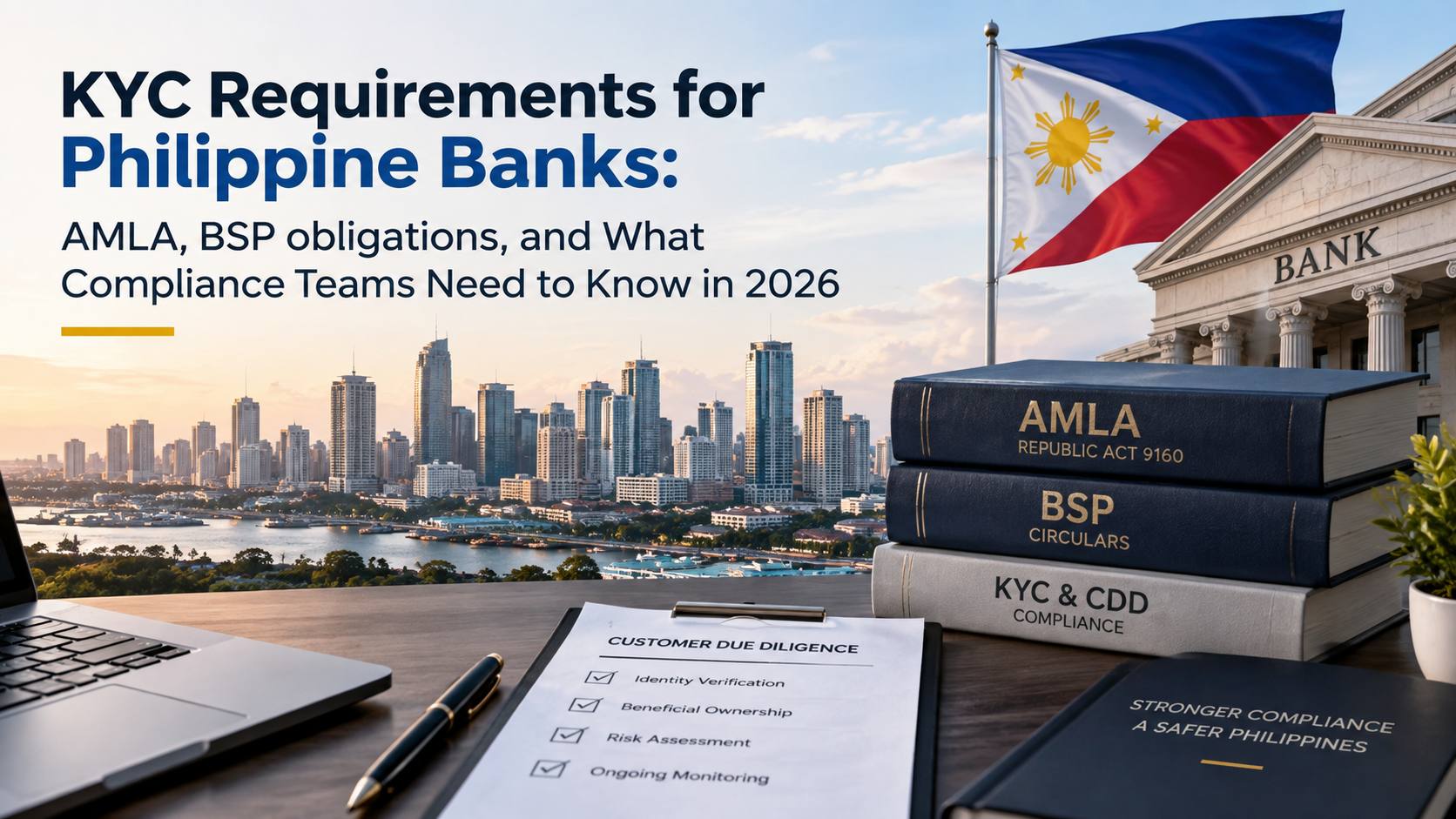
KYC Requirements for Philippine Banks: AMLA, BSP obligations, and What Compliance Teams Need to Know in 2026
The Philippines was removed from the FATF list of jurisdictions under increased monitoring in February 2025. This guide explains current AMLA and BSP KYC/CDD requirements for banks, including beneficial ownership, digital onboarding, reporting and record retention.
KYC Requirements for Philippine Banks: AMLA, BSP obligations, and What Compliance Teams Need to Know in 2026
The Philippines was removed from the FATF list of jurisdictions under increased monitoring in February 2025. This guide explains current AMLA and BSP KYC/CDD requirements for banks, including beneficial ownership, digital onboarding, reporting and record retention.