

Inside Operation Taipan: Australia’s AML Wake-Up Call
.svg)
Money laundering does not always hide in the shadows.
Sometimes, it operates openly — at scale — until someone starts asking why the numbers no longer make sense.
That was the defining lesson of Operation Taipan, one of Australia’s most significant anti-money laundering investigations, led by AUSTRAC in collaboration with major banks and law enforcement. What began as a single anomaly during COVID-19 lockdowns evolved into a case that fundamentally reshaped how Australia detects and disrupts organised financial crime.
Although Operation Taipan began several years ago, its relevance has only grown stronger in 2026. As Australia’s financial system becomes faster, more automated, and increasingly digitised, the conditions that enabled Taipan’s laundering model are no longer exceptional — they are becoming structural. The case remains one of the clearest demonstrations of how modern money laundering exploits scale, coordination, and speed rather than secrecy, making its lessons especially urgent today.

The Anomaly That Started It All
In 2021, AUSTRAC analysts noticed something unusual: persistent, late-night cash deposits into intelligent deposit machines (IDMs) across Melbourne.
On their own, cash deposits are routine.
But viewed collectively, the pattern stood out.
One individual was repeatedly feeding tens of thousands of dollars into IDMs across different locations, night after night. As analysts widened their lens, the scale became impossible to ignore. Over roughly 12 months, the network behind these deposits was responsible for around A$62 million in cash, accounting for nearly 16% of all cash deposits in Victoria during that period.
This was not opportunistic laundering.
It was industrial-scale financial crime.
How the Laundering Network Operated
Cash as the Entry Point
The syndicate relied heavily on cash placement through IDMs. By spreading deposits across locations, times, and accounts, they avoided traditional threshold-based alerts while maintaining relentless volume.
Velocity Over Stealth
Funds did not linger. Deposits were followed by rapid onward movement through multiple accounts, often layered further through transfers and conversions. Residual balances remained low, limiting exposure at any single point.
Coordination at Scale
This was not a lone money mule. AUSTRAC’s analysis revealed a highly coordinated network, with defined roles, consistent behaviours, and disciplined execution. The laundering succeeded not because transactions were hidden, but because collective behaviour blended into everyday activity.
Why Traditional Controls Failed
Operation Taipan exposed a critical weakness in conventional AML approaches:
Alert volume does not equal risk coverage.
No single transaction crossed an obvious red line. Thresholds were avoided. Rules were diluted. Investigation timelines lagged behind the speed at which funds moved through the system.
What ultimately surfaced the risk was not transaction size, but behavioural consistency and coordination over time.
The Role of the Fintel Alliance
Operation Taipan did not succeed through regulatory action alone. Its breakthrough came through deep public-private collaboration under the Fintel Alliance, bringing together AUSTRAC, Australia’s largest banks, and law enforcement.
By sharing intelligence and correlating data across institutions, investigators were able to:
- Link seemingly unrelated cash deposits
- Map network-level behaviour
- Identify individuals coordinating deposits statewide
This collaborative, intelligence-led model proved decisive — and remains a cornerstone of Australia’s AML posture today.

The Outcome
Three key members of the syndicate were arrested, pleaded guilty, and were sentenced. Tens of millions of dollars in illicit funds were directly linked to their activities.
But the more enduring impact was systemic.
According to AUSTRAC, Operation Taipan changed Australia’s fight against money laundering, shifting the focus from reactive alerts to proactive, intelligence-led detection.
What Operation Taipan Means for AML Programmes in 2026 and Beyond
By 2026, the conditions that enabled Operation Taipan are no longer rare.
1. Cash Still Matters
Despite the growth of digital payments, cash remains a powerful laundering vector when paired with automation and scale. Intelligent machines reduce friction for customers and criminals.
2. Behaviour Beats Thresholds
High-velocity, coordinated behaviour can be riskier than large transactions. AML systems must detect patterns across time, accounts, and locations, not just point-in-time anomalies.
3. Network Intelligence Is Essential
Institution-level monitoring alone cannot expose syndicates deliberately fragmenting activity. Federated intelligence and cross-institution collaboration are now essential.
4. Speed Is the New Battleground
Modern laundering optimises for lifecycle completion. Detection that occurs after funds have exited the system is already too late.
In today’s environment, the Taipan model is not an outlier — it is a preview.
Conclusion: When Patterns Speak Louder Than Transactions
Operation Taipan succeeded because someone asked the right question:
Why does this much money behave this consistently?
In an era of instant payments, automated cash handling, and fragmented financial ecosystems, that question may be the most important control an AML programme can have.
Operation Taipan is being discussed in 2026 not because it is new — but because the system is finally beginning to resemble the one it exposed.
Australia learned early.
Others would do well to take note.
Experience the most intelligent AML and fraud prevention platform
Experience the most intelligent AML and fraud prevention platform
Experience the most intelligent AML and fraud prevention platform
Top AML Scenarios in ASEAN
The Role of AML Software in Compliance
Talk to an Expert
Our Thought Leadership Guides

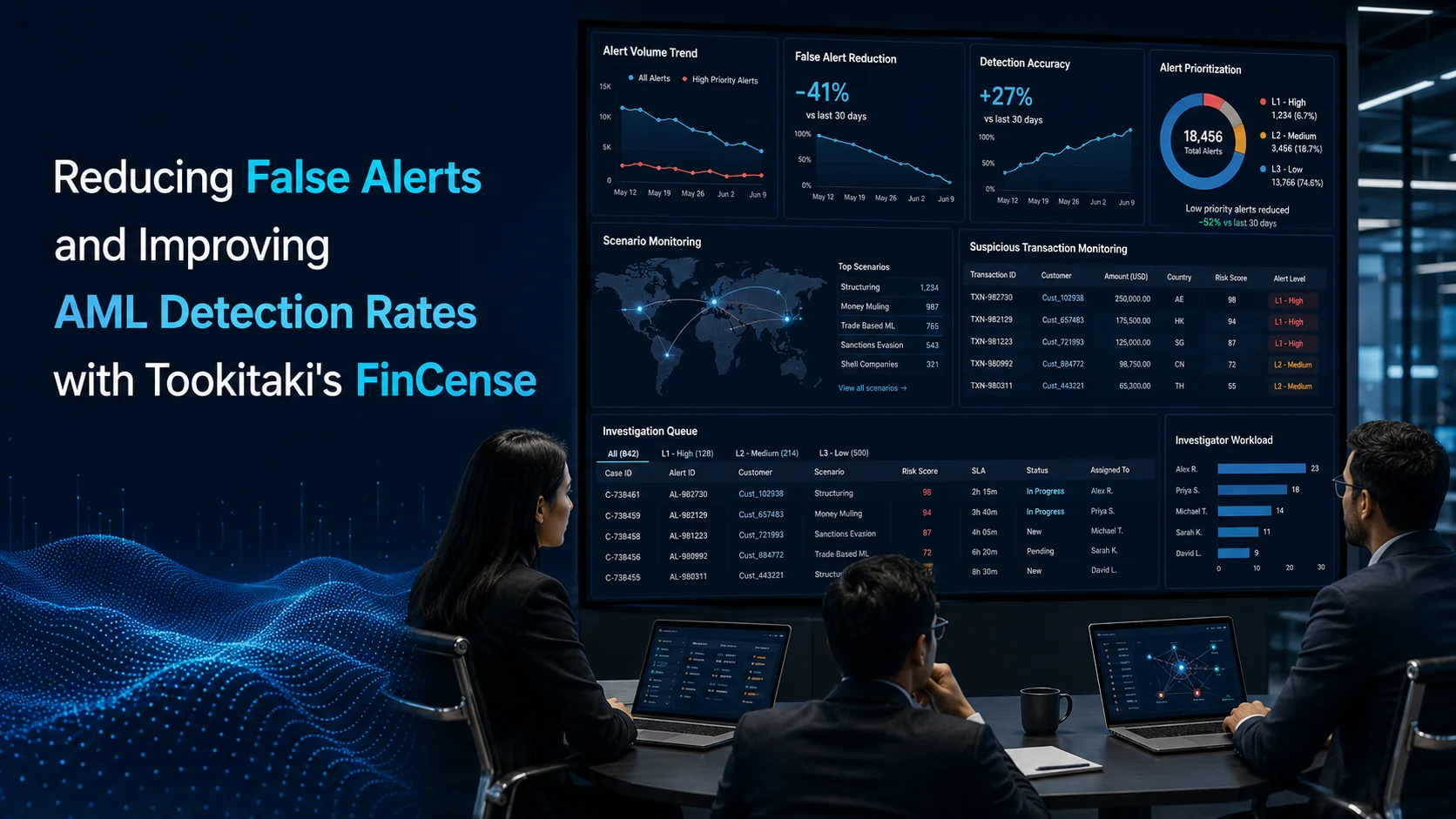
Reducing False Alerts and Improving AML Detection Rates with Tookitaki's FinCense
False positives overwhelm AML compliance teams while genuine financial crime goes undetected. Tookitaki addresses this two ways: an Alert Prioritization AI Agent that works on top of any legacy system, and FinCense Transaction Monitoring with scenario-based detection and automated threshold tuning.
AML Compliance for Digital Banks in Malaysia: Meeting BNM's Requirements with FinCense
Malaysia's digital banks face BNM's 2023 AML/CFT Policy Document, FATF's updated recommendations, and mounting pressure on eKYC and transaction monitoring standards. Here is how FinCense addresses these requirements.


Living Under the STR Clock: The Growing Pressure on AML Investigators
AML investigators face increasing pressure to make Suspicious Transaction Report decisions under tight timelines and growing alert volumes. Explore the challenges behind STR reporting and the shift toward intelligence-led investigations.

