

Living Under the STR Clock: The Growing Pressure on AML Investigators
.svg)
In AML compliance, one decision carries more weight than most: whether to file a Suspicious Transaction Report.
It is rarely obvious.
It is rarely straightforward.
And it often comes with a ticking clock.
Every day, AML investigators review alerts that may or may not indicate financial crime. Some appear suspicious but lack context. Others look normal until connected with broader patterns. The decision to escalate, investigate further, or file an STR must often be made with incomplete information and limited time.
This is the silent pressure shaping modern AML operations.

The Decision Is Harder Than It Looks
From the outside, STR reporting appears procedural. In reality, it is deeply judgment-driven.
Investigators must determine:
- whether behaviour is unusual or suspicious
- whether patterns indicate layering or legitimate activity
- whether escalation is warranted
- whether enough evidence exists to support reporting
These decisions are rarely binary. Many cases sit in a grey zone, requiring careful analysis and documentation.
Complicating matters further, the expectation is not just to detect suspicious activity, but to do so consistently and within regulatory timelines.
The STR Clock Creates Operational Tension
Regulatory frameworks require timely reporting of suspicious activity. While this is essential for financial crime prevention, it also introduces operational pressure.
Investigators must:
- review transaction behaviour
- analyse customer profiles
- identify linked accounts
- assess counterparties
- document findings
- seek internal approvals
All before reporting deadlines.
This creates a constant tension between speed and confidence. Filing too early risks incomplete reporting. Delaying too long risks regulatory breaches.
For many compliance teams, this balancing act is one of the most challenging aspects of STR reporting.
Alert Volumes Add to the Burden
Modern transaction monitoring systems generate large volumes of alerts. While necessary for detection, these alerts often include:
- low-risk activity
- borderline behaviour
- incomplete context
- fragmented signals
Investigators must review each alert carefully, even when many turn out to be non-suspicious.
Over time, this leads to:
- decision fatigue
- longer investigation cycles
- inconsistent assessments
- difficulty prioritising risk
The more alerts investigators receive, the harder it becomes to identify truly suspicious behaviour quickly.
Investigations Are Becoming More Complex
Financial crime has evolved significantly in recent years. Investigators now deal with:
- real-time payments
- mule networks
- cross-border fund movement
- shell entities
- layered transactions
- digital wallet ecosystems
Suspicious activity is no longer confined to a single transaction. It often emerges across multiple accounts, channels, and jurisdictions.
This complexity increases the difficulty of making STR decisions based on limited visibility.
The Human Element Behind STR Reporting
Behind every STR decision is a compliance professional making a judgment call.
They must balance:
- regulatory expectations
- operational workload
- investigative uncertainty
- accountability for decisions
- audit scrutiny
This human element is often overlooked, but it plays a central role in AML effectiveness.
Strong compliance outcomes depend not only on detection systems, but on how well investigators are supported in making informed decisions.
Moving Toward Intelligence-Led Investigations
As alert volumes and transaction complexity grow, many institutions are rethinking traditional investigation workflows.
Instead of relying solely on alerts, there is increasing focus on:
- contextual risk insights
- behavioural analysis
- linked entity visibility
- dynamic prioritisation
- guided investigation workflows
These capabilities help investigators understand risk more quickly and reduce the burden of manual analysis.
The shift is subtle but important: from reviewing alerts to understanding behaviour.

Supporting Investigators, Not Replacing Them
Technology in AML is evolving from detection engines to investigation support tools.
The goal is not to remove human judgment, but to strengthen it.
Modern approaches increasingly provide:
- summarised transaction behaviour
- identification of related entities
- risk-based alert prioritisation
- structured investigation workflows
- consistent documentation support
These capabilities help investigators make more confident STR decisions while maintaining regulatory rigour.
A Gradual Shift in the Industry
Some newer compliance platforms are beginning to incorporate investigation-centric capabilities designed to reduce decision pressure and improve consistency.
For example, solutions like Tookitaki’s FinCense platform focus on bringing together transaction monitoring, screening signals, behavioural insights, and investigation workflows into a unified environment. By providing contextual intelligence and prioritisation, such approaches aim to help investigators assess risk more efficiently without relying solely on manual alert reviews.
This reflects a broader shift in AML compliance: from alert-heavy processes toward intelligence-led investigations that better support the human decision-making process.
The Future of STR Reporting
STR reporting will remain a critical pillar of financial crime prevention. But the environment in which these decisions are made is changing.
Rising transaction volumes, faster payments, and increasingly sophisticated laundering techniques are placing greater pressure on investigators.
To maintain effectiveness, institutions are moving toward approaches that:
- reduce alert noise
- provide contextual intelligence
- improve prioritisation
- support consistent decision-making
- streamline documentation
These changes do not remove the responsibility of STR decisions. But they can make those decisions more informed and less burdensome.
Conclusion
Living under the STR clock is now part of everyday reality for AML investigators. The responsibility to detect suspicious activity within tight timelines, often with incomplete information, creates significant operational pressure.
As financial crime grows more complex, supporting investigators becomes just as important as improving detection.
By shifting toward intelligence-led investigations and better contextual visibility, institutions can help compliance teams make faster, more confident STR decisions — without compromising regulatory expectations.
And ultimately, that support may be the difference between uncertainty and clarity when the STR clock is ticking.
Experience the most intelligent AML and fraud prevention platform
Experience the most intelligent AML and fraud prevention platform
Experience the most intelligent AML and fraud prevention platform
Top AML Scenarios in ASEAN
The Role of AML Software in Compliance
Talk to an Expert
Our Thought Leadership Guides
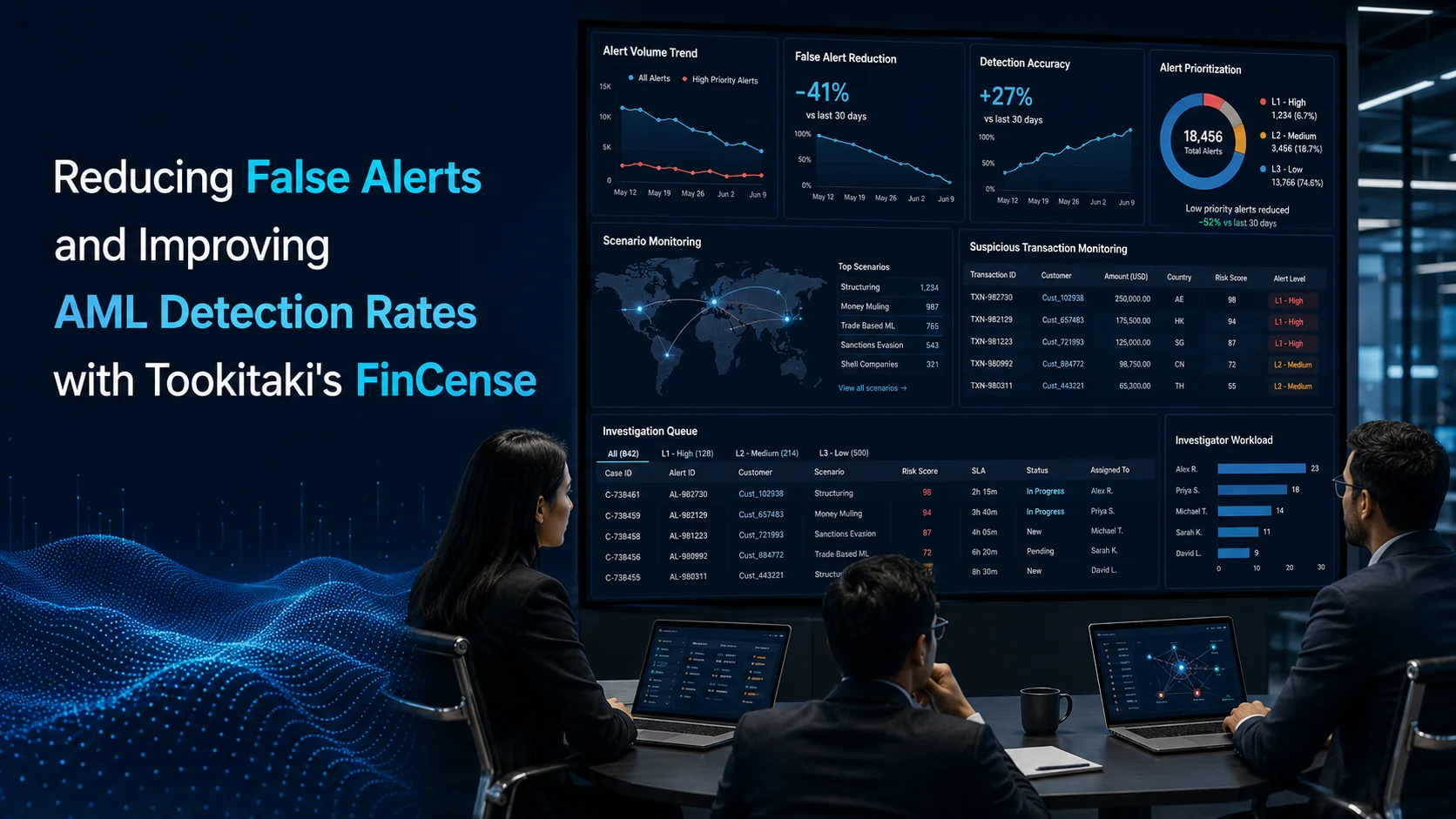
Reducing False Alerts and Improving AML Detection Rates with Tookitaki's FinCense
False positives overwhelm AML compliance teams while genuine financial crime goes undetected. Tookitaki addresses this two ways: an Alert Prioritization AI Agent that works on top of any legacy system, and FinCense Transaction Monitoring with scenario-based detection and automated threshold tuning.
AML Compliance for Digital Banks in Malaysia: Meeting BNM's Requirements with FinCense
Malaysia's digital banks face BNM's 2023 AML/CFT Policy Document, FATF's updated recommendations, and mounting pressure on eKYC and transaction monitoring standards. Here is how FinCense addresses these requirements.



The Penthouse Syndicate: Inside Australia’s $100M Mortgage Fraud Scandal
Explore the Penthouse Syndicate mortgage fraud investigation in Australia and how organised crime networks allegedly exploited home loans and property transactions to move illicit funds through the financial system.
