

The Cost of a Missed Name: Rethinking Watchlist Screening and Sanctions Compliance for Banks in the Philippines
.svg)
In sanctions compliance, one missed match is not an error. It is a headline.
Introduction
Sanctions breaches rarely begin with complex schemes. They often begin with something deceptively simple: a name that was not screened properly, a match that was dismissed too quickly, or a list that was not updated in time.
For banks in the Philippines, watchlist screening and sanctions compliance have become increasingly high-stakes responsibilities. As the country strengthens its regulatory framework and deepens cross-border financial integration, exposure to global sanctions regimes, politically exposed persons, and restricted entities continues to grow.
Digital banking expansion, real-time cross-border payments, and high customer onboarding volumes amplify this exposure. Screening must happen instantly, accurately, and consistently across millions of customers and transactions.
This is why watchlist screening and sanctions compliance for banks in the Philippines can no longer rely on basic name-matching tools. It requires intelligent, scalable, and explainable systems that protect trust without creating operational chaos.

Why Watchlist Screening Is More Complex Than It Appears
On the surface, watchlist screening seems straightforward. Compare customer names against sanctions lists and flag potential matches.
In reality, the process is far more complex.
Names vary across languages, alphabets, and transliteration formats. Spelling inconsistencies are common. Alias usage is widespread. False positives can overwhelm compliance teams. False negatives can result in regulatory penalties and reputational damage.
Sanctions lists themselves are dynamic. Global regulatory bodies update lists frequently. Politically exposed persons lists evolve. Local enforcement priorities shift.
In a high-volume banking environment like the Philippines, screening systems must handle:
- Millions of customers
- Continuous onboarding
- Real-time payment flows
- Cross-border transactions
- Ongoing customer rescreening
Accuracy, speed, and governance must coexist.
The Risk Landscape for Philippine Banks
Philippine banks operate within a rapidly evolving regional and global environment.
Cross-border remittances remain a central feature of the economy. Trade corridors link the Philippines to multiple jurisdictions. Digital wallets and fintech partnerships extend reach beyond traditional banking boundaries.
With this expansion comes sanctions and watchlist exposure.
Banks must ensure compliance with:
- Global sanctions regimes
- Domestic regulatory directives
- Politically exposed person monitoring
- Adverse media screening
- High-risk entity lists
The complexity lies not only in screening at onboarding, but in maintaining continuous compliance as customer behaviour and regulatory landscapes evolve.
The False Positive Problem
One of the most persistent challenges in watchlist screening is false positives.
Name-based matching systems often flag numerous potential matches that turn out to be benign. Common names, transliteration variations, and incomplete data contribute to excessive alerts.
High false positive rates lead to:
- Investigator fatigue
- Slower onboarding
- Customer frustration
- Operational inefficiency
- Inconsistent decision-making
In large banks, screening alerts can reach tens or hundreds of thousands per month.
Reducing false positives without compromising coverage is one of the defining requirements of modern sanctions compliance.
The Danger of False Negatives
While false positives strain operations, false negatives carry existential risk.
A missed sanctions match can result in:
- Regulatory fines
- Reputational damage
- Public scrutiny
- Correspondent banking disruption
- Loss of market confidence
In an interconnected financial system, a single breach can cascade into broader trust issues.
Effective watchlist screening software must therefore balance precision and sensitivity carefully.
What Modern Watchlist Screening Software Must Deliver
To meet today’s requirements, watchlist screening and sanctions compliance software must provide:
- Advanced name matching with fuzzy logic
- Multilingual and transliteration support
- Alias recognition
- Context-aware scoring
- Real-time screening capability
- Continuous rescreening
- Clear audit trails
- Scalable infrastructure
It must also integrate seamlessly with transaction monitoring, case management, and reporting workflows.
Screening cannot exist in isolation.
Real-Time Screening in a Real-Time Economy
Real-time payments introduce a new dimension to sanctions compliance.
Transactions occur instantly. Decisions must be made within milliseconds. Manual intervention is not feasible at scale.
Watchlist screening systems must evaluate counterparties and transactions immediately, applying intelligent scoring to determine whether to allow, hold, or escalate activity.
This requires high-performance architecture and risk-based prioritisation.
Delays can disrupt legitimate commerce. Missed matches can expose institutions to severe consequences.

Ongoing Monitoring and Continuous Rescreening
Sanctions compliance does not end at onboarding.
Customers must be rescreened continuously as lists update and as customer behaviour evolves. Static screening at account opening is insufficient.
Modern watchlist screening systems automate:
- Periodic rescreening
- Real-time list updates
- Behaviour-triggered re-evaluation
- Risk score adjustments
This ensures compliance remains aligned with current regulatory expectations.
How Tookitaki Approaches Watchlist Screening and Sanctions Compliance
Tookitaki integrates watchlist screening within its broader Trust Layer framework.
Through FinCense, screening is not a standalone process. It is embedded into the end-to-end compliance lifecycle, from onboarding to transaction monitoring to investigation and reporting.
Key strengths include:
- Intelligent name matching
- Risk-based alert prioritisation
- Real-time and batch screening support
- Continuous rescreening automation
- Integration with transaction monitoring
The platform supports high-volume environments, screening tens of millions of customers while maintaining performance and accuracy.
Reducing False Positives Through Intelligence
Tookitaki’s intelligence-led approach has delivered measurable results in deployment environments, including significant reductions in false positives while maintaining full risk coverage.
By combining:
- Behavioural context
- Risk-based scoring
- Network analysis
- Typology intelligence
Screening decisions become more precise.
This reduces investigator workload and improves onboarding speed without compromising compliance.
The Role of the AFC Ecosystem in Screening
The AFC Ecosystem contributes real-world typologies and red flags that enhance detection and risk scoring logic.
While sanctions lists provide baseline inputs, contextual intelligence helps identify higher-risk patterns associated with sanctioned entities and politically exposed persons.
This ensures screening frameworks remain aligned with emerging risks rather than relying solely on static name lists.
Agentic AI in Screening and Investigation
FinMate, Tookitaki’s Agentic AI copilot, assists compliance teams in reviewing watchlist alerts.
It can:
- Summarise match rationale
- Highlight key risk drivers
- Compare contextual data
- Structure investigative reasoning
This reduces decision time and improves consistency.
In high-volume environments, investigator support becomes critical.
Governance and Regulatory Defensibility
Watchlist screening must withstand regulatory scrutiny.
Banks must demonstrate:
- Comprehensive list coverage
- Timely updates
- Clear match resolution logic
- Consistent decision documentation
- Strong audit trails
Tookitaki’s cloud-native architecture and secure code-to-cloud stack support these governance requirements.
Independent validation, certifications, and large-scale deployments reinforce operational resilience.
A Practical Scenario: Screening at Scale
Consider a large Philippine bank onboarding tens of thousands of customers monthly.
Legacy screening tools generate excessive alerts due to name similarities. Onboarding slows. Investigators struggle with volume.
After implementing intelligent watchlist screening software:
- False positives decline significantly
- Alert quality improves
- Investigation time reduces
- Customer onboarding accelerates
- Audit documentation becomes structured and consistent
Compliance strengthens without operational disruption.
The Future of Sanctions Compliance
Sanctions regimes are becoming more dynamic and politically sensitive.
Future screening systems will rely more heavily on:
- AI-enhanced name matching
- Contextual entity resolution
- Real-time counterparty monitoring
- Integrated FRAML intelligence
- Cross-institution collaboration
Agentic AI will increasingly support investigative interpretation.
As financial ecosystems grow more interconnected, sanctions compliance will require stronger integration with transaction monitoring and enterprise risk frameworks.
Conclusion
Watchlist screening and sanctions compliance are no longer back-office utilities. They are frontline defences that protect institutional trust.
For banks in the Philippines, high transaction volumes, cross-border integration, and digital expansion make screening both more complex and more critical.
Modern watchlist screening and sanctions compliance software must be intelligent, scalable, explainable, and integrated across the compliance lifecycle.
With Tookitaki’s FinCense platform, supported by FinMate and enriched by the AFC Ecosystem, banks can move beyond reactive name matching toward proactive, intelligence-led compliance.
In sanctions compliance, precision protects trust. And trust is the most valuable asset a bank holds.
Experience the most intelligent AML and fraud prevention platform
Experience the most intelligent AML and fraud prevention platform
Experience the most intelligent AML and fraud prevention platform
Top AML Scenarios in ASEAN
The Role of AML Software in Compliance
The Role of AML Software in Compliance
Talk to an Expert
Our Thought Leadership Guides


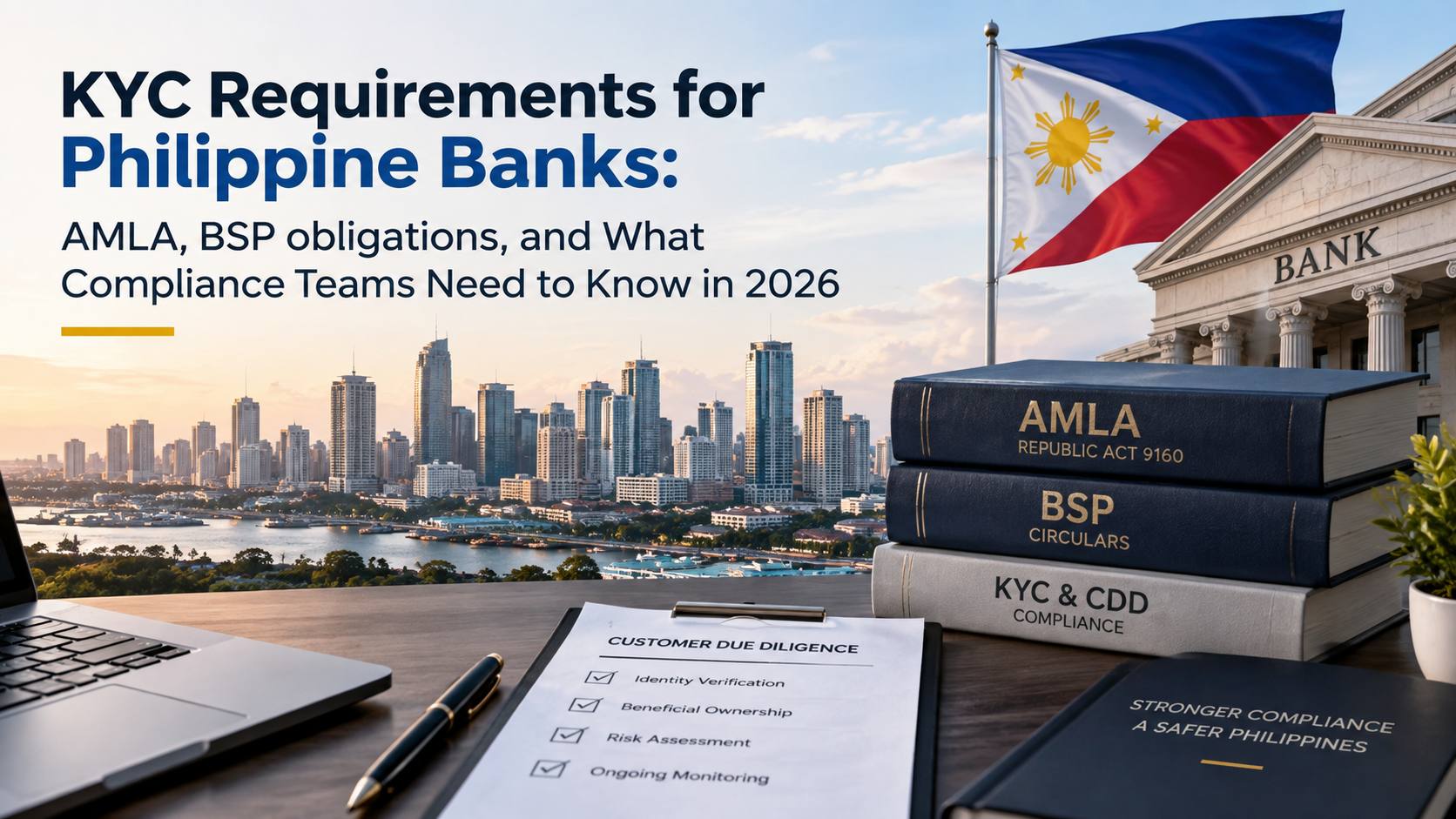
KYC Requirements for Philippine Banks: AMLA, BSP obligations, and What Compliance Teams Need to Know in 2026
The Philippines was removed from the FATF list of jurisdictions under increased monitoring in February 2025. This guide explains current AMLA and BSP KYC/CDD requirements for banks, including beneficial ownership, digital onboarding, reporting and record retention.
KYC Requirements for Philippine Banks: AMLA, BSP obligations, and What Compliance Teams Need to Know in 2026
The Philippines was removed from the FATF list of jurisdictions under increased monitoring in February 2025. This guide explains current AMLA and BSP KYC/CDD requirements for banks, including beneficial ownership, digital onboarding, reporting and record retention.