

Seeing Risk Before It Escalates: Why AML Risk Assessment Software Is Becoming the Brain of Modern Compliance
.svg)
Compliance fails quietly long before alerts start rising.
Introduction
Most AML failures do not begin with a missed suspicious transaction. They begin much earlier, at the point where risk is misunderstood, underestimated, or treated as static.
In the Philippines, the financial landscape is expanding rapidly. Digital banks are scaling. Payment institutions are processing unprecedented volumes. Cross-border corridors are deepening. With growth comes complexity, and with complexity comes evolving financial crime risk.
This environment demands more than reactive detection. It requires proactive understanding.
This is where AML risk assessment software plays a critical role. It acts as the intelligence layer that informs monitoring, customer due diligence, scenario calibration, and resource allocation. Without accurate and dynamic risk assessment, even the most advanced transaction monitoring systems operate blindly.
Risk assessment is no longer an annual compliance exercise. It is becoming the brain of modern AML programmes.

Why Static Risk Assessments No Longer Work
Traditionally, AML risk assessments were periodic exercises. Institutions would review products, customer segments, geographic exposure, and delivery channels once or twice a year. Risk scores were assigned. Controls were adjusted accordingly.
This approach was manageable in slower, lower-volume environments.
Today, it is insufficient.
Risk profiles now change in real time. New products launch rapidly. Customer behaviour evolves. Fraud tactics shift. Cross-border flows fluctuate. Digital channels introduce new exposure points.
A risk assessment conducted months ago may no longer reflect operational reality.
Static spreadsheets and manual reviews cannot keep pace with this evolution. They also lack granularity. Broad customer categories and fixed risk weightings often mask emerging pockets of exposure.
Modern compliance requires AML risk assessment software that continuously evaluates risk based on live data rather than static assumptions.
What AML Risk Assessment Software Actually Does
AML risk assessment software provides a structured and automated framework for identifying, quantifying, and monitoring financial crime risk across an institution.
It evaluates risk across multiple dimensions, including:
- Customer type and profile
- Products and services
- Delivery channels
- Geographic exposure
- Transaction behaviour
- Emerging typologies
Rather than relying solely on qualitative judgment, modern systems combine data-driven scoring models with regulatory guidance to produce dynamic risk ratings.
Importantly, AML risk assessment software connects risk understanding to operational controls. It informs transaction monitoring thresholds, enhanced due diligence triggers, and investigative prioritisation.
Without this link, risk assessment becomes a reporting exercise rather than a decision engine.
The Philippines Context: A Rapidly Evolving Risk Landscape
The Philippine financial ecosystem presents unique risk dynamics.
Remittances remain a critical economic driver. Digital wallets and QR payments are embedded in daily commerce. Real-time transfers have become standard. Regional and international payment corridors are expanding.
At the same time, exposure to social engineering scams, mule recruitment, cyber-enabled fraud, and cross-border laundering continues to grow.
Institutions must assess risk not only at the enterprise level, but at the product, corridor, and behavioural levels.
AML risk assessment software allows institutions to understand where exposure is increasing, where controls must adapt, and where enhanced monitoring is required.
In a market characterised by speed and scale, risk intelligence must move just as quickly.
From Broad Categories to Granular Risk Intelligence
One of the most important evolutions in AML risk assessment software is the shift from broad risk categories to granular, behaviour-informed risk scoring.
Instead of assigning risk solely based on customer type or geography, modern systems incorporate:
- Transaction frequency and velocity
- Corridor usage patterns
- Network relationships
- Behavioural deviations
- Product usage combinations
This enables a far more precise understanding of risk.
For example, two customers in the same high-risk category may exhibit vastly different behaviours. One may transact consistently within expected parameters. The other may show sudden corridor shifts and rapid fund pass-through activity.
Granular risk assessment distinguishes between these profiles.
Dynamic Risk Scoring: Risk That Evolves With Behaviour
Risk is not static. AML risk assessment software must reflect that reality.
Dynamic risk scoring updates customer and enterprise risk profiles continuously as behaviour changes. This ensures that monitoring intensity and due diligence requirements remain proportionate.
For instance, if a customer begins transacting through new high-risk jurisdictions without a clear rationale, their risk score should adjust automatically. This change can trigger enhanced monitoring or review workflows.
Dynamic scoring ensures that compliance teams are responding to actual risk rather than outdated classifications.
Enterprise-Wide Risk Visibility
AML risk assessment software must provide more than individual customer scores. It must provide enterprise-wide visibility.
Compliance leaders need to understand:
- Risk concentration across products
- Geographic exposure trends
- Channel-based vulnerabilities
- Segment-level risk shifts
- Emerging typology impact
Dashboards and reporting capabilities should enable senior management and boards to make informed decisions about resource allocation and control enhancement.
Without enterprise visibility, institutions risk reacting tactically rather than strategically.
Reducing Manual Burden and Improving Governance
Manual risk assessments are time-consuming and prone to inconsistency.
AML risk assessment software automates data aggregation, scoring, and reporting, reducing manual workload while improving consistency.
It also strengthens governance by:
- Providing audit trails for scoring logic
- Documenting methodology changes
- Ensuring alignment between risk ratings and monitoring thresholds
- Supporting regulatory reporting requirements
Strong governance is particularly important in environments where regulatory scrutiny is increasing.
How Tookitaki Approaches AML Risk Assessment Software
Tookitaki integrates AML risk assessment into its broader Trust Layer framework.
Within FinCense, risk assessment is not an isolated module. It informs and interacts with transaction monitoring, case management, and reporting.
Risk scoring incorporates behavioural analytics, geographic exposure, and typology intelligence. As risk changes, monitoring intensity adjusts accordingly.
This integration ensures that risk assessment directly impacts operational controls rather than existing as a separate compliance report.
The platform supports dynamic risk updates, enabling institutions to reflect behavioural changes in near real time.
The Role of the AFC Ecosystem in Risk Assessment
A key differentiator in Tookitaki’s approach is the AFC Ecosystem.
The AFC Ecosystem provides continuously updated typologies and red flags contributed by financial crime experts across markets. These insights inform risk models and scoring frameworks.
As new laundering or fraud techniques emerge, risk assessment logic evolves accordingly. This ensures that exposure mapping remains aligned with real-world threats.
In fast-moving environments like the Philippines, this adaptability is critical.
Agentic AI and Risk Interpretation
Risk assessment generates data, but interpretation remains crucial.
FinMate, Tookitaki’s Agentic AI copilot, assists compliance teams by explaining risk drivers and summarising changes in customer or segment-level exposure.
This improves clarity and consistency in decision-making, particularly when complex risk factors intersect.
Agentic AI does not replace judgment. It enhances understanding.

A Practical Scenario: Dynamic Risk in Action
Consider a payment institution operating across multiple corridors.
A customer historically transacts within domestic channels. Over time, the customer begins sending funds to new jurisdictions associated with elevated risk. Transaction velocity increases, and counterparties change.
Dynamic AML risk assessment software detects these behavioural shifts and updates the customer’s risk profile automatically. Monitoring thresholds adjust accordingly, and enhanced review is triggered.
Investigators receive clear explanations of why the risk score changed.
Without dynamic risk assessment, this evolution may have gone unnoticed until suspicious transactions were escalated.
Measurable Outcomes of Intelligent Risk Assessment
Institutions that adopt integrated AML risk assessment software experience measurable improvements.
They achieve:
- Faster identification of emerging risk
- More proportionate monitoring controls
- Reduced manual recalibration effort
- Improved alignment between risk ratings and detection outcomes
- Stronger audit defensibility
When combined with intelligence-led monitoring, institutions have achieved substantial reductions in false positives and investigation time while maintaining full risk coverage.
Risk assessment becomes a force multiplier rather than an administrative task.
Future-Proofing AML Risk Assessment
The future of AML risk assessment software will emphasise:
- Continuous, real-time risk recalibration
- Predictive risk modelling
- Integrated FRAML exposure mapping
- Cross-institution intelligence collaboration
- AI-assisted governance reporting
As financial ecosystems become more interconnected, risk will evolve more rapidly.
Institutions that rely on static annual assessments will struggle to keep pace.
Those that adopt dynamic, integrated risk intelligence will be better positioned to respond.
Conclusion
AML risk assessment software is no longer a compliance formality. It is the intelligence foundation that determines how effectively an institution manages financial crime exposure.
In the Philippines, where digital payments, cross-border flows, and transaction volumes are expanding rapidly, risk understanding must evolve just as quickly.
Modern AML risk assessment software provides dynamic scoring, granular behavioural analysis, enterprise visibility, and governance strength.
With Tookitaki’s FinCense platform, enriched by the AFC Ecosystem and supported by FinMate, institutions can transform risk assessment from a static report into a living intelligence engine.
In an environment defined by speed and complexity, seeing risk early is what separates resilient institutions from vulnerable ones.
Experience the most intelligent AML and fraud prevention platform
Experience the most intelligent AML and fraud prevention platform
Experience the most intelligent AML and fraud prevention platform
Top AML Scenarios in ASEAN
The Role of AML Software in Compliance
The Role of AML Software in Compliance
Talk to an Expert
Our Thought Leadership Guides


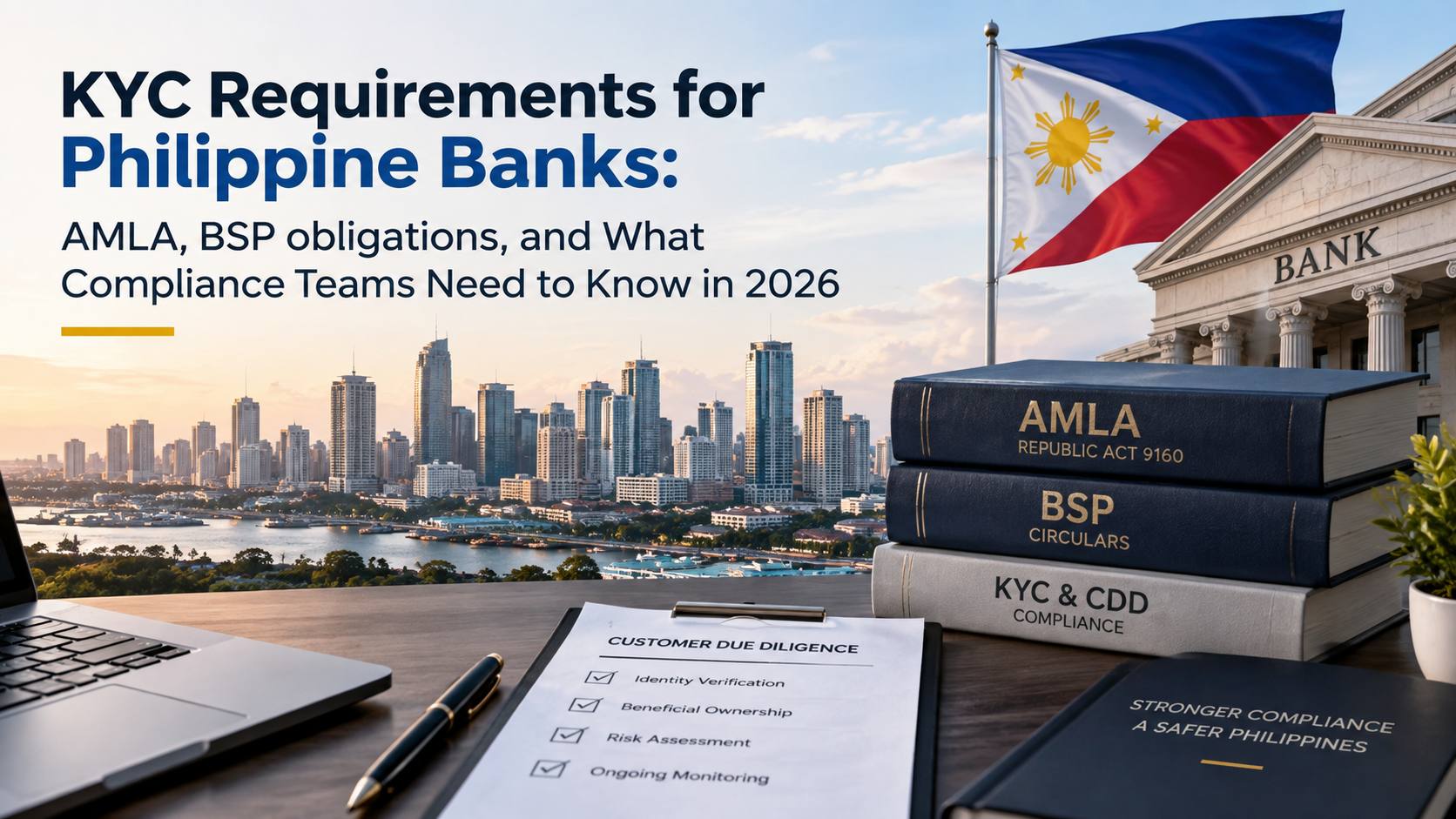
KYC Requirements for Philippine Banks: AMLA, BSP obligations, and What Compliance Teams Need to Know in 2026
The Philippines was removed from the FATF list of jurisdictions under increased monitoring in February 2025. This guide explains current AMLA and BSP KYC/CDD requirements for banks, including beneficial ownership, digital onboarding, reporting and record retention.
KYC Requirements for Philippine Banks: AMLA, BSP obligations, and What Compliance Teams Need to Know in 2026
The Philippines was removed from the FATF list of jurisdictions under increased monitoring in February 2025. This guide explains current AMLA and BSP KYC/CDD requirements for banks, including beneficial ownership, digital onboarding, reporting and record retention.