

Sanctions Screening Software for Financial Institutions in Australia
.svg)
Sanctions screening fails not when lists are outdated, but when decisions are fragmented.
Introduction
Sanctions screening is often described as a binary control. A name matches or it does not. An alert is raised or it is cleared. A customer is allowed to transact or is blocked.
In practice, sanctions screening inside Australian financial institutions is anything but binary.
Modern sanctions risk sits at the intersection of fast-changing watchlists, complex customer structures, real-time payments, and heightened regulatory expectations. Screening software must do far more than compare names against lists. It must help institutions decide, consistently and defensibly, what to do next.
This is why sanctions screening software for financial institutions in Australia is evolving from a standalone matching engine into a core component of a broader Trust Layer. One that connects screening with risk context, alert prioritisation, investigation workflows, and regulatory reporting.
This blog explores how sanctions screening operates in Australia today, where traditional approaches break down, and what effective sanctions screening software must deliver in a modern compliance environment.

Why Sanctions Screening Has Become More Complex
Sanctions risk has changed in three fundamental ways.
Sanctions lists move faster
Global sanctions regimes update frequently, often in response to geopolitical events. Lists are no longer static reference data. They are living risk signals.
Customer structures are more complex
Financial institutions deal with individuals, corporates, intermediaries, and layered ownership structures. Screening is no longer limited to a single name field.
Payments move instantly
Real-time and near-real-time payments reduce the margin for error. Screening decisions must be timely, proportionate, and explainable.
Under these conditions, simple list matching is no longer sufficient.
The Problem with Traditional Sanctions Screening
Most sanctions screening systems were designed for a slower, simpler world.
They typically operate as:
- Periodic batch screening engines
- Standalone modules disconnected from broader risk context
- Alert generators rather than decision support systems
This creates several structural weaknesses.
Too many alerts, too little clarity
Traditional screening systems generate high alert volumes, the majority of which are false positives. Common names, partial matches, and transliteration differences overwhelm analysts.
Alert volume becomes a distraction rather than a safeguard.
Fragmented investigations
When screening operates in isolation, analysts must pull information from multiple systems to assess risk. This slows investigations and increases inconsistency.
Weak prioritisation
All screening alerts often enter queues with equal weight. High-risk sanctions matches compete with low-risk coincidental similarities.
This dilutes attention and increases operational risk.
Defensibility challenges
Regulators expect institutions to demonstrate not just that screening occurred, but that decisions were reasonable, risk-based, and well documented.
Standalone screening engines struggle to support this expectation.
Sanctions Screening in the Australian Context
Australian financial institutions face additional pressures that raise the bar for sanctions screening software.
Strong regulatory scrutiny
Australian regulators expect sanctions screening controls to be effective, proportionate, and explainable. Mechanical rescreening without risk context is increasingly questioned.
Lean compliance operations
Many institutions operate with compact compliance teams. Excessive alert volumes directly impact sustainability.
Customer experience sensitivity
Unnecessary delays or blocks caused by false positives undermine trust, particularly in digital channels.
Sanctions screening software must therefore reduce noise without reducing coverage.
The Shift from Screening as a Control to Screening as a System
The most important evolution in sanctions screening is conceptual.
Effective sanctions screening is no longer a single step. It is a system of connected decisions.
This system has four defining characteristics.
1. Continuous, Event-Driven Screening
Modern sanctions screening software operates continuously rather than periodically.
Screening is triggered by:
- Customer onboarding
- Meaningful customer profile changes
- Relevant watchlist updates
This delta-based approach eliminates unnecessary rescreening while ensuring material changes are captured.
Continuous screening reduces false positives at the source, before alerts are even generated.
2. Contextual Risk Enrichment
A sanctions alert without context is incomplete.
Effective screening software evaluates alerts alongside:
- Customer risk profiles
- Product and channel usage
- Transaction behaviour
- Historical screening outcomes
Context allows institutions to distinguish between coincidence and genuine exposure.
3. Alert Consolidation and Prioritisation
Sanctions alerts should not exist in isolation.
Modern sanctions screening software consolidates alerts across:
- Screening
- Transaction monitoring
- Risk profiling
This enables a “one customer, one case” approach, where all relevant risk signals are reviewed together.
Intelligent prioritisation ensures high-risk sanctions exposure is addressed immediately, while low-risk matches do not overwhelm teams.
4. Structured Investigation and Closure
Sanctions screening does not end when an alert is raised. It ends when a defensible decision is made.
Effective software supports:
- Structured investigation workflows
- Progressive evidence capture
- Clear audit trails
- Supervisor review and approval
- Regulator-ready documentation
This transforms sanctions screening from a reactive task into a controlled decision process.

Why Explainability Matters in Sanctions Screening
Sanctions screening decisions are often reviewed long after they are made.
Institutions must be able to explain:
- Why screening was triggered
- Why a match was considered relevant or irrelevant
- What evidence was reviewed
- How the final decision was reached
Explainability protects institutions during audits and builds confidence internally.
Black-box screening systems create operational and regulatory risk.
The Role of Technology in Modern Sanctions Screening
Technology plays a critical role, but only when applied correctly.
Modern sanctions screening software combines:
- Rules and intelligent matching
- Machine learning for prioritisation and learning
- Workflow orchestration
- Reporting and audit support
Technology does not replace judgement. It scales it.
Common Mistakes Financial Institutions Still Make
Despite advancements, several pitfalls persist.
- Treating sanctions screening as a compliance checkbox
- Measuring success only by alert volume
- Isolating screening from investigations
- Over-reliance on manual review
- Failing to learn from outcomes
These mistakes keep sanctions screening noisy, slow, and hard to defend.
How Sanctions Screening Fits into the Trust Layer
In a Trust Layer architecture, sanctions screening is not a standalone defence.
It works alongside:
- Transaction monitoring
- Customer risk scoring
- Case management
- Alert prioritisation
- Reporting and analytics
This integration ensures sanctions risk is assessed holistically rather than in silos.
Where Tookitaki Fits
Tookitaki approaches sanctions screening as part of an end-to-end Trust Layer rather than an isolated screening engine.
Within the FinCense platform:
- Sanctions screening is continuous and event-driven
- Alerts are enriched with customer and transactional context
- Cases are consolidated and prioritised intelligently
- Investigations follow structured workflows
- Decisions remain explainable and audit-ready
This allows financial institutions to manage sanctions risk effectively without overwhelming operations.
Measuring the Effectiveness of Sanctions Screening Software
Effective sanctions screening should be measured beyond detection.
Key indicators include:
- Reduction in repeat false positives
- Time to decision
- Consistency of outcomes
- Quality of investigation narratives
- Regulatory review outcomes
Strong sanctions screening software improves decision quality, not just alert metrics.
The Future of Sanctions Screening in Australia
Sanctions screening will continue to evolve alongside payments, geopolitics, and regulatory expectations.
Future-ready screening software will focus on:
- Continuous monitoring rather than batch rescreening
- Better prioritisation rather than more alerts
- Stronger integration with investigations
- Clearer explainability
- Operational sustainability
Institutions that invest in screening systems built for these realities will be better positioned to manage risk with confidence.
Conclusion
Sanctions screening is no longer about checking names against lists. It is about making timely, consistent, and defensible decisions in a complex risk environment.
For financial institutions in Australia, effective sanctions screening software must operate as part of a broader Trust Layer, connecting screening with context, prioritisation, investigation, and reporting.
When screening is treated as a system rather than a step, false positives fall, decisions improve, and compliance becomes sustainable.
Experience the most intelligent AML and fraud prevention platform
Experience the most intelligent AML and fraud prevention platform
Experience the most intelligent AML and fraud prevention platform
Top AML Scenarios in ASEAN
The Role of AML Software in Compliance
The Role of AML Software in Compliance
Talk to an Expert
Our Thought Leadership Guides

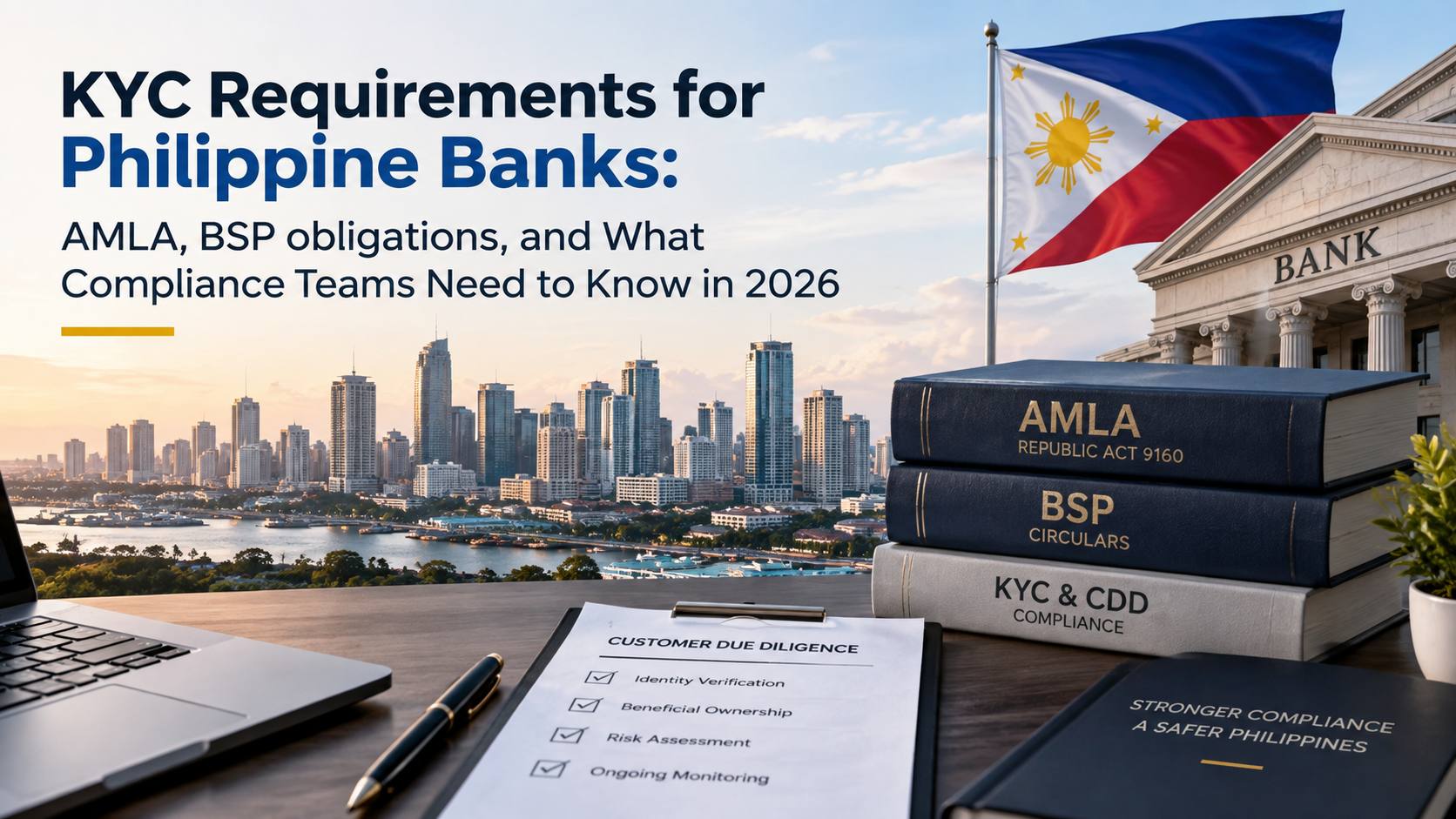
KYC Requirements for Philippine Banks: AMLA, BSP obligations, and What Compliance Teams Need to Know in 2026
The Philippines was removed from the FATF list of jurisdictions under increased monitoring in February 2025. This guide explains current AMLA and BSP KYC/CDD requirements for banks, including beneficial ownership, digital onboarding, reporting and record retention.

KYC Requirements for Philippine Banks: AMLA, BSP obligations, and What Compliance Teams Need to Know in 2026
The Philippines was removed from the FATF list of jurisdictions under increased monitoring in February 2025. This guide explains current AMLA and BSP KYC/CDD requirements for banks, including beneficial ownership, digital onboarding, reporting and record retention.