

Cross-Border Transaction Monitoring for AML Compliance in the Philippines
.svg)
When money crosses borders at speed, risk rarely stays behind.
Introduction
Cross-border payments are a critical lifeline for the Philippine economy. Remittances, trade flows, digital commerce, and regional payment corridors move billions of pesos across borders every day. For banks and payment institutions, these flows enable growth, inclusion, and global connectivity.
They also introduce some of the most complex money laundering risks in the financial system.
Criminal networks exploit cross-border channels to fragment transactions, layer funds across jurisdictions, and obscure the origin of illicit proceeds. What appears routine in isolation often forms part of a larger laundering pattern once viewed across borders and time.
This is why cross-border transaction monitoring for AML compliance in the Philippines has become a defining challenge. Institutions must detect meaningful risk without slowing legitimate flows, overwhelming compliance teams, or losing regulatory confidence. Traditional monitoring approaches are increasingly stretched in this environment.
Modern AML compliance now depends on transaction monitoring systems that understand cross-border behaviour at scale and in context.

Why Cross-Border Transactions Are Inherently Higher Risk
Cross-border transactions introduce complexity that domestic payments do not.
Funds move across different regulatory regimes, financial infrastructures, and data standards. Visibility can be fragmented, especially when transactions pass through intermediaries or correspondent banking networks.
Criminals take advantage of this fragmentation. They move funds through multiple jurisdictions to create distance between the source of funds and their final destination. Transactions are often broken into smaller amounts, routed through wallets or mule accounts, and executed rapidly to reduce the chance of detection.
In the Philippine context, cross-border risk is amplified by:
- high remittance volumes
- regional payment corridors
- growing digital wallet usage
- increased real-time payment adoption
Monitoring these flows requires more than static rules or country risk lists. It requires systems that understand behaviour, relationships, and patterns across borders.
The Limitations of Traditional Cross-Border Monitoring
Many institutions still monitor cross-border transactions using approaches designed for a slower, lower-volume environment.
Static rules based on transaction amount, frequency, or country codes are common. While these controls provide baseline coverage, they struggle to detect modern laundering techniques.
One major limitation is context. Traditional systems often evaluate each transaction independently, without fully linking activity across accounts, corridors, or time periods. This makes it difficult to identify layered or coordinated behaviour.
Another challenge is alert overload. Cross-border rules tend to be conservative, generating large volumes of alerts to avoid missing risk. As volumes grow, compliance teams are overwhelmed with low-quality alerts, reducing focus on genuinely suspicious activity.
Latency is also an issue. Batch-based monitoring means risk is identified after funds have already moved, limiting the ability to respond effectively.
These constraints make it increasingly difficult to demonstrate effective AML compliance in high-volume cross-border environments.
What Effective Cross-Border Transaction Monitoring Really Requires
Effective cross-border transaction monitoring is not about adding more rules. It is about changing how risk is understood and prioritised.
First, monitoring must be behaviour-led rather than transaction-led. Individual cross-border transactions may appear legitimate, but patterns over time often reveal risk.
Second, systems must operate at scale and speed. Cross-border monitoring must keep pace with real-time and near real-time payments without degrading performance.
Third, monitoring must link activity across borders. Relationships between senders, receivers, intermediaries, and jurisdictions matter more than isolated events.
Finally, explainability and governance must remain strong. Institutions must be able to explain why activity was flagged, even when detection logic is complex.
Key Capabilities for Cross-Border AML Transaction Monitoring
Behavioural Pattern Detection Across Borders
Behaviour-led monitoring analyses how customers transact across jurisdictions rather than focusing on individual transfers. Sudden changes in corridors, counterparties, or transaction velocity can indicate laundering risk.
This approach is particularly effective in detecting layering and rapid pass-through activity across multiple countries.
Corridor-Based Risk Intelligence
Cross-border risk often concentrates in specific corridors rather than individual countries. Monitoring systems must understand corridor behaviour, typical transaction patterns, and deviations from the norm.
Corridor-based intelligence allows institutions to focus on genuinely higher-risk flows without applying blanket controls that generate noise.
Network and Relationship Analysis
Cross-border laundering frequently involves networks of related accounts, mules, and intermediaries. Network analysis helps uncover coordinated activity that would otherwise remain hidden across jurisdictions.
This capability is essential for identifying organised laundering schemes that span multiple countries.
Real-Time or Near Real-Time Detection
In high-speed payment environments, delayed detection increases exposure. Modern cross-border monitoring systems analyse transactions as they occur, enabling faster intervention and escalation.
Risk-Based Alert Prioritisation
Not all cross-border alerts carry the same level of risk. Effective systems prioritise alerts based on behavioural signals, network indicators, and contextual risk factors.
This ensures that compliance teams focus on the most critical cases, even when transaction volumes are high.
Cross-Border AML Compliance Expectations in the Philippines
Regulators in the Philippines expect financial institutions to apply enhanced scrutiny to cross-border activity, particularly where risk indicators are present.
Supervisory reviews increasingly focus on:
- effectiveness of detection, not alert volume
- ability to identify complex and evolving typologies
- quality and consistency of investigations
- governance and explainability
Institutions must demonstrate that their transaction monitoring systems are proportionate to their cross-border exposure and capable of adapting as risks evolve.
Static frameworks and one-size-fits-all rules are no longer sufficient to meet these expectations.

How Tookitaki Enables Cross-Border Transaction Monitoring
Tookitaki approaches cross-border transaction monitoring as an intelligence and scale problem, not a rules problem.
Through FinCense, Tookitaki enables continuous monitoring of cross-border transactions using behavioural analytics, advanced pattern detection, and machine learning. Detection logic focuses on how funds move across borders rather than isolated transfers.
FinCense is built to handle high transaction volumes and real-time environments, making it suitable for institutions processing large cross-border flows.
FinMate, Tookitaki’s Agentic AI copilot, supports investigators by summarising cross-border transaction behaviour, highlighting key risk drivers, and explaining why alerts were generated. This significantly reduces investigation time while improving consistency.
The AFC Ecosystem strengthens cross-border monitoring by providing continuously updated typologies and red flags derived from real-world cases across regions. These insights ensure that detection logic remains aligned with evolving cross-border laundering techniques.
Together, these capabilities allow institutions to monitor cross-border activity effectively without increasing operational strain.
A Practical Scenario: Seeing the Pattern Across Borders
Consider a financial institution processing frequent outbound transfers to multiple regional destinations. Individually, the transactions are low value and appear routine.
A behaviour-led, cross-border monitoring system identifies a pattern. Funds are received domestically and rapidly transferred across different corridors, often involving similar counterparties and timing. Network analysis reveals links between accounts that were previously treated as unrelated.
Alerts are prioritised based on overall risk rather than transaction count. Investigators receive a consolidated view of activity across borders, enabling faster and more confident decision-making.
Without cross-border intelligence and pattern analysis, this activity might have remained undetected.
Benefits of Modern Cross-Border Transaction Monitoring
Modern cross-border transaction monitoring delivers clear advantages.
Detection accuracy improves as systems focus on patterns rather than isolated events. False positives decrease, reducing investigation backlogs. Institutions gain better visibility into cross-border exposure across corridors and customer segments.
From a compliance perspective, explainability and audit readiness improve. Institutions can demonstrate that monitoring decisions are risk-based, consistent, and aligned with regulatory expectations.
Most importantly, effective cross-border monitoring protects trust in a highly interconnected financial ecosystem.
The Future of Cross-Border AML Monitoring
Cross-border transaction monitoring will continue to evolve as payments become faster and more global.
Future systems will rely more heavily on predictive intelligence, identifying early indicators of risk before funds move across borders. Integration between AML and fraud monitoring will deepen, providing a unified view of cross-border financial crime.
Agentic AI will play a growing role in supporting investigations, interpreting complex patterns, and guiding decisions. Collaborative intelligence models will help institutions learn from emerging cross-border threats without sharing sensitive data.
Institutions that invest in intelligence-driven monitoring today will be better positioned to navigate this future.
Conclusion
Cross-border payments are essential to the Philippine financial system, but they also introduce some of the most complex AML risks.
Traditional monitoring approaches struggle to keep pace with the scale, speed, and sophistication of modern cross-border activity. Effective cross-border transaction monitoring for AML compliance in the Philippines requires systems that are behaviour-led, scalable, and explainable.
With Tookitaki’s FinCense platform, supported by FinMate and enriched by the AFC Ecosystem, financial institutions can move beyond fragmented rules and gain clear insight into cross-border risk.
In an increasingly interconnected world, the ability to see patterns across borders is what defines strong AML compliance.
Experience the most intelligent AML and fraud prevention platform
Experience the most intelligent AML and fraud prevention platform
Experience the most intelligent AML and fraud prevention platform
Top AML Scenarios in ASEAN
The Role of AML Software in Compliance
The Role of AML Software in Compliance
Talk to an Expert
Our Thought Leadership Guides

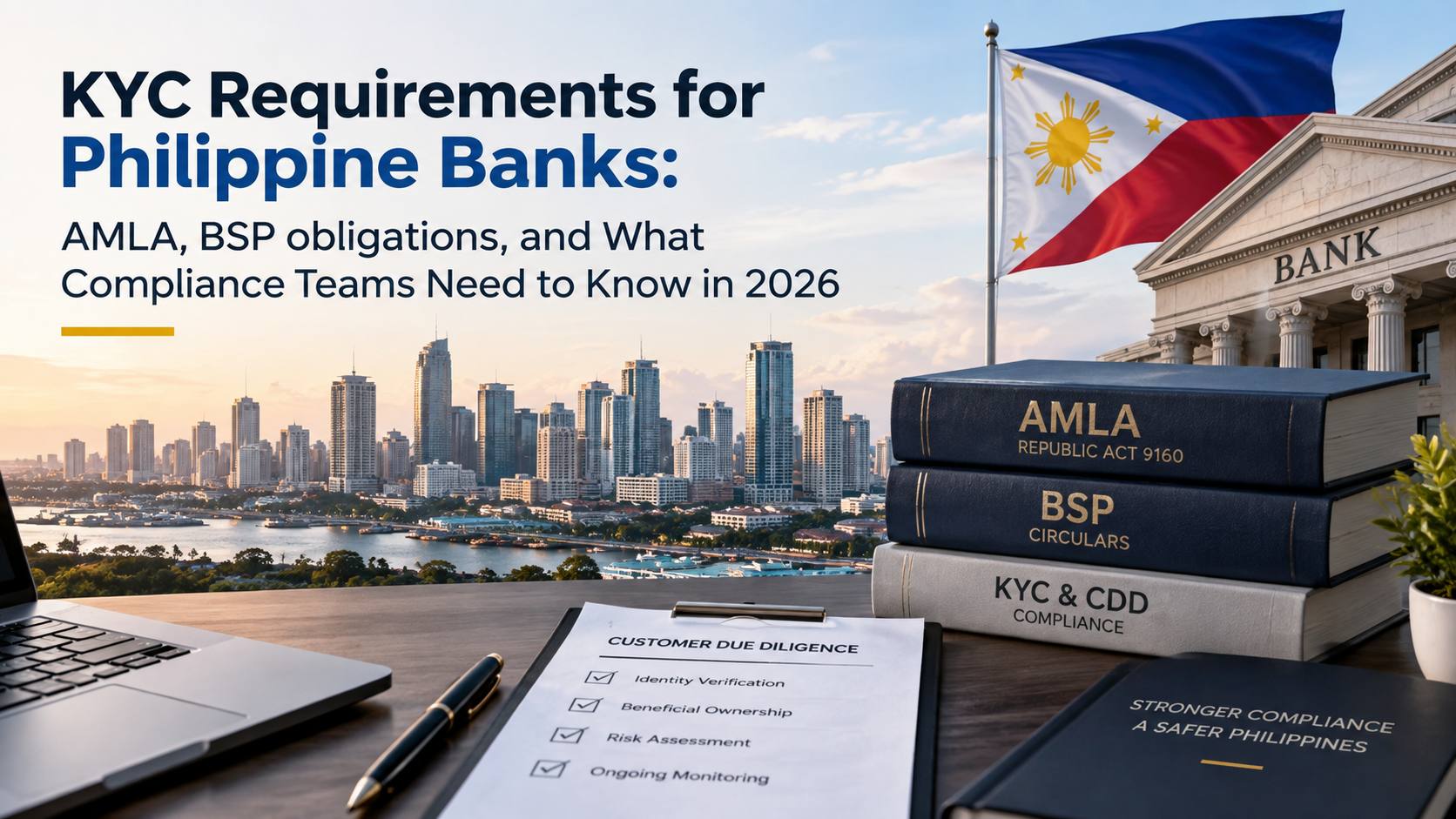
KYC Requirements for Philippine Banks: AMLA, BSP obligations, and What Compliance Teams Need to Know in 2026
The Philippines was removed from the FATF list of jurisdictions under increased monitoring in February 2025. This guide explains current AMLA and BSP KYC/CDD requirements for banks, including beneficial ownership, digital onboarding, reporting and record retention.
KYC Requirements for Philippine Banks: AMLA, BSP obligations, and What Compliance Teams Need to Know in 2026
The Philippines was removed from the FATF list of jurisdictions under increased monitoring in February 2025. This guide explains current AMLA and BSP KYC/CDD requirements for banks, including beneficial ownership, digital onboarding, reporting and record retention.