

Sanctions Screening in Singapore: MAS Requirements and How Financial Institutions Comply
.svg)
Sanctions screening is a mandatory obligation for every financial institution licensed by MAS. It is not a best practice or a risk management option — it is a legal requirement grounded in both Singapore's domestic legislation and the UN Security Council resolutions Singapore is obligated to implement. An institution that processes a transaction involving a designated person or entity, or that maintains a business relationship with one, is exposed to criminal liability regardless of whether the institution knew of the designation at the time.
The compliance challenge is operational. The sanctions lists that Singapore institutions must screen against are numerous, updated frequently, and governed by different legal instruments. The names and entities on those lists present matching challenges: transliterations from Arabic, Farsi, Korean, and Russian script, name variants across jurisdictions, and aliases registered at different points in a designation's history. Screening tools that rely on exact-string matching will miss designations that appear in a different transliteration. Screening tools that are over-sensitive will generate false positives at volumes that make manual review unsustainable.
This guide covers what MAS requires for sanctions screening, which lists must be screened against, what the screening standard is, and where institutions commonly fall short in examination.

The legal basis for sanctions screening in Singapore
Sanctions compliance in Singapore sits across two legal frameworks.
The United Nations Act 2001 implements UN Security Council resolutions in Singapore. Under this Act, Singapore gives effect to asset freezes, travel bans, and arms embargoes imposed by the UNSC. The MAS Act empowers MAS to issue directions and regulations giving effect to UN sanctions in the financial sector. Any financial institution that deals with the property of a designated person under a UNSC resolution breaches Singapore law directly.
MAS Notice 626 (and related notices for payment institutions, merchant banks, and finance companies) imposes screening obligations as part of the broader AML/CFT framework. Under Notice 626, banks must screen customers and transactions against designated lists as part of their CDD and ongoing monitoring obligations. Failure to screen, or failure to screen against the correct lists, is treated as a CDD deficiency in examination — separate from any direct liability under the UN Act.
The two frameworks create different compliance obligations: the UN Act creates criminal liability for transacting with a designated person; Notice 626 creates a regulatory obligation to have a screening programme that prevents such transactions from occurring. An institution that has a screening programme but fails to detect a designation may still face regulatory action under Notice 626 even if no criminal liability arises.
Lists that Singapore institutions must screen against
The minimum list of sources that MAS-regulated banks and financial institutions must screen against:
MAS Targeted Financial Sanctions list: MAS maintains a consolidated list of persons and entities subject to targeted financial sanctions in Singapore, drawn from UNSC resolutions and supplemented by Singapore's domestic designations. This list is available on the MAS website and is updated when UNSC resolutions are adopted or when Singapore makes domestic designations. Institutions must incorporate list updates into their screening without delay.
UN Security Council consolidated list: The UN 1267/1989/2253 Committee list (Al-Qaeda and associated individuals and entities), the 1988 Committee list (Taliban), and other UNSC committee lists must be screened against. MAS's consolidated list draws from these sources, but institutions with cross-border transaction exposure often screen directly against UN list sources to ensure they have the most current designations.
OFAC SDN list: While OFAC is a US agency, Singapore institutions with USD-clearing relationships, US-person customers, or US-dollar correspondent banking exposure face OFAC compliance obligations through their banking relationships. Most Singapore banks with US correspondent relationships screen the OFAC Specially Designated Nationals and Blocked Persons (SDN) list as part of their baseline screening programme. Failure to identify OFAC-sanctioned entities in transactions routed through US correspondent relationships can result in enforcement action by OFAC against the US correspondent, creating relationship and reputational risk for the Singapore institution.
DFAT consolidated list (where applicable): For institutions with Australian correspondent relationships or Australian-person customers, DFAT's consolidated list is relevant. The MAS list and DFAT list overlap significantly but not entirely.
EU consolidated list (where applicable): For institutions with EU-currency transactions or EU-person customers, the EU consolidated list covers designations that are not mirrored in the MAS list.
Domestic designations under the Terrorism (Suppression of Financing) Act: Singapore's TSOFA covers terrorism financing-specific designations separate from the general UNSC framework.
In practice, most Singapore banks screen a superset of these lists through their screening system rather than selecting lists manually. The question in examination is not whether the institution screens any list, but whether the scope of lists screened is consistent with the institution's business profile and risk assessment.
The screening standard: what MAS expects
Screening a list is not the same as screening it effectively. MAS's examination findings on sanctions screening focus on four operational standards:
Real-time screening for transactions: Screening must be capable of running against transactions in real time — before settlement, not in a batch process run after funds have moved. For cross-border wire transfers, this means screening the originator, beneficiary, and any intermediary entities in the transfer message before the transaction is released. Batch screening that runs nightly does not satisfy this requirement for payment processing.
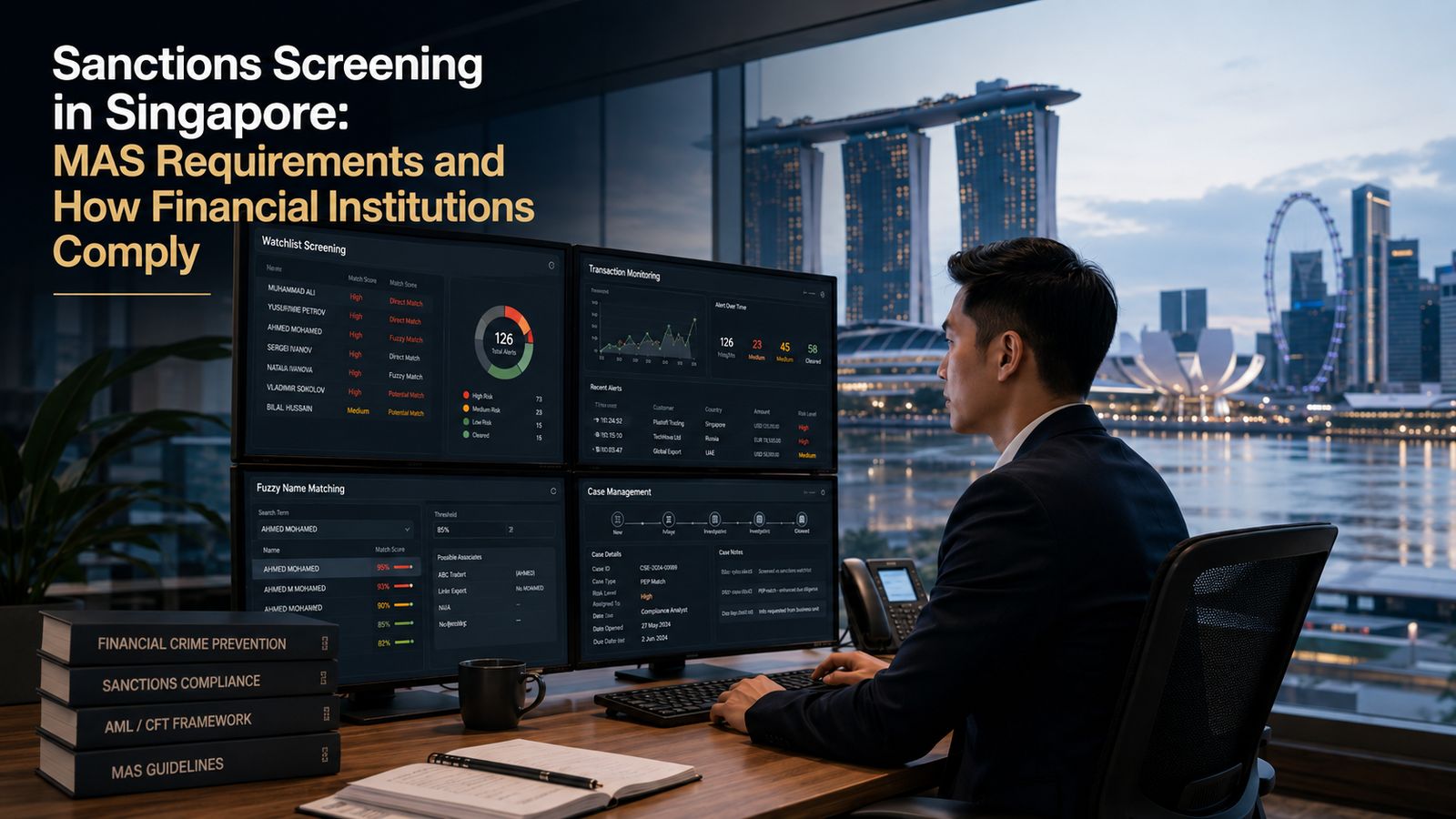
Fuzzy matching, not exact-string matching: Names on sanctions lists appear in multiple transliterations, with and without titles, with name order transposed between given and family names, and with aliases registered at different points. A screening system that only matches exact strings will not catch the same name in a different transliteration or with a minor spelling variation. MAS expects screening programmes to use fuzzy-matching logic with documented thresholds — and to be able to demonstrate that the thresholds are calibrated to catch genuine matches rather than eliminate false positives at the cost of missed designations.
Ongoing screening, not onboarding-only: Customers screened clean at onboarding may become designated during the relationship. The MAS Notice 626 ongoing monitoring obligation includes ongoing screening. Most institutions run daily batch screening of the active customer base against updated lists. This satisfies the ongoing obligation provided the batch runs on the same day that list updates are published, not the following day.
Documentation of screening decisions: When a potential match is identified and reviewed by a compliance officer who concludes it is a false positive, that decision must be documented. The record should show the name matched, the reason the match was concluded to be a false positive, and the identity of the officer who made the determination. Undocumented dismissals of matches — where the system generated an alert that was closed without a record — are a recurring examination finding.
Common examination findings on sanctions screening
MAS examination findings on sanctions screening cluster around three failures:
List coverage gaps: The institution screens MAS and OFAC but not the domestic terrorism financing list, or screens the OFAC SDN list but not the OFAC non-SDN lists relevant to its business lines. The appropriate list scope depends on the institution's transaction flows, correspondent relationships, and customer profile — a retail bank with no cross-border business has different list requirements from a wholesale bank running correspondent relationships across ten jurisdictions.
Delayed list updates: Institutions that download list updates weekly rather than on publication miss the window between a new designation and the next update cycle. For institutions with high transaction volumes, a one-week window is a material exposure period.
Insufficient fuzzy-matching thresholds: Institutions that set fuzzy-matching thresholds at very high similarity levels to reduce false positives risk missing genuine matches. MAS expects institutions to be able to demonstrate, with reference to test cases, that their threshold is calibrated to catch known-difficult matching scenarios — common name variants, transliteration differences, and historical aliases — not just identical-string matches.
PEP screening and the relationship to sanctions screening
PEP screening and sanctions screening are distinct obligations that operate in parallel. A PEP who is not sanctioned still triggers enhanced due diligence under Notice 626. A sanctioned person who is not a PEP triggers asset-freeze obligations. The two lists are not interchangeable.
In practice, most screening systems handle both in a single workflow, with PEP matches routed to the EDD process and sanctions matches routed to a separate compliance hold workflow pending legal review. The important distinction is that a PEP match permits continued relationship with enhanced diligence, while a sanctions match requires asset freezing and reporting to MAS — the compliance response is entirely different. Treating a sanctions match as a PEP alert requiring EDD rather than an asset-freeze situation is a material compliance failure.
For a detailed breakdown of PEP screening requirements and how they interact with EDD obligations, see our PEP screening guide.
How Tookitaki’s FinCense supports sanctions screening compliance
FinCense's screening module matches customer and transaction data against the full range of required sanctions lists, PEP databases, and adverse media sources using natural language processing and machine learning. Fuzzy matching handles name variants, transliterations, and partial matches that exact-string matching misses, calibrated to maintain detection coverage without generating false positive volumes that overwhelm review capacity. False positive rates are reduced by up to 70% compared to exact-string and low-sophistication fuzzy matching approaches.
For transaction screening, FinCense screens originator, beneficiary, and intermediary entity details in real time, before settlement, covering the cross-border wire transfer obligation under MAS Notice 626 and the travel rule requirement for payment institutions. List updates from MAS, OFAC, and UN sources are incorporated automatically, without manual intervention.
Screening matches are managed in FinCense's integrated case management environment. Potential match alerts include the matched name, the source list, the match confidence score, and the customer's transaction history and risk profile alongside the alert. Compliance officers document their match review decision within the same case record, creating the audit trail MAS examines.
For a full overview of AML compliance for Singapore banks, see our Singapore AML compliance guide. For MAS Notice 626 obligations in detail, see our MAS Notice 626 guide.
To see how FinCense handles sanctions and PEP screening for MAS-regulated institutions, book a demo with our Singapore team.
Frequently asked questions
What sanctions lists must Singapore banks screen against?
At minimum: the MAS Targeted Financial Sanctions list, UN Security Council consolidated lists, and domestic designations under the Terrorism (Suppression of Financing) Act. Banks with USD-clearing or US-correspondent relationships should also screen the OFAC SDN list. The appropriate list scope depends on the institution's transaction flows and customer profile.
What is the MAS Targeted Financial Sanctions list?
The MAS TFS list is a consolidated list maintained by MAS of persons and entities subject to targeted financial sanctions in Singapore. It draws from UN Security Council resolutions and Singapore domestic designations. MAS updates the list when new UNSC resolutions are adopted or new domestic designations are made.
Does real-time screening apply to all transactions?
For payment transactions and cross-border wire transfers, screening must run before settlement. Batch screening that runs after funds have moved does not satisfy the requirement for transaction screening. Ongoing customer screening (against the active customer base) is typically run as a daily batch against updated lists.
What happens when a sanctions match is identified?
A confirmed sanctions match triggers an asset-freeze obligation under the UN Act and a reporting obligation to MAS. The institution must freeze the customer's assets, cease any transactions with the designated person or entity, and report the match to MAS. This is a materially different response from a PEP match, which triggers enhanced due diligence rather than asset freezing.
How should false positives from sanctions screening be handled?
When a potential match is reviewed and concluded to be a false positive, the decision must be documented: the name matched, the reason for the false positive conclusion, and the identity of the reviewing officer. Undocumented dismissals of screening alerts are a recurring MAS examination finding.
Is PEP screening the same as sanctions screening?
No. PEP screening and sanctions screening are separate obligations. A PEP match triggers enhanced due diligence. A sanctions match triggers asset freezing and reporting. The two processes typically run in parallel but route matches to different compliance workflows.
Experience the most intelligent AML and fraud prevention platform
Experience the most intelligent AML and fraud prevention platform
Experience the most intelligent AML and fraud prevention platform
Top AML Scenarios in ASEAN
The Role of AML Software in Compliance
The Role of AML Software in Compliance
Talk to an Expert
Our Thought Leadership Guides


KYC Requirements for Philippine Banks: AMLA, BSP obligations, and What Compliance Teams Need to Know in 2026
The Philippines was removed from the FATF list of jurisdictions under increased monitoring in February 2025. This guide explains current AMLA and BSP KYC/CDD requirements for banks, including beneficial ownership, digital onboarding, reporting and record retention.
KYC Requirements for Philippine Banks: AMLA, BSP obligations, and What Compliance Teams Need to Know in 2026
The Philippines was removed from the FATF list of jurisdictions under increased monitoring in February 2025. This guide explains current AMLA and BSP KYC/CDD requirements for banks, including beneficial ownership, digital onboarding, reporting and record retention.