Compliance Hub

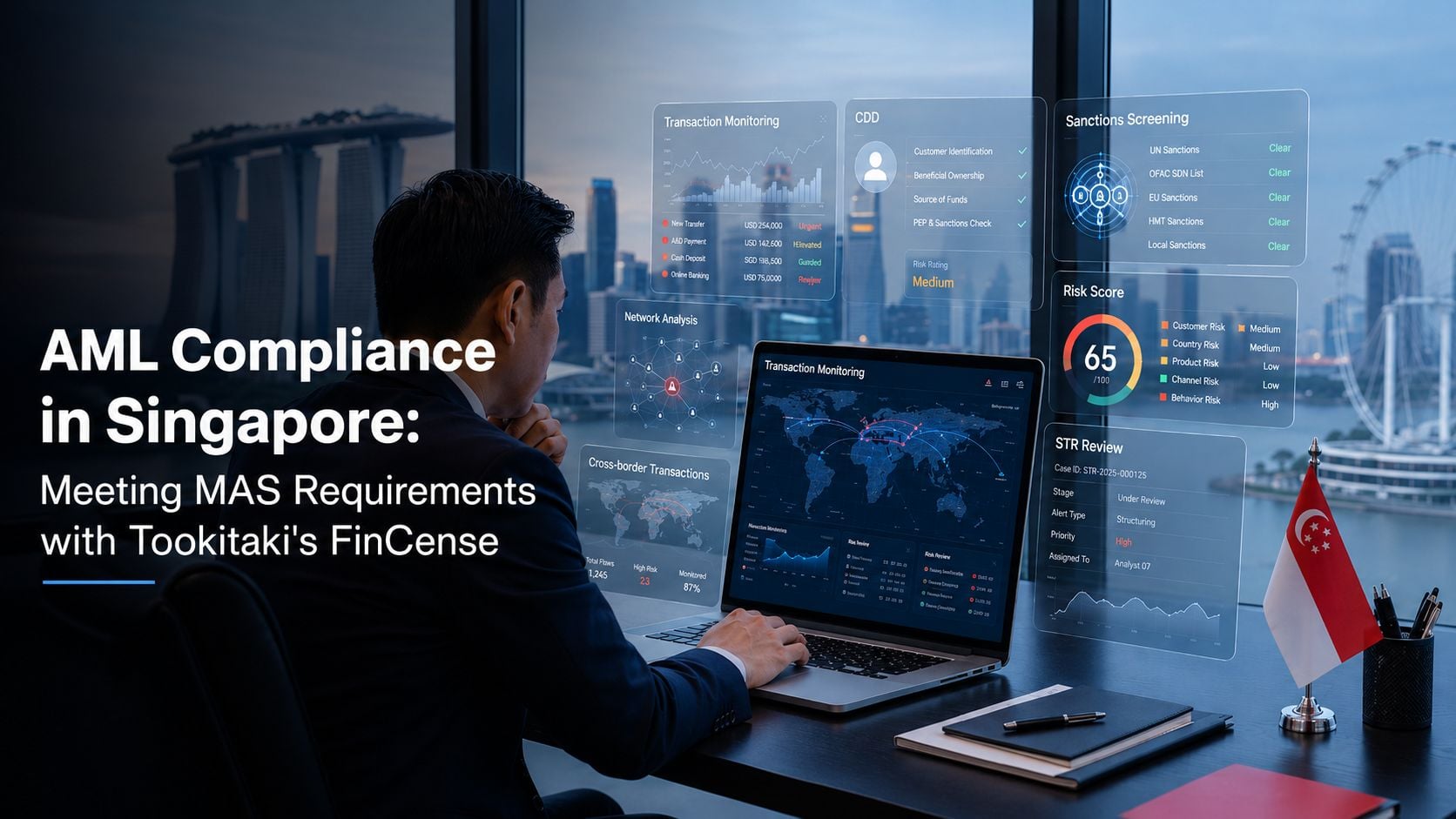
AML Singapore: Navigating Compliance Challenges and Innovations with Tookitaki

Site Logo
Tookitaki
8 min
read

Introduction: Why AML is a Critical Priority in Singapore

As one of Asia’s foremost financial hubs, Singapore plays a central role in global banking, trade finance, and digital payments. With this status comes responsibility—and one of the most pressing is ensuring a strong Anti-Money Laundering (AML) framework.

AML Singapore is not just a regulatory obligation; it is a cornerstone of maintaining institutional trust, national security, and international credibility. The Monetary Authority of Singapore (MAS) has developed a sophisticated AML regulatory regime to combat financial crime, requiring all financial institutions to stay vigilant, adaptive, and technologically enabled.

In this evolving compliance landscape, Tookitaki has emerged as a trusted RegTech partner for banks and financial institutions, helping them not just meet MAS requirements—but exceed them. This blog explores the AML environment in Singapore, the challenges institutions face, and how Tookitaki is enabling the shift from reactive compliance to proactive, intelligence-led financial crime prevention.

{{cta-first}}

Understanding the AML Landscape in Singapore

Singapore’s AML framework is anchored in global standards and tailored to the country’s role in global finance. Financial institutions are required to comply with:

  • The Corruption, Drug Trafficking and Other Serious Crimes (Confiscation of Benefits) Act (CDSA)
  • The Terrorism (Suppression of Financing) Act (TSOFA)
  • MAS Notices 626, 824, and 3001, which detail AML/CFT obligations for different classes of institutions
  • Guidelines from the Suspicious Transaction Reporting Office (STRO)

These laws mandate stringent Know-Your-Customer (KYC) procedures, continuous transaction monitoring, and the filing of Suspicious Transaction Reports (STRs).

Singapore’s approach is risk-based and technology-driven, with MAS encouraging financial institutions to innovate while upholding robust governance. The release of the 2024 Money Laundering National Risk Assessment further highlights the evolving threats such as cyber-enabled fraud, misuse of corporate vehicles, and trade-based money laundering.

In short, AML Singapore is an ever-evolving discipline requiring a dynamic response from institutions.

AML Singapore

Key Compliance Challenges Facing Financial Institutions in Singapore

Despite a robust framework, financial institutions in Singapore continue to grapple with multiple challenges:

1. High Alert Volumes and False Positives

Traditional rule-based systems often flood compliance teams with irrelevant alerts. Analysts must manually sift through noise to find true suspicious activities, wasting time and resources.

2. Fragmented Data and Siloed Systems

Many institutions run compliance operations across disconnected systems, making it difficult to gain a unified view of customer risk or track suspicious behaviour across products.

3. Cross-Border Complexity

As Singapore banks serve global clients, they face increased exposure to cross-border risks, mule accounts, and layered transactions that evade traditional controls.

4. Slow Scenario Deployment

Institutions struggle to keep up with fast-evolving fraud and AML scenarios. Delays in creating or updating monitoring scenarios can leave blind spots in detection systems.

These challenges demand more than incremental upgrades—they require a rethinking of how compliance is approached and executed.

How Tookitaki Is Transforming AML in Singapore

Tookitaki, a Singapore-headquartered company, offers FinCense, a next-generation compliance platform designed to address the real-world problems faced by compliance teams. FinCense is built to make AML programs more intelligent, accurate, and collaborative.

Key Innovations Powering FinCense:

AI-Powered Detection with Lower False Positives

Tookitaki’s federated machine learning models are trained on real-world scenarios contributed by its AFC Ecosystem—a global community of financial crime experts. These models deliver industry-leading detection accuracy while reducing false positives by a significant margin.

Scenario-Based Monitoring at Scale

Institutions can deploy out-of-the-box risk scenarios or customise their own, aligned to their business needs. In Singapore, scenarios are regularly updated to address risks flagged by MAS and STRO.

Centralised Case Management

FinCense comes with a powerful case manager that allows compliance teams to investigate, collaborate, and resolve alerts in one place. No more toggling between systems or losing context.

Real-Time Alert Response

Through built-in automation and smart dispositioning, alerts can be triaged and responded to in real time, speeding up STR filings and customer response actions.

Local LLM Copilot – FinMate

FinCense integrates FinMate, Tookitaki’s local LLM-based AI copilot that assists analysts by summarising alert details, suggesting next steps, and helping generate investigation narratives.

Together, these innovations are transforming AML Singapore efforts from reactive to resilient.

Case Study: A Singapore-Based Bank Adopts FinCense

A leading Singapore bank recently deployed Tookitaki’s FinCense as its primary fraud prevention system, and the results have been transformative.

What They Implemented:

  • 20+ transaction monitoring scenarios across CASA, lending, SME banking, and payments
  • A centralised case management system for investigation and reporting
  • A fully MAS-compliant risk framework validated by EY

Key Outcomes:

  • 100% Risk Coverage Delivered
  • ~50% Faster Scenario Onboarding Time
  • 2x Decrease in Alerts-to-Transaction Ratio, even with a 4x increase in transaction volumes
  • STR-to-Alert Ratio of 25–30%, a 6x improvement over legacy systems

This means that for every 4 alerts generated, an STR is filed—showing improved precision and regulatory relevance.

“System evaluated by EY and the results were accepted by MAS.”

This case demonstrates how FinCense is helping institutions not just stay compliant—but operate smarter and grow faster in Singapore’s high-stakes environment.

The Road Ahead: Future-Proofing AML in Singapore

The future of AML Singapore will depend on the ability of institutions to:

  • Detect emerging risks like AI-generated fraud and complex shell structures
  • Collaborate across institutions and geographies for intelligence sharing
  • Align with evolving MAS expectations around explainable AI and ethical use of technology
  • Maintain operational efficiency while handling growing volumes of real-time transactions

Tookitaki is already paving the way here—with a federated learning approach, ongoing community-driven typology updates, and seamless integration across risk systems.

The AFC Ecosystem adds an unmatched layer of collective intelligence, allowing Tookitaki clients to stay one step ahead—without going it alone.

{{cta-whitepaper}}

Conclusion: Transforming Compliance into a Competitive Advantage

Singapore has set the global benchmark for AML, and institutions operating here must rise to that challenge. But compliance need not be a burden—it can be a differentiator, a trust signal, and a growth enabler.

With Tookitaki’s FinCense platform, financial institutions in Singapore are:

  • Reducing false positives
  • Filing more meaningful STRs
  • Meeting MAS compliance with confidence
  • Equipping their teams with AI-powered tools
  • Benefiting from global collaboration through the AFC Ecosystem

If your organisation is navigating the complexities of AML Singapore, now is the time to explore how Tookitaki can help you turn compliance into a catalyst for success.

By submitting the form, you agree that your personal data will be processed to provide the requested content (and for the purposes you agreed to above) in accordance with the Privacy Notice

success icon

We’ve received your details and our team will be in touch shortly.

In the meantime, explore how Tookitaki is transforming financial crime prevention.
Learn More About Us
Oops! Something went wrong while submitting the form.

Ready to Streamline Your Anti-Financial Crime Compliance?

Our Thought Leadership Guides

Blogs
30 Jan 2026
6 min
read

Smarter Anti-Fraud Monitoring: How Singapore is Reinventing Trust in Finance

A New Era of Financial Crime Calls for New Defences

In today’s hyper-digital financial ecosystem, fraudsters aren’t hiding in the shadows—they’re moving at the speed of code. From business email compromise to mule networks and synthetic identities, financial fraud has become more organised, more global, and more real-time.

Singapore, one of Asia’s most advanced financial hubs, is facing these challenges head-on with a wave of anti-fraud monitoring innovations. At the core is a simple shift: don’t just detect crime—prevent it before it starts.

Talk to an Expert

The Evolution of Anti-Fraud Monitoring

Let’s take a step back. Anti-fraud monitoring has moved through three key stages:

  1. Manual Review Era: Reliant on human checks and post-event investigations
  2. Rule-Based Automation: Transaction alerts triggered by fixed thresholds and logic
  3. AI-Powered Intelligence: Today’s approach blends behaviour analytics, real-time data, and machine learning to catch subtle, sophisticated fraud

The third phase is where Singapore’s banks are placing their bets.

What Makes Modern Anti-Fraud Monitoring Truly Smart?

Not all systems that claim to be intelligent are created equal. Here’s what defines next-generation monitoring:

  • Continuous Learning: Algorithms that improve with every transaction
  • Behaviour-Driven Models: Understands typical customer behaviour and flags outliers
  • Entity Linkage Detection: Tracks how accounts, devices, and identities connect
  • Multi-Layer Contextualisation: Combines transaction data with metadata like geolocation, device ID, login history

This sophistication allows monitoring systems to spot emerging threats like:

  • Shell company layering
  • Rapid movement of funds through mule accounts
  • Unusual transaction bursts in dormant accounts

Key Use Cases in the Singapore Context

Anti-fraud monitoring in Singapore must adapt to specific local trends. Some critical use cases include:

  • Mule Account Detection: Flagging coordinated transactions across seemingly unrelated accounts
  • Investment Scam Prevention: Identifying patterns of repeated, high-value transfers to new payees
  • Cross-Border Remittance Risks: Analysing flows through PTAs and informal remittance channels
  • Digital Wallet Monitoring: Spotting inconsistencies in e-wallet usage, particularly spikes in top-ups and withdrawals

Each of these risks demands a different detection logic—but unified through a single intelligence layer.

Signals That Matter: What Anti-Fraud Monitoring Tracks

Forget just watching for large transactions. Modern monitoring systems look deeper:

  • Frequency and velocity of payments
  • Geographical mismatch in device and transaction origin
  • History of the payee and counterparty
  • Login behaviours—such as device switching or multiple accounts from one device
  • Usage of new beneficiaries post dormant periods

These signals, when analysed together, create a fraud risk score that investigators can act on with precision.

Challenges That Institutions Face

While the tech exists, implementation is far from simple. Common hurdles include:

  • Data Silos: Disconnected transaction data across departments
  • Alert Fatigue: Too many false positives overwhelm investigation teams
  • Lack of Explainability: AI black boxes are hard to audit and trust
  • Changing Fraud Patterns: Tactics evolve faster than models can adapt

A winning anti-fraud strategy must solve for both detection and operational friction.

ChatGPT Image Jan 29, 2026, 01_22_27 PM

Why Real-Time Capabilities Matter

Modern fraud isn’t patient. It doesn’t unfold over days or weeks. It happens in seconds.

That’s why real-time monitoring is no longer optional. It’s essential. Here’s what it allows:

  • Instant Blocking of Suspicious Transactions: Before funds are lost
  • Faster Alert Escalation: Cut investigation lag
  • Contextual Case Building: All relevant data is pre-attached to the alert
  • User Notifications: Banks can reach out instantly to verify high-risk actions

This approach is particularly valuable in scam-heavy environments, where victims are often socially engineered to approve payments themselves.

How Tookitaki Delivers Smart Anti-Fraud Monitoring

Tookitaki’s FinCense platform reimagines fraud prevention by leveraging collective intelligence. Here’s what makes it different:

  • Federated Learning: Models are trained on a wider set of fraud scenarios contributed by a global network of banks
  • Scenario-Based Detection: Human-curated typologies help identify context-specific patterns of fraud
  • Real-Time Simulation: Compliance teams can test new rules before deploying them live
  • Smart Narratives: AI-generated alert summaries explain why something was flagged

This makes Tookitaki especially valuable for banks dealing with:

  • Rapid onboarding of new customers via digital channels
  • Cross-border payment volumes
  • Frequent typology shifts in scam behaviour

Rethinking Operational Efficiency

Advanced detection alone isn’t enough. If your team can’t act on insights, you’ve only shifted the bottleneck.

Tookitaki helps here too:

  • Case Manager: One dashboard with pre-prioritised alerts, audit trails, and collaboration tools
  • Smart Narratives: No more manual note-taking—investigation summaries are AI-generated
  • Explainability Layer: Every decision can be justified to regulators

The result? Better productivity and faster resolution times.

The Role of Public-Private Partnerships

Singapore has shown that collaboration is key. The Anti-Scam Command, formed between the Singapore Police Force and major banks, shows what coordinated fraud prevention looks like.

As MAS pushes for more cross-institutional knowledge sharing, monitoring systems must be able to ingest collective insights—whether they’re scam reports, regulatory advisories, or new typologies shared by the community.

This is why Tookitaki’s AFC Ecosystem plays a crucial role. It brings together real-world intelligence from banks across Asia to build smarter, regionally relevant detection models.

The Future of Anti-Fraud Monitoring

Where is this all headed? Expect the future of anti-fraud monitoring to be:

  • Predictive, Not Just Reactive: Models will forecast risky behaviour, not just catch it
  • Hyper-Personalised: Systems will adapt to individual customer risk profiles
  • Embedded in UX: Fraud prevention will be built into onboarding, transaction flows, and user journeys
  • More Human-Centric: With Gen AI helping investigators reduce burnout and focus on insights, not grunt work

Final Thoughts

Anti-fraud monitoring has become a frontline defence in financial services. In a city like Singapore—where trust, technology, and finance converge—the push is clear: smarter systems that detect faster, explain better, and prevent earlier.

For institutions, the message is simple. Don’t just monitor. Outthink. Outsmart. Outpace.

Tookitaki’s FinCense platform provides that edge—backed by explainable AI, federated typologies, and a community that believes financial crime is better fought together.

Smarter Anti-Fraud Monitoring: How Singapore is Reinventing Trust in Finance
Blogs
29 Jan 2026
6 min
read

Fraud Detection and Prevention Is Not a Tool. It Is a System.

Organisations do not fail at fraud because they lack tools. They fail because their fraud systems do not hold together when it matters most.

Introduction

Fraud detection and prevention is often discussed as if it were a product category. Buy the right solution. Deploy the right models. Turn on the right rules. Fraud risk will be controlled.

In reality, this thinking is at the root of many failures.

Fraud does not exploit a missing feature. It exploits gaps between decisions. It moves through moments where detection exists but prevention does not follow, or where prevention acts without understanding context.

This is why effective fraud detection and prevention is not a single tool. It is a system. A coordinated chain of sensing, decisioning, and response that must work together under real operational pressure.

This blog explains why treating fraud detection and prevention as a system matters, where most organisations break that system, and what a truly effective fraud detection and prevention solution looks like in practice.

Talk to an Expert

Why Fraud Tools Alone Are Not Enough

Most organisations have fraud tools. Many still experience losses, customer harm, and operational disruption.

This is not because the tools are useless. It is because tools are often deployed in isolation.

Detection tools generate alerts.
Prevention tools block transactions.
Case tools manage investigations.

But fraud does not respect organisational boundaries. It moves faster than handoffs and thrives in gaps.

When detection and prevention are not part of a single system, several things happen:

  • Alerts are generated too late
  • Decisions are made without context
  • Responses are inconsistent
  • Customers experience unnecessary friction
  • Fraudsters exploit timing gaps

The presence of tools does not guarantee the presence of control.

Detection Without Prevention and Prevention Without Detection

Two failure patterns appear repeatedly across institutions.

Detection without prevention

In this scenario, fraud detection identifies suspicious behaviour, but the organisation cannot act fast enough.

Alerts are generated. Analysts investigate. Reports are written. But by the time decisions are made, funds have moved or accounts have been compromised further.

Detection exists. Prevention does not arrive in time.

Prevention without detection

In the opposite scenario, prevention controls are aggressive but poorly informed.

Transactions are blocked based on blunt rules. Customers are challenged repeatedly. Genuine activity is disrupted. Fraudsters adapt their behaviour just enough to slip through.

Prevention exists. Detection lacks intelligence.

Neither scenario represents an effective fraud detection and prevention solution.

The Missing Layer Most Fraud Solutions Overlook

Between detection and prevention sits a critical layer that many organisations underinvest in.

Decisioning.

Decisioning is where signals are interpreted, prioritised, and translated into action. It answers questions such as:

  • How risky is this activity right now
  • What response is proportionate
  • How confident are we in this signal
  • What is the customer impact of acting

Without a strong decision layer, fraud systems either hesitate or overreact.

Effective fraud detection and prevention solutions are defined by the quality of their decisions, not the volume of their alerts.

ChatGPT Image Jan 28, 2026, 01_33_25 PM

What a Real Fraud Detection and Prevention System Looks Like

When fraud detection and prevention are treated as a system, several components work together seamlessly.

1. Continuous sensing

Fraud systems must continuously observe behaviour, not just transactions.

This includes:

  • Login patterns
  • Device changes
  • Payment behaviour
  • Timing and sequencing of actions
  • Changes in normal customer behaviour

Fraud often reveals itself through patterns, not single events.

2. Contextual decisioning

Signals mean little without context.

A strong system understands:

  • Who the customer is
  • How they usually behave
  • What risk they carry
  • What else is happening around this event

Context allows decisions to be precise rather than blunt.

3. Proportionate responses

Not every risk requires the same response.

Effective fraud prevention uses graduated actions such as:

  • Passive monitoring
  • Step up authentication
  • Temporary delays
  • Transaction blocks
  • Account restrictions

The right response depends on confidence, timing, and customer impact.

4. Feedback and learning

Every decision should inform the next one.

Confirmed fraud, false positives, and customer disputes all provide learning signals. Systems that fail to incorporate feedback quickly fall behind.

5. Human oversight

Automation is essential at scale, but humans remain critical.

Analysts provide judgement, nuance, and accountability. Strong systems support them rather than overwhelm them.

Why Timing Is Everything in Fraud Prevention

One of the most important differences between effective and ineffective fraud solutions is timing.

Fraud prevention is most effective before or during the moment of risk. Post event detection may support recovery, but it rarely prevents harm.

This is particularly important in environments with:

  • Real time payments
  • Instant account access
  • Fast moving scam activity

Systems that detect risk minutes too late often detect it perfectly, but uselessly.

How Fraud Systems Break Under Pressure

Fraud detection and prevention systems are often tested during:

  • Scam waves
  • Seasonal transaction spikes
  • Product launches
  • System outages

Under pressure, weaknesses emerge.

Common breakpoints include:

  • Alert backlogs
  • Inconsistent responses
  • Analyst overload
  • Customer complaints
  • Manual workarounds

Systems designed as collections of tools tend to fracture. Systems designed as coordinated flows tend to hold.

Fraud Detection and Prevention in Banking Contexts

Banks face unique fraud challenges.

They operate at scale.
They must protect customers and trust.
They are held to high regulatory expectations.

Fraud prevention decisions affect not just losses, but reputation and customer confidence.

For Australian institutions, additional pressures include:

  • Scam driven fraud involving vulnerable customers
  • Fast domestic payment rails
  • Lean fraud and compliance teams

For community owned institutions such as Regional Australia Bank, the need for efficient, proportionate fraud systems is even greater. Overly aggressive controls damage trust. Weak controls expose customers to harm.

Why Measuring Fraud Success Is So Difficult

Many organisations measure fraud effectiveness using narrow metrics.

  • Number of alerts
  • Number of blocked transactions
  • Fraud loss amounts

These metrics tell part of the story, but miss critical dimensions.

A strong fraud detection and prevention solution should also consider:

  • Customer friction
  • False positive rates
  • Time to decision
  • Analyst workload
  • Consistency of outcomes

Preventing fraud at the cost of customer trust is not success.

Common Myths About Fraud Detection and Prevention Solutions

Several myths continue to shape poor design choices.

More data equals better detection

More data without structure creates noise.

Automation removes risk

Automation without judgement shifts risk rather than removing it.

One control fits all scenarios

Fraud is situational. Controls must be adaptable.

Fraud and AML are separate problems

Fraud often feeds laundering. Treating them as disconnected hides risk.

Understanding these myths helps organisations design better systems.

The Role of Intelligence in Modern Fraud Systems

Intelligence is what turns tools into systems.

This includes:

  • Behavioural intelligence
  • Network relationships
  • Pattern recognition
  • Typology understanding

Intelligence allows fraud detection to anticipate rather than react.

How Fraud and AML Systems Are Converging

Fraud rarely ends with the fraudulent transaction.

Scam proceeds are moved.
Accounts are repurposed.
Mule networks emerge.

This is why modern fraud detection and prevention solutions increasingly connect with AML systems.

Shared intelligence improves:

  • Early detection
  • Downstream monitoring
  • Investigation efficiency
  • Regulatory confidence

Treating fraud and AML as isolated domains creates blind spots.

Where Tookitaki Fits in a System Based View

Tookitaki approaches fraud detection and prevention through the lens of coordinated intelligence rather than isolated controls.

Through its FinCense platform, institutions can:

  • Apply behaviour driven detection
  • Use typology informed intelligence
  • Prioritise risk meaningfully
  • Support explainable decisions
  • Align fraud signals with broader financial crime monitoring

This system based approach helps institutions move from reactive controls to coordinated prevention.

What the Future of Fraud Detection and Prevention Looks Like

Fraud detection and prevention solutions are evolving away from tool centric thinking.

Future systems will focus on:

  • Real time intelligence
  • Faster decision cycles
  • Better coordination across functions
  • Human centric design
  • Continuous learning

The organisations that succeed will be those that design fraud as a system, not a purchase.

Conclusion

Fraud detection and prevention cannot be reduced to a product or a checklist. It is a system of sensing, decisioning, and response that must function together under real conditions.

Tools matter, but systems matter more.

Organisations that treat fraud detection and prevention as an integrated system are better equipped to protect customers, reduce losses, and maintain trust. Those that do not often discover the gaps only after harm has occurred.

In modern financial environments, fraud prevention is not about having the right tool.
It is about building the right system.

Fraud Detection and Prevention Is Not a Tool. It Is a System.
Blogs
28 Jan 2026
6 min
read

Machine Learning in Anti Money Laundering: What It Really Changes (And What It Does Not)

Machine learning has transformed parts of anti money laundering, but not always in the ways people expect.

Introduction

Machine learning is now firmly embedded in the language of anti money laundering. Vendor brochures highlight AI driven detection. Conferences discuss advanced models. Regulators reference analytics and innovation.

Yet inside many financial institutions, the lived experience is more complex. Some teams see meaningful improvements in detection quality and efficiency. Others struggle with explainability, model trust, and operational fit.

This gap between expectation and reality exists because machine learning in anti money laundering is often misunderstood. It is either oversold as a silver bullet or dismissed as an academic exercise disconnected from day to day compliance work.

This blog takes a grounded look at what machine learning actually changes in anti money laundering, what it does not change, and how institutions should think about using it responsibly in real operational environments.

Talk to an Expert

Why Machine Learning in AML Is So Often Misunderstood

Machine learning carries a strong mystique. For many, it implies automation, intelligence, and precision beyond human capability. In AML, this perception has led to two common misconceptions.

The first is that machine learning replaces rules, analysts, and judgement.
The second is that machine learning automatically produces better outcomes simply by being present.

Neither is true.

Machine learning is a tool, not an outcome. Its impact depends on where it is applied, how it is governed, and how well it is integrated into AML workflows.

Understanding its true role requires stepping away from hype and looking at operational reality.

What Machine Learning Actually Is in an AML Context

In simple terms, machine learning refers to techniques that allow systems to identify patterns and relationships in data and improve over time based on experience.

In anti money laundering, this typically involves:

  • Analysing large volumes of transaction and behavioural data
  • Identifying patterns that correlate with suspicious activity
  • Assigning risk scores or classifications
  • Updating models as new data becomes available

Machine learning does not understand intent. It does not know what crime looks like. It identifies statistical patterns that are associated with outcomes observed in historical data.

This distinction is critical.

What Machine Learning Genuinely Changes in Anti Money Laundering

When applied thoughtfully, machine learning can meaningfully improve several aspects of AML.

1. Pattern detection at scale

Traditional rule based systems are limited by what humans explicitly define. Machine learning can surface patterns that are too subtle, complex, or high dimensional for static rules.

This includes:

  • Gradual behavioural drift
  • Complex transaction sequences
  • Relationships across accounts and entities
  • Changes in normal activity that are hard to quantify manually

At banking scale, this capability is valuable.

2. Improved prioritisation

Machine learning models can help distinguish between alerts that look similar on the surface but carry very different risk levels.

Rather than treating all alerts equally, ML can support:

  • Risk based ranking
  • Better allocation of analyst effort
  • Faster identification of genuinely suspicious cases

This improves efficiency without necessarily increasing alert volume.

3. Reduction of false positives

One of the most practical benefits of machine learning in AML is its ability to reduce unnecessary alerts.

By learning from historical outcomes, models can:

  • Identify patterns that consistently result in false positives
  • Deprioritise benign behaviour
  • Focus attention on anomalies that matter

For analysts, this has a direct impact on workload and morale.

4. Adaptation to changing behaviour

Financial crime evolves constantly. Static rules struggle to keep up.

Machine learning models can adapt more quickly by:

  • Incorporating new data
  • Adjusting decision boundaries
  • Reflecting emerging behavioural trends

This does not eliminate the need for typology updates, but it complements them.

What Machine Learning Does Not Change

Despite its strengths, machine learning does not solve several fundamental challenges in AML.

1. It does not remove the need for judgement

AML decisions are rarely binary. Analysts must assess context, intent, and plausibility.

Machine learning can surface signals, but it cannot:

  • Understand customer explanations
  • Assess credibility
  • Make regulatory judgements

Human judgement remains central.

2. It does not guarantee explainability

Many machine learning models are difficult to interpret, especially complex ones.

Without careful design, ML can:

  • Obscure why alerts were triggered
  • Make tuning difficult
  • Create regulatory discomfort

Explainability must be engineered deliberately. It does not come automatically with machine learning.

3. It does not fix poor data

Machine learning models are only as good as the data they learn from.

If data is:

  • Incomplete
  • Inconsistent
  • Poorly labelled

Then models will reflect those weaknesses. Machine learning does not compensate for weak data foundations.

4. It does not replace governance

AML is a regulated function. Models must be:

  • Documented
  • Validated
  • Reviewed
  • Governed

Machine learning increases the importance of governance rather than reducing it.

Where Machine Learning Fits Best in the AML Lifecycle

The most effective AML programmes apply machine learning selectively rather than universally.

Customer risk assessment

ML can help identify customers whose behaviour deviates from expected risk profiles over time.

This supports more dynamic and accurate risk classification.

Transaction monitoring

Machine learning can complement rules by:

  • Detecting unusual behaviour
  • Highlighting emerging patterns
  • Reducing noise

Rules still play an important role, especially for known regulatory thresholds.

Alert prioritisation

Rather than replacing alerts, ML often works best by ranking them.

This allows institutions to focus on what matters most without compromising coverage.

Investigation support

ML can assist investigators by:

  • Highlighting relevant context
  • Identifying related accounts or activity
  • Summarising behavioural patterns

This accelerates investigations without automating decisions.

ChatGPT Image Jan 27, 2026, 12_50_15 PM

Why Governance Matters More with Machine Learning

The introduction of machine learning increases the complexity of AML systems. This makes governance even more important.

Strong governance includes:

  • Clear documentation of model purpose
  • Transparent decision logic
  • Regular performance monitoring
  • Bias and drift detection
  • Clear accountability

Without this, machine learning can create risk rather than reduce it.

Regulatory Expectations Around Machine Learning in AML

Regulators are not opposed to machine learning. They are opposed to opacity.

Institutions using ML in AML are expected to:

  • Explain how models influence decisions
  • Demonstrate that controls remain risk based
  • Show that outcomes are consistent
  • Maintain human oversight

In Australia, these expectations align closely with AUSTRAC’s emphasis on explainability and defensibility.

Australia Specific Considerations

Machine learning in AML must operate within Australia’s specific risk environment.

This includes:

  • High prevalence of scam related activity
  • Rapid fund movement through real time payments
  • Strong regulatory scrutiny
  • Lean compliance teams

For community owned institutions such as Regional Australia Bank, the balance between innovation and operational simplicity is especially important.

Machine learning must reduce burden, not introduce fragility.

Common Mistakes Institutions Make with Machine Learning

Several pitfalls appear repeatedly.

Chasing complexity

More complex models are not always better. Simpler, explainable approaches often perform more reliably.

Treating ML as a black box

If analysts do not trust or understand the output, effectiveness drops quickly.

Ignoring change management

Machine learning changes workflows. Teams need training and support.

Over automating decisions

Automation without oversight creates compliance risk.

Avoiding these mistakes requires discipline and clarity of purpose.

What Effective Machine Learning Adoption Actually Looks Like

Institutions that succeed with machine learning in AML tend to follow similar principles.

They:

  • Use ML to support decisions, not replace them
  • Focus on explainability
  • Integrate models into existing workflows
  • Monitor performance continuously
  • Combine ML with typology driven insight
  • Maintain strong governance

The result is gradual, sustainable improvement rather than dramatic but fragile change.

Where Tookitaki Fits into the Machine Learning Conversation

Tookitaki approaches machine learning in anti money laundering as a means to enhance intelligence and consistency rather than obscure decision making.

Within the FinCense platform, machine learning is used to:

  • Identify behavioural anomalies
  • Support alert prioritisation
  • Reduce false positives
  • Surface meaningful context for investigators
  • Complement expert driven typologies

This approach ensures that machine learning strengthens AML outcomes while remaining explainable and regulator ready.

The Future of Machine Learning in Anti Money Laundering

Machine learning will continue to play an important role in AML, but its use will mature.

Future directions include:

  • Greater focus on explainable models
  • Tighter integration with human workflows
  • Better handling of behavioural and network risk
  • Continuous monitoring for drift and bias
  • Closer alignment with regulatory expectations

The institutions that benefit most will be those that treat machine learning as a capability to be governed, not a feature to be deployed.

Conclusion

Machine learning in anti money laundering does change important aspects of detection, prioritisation, and efficiency. It allows institutions to see patterns that were previously hidden and manage risk at scale more effectively.

What it does not do is eliminate judgement, governance, or responsibility. AML remains a human led discipline supported by technology, not replaced by it.

By understanding what machine learning genuinely offers and where its limits lie, financial institutions can adopt it in ways that improve outcomes, satisfy regulators, and support the people doing the work.

In AML, progress does not come from chasing the newest model.
It comes from applying intelligence where it truly matters.

Machine Learning in Anti Money Laundering: What It Really Changes (And What It Does Not)