

Machine Learning in Anti Money Laundering: The Intelligence Behind Modern Compliance
.svg)
Money laundering is evolving. Your detection systems must evolve faster.
In Singapore’s fast-moving financial ecosystem, anti-money laundering controls are under constant pressure. Cross-border capital flows, digital banking growth, and increasingly sophisticated criminal networks have exposed the limits of traditional rule-based systems.
Enter machine learning.
Machine learning in anti money laundering is no longer experimental. It is becoming the backbone of next-generation compliance. For banks in Singapore, it represents a shift from reactive monitoring to predictive intelligence.
This blog explores how machine learning is transforming AML, what regulators expect, and how financial institutions can deploy it responsibly and effectively.

Why Traditional AML Systems Are Reaching Their Limits
For decades, AML transaction monitoring relied on static rules:
- Transactions above a fixed threshold
- Transfers to high-risk jurisdictions
- Sudden spikes in account activity
These rules still serve as a foundation. But modern financial crime rarely operates in such obvious patterns.
Criminal networks now:
- Structure transactions below reporting thresholds
- Use multiple mule accounts for rapid pass-through
- Exploit shell companies and nominee structures
- Layer funds across jurisdictions in minutes
In Singapore’s real-time payment environment, static rules generate two problems:
- Too many false positives
- Too many missed nuanced risks
Machine learning in anti money laundering addresses both.
What Machine Learning Actually Means in AML
Machine learning refers to algorithms that learn from data patterns rather than relying solely on predefined rules.
In AML, machine learning models can:
- Identify anomalies in transaction behaviour
- Detect hidden relationships between accounts
- Predict risk levels based on historical patterns
- Continuously improve as new data flows in
Unlike static rules, machine learning adapts.
This adaptability is crucial in Singapore, where financial crime patterns are often cross-border and dynamic.
Core Applications of Machine Learning in Anti Money Laundering
1. Anomaly Detection
One of the most powerful uses of machine learning is behavioural anomaly detection.
Instead of applying the same threshold to every customer, the model learns:
- What is normal for this specific customer
- What is typical for similar customer segments
- What deviations signal elevated risk
For example:
A high-net-worth client making large transfers may be normal.
A retail customer with no prior international activity suddenly sending multiple cross-border transfers is not.
Machine learning detects these deviations instantly and with higher precision than rule-based systems.
2. Network and Graph Analytics
Money laundering is rarely an isolated act. It often involves networks.
Machine learning combined with graph analytics can uncover:
- Connected mule accounts
- Shared devices or IP addresses
- Circular transaction flows
- Shell company clusters
In Singapore, where corporate structures can span multiple jurisdictions, network analysis is critical.
Rather than flagging one suspicious transaction, machine learning can detect coordinated behaviour across entities.
3. Risk Scoring and Prioritisation
Alert fatigue is one of the biggest challenges in AML compliance.
Machine learning models help by:
- Assigning dynamic risk scores
- Prioritising high-confidence alerts
- Reducing low-risk noise
This improves operational efficiency and allows compliance teams to focus on truly suspicious activity.
For Singaporean banks facing high transaction volumes, this efficiency gain is not just helpful. It is necessary.
4. Model Drift Detection
Financial crime evolves.
A machine learning model trained on last year’s typologies may become less effective if fraud patterns shift. This is known as model drift.
Advanced AML systems monitor for drift by:
- Comparing predicted outcomes against actual results
- Tracking changes in data distribution
- Triggering retraining when performance declines
This ensures machine learning in anti money laundering remains effective over time.

The Singapore Regulatory Perspective
The Monetary Authority of Singapore encourages innovation but emphasises governance and accountability.
When deploying machine learning in anti money laundering, banks must address:
Explainability
Regulators expect institutions to explain why a transaction was flagged.
Black-box models without interpretability are risky. Models must provide:
- Clear feature importance
- Transparent scoring logic
- Traceable audit trails
Fairness and Bias
Machine learning models must avoid unintended bias. Banks must validate that risk scores are not unfairly influenced by irrelevant demographic factors.
Governance and Oversight
MAS expects:
- Model validation frameworks
- Independent testing
- Documented model lifecycle management
Machine learning must be governed with the same rigour as traditional controls.
The Benefits of Machine Learning in Anti Money Laundering
When deployed correctly, machine learning delivers measurable impact.
Reduced False Positives
Context-aware scoring reduces unnecessary alerts, improving investigation efficiency.
Improved Detection Rates
Subtle patterns missed by rules are identified through behavioural modelling.
Faster Adaptation to Emerging Risks
Machine learning models retrain and evolve as new typologies appear.
Stronger Cross-Border Risk Detection
Singapore’s exposure to international financial flows makes adaptive models especially valuable.
Challenges Banks Must Address
Despite its promise, machine learning is not a silver bullet.
Data Quality
Poor data leads to poor models. Clean, structured, and complete data is essential.
Infrastructure Requirements
Real-time machine learning requires scalable computing architecture, including streaming pipelines and high-performance databases.
Skill Gaps
Deploying and governing models requires expertise in data science, compliance, and risk management.
Regulatory Scrutiny
Machine learning introduces additional audit complexity. Institutions must be prepared for deeper regulatory questioning.
The key is balanced implementation.
The Role of Collaborative Intelligence
One of the most significant developments in machine learning in anti money laundering is federated learning.
Rather than training models in isolation, federated learning allows institutions to:
- Learn from shared typologies
- Incorporate anonymised cross-institution insights
- Improve model robustness without sharing raw data
This is especially relevant in Singapore, where collaboration through initiatives such as COSMIC is gaining momentum.
Machine learning becomes more powerful when it learns collectively.
Tookitaki’s Approach to Machine Learning in AML
Tookitaki’s FinCense platform integrates machine learning at multiple layers.
Scenario-Enriched Machine Learning
Rather than relying purely on statistical models, FinCense combines machine learning with real-world typologies contributed by the AFC Ecosystem. This ensures models are grounded in practical financial crime scenarios.
Federated Learning Architecture
FinCense enables collaborative model enhancement across jurisdictions without exposing sensitive customer data.
Explainable AI Framework
Every alert generated is supported by transparent reasoning, ensuring compliance with MAS expectations.
Continuous Model Monitoring
Performance metrics, drift detection, and retraining workflows are built into the lifecycle management process.
This approach balances innovation with governance.
Where Machine Learning Fits in the Future of AML
The future of AML in Singapore will likely include:
- Greater integration between fraud and AML systems
- Real-time predictive analytics before transactions occur
- AI copilots assisting investigators
- Automated narrative generation for regulatory reporting
- Cross-border collaborative intelligence
Machine learning will not replace compliance professionals. It will augment them.
The goal is not automation for its own sake. It is better risk detection with lower operational friction.
Final Thoughts: Intelligence Is the New Baseline
Machine learning in anti money laundering is no longer a competitive advantage. It is becoming a baseline requirement for institutions operating in high-speed, high-risk environments like Singapore.
However, success depends on more than adopting algorithms. It requires:
- Strong governance
- High-quality data
- Explainable decisioning
- Continuous improvement
When implemented responsibly, machine learning transforms AML from reactive compliance into proactive risk management.
In a financial hub where trust is everything, intelligence is no longer optional. It is foundational.
Experience the most intelligent AML and fraud prevention platform
Experience the most intelligent AML and fraud prevention platform
Experience the most intelligent AML and fraud prevention platform
Top AML Scenarios in ASEAN
The Role of AML Software in Compliance
The Role of AML Software in Compliance
Talk to an Expert
Our Thought Leadership Guides


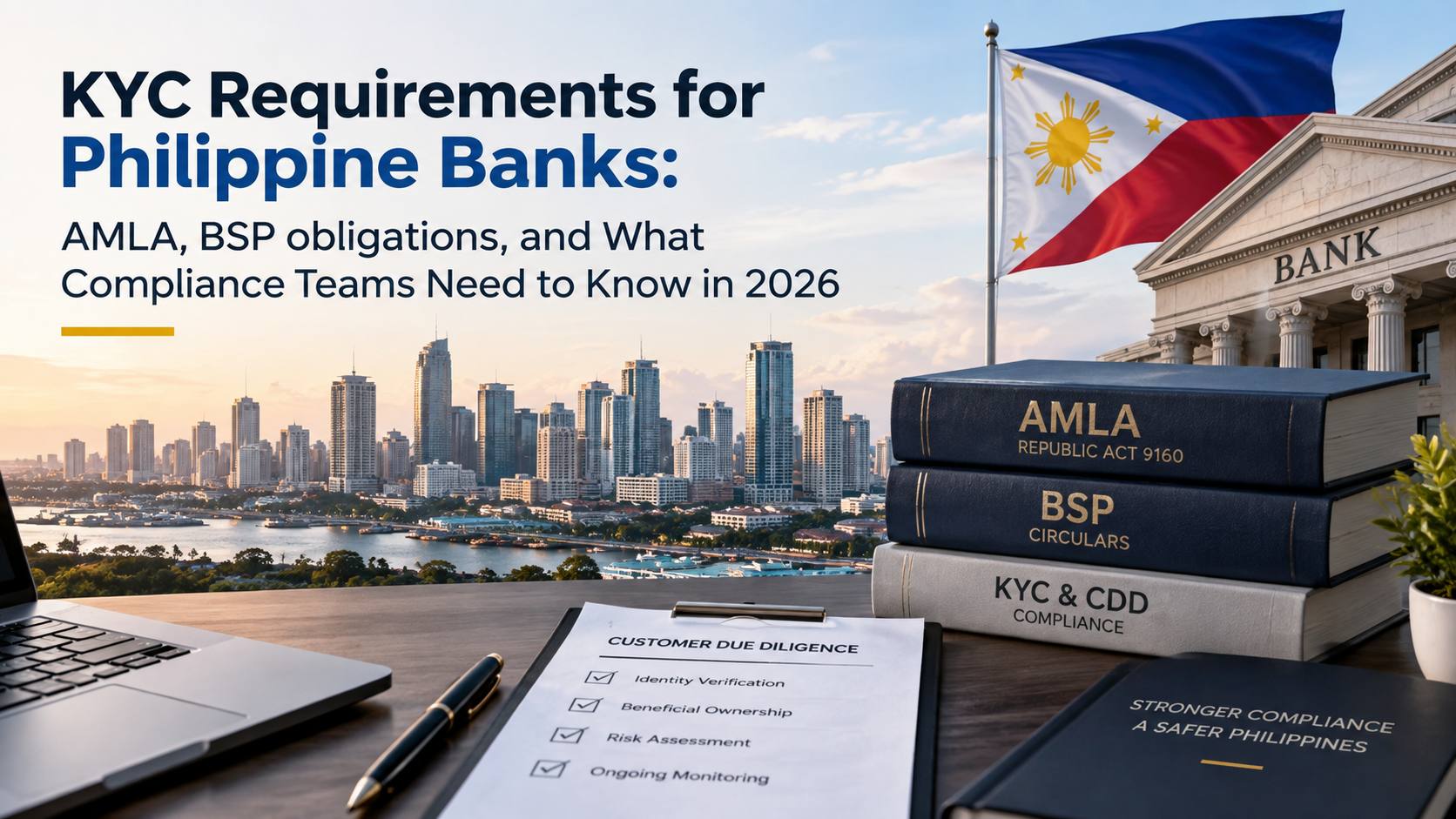
KYC Requirements for Philippine Banks: AMLA, BSP obligations, and What Compliance Teams Need to Know in 2026
The Philippines was removed from the FATF list of jurisdictions under increased monitoring in February 2025. This guide explains current AMLA and BSP KYC/CDD requirements for banks, including beneficial ownership, digital onboarding, reporting and record retention.
KYC Requirements for Philippine Banks: AMLA, BSP obligations, and What Compliance Teams Need to Know in 2026
The Philippines was removed from the FATF list of jurisdictions under increased monitoring in February 2025. This guide explains current AMLA and BSP KYC/CDD requirements for banks, including beneficial ownership, digital onboarding, reporting and record retention.