

From Alert to Closure: AML Case Management Software That Actually Works for Philippine Banks
.svg)
An alert is only the beginning. What happens next defines compliance.
Introduction
Every AML programme generates alerts. The real question is what happens after.
An alert that sits unresolved is risk. An alert reviewed inconsistently is regulatory exposure. An alert closed without clear documentation is a governance weakness waiting to surface in an audit.
In the Philippines, where transaction volumes are rising and digital banking is accelerating, the number of AML alerts continues to grow. Monitoring systems may be improving in precision, but investigative workload remains significant.
This is where AML case management software becomes central to operational effectiveness.
For banks in the Philippines, case management is no longer a simple workflow tool. It is the backbone that connects transaction monitoring, watchlist screening, risk assessment, and regulatory reporting into a unified and defensible process.
Done well, it strengthens compliance while improving efficiency. Done poorly, it becomes a bottleneck that undermines even the best detection systems.

Why Case Management Is the Hidden Pressure Point in AML
Most AML discussions focus on detection technology. However, detection is only the first step in the compliance lifecycle.
After an alert is generated, institutions must:
- Review and analyse the activity
- Document investigative steps
- Escalate when required
- File suspicious transaction reports (STRs)
- Maintain audit trails
- Ensure consistent decision-making
Without structured case management, these steps become fragmented.
Investigators rely on emails, spreadsheets, and manual notes. Escalation pathways become unclear. Documentation quality varies across teams. Audit readiness suffers.
AML case management software addresses these operational weaknesses by standardising workflows and centralising information.
The Philippine Banking Context
Philippine banks operate in a rapidly expanding financial ecosystem.
Digital wallets, QR payments, cross-border remittances, and fintech integrations contribute to rising transaction volumes. Real-time payments compress decision windows. Regulatory scrutiny continues to strengthen.
This combination creates operational strain.
Alert volumes increase. Investigative timelines tighten. Documentation standards must remain robust. Regulatory reviews demand evidence of consistent processes.
In this environment, AML case management software must do more than track cases. It must streamline decision-making without compromising governance.
What AML Case Management Software Actually Does
At its core, AML case management software provides a structured framework to manage the lifecycle of suspicious activity alerts.
This includes:
- Case creation and assignment
- Workflow routing and escalation
- Centralised documentation
- Evidence management
- Risk scoring and prioritisation
- STR preparation and filing
- Audit trail generation
Modern systems integrate directly with transaction monitoring and watchlist screening platforms, ensuring alerts automatically convert into structured cases.
The goal is consistency, traceability, and efficiency.
Common Challenges Without Dedicated Case Management
Banks that rely on fragmented systems encounter predictable problems.
Inconsistent Investigative Standards
Different investigators document findings differently. Decision rationales vary. Regulatory defensibility weakens.
Slow Escalation
Manual routing delays case progression. High-risk alerts may not receive timely attention.
Poor Audit Trails
Scattered documentation makes regulatory reviews stressful and time-consuming.
Investigator Fatigue
Administrative overhead consumes time that should be spent analysing risk.
AML case management software addresses each of these challenges systematically.
Key Capabilities Banks Should Look For
When evaluating AML case management software, Philippine banks should prioritise several core capabilities.
Structured Workflow Automation
Clear, rule-based routing ensures cases move through defined stages without manual intervention.
Risk-Based Prioritisation
High-risk cases should surface first, allowing teams to allocate resources effectively.
Centralised Evidence Repository
All documentation, transaction details, screening results, and analyst notes should reside in one secure location.
Integrated STR Workflow
Preparation and filing of suspicious transaction reports should occur within the same environment.
Performance and Scalability
As alert volumes increase, performance must remain stable.
Governance and Auditability
Every action must be logged and traceable.
From Manual Review to Intelligent Case Handling
Traditional case management systems function primarily as digital filing cabinets.
Modern AML case management software must go further.
It should assist investigators in:
- Identifying key risk indicators
- Highlighting behavioural patterns
- Comparing similar historical cases
- Ensuring documentation completeness
- Standardising investigative reasoning
Intelligence-led case management reduces variability and improves consistency across teams.
How Tookitaki Approaches AML Case Management
Within Tookitaki’s FinCense platform, AML case management is embedded into the broader Trust Layer architecture.
It is not a disconnected module. It is tightly integrated with:
- Transaction monitoring
- Watchlist screening
- Risk assessment
- STR reporting
Alerts convert seamlessly into structured cases. Investigators access enriched context automatically. Risk-based prioritisation ensures critical cases surface first.
This integration reduces friction between detection and investigation.
Reducing Operational Burden Through Intelligent Automation
Banks deploying intelligence-led compliance platforms have achieved measurable operational improvements.
These include:
- Significant reductions in false positives
- Faster alert disposition
- Improved alert quality
- Stronger documentation consistency
Automation supports investigators without replacing them. It handles administrative steps while allowing analysts to focus on risk interpretation.
In high-volume environments, this distinction is critical.
The Role of Agentic AI in Case Management
Tookitaki’s FinMate, an Agentic AI copilot, enhances investigative workflows.
FinMate assists by:
- Summarising transaction histories
- Highlighting behavioural deviations
- Structuring narrative explanations
- Identifying relevant risk indicators
- Supporting consistent decision documentation
This reduces review time and improves clarity.
As transaction volumes grow, investigator augmentation becomes essential.

Regulatory Expectations and Audit Readiness
Regulators increasingly evaluate not just whether alerts were generated, but how cases were handled.
Banks must demonstrate:
- Clear escalation pathways
- Consistent decision standards
- Comprehensive documentation
- Timely STR filing
- Strong internal controls
AML case management software supports these requirements by embedding governance into workflows.
Audit trails become automated rather than retroactively assembled.
A Practical Scenario: Case Management at Scale
Consider a Philippine bank processing millions of transactions daily.
Transaction monitoring systems generate thousands of alerts weekly. Without structured case management, investigators struggle to prioritise effectively. Documentation varies. Escalation delays occur.
After implementing integrated AML case management software:
- Alerts are prioritised automatically
- Cases route through defined workflows
- Documentation templates standardise reporting
- STR filing integrates directly
- Investigation timelines shorten
Operational efficiency improves while governance strengthens.
This is the difference between case tracking and case management.
Connecting Case Management to Enterprise Risk
AML case management software should also provide insight at the portfolio level.
Compliance leaders should be able to assess:
- Case volumes by segment
- Investigation timelines
- Escalation rates
- STR filing trends
- Investigator workload distribution
This visibility supports strategic resource planning and risk mitigation.
Without analytics, case management becomes reactive.
Future-Proofing AML Case Management
As financial ecosystems become more digital and interconnected, AML case management software will evolve to include:
- Real-time collaboration tools
- Integrated FRAML intelligence
- AI-assisted decision support
- Cross-border case linking
- Predictive risk insights
Institutions that invest in scalable and integrated platforms today will be better prepared for future regulatory and operational demands.
Why Case Management Is a Strategic Decision
AML case management software is often viewed as an operational upgrade.
In reality, it is a strategic investment.
It determines whether detection efforts translate into defensible action. It influences regulatory confidence. It impacts investigator morale. It shapes operational efficiency.
In high-growth markets like the Philippines, where compliance complexity continues to rise, structured case management is no longer optional.
It is foundational.
Conclusion
AML case management software sits at the centre of effective compliance.
For banks in the Philippines, rising transaction volumes, digital expansion, and increasing regulatory expectations demand structured, intelligent, and scalable workflows.
Modern case management software must integrate seamlessly with detection systems, prioritise risk effectively, automate documentation, and support investigators with contextual intelligence.
Through FinCense, supported by FinMate and enriched by the AFC Ecosystem, Tookitaki provides an integrated Trust Layer that transforms case handling from a manual process into an intelligent compliance engine.
An alert may begin the compliance journey.
Case management determines how it ends.
Experience the most intelligent AML and fraud prevention platform
Experience the most intelligent AML and fraud prevention platform
Experience the most intelligent AML and fraud prevention platform
Top AML Scenarios in ASEAN
The Role of AML Software in Compliance
The Role of AML Software in Compliance
Talk to an Expert
Our Thought Leadership Guides


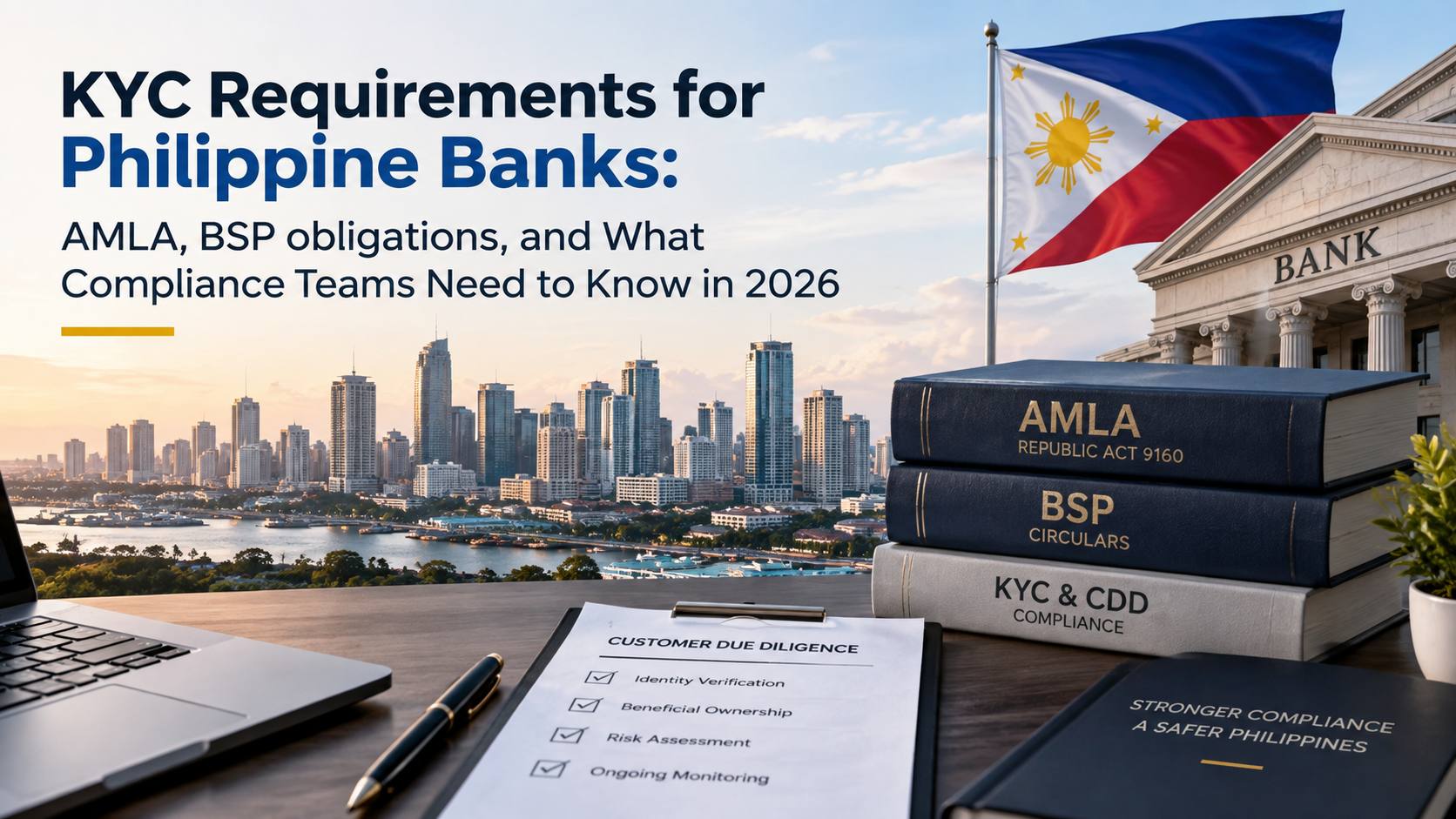
KYC Requirements for Philippine Banks: AMLA, BSP obligations, and What Compliance Teams Need to Know in 2026
The Philippines was removed from the FATF list of jurisdictions under increased monitoring in February 2025. This guide explains current AMLA and BSP KYC/CDD requirements for banks, including beneficial ownership, digital onboarding, reporting and record retention.
KYC Requirements for Philippine Banks: AMLA, BSP obligations, and What Compliance Teams Need to Know in 2026
The Philippines was removed from the FATF list of jurisdictions under increased monitoring in February 2025. This guide explains current AMLA and BSP KYC/CDD requirements for banks, including beneficial ownership, digital onboarding, reporting and record retention.