Banking on Trust: How Modern AML Solutions Are Redefining Compliance for Banks
.svg)
For banks, AML is no longer just about compliance. It is about trust, resilience, and long-term relevance.
Introduction
Banks sit at the very centre of the financial system. They move capital across borders, enable economic growth, and safeguard public confidence in money itself. Because of this central role, banks also carry the highest expectations when it comes to preventing money laundering and financial crime.
In the Philippines, these expectations have intensified. Digital banking adoption has accelerated, transaction volumes have surged, and cross-border payment activity has expanded rapidly. At the same time, financial crime has become more sophisticated. Criminal networks now exploit speed, scale, and technology to move illicit funds through legitimate banking channels with alarming efficiency.
Against this backdrop, traditional AML approaches are showing their limits. Many banks still rely on fragmented systems, rigid rules, and heavily manual investigations. These approaches struggle to keep pace with modern threats and increasing regulatory scrutiny.
This is why AML solutions for banks are undergoing a fundamental transformation. Today’s leading platforms are intelligence-driven, integrated, and built to operate at banking scale. They do not simply help banks comply with regulations. They help banks protect trust, strengthen governance, and operate with confidence in a fast-changing risk environment.

Why Banks Face a Different AML Reality
AML is important for every financial institution, but banks operate under a different level of exposure and accountability.
Banks typically manage high transaction volumes across retail, corporate, and institutional customers. They support complex products such as trade finance, correspondent banking, treasury services, and cross-border remittances. These activities make banks attractive targets for criminals seeking to legitimise illicit funds.
At the same time, regulatory expectations for banks are significantly higher. Supervisors expect banks to demonstrate not only that controls exist, but that they are effective, well governed, and continuously improved. Failures in AML can result in severe penalties, reputational damage, and loss of public confidence.
For banks, AML is not a peripheral function. It is a core pillar of operational resilience and institutional credibility. As financial crime becomes more complex and interconnected, banks need AML solutions that are built specifically for their scale, risk profile, and regulatory environment.
The Limits of Traditional AML Systems in Banks
Many banks have invested heavily in AML technology over the years. However, these investments have often resulted in a patchwork of tools rather than a cohesive system.
One common challenge is fragmentation. Screening, transaction monitoring, customer risk scoring, case management, and reporting are frequently handled by separate systems. Investigators and compliance teams must move between platforms, manually consolidate information, and reconstruct the full context of a case.
Another issue is alert overload. Rule-heavy monitoring systems generate large volumes of alerts, many of which are low risk or false positives. Investigators spend more time clearing noise than analysing genuinely suspicious behaviour.
Manual processes further compound the problem. Case reviews, evidence collection, and reporting often rely on spreadsheets and documents maintained outside the core system. This slows investigations and makes consistency difficult to maintain across teams and business units.
Perhaps most importantly, traditional systems struggle to demonstrate effectiveness. Regulators increasingly ask not just whether alerts were generated, but whether the system meaningfully reduced risk. Legacy tools are poorly equipped to answer this question clearly.
These challenges are structural rather than operational. They point to the need for a new generation of AML solutions designed specifically for the realities of modern banking.
What Modern AML Solutions for Banks Look Like
Modern AML solutions for banks are fundamentally different from the systems of the past. They are not collections of isolated modules, but integrated platforms designed to support the entire AML lifecycle.
At their core, these solutions combine data, intelligence, and automation. They ingest information from across the bank, analyse behaviour in context, and support consistent decision-making at scale.
A modern AML platform for banks typically provides end-to-end coverage, from onboarding and screening through transaction monitoring, investigations, and regulatory reporting. It operates in near real time, adapts to changing risk patterns, and provides clear explanations for its outputs.
Equally important, modern AML solutions are designed with governance in mind. They provide transparency into how risk is assessed, how decisions are made, and how controls perform over time. This level of visibility is essential for meeting supervisory expectations and supporting board-level oversight.
Core Capabilities Banks Should Expect from AML Solutions
When evaluating AML solutions, banks should look beyond feature lists and focus on capabilities that directly address operational and regulatory realities.
Advanced Transaction Monitoring at Scale
Banks require monitoring systems that can handle large transaction volumes without sacrificing accuracy. Modern solutions use advanced analytics and machine learning to identify suspicious patterns while significantly reducing false positives. This allows investigators to focus on meaningful risk rather than routine activity.
Dynamic Customer Risk Scoring
Customer risk is not static. Modern AML solutions continuously update risk scores based on behaviour, transaction activity, and emerging typologies. This ensures that high-risk customers are identified early and managed appropriately.
Intelligent Case Management
Effective investigations depend on context. Modern case management tools bring together alerts, customer information, transaction history, and related entities into a single, coherent view. This enables investigators to understand the full picture quickly and make consistent decisions.
Explainable AI for Regulatory Confidence
As banks adopt more advanced analytics, explainability becomes critical. Regulators expect banks to understand and justify how AI-driven models influence decisions. Leading AML solutions embed explainability into every layer, ensuring transparency and accountability.
Evolving Scenario and Typology Coverage
Financial crime evolves constantly. Banks need AML solutions that can incorporate new scenarios and typologies quickly, without lengthy redevelopment cycles. This adaptability is essential for staying ahead of emerging threats.
Seamless Integration Across Banking Systems
AML solutions must integrate smoothly with core banking platforms, digital channels, payment systems, and data warehouses. Strong integration reduces manual work and ensures a consistent view of risk across the institution.
Operational Efficiency with Lower False Positives
Ultimately, effectiveness and efficiency must go hand in hand. Modern AML solutions reduce operational burden while improving detection quality, allowing banks to scale compliance without proportionally increasing costs.
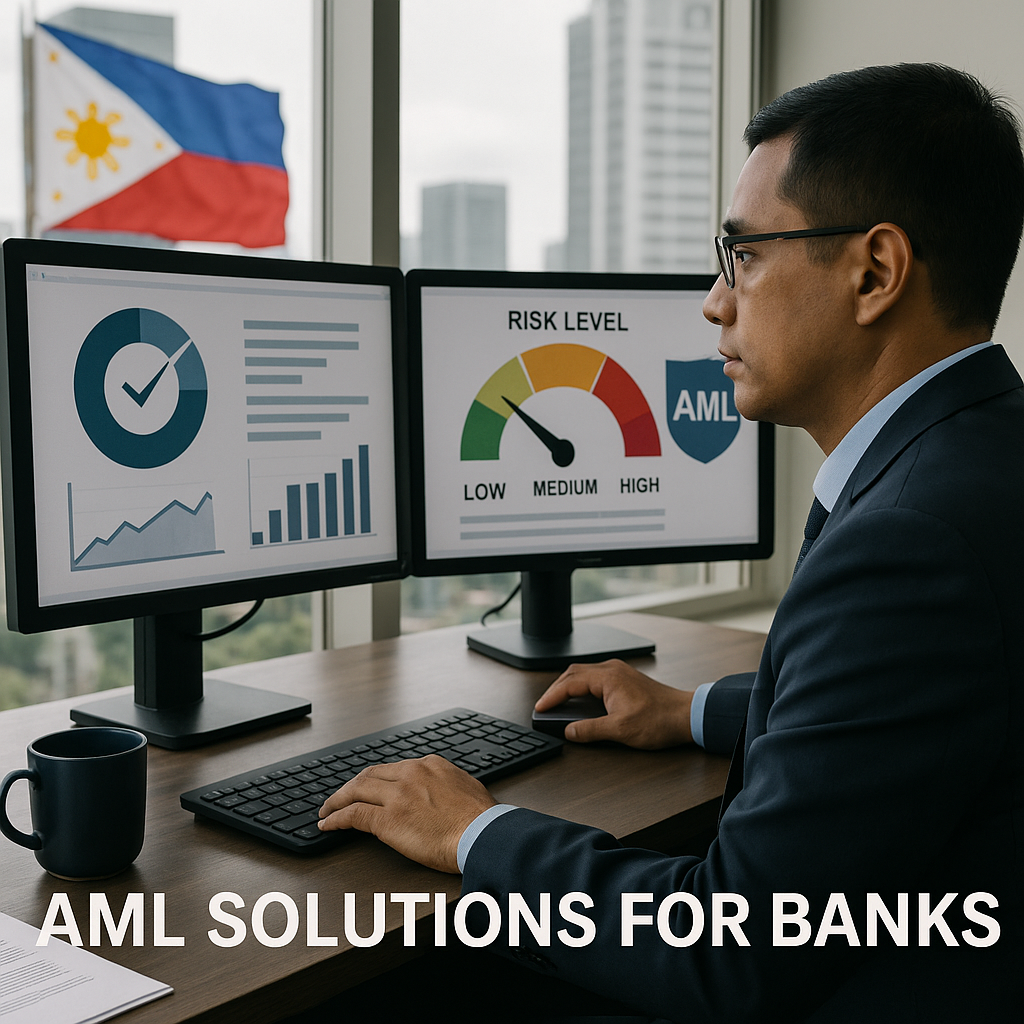
Tookitaki’s Approach to AML Solutions for Banks
Tookitaki approaches AML for banks with a clear philosophy: compliance must be intelligent, explainable, and built on collaboration.
At the heart of Tookitaki’s offering is FinCense, an end-to-end AML platform designed to support banks across the full compliance lifecycle. FinCense brings together transaction monitoring, name screening, dynamic risk scoring, case management, and governance into a single, integrated system.
Rather than relying solely on static rules, FinCense applies advanced analytics and machine learning to identify risk patterns with greater precision. This helps banks reduce alert volumes while improving detection quality.
Tookitaki also introduces FinMate, an Agentic AI copilot that supports investigators and risk teams. FinMate assists by summarising cases, explaining risk drivers, highlighting anomalies, and responding to natural-language queries. This reduces investigation time and improves consistency across teams.
A key differentiator for Tookitaki is the AFC Ecosystem, a collaborative intelligence network where financial crime experts contribute real-world typologies, scenarios, and red flags. These insights continuously enhance FinCense, allowing banks to benefit from collective intelligence without sharing sensitive data.
Together, these capabilities position Tookitaki as a trust layer for banks, helping them move from reactive compliance to proactive risk management.
Case Scenario: How a Bank Strengthens Its AML Framework
Consider a mid-to-large bank operating across multiple regions in the Philippines. The bank faces rising transaction volumes, increased digital adoption, and growing regulatory scrutiny.
Before modernising its AML framework, the bank struggled with high alert volumes, slow investigations, and limited visibility across business units. Investigators spent significant time reconciling data from different systems, and management found it difficult to obtain a clear view of enterprise-wide risk.
After implementing a modern AML platform, the bank achieved meaningful improvements. Alert quality improved as advanced analytics reduced false positives. Investigations became faster and more consistent due to unified case views and AI-assisted analysis. Risk dashboards provided management with clear, real-time insights into exposure across products and customer segments.
Perhaps most importantly, regulatory interactions became more constructive. The bank was able to demonstrate not just that controls existed, but that they were effective, well governed, and continuously enhanced.
How Modern AML Solutions Support Regulatory Expectations
Regulatory expectations for banks in the Philippines continue to evolve. Supervisors increasingly focus on effectiveness, governance, and the maturity of the risk-based approach.
Modern AML solutions directly support these expectations by providing continuous risk monitoring rather than periodic assessments. They enable banks to demonstrate how risk scores are derived, how alerts are prioritised, and how decisions are documented.
Strong audit trails, explainable analytics, and consistent workflows make it easier for banks to respond to supervisory queries and internal audits. Instead of preparing ad-hoc explanations, banks can rely on built-in transparency.
This shift from reactive reporting to proactive governance is a key advantage of modern AML platforms.
Benefits of AML Solutions Designed for Banks
Banks that adopt modern AML solutions experience benefits that extend well beyond compliance.
They reduce regulatory risk by strengthening detection accuracy and governance. They lower operational costs by automating manual processes and reducing false positives. They accelerate investigations and improve team productivity. They enhance customer experience by minimising unnecessary friction. They provide senior management with clear, actionable visibility into risk.
Most importantly, they reinforce trust. In an environment where confidence in financial institutions is critical, strong AML capabilities become a strategic asset rather than a cost centre.
The Future of AML in Banking
AML in banking is entering a new phase. The future will be defined by intelligence-led systems that operate continuously, adapt quickly, and support human decision-making rather than replace it.
We will see greater convergence between AML and fraud platforms, enabling a unified view of financial crime risk. Agentic AI will play a growing role in assisting investigators, risk officers, and compliance leaders. Collaborative intelligence will help banks stay ahead of emerging threats across regions.
Banks that invest in modern AML solutions today will be better positioned to navigate this future with confidence.
Conclusion
Banks cannot afford to rely on fragmented, outdated AML systems in a world of fast-moving financial crime. Modern AML solutions for banks provide the integration, intelligence, and transparency required to meet regulatory expectations and protect institutional trust.
With platforms like Tookitaki’s FinCense, supported by FinMate and enriched by the AFC Ecosystem, banks can move beyond checkbox compliance and build resilient, future-ready AML frameworks.
In an increasingly complex financial landscape, the banks that succeed will be those that treat AML not as an obligation, but as a foundation for trust and sustainable growth.
Experience the most intelligent AML and fraud prevention platform
Experience the most intelligent AML and fraud prevention platform
Experience the most intelligent AML and fraud prevention platform
Top AML Scenarios in ASEAN
The Role of AML Software in Compliance
The Role of AML Software in Compliance