Reducing False Positives in Transaction Monitoring: A Practical Playbook
.svg)
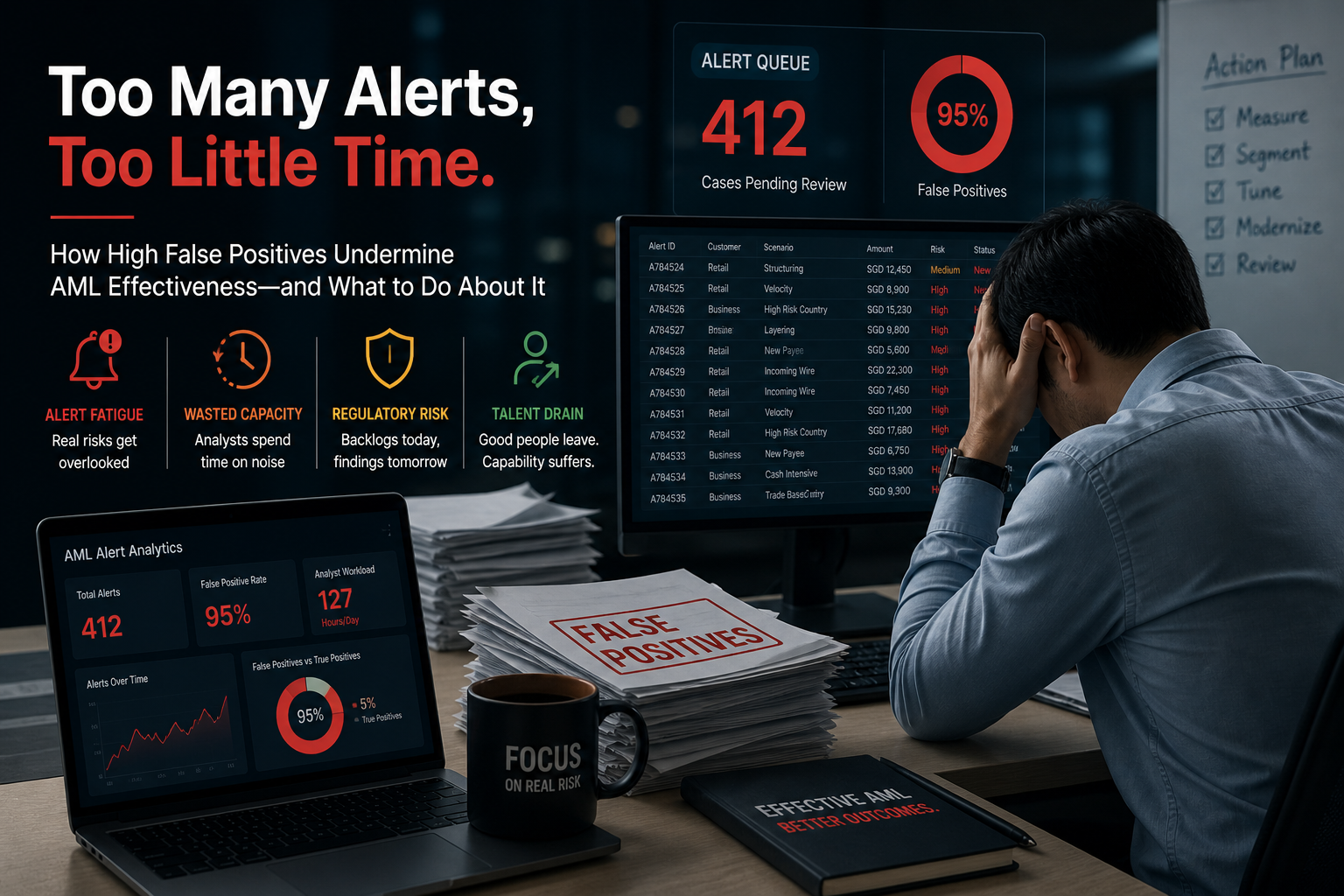
It is 9:30 on a Tuesday. The overnight batch run has finished. The alert queue shows 412 cases requiring review. Your team of five analysts has roughly six hours of productive investigation time between them today.
Do the arithmetic: each analyst needs to process 82 alerts to clear the queue before the next batch runs. At 20 minutes per alert — if the review is thorough — that is 27 hours of work for five people. It cannot be done properly. It will not be done properly.
And buried somewhere in those 412 alerts are the 20 or so that actually matter.
This is not a hypothetical. APAC compliance teams at banks, payment service providers, and fintechs describe exactly this operating reality. The false positive transaction monitoring problem is not a technical metric — it is a daily management failure that compounds over time. Analysts triage faster to survive the queue. The real signals get the same two-minute review as the noise. The programme that exists on paper bears no resemblance to what actually happens.
This article is not about what false positives are. If you are reading this, you know. It is about the cost of living with a high AML false positive rate — and the five practical steps that compliance teams use to bring it down.

What a High False Positive Rate Actually Costs
The standard complaint about transaction monitoring alert fatigue is that it wastes analyst time. That framing understates the problem.
Analyst capacity: the numbers are stark. At a 95% false positive rate with 400 alerts per day, 380 are dead ends. At 20 minutes per alert — which is the minimum for a documented, defensible triage — that is 127 analyst-hours per day spent reviewing noise. A compliance team needs approximately 16 full-time analysts doing nothing but alert triage to manage that volume at an adequate standard. Most APAC institutions have two to five.
Missed genuine signals: the hidden cost. The real damage is not the wasted hours — it is what happens to the 20 genuine alerts buried in 380 false ones. When analysts are clearing a 400-alert queue with limited capacity, they cannot give each case appropriate attention. The suspicious transaction that warrants a 90-minute EDD review gets the same 3 minutes as the noise around it. Alert fatigue is not just inefficiency. It is a mechanism for missing financial crime.
Regulatory exposure: backlogs are a finding. AUSTRAC's examination methodology includes review of alert disposition quality and queue backlogs. A compliance programme with a permanent backlog — where cases are not being reviewed within a defensible timeframe — is a programme finding, not merely an operational concern. MAS Notice 626 similarly expects that suspicious transaction monitoring is effective, not just that a system exists. Regulators in both jurisdictions have cited inadequate alert review as an examination failure in enforcement actions. The AML false positive rate problem is a regulatory risk, not a process inefficiency.
Staff turnover: the compounding effect. AML analysts in APAC are in short supply, and the shortage is getting worse as the regulated population expands under frameworks like Australia's Tranche 2 reforms and Singapore's digital banking licensing regime. A team that spends 90% of its time closing dead-end alerts has a retention problem. The analysts who leave are the ones with enough experience to find a role where their work matters. The ones who stay become less effective over time. Institutional knowledge walks out the door.
Why Rule-Based Systems Generate High False Positive Rates
Before addressing the fix, the cause.
Most transaction monitoring platforms in production at APAC banks and payment firms are built primarily on rules — logic statements that fire when a transaction crosses a defined threshold. The problem is not that rules are wrong. Rules are appropriate for known, well-defined typologies. The problem is structural.
Rules go stale. A rule calibrated for the institution's customer population in 2022 reflects transaction patterns from 2022. Customer behaviour changes. New products get launched. Regulatory requirements shift what customers route through which channels. A threshold that was appropriately sensitive at go-live will generate noise within 18 months if it is not recalibrated.
Rules ignore the customer. A rule firing on any international wire above $50,000 treats every customer the same. A high-net-worth client sending a monthly transfer to an offshore investment account triggers the same alert as a newly opened retail account sending the same pattern. The transaction looks identical to the rule — the context is invisible.
Rules cannot anticipate new typologies. When authorised push payment (APP) scams emerged as a dominant fraud vector across Australia and Singapore, every existing rule threshold started triggering on the pattern before teams had time to tune. The spike in false positives from a new typology can last months before calibration catches up.
Vendor defaults are not institution-specific. A transaction monitoring system configured on vendor-default thresholds is calibrated for an imagined average institution — not the specific customer base, geography, and product mix of the institution running it. AUSTRAC has explicitly noted this in published guidance. Running on defaults is not a defensible position under examination.
Five Practical Steps to Reduce False Positives
Step 1: Measure What You Actually Have
You cannot reduce something you have not measured.
Most compliance teams know their total daily alert volume. Few have a breakdown of false positive rate by alert scenario, by customer segment, and by transaction channel. That breakdown is the starting point for any calibration effort.
Pull the last 90 days of alert data. For each alert scenario, calculate the ratio of alerts closed without further action to alerts that progressed to an STR or EDD. That ratio is your scenario-level false positive rate. You will find three or four scenarios generating the majority of your noise — and those are the calibration targets.
This analysis also tells you which scenarios are genuinely earning their place in the rule library and which are generating alerts that no analyst has been able to explain in 12 months. You need that data before you touch a single threshold.
Step 2: Segment by Customer Risk Profile
The same transaction looks different depending on who is sending it.
A rule that fires on any international wire above $50,000 will generate noise for high-net-worth clients and genuine signals for retail customers. The rule is not wrong — it is not differentiated. Risk-segmenting your alert thresholds means applying different parameters to different customer risk tiers.
For a high-net-worth client with a documented wealth source, a history of international transactions, and a stated investment mandate, the threshold for that wire scenario should be materially higher than for a retail account with six months of history. A single institution-wide threshold is a blunt instrument.
This is one of the highest-impact single changes a compliance team can make without replacing its transaction monitoring platform. It requires access to customer risk classification data and the ability to apply segmented parameters — which most modern TM systems support but which most institutions have not configured.
Step 3: Retire Stale Rules
Most transaction monitoring systems accumulate rules over time. New typologies get added. Old ones are almost never removed.
A rule written in 2019 for a fraud pattern that no longer applies is generating alerts that analysts close on sight — and generating them reliably, every batch run, because the condition is always met. That rule is not protecting the institution. It is consuming analyst capacity.
Run an audit of the full rule library. For any scenario with a false positive rate above 98% and zero genuine catches in the past 12 months, retire the rule. Document the decision, the data that supports it, and the review date. AUSTRAC expects evidence that alert thresholds are actively managed — a retirement decision with supporting data is better evidence than a rule that has been silently ignored for three years.
This is standard hygiene. Most compliance teams have not done it because calibration work is not glamorous and implementation backlogs are long.
Step 4: Move from Rules-Only to Hybrid Detection
Rules are deterministic. They fire when conditions are met, regardless of context. A hybrid system combines rules for known, well-defined typologies with behaviour-based models that evaluate the transaction in context.
Machine learning models can factor in variables that rules cannot: the customer's transaction history, peer group behaviour, time-of-day patterns, the channel the transaction is moving through, and the relationship between recent account activity and the triggering transaction. A $50,000 international wire from an account that has never sent an international wire before looks different from the same wire from an account where this is the 12th such transfer this quarter.
The evidence for hybrid detection is not theoretical. Institutions that have moved from rules-only to hybrid architectures consistently report lower false positive rates and higher genuine detection rates simultaneously. Reducing false positives and improving detection quality are not in tension — they move together when the underlying detection logic is more precise.
Both AUSTRAC and MAS have signalled that rules-only monitoring is no longer sufficient for modern financial crime patterns. MAS's guidance on technology risk management and the application of technology-enabled controls is explicit on this point. AUSTRAC's 2023–24 enforcement priorities referenced the need for institutions to move beyond static threshold monitoring. For a complete picture of what modern detection architecture looks like, the complete guide to transaction monitoring covers the detection models in detail.
Step 5: Build Calibration Into Operations, Not Just Implementation
False positive rates drift upward when thresholds are not actively maintained. The calibration done at go-live will not hold for two years.
Build a quarterly calibration review into the compliance programme as a standing process. The review should cover the 10 highest-volume alert scenarios, compare the false positive rate trend over the past quarter, and document threshold adjustments with supporting rationale. The output of each review should be a calibration log entry — a record that the programme is being actively managed.
This documentation serves two purposes. First, it reduces false positive rates by catching threshold drift early. Second, it provides examination evidence. When AUSTRAC or MAS asks for evidence that alert thresholds are calibrated to the institution's risk profile, a quarterly calibration log with supporting data is a substantive answer. A vendor configuration file from 2022 is not.
What Good Looks Like
A well-calibrated AI-augmented transaction monitoring system should achieve below 85% false positive rate in production. That is not a theoretical benchmark — it is the range that production deployments demonstrate when detection architecture combines rules with behaviour-based models and thresholds are actively maintained.
Tookitaki's FinCense has reduced false positive rates by up to 50% compared to legacy rule-based systems in production deployments across APAC institutions. For a compliance team managing 400 alerts per day, a 50% reduction means approximately 200 fewer dead-end investigations daily. That capacity does not disappear — it goes to genuine risk review, EDD interviews, and STR quality.
The federated learning architecture behind FinCense addresses a detection gap that no single institution can close alone. Coordinated mule account activity typically moves between institutions — a pattern no individual bank can see in its own data. Detection models trained across a network of institutions make that cross-institution pattern visible. This is why the reduction in false positives and the improvement in genuine detection occur together: the models are trained on a broader signal set than any single institution's transaction history.
For the full vendor evaluation framework — including the specific questions to ask about false positive performance benchmarks, calibration support, and APAC regulatory alignment — see our Transaction Monitoring Software Buyer's Guide.
If your team is managing a 90%+ false positive rate and the operational picture described in this article is familiar, the starting point is a benchmarking conversation — not a full platform replacement. Book a demo to see FinCense's false positive benchmarks from comparable APAC deployments and get a calibration assessment against your current alert volumes.
Experience the most intelligent AML and fraud prevention platform
Experience the most intelligent AML and fraud prevention platform
Experience the most intelligent AML and fraud prevention platform
Top AML Scenarios in ASEAN
The Role of AML Software in Compliance
The Role of AML Software in Compliance