

The Complete AML Software Guide for Banks and Financial Institutions
.svg)
AML software is no longer just a compliance requirement. It is a core system that determines how effectively banks detect risk, protect customers, and operate with confidence.
Introduction
Anti money laundering compliance has changed dramatically over the past decade. What was once a largely rules driven, reactive process is now a complex, intelligence led discipline shaped by real time payments, evolving criminal behaviour, and increasing regulatory expectations.
At the centre of this shift sits AML software.
For banks, credit unions, fintechs, and regulated financial institutions, AML software is no longer just a monitoring tool. It is the engine that connects customer risk assessment, transaction monitoring, investigations, regulatory reporting, and governance into a single operational framework.
This guide explains what AML software actually does in modern financial institutions, how it is used day to day, where legacy systems fall short, and what organisations should look for when evaluating modern AML platforms. It is written for compliance leaders, operations teams, and decision makers who want clarity rather than marketing language.

What Is AML Software in Practice
At a high level, AML software helps financial institutions identify, assess, and manage money laundering and related financial crime risks. But that definition only scratches the surface.
In practice, AML software performs five interconnected functions.
1. Customer risk assessment
AML software evaluates customer risk based on factors such as profile characteristics, geographic exposure, product usage, and known risk indicators. This risk assessment influences how closely a customer is monitored over time.
2. Transaction monitoring
The software continuously analyses transactions to identify unusual or suspicious activity. This includes detecting behavioural anomalies, velocity changes, structuring patterns, and potential laundering techniques.
3. Alert generation and prioritisation
When suspicious behaviour is detected, AML software generates alerts and prioritises them based on risk. High quality systems focus on alert relevance, not volume.
4. Investigation and case management
AML software provides tools for investigators to review alerts, analyse context, document findings, and make defensible decisions.
5. Regulatory reporting and auditability
The system supports the preparation of suspicious matter reports and maintains audit trails that demonstrate compliance to regulators.
AML software is therefore not a single module. It is an ecosystem that supports the entire AML lifecycle.
How AML Software Is Used Inside Banks
Understanding how AML software is used day to day helps explain why its quality matters so much.
Continuous monitoring
AML software runs constantly in the background, analysing millions of transactions and behavioural signals. It must operate reliably at scale without disrupting customer activity.
Analyst driven decision making
Alerts generated by AML software are reviewed by analysts who rely on the system to provide context, evidence, and clarity. The software shapes how quickly and accurately decisions can be made.
Ongoing risk management
Customer risk is not static. AML software updates risk profiles as behaviour changes, ensuring that monitoring remains proportionate.
Governance and oversight
Compliance leaders use AML software to track alert volumes, investigation outcomes, reporting timelines, and control effectiveness.
When AML software performs well, teams work with focus and confidence. When it performs poorly, inefficiency and risk multiply quickly.
Why Legacy AML Software Struggles Today
Many institutions still operate AML platforms designed for a very different risk environment. These systems struggle for several reasons.
Static rules
Legacy systems rely heavily on fixed thresholds. Criminals adapt quickly to these rules, reducing their effectiveness.
High false positives
Broad rules generate large volumes of alerts that are ultimately benign. This overwhelms teams and obscures real risk.
Limited behavioural intelligence
Older systems focus on transactions in isolation rather than understanding customer behaviour over time.
Fragmented workflows
Detection, investigation, and reporting often sit in separate tools, forcing analysts to piece together context manually.
Poor explainability
When systems cannot clearly explain why an alert was triggered, tuning becomes difficult and audit exposure increases.
As payments become faster and crime more sophisticated, these limitations become more pronounced.
What Modern AML Software Does Differently
Modern AML software platforms are built to address the realities of today’s financial crime landscape.
Behaviour driven detection
Instead of relying solely on rules, modern AML software analyses how customers normally behave and flags meaningful deviations.
Risk based alerting
Alerts are prioritised based on risk, allowing teams to focus on what matters most.
Integrated case management
Detection and investigation sit within a unified workflow, reducing friction and improving consistency.
Explainable analytics
Risk scores and alerts are transparent, with clear reasoning that supports regulatory scrutiny.
Scalability and performance
Modern platforms handle high transaction volumes and real time payments without degradation.
These capabilities do not eliminate the need for human judgement. They support it.

Core Components of Effective AML Software
While implementations vary, strong AML software typically includes the following components.
Customer risk engine
Establishes and updates risk profiles that influence monitoring intensity.
Transaction monitoring engine
Analyses activity across channels and products.
Alert management
Organises and prioritises alerts for efficient review.
Case management
Provides structured workflows, evidence capture, and decision documentation.
Reporting and audit layer
Supports regulatory reporting and maintains complete audit trails.
The strength of an AML platform depends on how well these components work together.
Regulatory Expectations and AML Software
Regulators do not mandate specific technologies, but they do expect outcomes that AML software must support.
Financial institutions are expected to demonstrate:
- A risk based approach to monitoring
- Clear reasoning behind decisions
- Timely escalation and reporting
- Consistent investigation quality
- Strong governance and auditability
AML software is the primary mechanism through which these expectations are met in practice.
How to Evaluate AML Software
Selecting AML software is a strategic decision with long term implications. Institutions should evaluate platforms across several dimensions.
1. Detection quality
Does the software surface meaningful risk or generate noise.
2. Explainability
Can analysts and auditors understand why alerts were triggered.
3. Operational efficiency
Does the system reduce manual effort and investigation time.
4. Scalability
Can it handle growth in customers, transactions, and complexity.
5. Integration
Does it connect smoothly with existing systems and data sources.
6. Governance
Does it support oversight, reporting, and regulatory interaction.
Evaluations should focus on real operational outcomes, not feature lists.
Common Mistakes Institutions Make
Several mistakes frequently undermine AML software investments.
Treating AML software as a compliance checkbox
This leads to minimal implementations that fail under real pressure.
Over customising rules
Excessive customisation increases complexity and maintenance burden.
Ignoring investigator experience
If analysts struggle to use the system, effectiveness drops quickly.
Failing to revisit models
AML software must evolve continuously as risk changes.
Avoiding these mistakes requires both technology and governance discipline.
The Role of AI in Modern AML Software
AI plays an increasingly important role in AML software, but its value depends on how it is applied.
Effective uses of AI include:
- Detecting subtle behavioural anomalies
- Identifying complex networks
- Supporting alert prioritisation
- Assisting investigators with context and summaries
AI should enhance transparency and control, not replace them. Explainability remains critical.
How AML Software Supports Operational Resilience
AML systems are now considered critical operational infrastructure.
Strong AML software contributes to resilience by:
- Reducing manual dependency
- Supporting consistent processes
- Handling volume spikes during scam waves
- Providing clear evidence during regulatory reviews
This aligns AML more closely with enterprise risk and operational stability.
Where Tookitaki Fits in the AML Software Landscape
Tookitaki approaches AML software as an intelligence driven, end to end platform rather than a collection of disconnected tools.
Through its FinCense platform, institutions can:
- Apply behaviour based detection
- Reduce false positives
- Support consistent investigations
- Maintain clear explainability
- Evolve typologies continuously
This approach supports institutions of varying sizes, including community owned banks such as Regional Australia Bank, in building AML programs that are effective, scalable, and defensible.
The Future of AML Software
AML software continues to evolve as financial crime changes.
Key directions include:
- Greater use of behavioural intelligence
- Stronger integration across fraud and AML
- Increased use of AI assisted investigations
- More emphasis on explainability and governance
- Continuous adaptation rather than periodic upgrades
Institutions that view AML software as a strategic capability rather than a static system will be better positioned for the future.
Conclusion
AML software sits at the heart of modern financial crime prevention. It shapes how risk is detected, how decisions are made, and how institutions demonstrate compliance.
As financial crime grows more complex and regulators demand greater clarity, the quality of AML software becomes a defining factor in a bank’s ability to operate safely and efficiently.
The most effective AML platforms do not simply generate alerts. They provide intelligence, structure, and confidence across the entire compliance lifecycle.
For banks and financial institutions, investing in the right AML software is not just about meeting regulatory expectations. It is about building a resilient, trusted, and future ready organisation.
Experience the most intelligent AML and fraud prevention platform
Experience the most intelligent AML and fraud prevention platform
Experience the most intelligent AML and fraud prevention platform
Top AML Scenarios in ASEAN

The Role of AML Software in Compliance
The Role of AML Software in Compliance
Talk to an Expert
Our Thought Leadership Guides


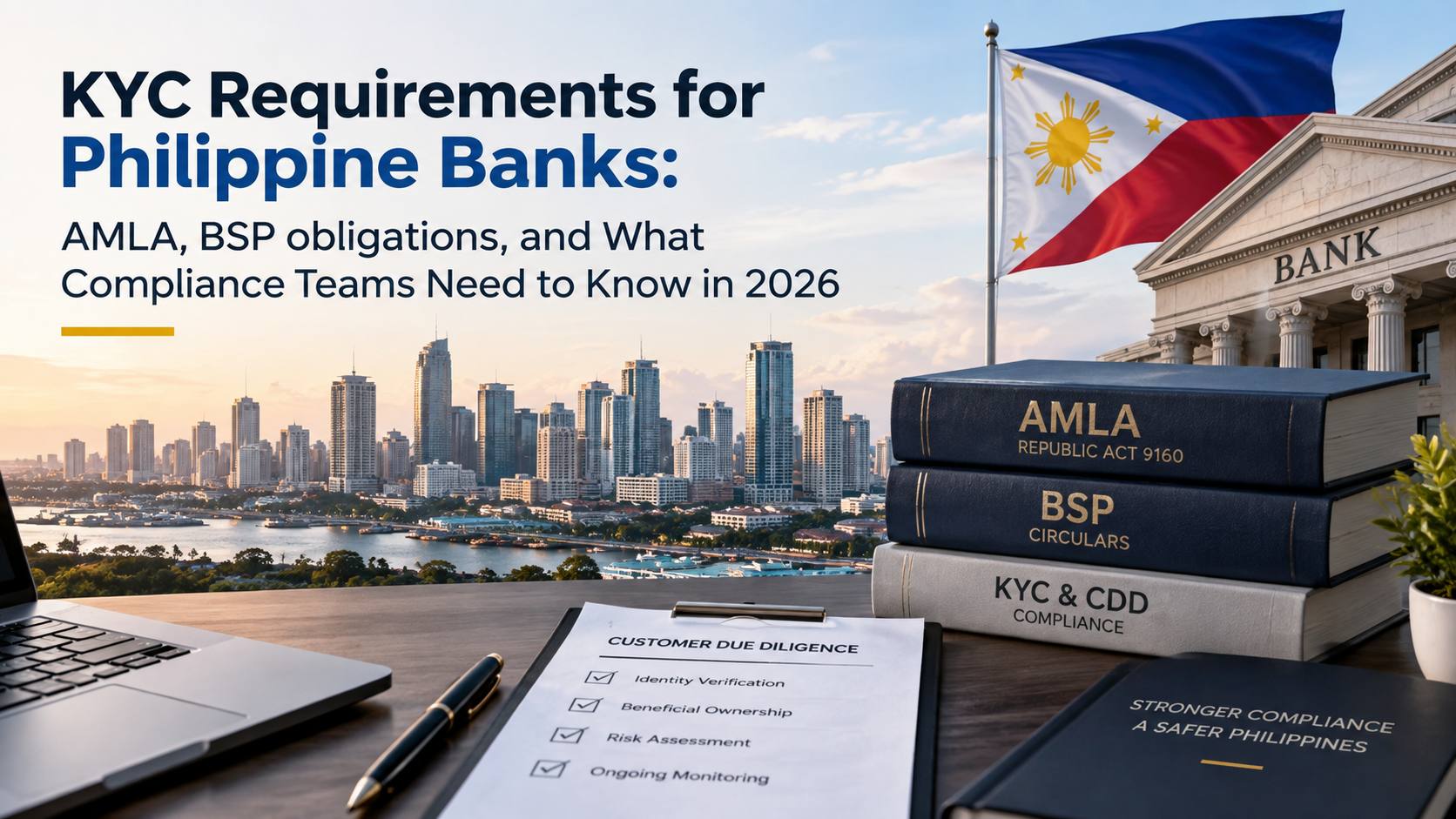
KYC Requirements for Philippine Banks: AMLA, BSP obligations, and What Compliance Teams Need to Know in 2026
The Philippines was removed from the FATF list of jurisdictions under increased monitoring in February 2025. This guide explains current AMLA and BSP KYC/CDD requirements for banks, including beneficial ownership, digital onboarding, reporting and record retention.
KYC Requirements for Philippine Banks: AMLA, BSP obligations, and What Compliance Teams Need to Know in 2026
The Philippines was removed from the FATF list of jurisdictions under increased monitoring in February 2025. This guide explains current AMLA and BSP KYC/CDD requirements for banks, including beneficial ownership, digital onboarding, reporting and record retention.