

From Obligation to Advantage: Rethinking AML Compliance for Modern Financial Institutions
.svg)
AML compliance is no longer a back-office obligation. It is now a frontline risk discipline.
Introduction
Financial institutions today operate in a fast-moving, digitally connected ecosystem where money moves instantly across accounts, platforms, and borders. While this transformation improves access and efficiency, it also creates new opportunities for financial crime. Regulators, customers, and stakeholders now expect institutions to identify suspicious activity early, respond quickly, and maintain strong governance.
This shift has elevated AML compliance from a regulatory requirement to a strategic priority. Banks and fintechs must move beyond manual processes and fragmented systems to implement intelligent, scalable compliance frameworks.
In markets like the Philippines, where digital payments, cross-border remittances, and fintech innovation continue to grow rapidly, AML compliance has become even more critical. Institutions must manage increasing transaction volumes while maintaining visibility into customer behaviour and risk exposure.
Modern AML compliance solutions address this challenge by combining transaction monitoring, screening, risk assessment, and case management into a unified framework. This integrated approach enables financial institutions to detect suspicious activity, reduce false positives, and strengthen regulatory alignment.

The Expanding Scope of AML Compliance
AML compliance today covers far more than transaction monitoring. Financial institutions must manage risk across the entire customer lifecycle.
This includes:
- Customer onboarding and due diligence
- Ongoing monitoring of transactions
- Sanctions and watchlist screening
- PEP screening and adverse media checks
- Risk assessment and scoring
- Investigation and case management
- Suspicious transaction reporting
Each component plays a role in identifying and managing financial crime risk.
Modern AML compliance software integrates these functions into a unified platform. This reduces operational silos and improves decision-making.
AML Compliance Challenges in the Philippines
Banks and fintechs in the Philippines face unique compliance challenges due to rapid financial digitisation.
High Transaction Volumes
Digital banking and instant payment systems generate large volumes of transactions. Monitoring these efficiently requires scalable AML compliance solutions.
Cross-Border Remittance Risk
The Philippines is one of the world’s largest remittance markets. Cross-border transactions increase exposure to money laundering risks.
Rapid Fintech Growth
Fintech innovation accelerates onboarding and payment processing. Compliance systems must adapt to fast customer growth.
Evolving Financial Crime Techniques
Financial crime networks increasingly combine fraud and laundering. AML compliance systems must detect complex patterns.
Regulatory Expectations
Regulators expect risk-based AML compliance frameworks with strong audit trails and reporting.
These factors highlight the need for modern AML compliance platforms.
Why Traditional AML Compliance Approaches Fall Short
Legacy AML compliance systems often rely on static rules and manual workflows. These approaches struggle in modern financial environments.
Common limitations include:
- Excessive false positives
- Manual investigations
- Limited behavioural analysis
- Delayed detection
- Fragmented workflows
- Poor scalability
These issues increase operational costs and reduce compliance effectiveness.
Modern AML compliance software addresses these challenges through automation, AI-driven analytics, and real-time monitoring.
What Modern AML Compliance Solutions Deliver
Next-generation AML compliance platforms provide intelligent risk detection and operational efficiency.
Key capabilities include:
Real-Time Transaction Monitoring
Modern AML compliance systems analyse transactions as they occur. This enables early detection of suspicious activity.
Real-time monitoring helps identify:
- Rapid fund movement
- Structuring patterns
- Mule account activity
- Cross-border laundering
- Suspicious payment flows
Early detection improves compliance outcomes.
Risk-Based Customer Monitoring
Modern AML compliance software applies risk-based models to monitor customers continuously.
Risk scoring considers:
- Customer profile
- Transaction behaviour
- Geographic exposure
- Network relationships
- Historical activity
This helps prioritise high-risk customers.
Integrated Screening Capabilities
AML compliance solutions include screening tools for:
- Sanctions lists
- PEP databases
- Watchlists
- Adverse media
Integrated screening ensures consistent risk evaluation.
Automated Case Management
AML compliance requires structured investigations. Case management tools streamline workflows.
Capabilities include:
- Alert-to-case conversion
- Investigator assignment
- Evidence collection
- Documentation
- Escalation workflows
Automation improves investigation efficiency.
AI-Driven Detection
Artificial intelligence enhances AML compliance by identifying complex patterns.
AI models:
- Reduce false positives
- Detect anomalies
- Identify emerging typologies
- Improve alert prioritisation
These capabilities improve detection accuracy.

AML Compliance for Banks and Fintechs
Banks and fintechs have different operating models, but both face increasing financial crime risk and regulatory pressure.
Banks typically need:
- High-volume transaction monitoring
- Corporate and retail risk assessment
- Cross-border payment oversight
- Strong governance and reporting controls
Fintechs often need:
- Fast onboarding controls
- Real-time payment risk detection
- Scalable compliance workflows
- Digital-first monitoring and screening
AML compliance platforms must support both environments without compromising efficiency or coverage.
Technology Architecture for Modern AML Compliance
Modern AML compliance software is built on scalable, integrated architecture.
Key components include:
- Real-time analytics engines
- AI-driven risk scoring models
- Screening modules
- Case management workflows
- Regulatory reporting tools
Cloud-native deployment allows institutions to process larger transaction volumes while maintaining performance. This architecture supports growth without forcing institutions to rebuild compliance systems every time scale increases.
Why Integration Matters More Than Ever
One of the biggest weaknesses in older AML environments is fragmentation.
Monitoring operates on one system. Screening is managed elsewhere. Investigations happen through email, spreadsheets, or disconnected case tools. This creates delays, duplication, and information gaps.
Integrated AML compliance software connects these functions. Screening results can influence monitoring thresholds. Investigation outcomes can update customer risk profiles. Risk scores can guide case prioritisation.
This integration improves operational efficiency and strengthens control quality across the compliance lifecycle.
AML Compliance Metrics That Matter
Modern AML compliance platforms must do more than exist. They must perform.
The most meaningful outcomes include:
- Lower false positives
- Faster alert reviews
- Higher quality alerts
- Improved investigation consistency
- Better regulatory defensibility
In practice, intelligent AML platforms have helped institutions achieve significant reductions in false positives, faster alert disposition, and stronger quality of investigative outcomes.
These are the metrics that matter because they show whether compliance is improving in substance, not just in process.
How Tookitaki FinCense Supports Modern AML Compliance
Tookitaki’s FinCense is built for this new era of AML compliance. As an AI-native platform, it brings together transaction monitoring, screening, customer risk scoring, and case management into a single environment, helping banks and fintechs strengthen compliance while reducing false positives and improving investigation efficiency.
Positioned as the Trust Layer, FinCense is designed to support real-time prevention and end-to-end AML compliance across high-volume, fast-moving financial ecosystems.
The Role of AI in AML Compliance
AI is transforming AML compliance by enabling adaptive risk detection.
AI capabilities include:
- Behavioural analytics
- Network analysis
- Pattern recognition
- Alert prioritisation
AI-driven AML compliance improves efficiency while reducing false positives. However, intelligence alone is not enough. Compliance teams must also be able to understand and explain why alerts were triggered.
That is why modern AML platforms combine machine learning with transparent risk-scoring frameworks and structured workflows.
Strengthening Regulatory Confidence
Regulators increasingly expect financial institutions to demonstrate strong governance and transparent controls.
AML compliance software helps institutions maintain:
- Structured audit trails
- Clear documentation of alert decisions
- Timely suspicious transaction reporting
- Consistent investigation workflows
These capabilities strengthen regulatory confidence because they show not just that a control exists, but that it is functioning effectively.
Frequently Asked Questions About AML Compliance
What is AML compliance?
AML compliance refers to the policies, controls, and systems financial institutions use to detect and prevent money laundering and related financial crime.
Why is AML compliance important?
AML compliance helps institutions protect the financial system, detect suspicious activity, meet regulatory requirements, and reduce exposure to financial crime risk.
What does AML compliance software do?
AML compliance software helps institutions monitor transactions, screen customers, assess risk, manage investigations, and prepare regulatory reports in a structured and scalable way.
Who needs AML compliance solutions?
Banks, fintechs, payment providers, remittance firms, and other regulated financial institutions all require AML compliance solutions.
How does AML compliance work in the Philippines?
Institutions in the Philippines are expected to implement risk-based AML controls, including monitoring, screening, due diligence, investigation, and regulatory reporting aligned with supervisory expectations.
The Future of AML Compliance
AML compliance will continue evolving as financial ecosystems become more digital.
Future trends include:
- Real-time compliance monitoring
- AI-driven risk prediction
- Integrated fraud and AML detection
- Collaborative intelligence sharing
- Automated regulatory reporting
Institutions that adopt modern AML compliance software today will be better prepared. Compliance is increasingly becoming a strategic differentiator. Institutions that demonstrate strong, scalable, and explainable AML controls build greater trust with customers, regulators, and partners.
Conclusion
AML compliance has evolved from a regulatory checkbox into a strategic necessity. Financial institutions must detect risk early, respond quickly, and maintain consistent governance across increasingly complex financial environments.
Modern AML compliance software enables banks and fintechs to move from reactive monitoring to proactive risk management. By integrating transaction monitoring, screening, AI-driven analytics, and case management, institutions can strengthen compliance while improving operational efficiency.
In rapidly growing financial ecosystems like the Philippines, effective AML compliance is essential for maintaining trust, protecting customers, and supporting sustainable growth.
Experience the most intelligent AML and fraud prevention platform
Experience the most intelligent AML and fraud prevention platform
Experience the most intelligent AML and fraud prevention platform
Top AML Scenarios in ASEAN
The Role of AML Software in Compliance
The Role of AML Software in Compliance
Talk to an Expert
Our Thought Leadership Guides


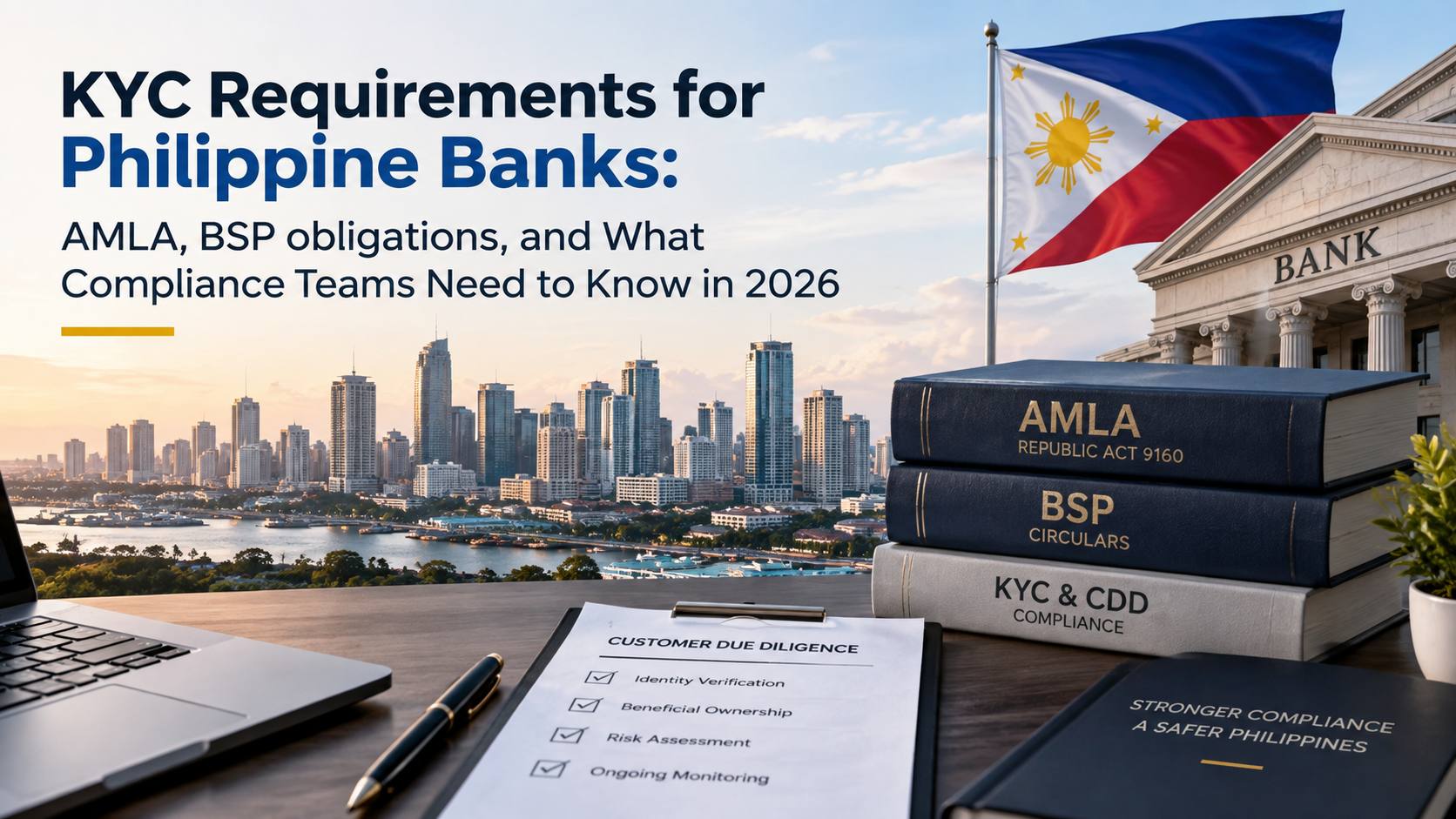
KYC Requirements for Philippine Banks: AMLA, BSP obligations, and What Compliance Teams Need to Know in 2026
The Philippines was removed from the FATF list of jurisdictions under increased monitoring in February 2025. This guide explains current AMLA and BSP KYC/CDD requirements for banks, including beneficial ownership, digital onboarding, reporting and record retention.
KYC Requirements for Philippine Banks: AMLA, BSP obligations, and What Compliance Teams Need to Know in 2026
The Philippines was removed from the FATF list of jurisdictions under increased monitoring in February 2025. This guide explains current AMLA and BSP KYC/CDD requirements for banks, including beneficial ownership, digital onboarding, reporting and record retention.