What AI-Native AML Means and Why It Matters for Your Compliance Programme
.svg)
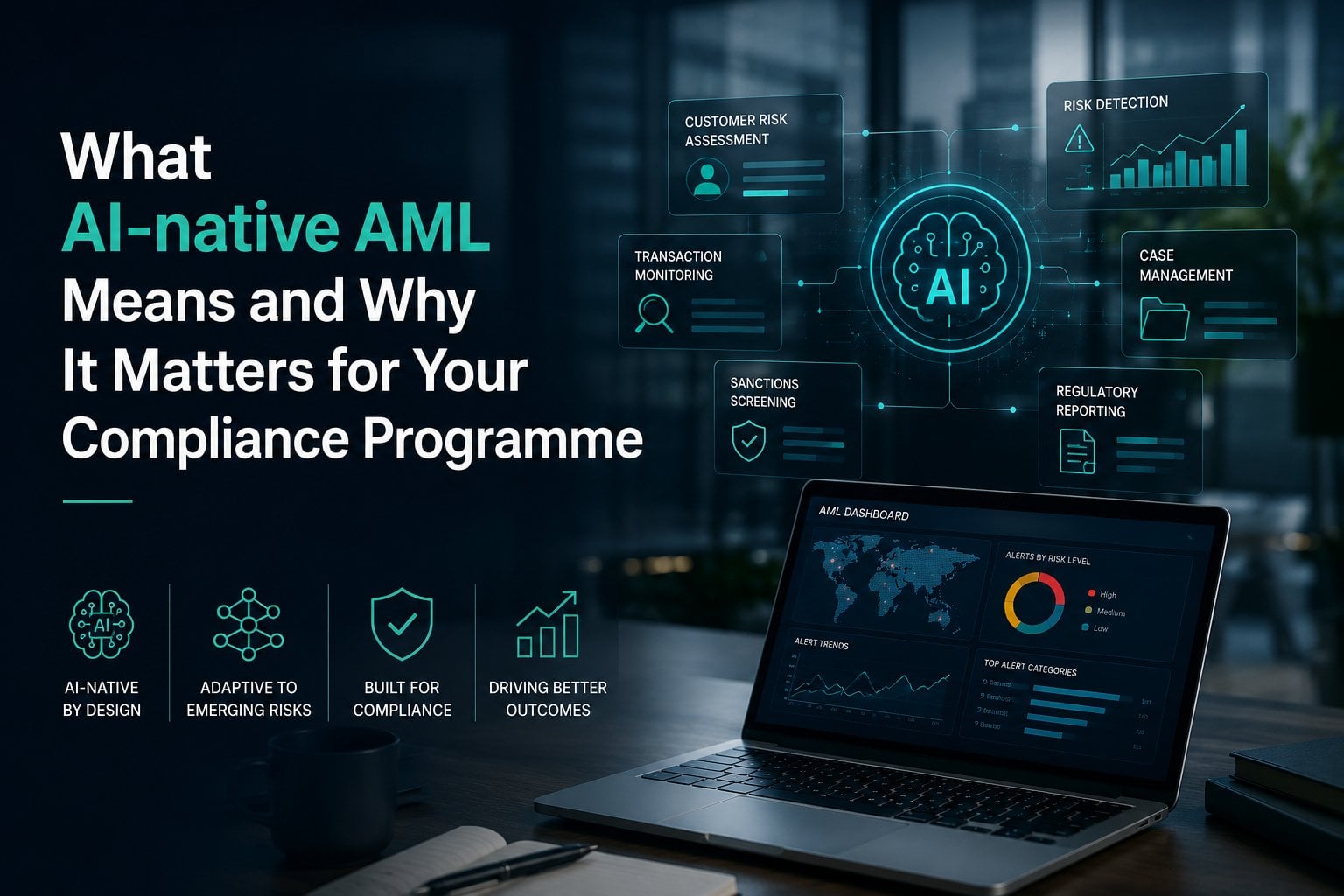
Almost every AML platform sold today carries some claim about artificial intelligence. The claims range from specific to vague, and the underlying reality ranges from genuine architectural integration to a scoring model attached to a system that was not designed for it.
This distinction is not semantic. An AML platform where AI operates as a module sitting on top of legacy detection logic behaves differently in production than one where machine learning, behavioural intelligence, rules, and explainability run on a shared foundation. The difference appears in how quickly new typologies reach the detection engine, who controls threshold changes, how model governance works, and what an examiner sees when they ask how a decision was made.
This guide explains what AI-native means in practice, how to identify it when evaluating vendors, and why the architecture behind an AI claim affects compliance outcomes.

The problem with "AI-powered" as a category
The phrase "AI-powered" has become broad enough to cover almost any implementation. A vendor that has added a risk scoring model to a rules engine, exposed via an API, can describe themselves as AI-powered. So can a vendor whose platform was designed from the start with machine learning, behavioural modelling, and explainability as core components of the detection architecture.
From a compliance perspective, these are not equivalent. The differences that matter are:
Who controls detection parameters. In an AI-added system, model changes typically require an engineering ticket or a vendor release cycle. Compliance teams can adjust rule thresholds but not the ML layer. In an AI-native system, compliance and risk teams configure scenarios, thresholds, match sensitivity, and model activation directly, through governed business workflows, without raising an IT request.
How new typologies reach detection. In an AI-added system, a new financial crime typology identified by an examiner or intelligence team needs to be manually translated into code before it can enter the detection pipeline. This takes weeks or months. In an AI-native system, the translation from typology to machine-readable behavioural risk factors is an automated step, and a validated typology can become a tested, deployable control in days.
What the audit trail looks like. In an AI-added system, the model output and the rules engine output are separate. Reconciling them into a single decision record for examination purposes requires manual work. In an AI-native system, rules, model outputs, and analyst actions feed a single alert, case, and audit workflow.
What explainability covers. An AI model added to a legacy system may produce a score with a reason code. An AI-native system produces evidence at three levels: what the model learned overall, what drove the specific alert, and how the evidence maps to the financial crime typology in language an investigator can use for STR documentation.
What AI-native looks like in the architecture
Tookitaki has built FinCense on a foundation called Tookitaki Data Science Studio (TDSS), a proprietary development, deployment, and governance framework that sits beneath all ML capabilities in the platform. Rules and models do not operate as separate systems: they use the same institutional data, feed the same control workflows, and can be activated in stages without re-architecting the platform.
TDSS supports supervised and unsupervised learning, regression, classification, anomaly detection, and graph-based techniques. Pre-built model pipelines are tailored to each institution's own data rather than relying on a single global model calibrated to an average that may not reflect the institution's customer base.
The practical consequence is that AI capabilities across transaction monitoring, screening, customer risk scoring, and case management all draw from one signal pipeline. An alert generated by transaction monitoring and a risk score generated by customer risk scoring share the same entity graph and the same underlying data. Fraud and AML detection run on the same engine rather than separate systems that need to be reconciled.
Control in the hands of compliance teams
A central design principle of an AI-native system is that compliance and risk teams control the detection parameters, not IT or vendor engineering queues.
FinCense implements this through the Scenario Design Studio, a no-code interface where compliance teams can configure scenarios, set thresholds, adjust match sensitivity, and activate or deactivate detection rules without code. When a change is needed, such as adjusting a threshold in response to new regulatory guidance or activating a new typology from the AFC Ecosystem, the compliance team makes that change directly.
Before any change goes into production, a simulation runs against historical transaction data. The team can examine projected alert volumes, coverage, and precision before the new configuration is live. If the results are acceptable, the change is promoted. If not, it is revised. Every change is versioned and attributable in the audit trail.
The result is that a threshold adjustment triggered by an examiner finding can be implemented and tested within hours, not through a development sprint. This matters most in the weeks following an examination or when a new typology emerges that regulators are asking about.
Model governance: what happens when models are updated
An AI-native platform needs a governed approach to model updates. Models trained on older data eventually drift as customer behaviour and criminal methods evolve. Retraining without governance creates risk: a model that changes silently leaves no record of why alert volumes shifted or which decision logic is currently active.
FinCense handles model updates through champion-challenger governance. The current production model (the champion) continues running while a retrained or alternative model (the challenger) is tested on live transaction data. The challenger is measured against the champion across performance, stability, and explainability metrics. It is promoted to production only when it demonstrably outperforms the champion, and that promotion is a governed decision with a full version record retained.
This approach aligns with model risk management expectations from regulators across APAC, including BSP, and frameworks referenced by the OCC and PRA. An institution running champion-challenger governance can show an examiner the specific decision that resulted in the current model version, along with the evidence that supported the promotion.
Explainability as a compliance control
Explainability in an AI-native platform operates at three levels, each serving a different function in compliance operations.
Global explainability describes what the model learned overall: which features matter most across all customers, how they influence predictions, and what decision logic the model has built. This is the level relevant to model risk reviews and to compliance leadership assessing whether the detection framework is aligned with the institution's risk appetite.
Local explainability describes what drove a specific alert: which features contributed to this customer's score, how strongly each factor affected the result, and what decision path was followed. This is the level investigators use when reviewing an alert and deciding whether to escalate.
Contextual explainability translates the technical evidence into financial crime language. Rather than a list of feature weights, the investigator sees a description of the relevant customer behaviour, the red flags, and the typology the alert connects to. This does not require data science expertise to read, and it provides the foundation for STR narrative drafting.
A reason code indicates what fired. Explainability shows what the model learned, why the specific decision occurred, and how the evidence maps to the financial crime context the institution is accountable for documenting.
How to evaluate AI claims when assessing vendors
When assessing an AML vendor's AI capabilities, five questions cut through broad claims:
- Can compliance teams configure scenarios, thresholds, and model activation without IT involvement? Ask for a demonstration, not a description.
- How does a new typology move from identification to live detection? Ask for the timeline and who does the work at each step.
- What does the audit trail show when a model change is made? Ask to see a version history for a recent model update.
- What does explainability cover? Ask for the three levels: what the model learned, what drove a specific alert, and how the evidence maps to financial crime context.
- What is the false positive rate in production at comparable institutions, not in a pilot environment?
An AI-native system produces specific, verifiable answers to all five. A system where AI has been added to legacy infrastructure typically cannot answer all five without caveats.
How FinCense approaches AI-native AML
FinCense was built on TDSS from the start, not retrofitted with AI after the core architecture was established. Rules, machine learning models, behavioural signals, entity relationships, and explainability operate on a shared foundation. AI is present across transaction monitoring, fraud detection, screening, customer risk scoring, alert prioritisation, and case management.
Tookitaki has been building production AI for financial crime since 2015. In 2020, UOB announced an AI-powered AML solution co-developed with Tookitaki following more than two years of rigorous validation across transaction monitoring and name screening. The reported true-positive prediction rate for high-priority cases was 96 per cent.
FinCense now monitors more than 100 billion transactions annually across its client base, with full platform deployment in approximately four months.
For how the three-stage ML process works inside transaction monitoring, see our guide to how machine learning works in AML transaction monitoring.
To see how FinCense's AI-native architecture works in your compliance environment, book a demo with our team.
Frequently asked questions
What is an AI-native AML platform?
An AI-native AML platform is one where machine learning, behavioural intelligence, rules, and explainability are built into the core detection architecture rather than added on top of a legacy system. The practical differences are: compliance teams control detection parameters without IT involvement, new typologies reach the detection engine in days rather than weeks, rules and model outputs feed a single audit trail, and explainability operates at the alert and typology level rather than as a score with a reason code.
What is Tookitaki Data Science Studio (TDSS)?
TDSS is the proprietary ML development, deployment, and governance framework beneath FinCense. It supports supervised and unsupervised learning, regression, classification, anomaly detection, and graph-based techniques. Automatic threshold generation, champion-challenger model governance, and explainable AI are all built into TDSS rather than added as external modules.
How does an AI-native AML system handle model governance?
FinCense uses champion-challenger model governance. The current production model (the champion) continues running while a retrained or alternative model (the challenger) is tested on live data. The challenger is promoted only when it outperforms the champion across performance, stability, and explainability metrics. Every model version, dataset snapshot, and promotion decision is versioned and retained in the audit trail.
What is the Scenario Design Studio?
Scenario Design Studio is the no-code interface in FinCense through which compliance and risk teams configure detection scenarios, set thresholds, adjust match sensitivity, and activate model features without engineering involvement. Changes are simulated against historical data before they go live. Every change is versioned and auditable.
What does AI explainability mean in AML?
In AML, explainability operates at three levels: global (what the model learned overall, which features matter most), local (what drove a specific alert, which factors contributed to the score), and contextual (a plain-language translation of the evidence in financial crime terms for investigators and STR documentation). A reason code is not the same as explainability; it indicates what threshold was exceeded but not why the model weighted the evidence the way it did.
How long does it take to deploy an AI-native AML platform?
FinCense deployment from contract to production takes approximately four months, including regulatory alignment. This is approximately 50 per cent faster than the industry average for comparable platforms. The Scenario Design Studio allows compliance teams to begin configuring scenarios and thresholds during deployment rather than waiting for IT to complete integration work.
Experience the most intelligent AML and fraud prevention platform
Experience the most intelligent AML and fraud prevention platform
Experience the most intelligent AML and fraud prevention platform
Top AML Scenarios in ASEAN

The Role of AML Software in Compliance
The Role of AML Software in Compliance