Customer Risk Scoring in AML: Why Static Models Fail and What Dynamic Scoring Looks Like
.svg)
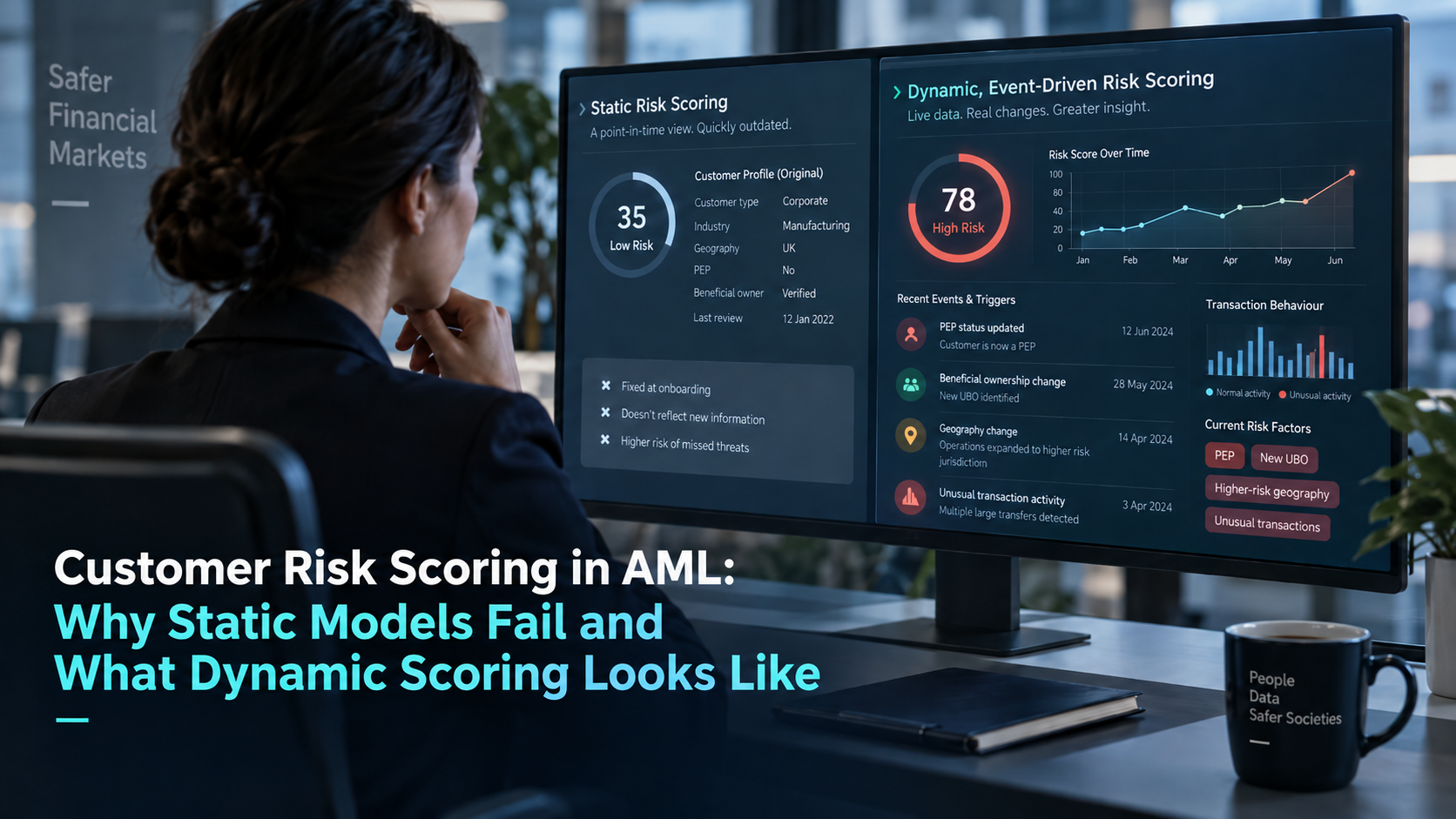
Many legacy customer risk scoring programmes still operate as periodic snapshots. A customer is assessed at onboarding, assigned a risk rating using factors such as customer type, geography, products and expected activity, and then reviewed according to a schedule set by the institution. Between reviews, the rating may remain unchanged even when the customer’s circumstances or activity change materially.
That creates an obvious control gap. A customer may become a politically exposed person (PEP), change beneficial ownership, begin using higher-risk products or start transacting in ways that are inconsistent with the stated purpose of the relationship. Transaction monitoring may identify some of this activity, but the information does not always flow back into the customer risk assessment or the wider due diligence process.
Regulators do not prescribe one universal scoring architecture, nor do they require every institution to use artificial intelligence or a continuously recalculated numerical score. They do, however, expect customer risk to be understood and managed throughout the business relationship. Dynamic or event-driven scoring is one way to operationalise that expectation.

What regulators actually expect
The global baseline comes from FATF Recommendation 10. Financial institutions should conduct ongoing due diligence and scrutinise transactions throughout a business relationship to ensure that activity is consistent with their knowledge of the customer, the customer’s business and the customer’s risk profile. FATF also expects due diligence measures to be applied according to risk and to existing customers at appropriate times.
Singapore’s MAS AML/CFT framework for banks similarly requires ongoing monitoring of business relations and periodic review of customer information, with enhanced measures for higher-risk relationships. These requirements support a current, risk-based understanding of the customer, but they do not mandate a particular scoring engine, recalculation frequency or use of AI.
Australia’s current AML/CTF framework is particularly explicit about event-driven reassessment. AUSTRAC states that a reporting entity must review and, where appropriate, update a customer’s money-laundering, terrorism-financing and proliferation-financing risk when relevant factors change. Examples include a customer becoming a PEP, changes to corporate structure or beneficial ownership, use of new services or channels, exposure to different countries, and unusual transactions or behaviour that may give rise to a suspicious matter reporting obligation.
AUSTRAC also requires KYC information to be reviewed at a frequency appropriate to customer risk. Monitoring may be manual, automated or a combination of both, depending on the nature, size and complexity of the business. The regulatory outcome is timely identification and management of changing risk - not compulsory use of a real-time numerical score.
Malaysia provides a related, but distinct, example. Appendix 11 of Bank Negara Malaysia’s revised Risk Management in Technology policy, issued on 28 November 2025, requires relevant financial institutions to establish detailed customer risk profiles for retail digital fraud detection using behavioural analysis. It also requires suspicious or fraudulent transactions to be detected and blocked in real time. These are fraud-detection standards, not a standalone requirement governing AML customer risk ratings. They nevertheless illustrate the broader movement towards behaviour-aware customer controls.
Why static customer risk scores create control gaps
The rating can become stale
A rating assigned at onboarding reflects the information available at that time: occupation or business activity, geography, product selection, ownership, source of funds and expected transaction behaviour. If the assessment is updated only at the next scheduled review, it may fail to reflect material changes that occur in the meantime.
Risk assessment and monitoring can become disconnected
Customer risk should inform the nature and intensity of ongoing monitoring. Higher-risk customers may require more intensive monitoring, more frequent review or different thresholds and controls, depending on the institution’s risk assessment. If monitoring identifies a meaningful behavioural change but that information never reaches the customer risk process, the institution is acting on two different versions of the customer.
Trigger-based due diligence may be delayed
Enhanced due diligence (EDD) should not depend only on the calendar. PEP status, material ownership changes, higher-risk jurisdiction exposure, significant unexplained changes in activity and other events may require the institution to reassess the relationship and determine whether additional measures are necessary. A fixed review cycle can delay that decision.
The rationale may be difficult to reconstruct
An institution should be able to explain why a customer received a particular risk rating and what information was used. A model that stores only the final label - without the applicable rules, risk factors, source data, overrides and model version - creates a weak audit trail even if the original calculation was reasonable.
What a current customer risk assessment should cover
A sound customer risk assessment generally combines relatively stable customer attributes with information that can change during the relationship. The precise factors and weightings should be derived from the institution’s business-wide risk assessment, customer base, products, delivery channels and jurisdictions.
Relatively stable customer factors
- Customer type, legal form and ownership or control structure
- Country of residence, incorporation and operation
- Products, services and delivery channels used
- Occupation, industry or declared business activity
- Purpose and intended nature of the relationship
- Source of funds and, where appropriate, source of wealth
- PEP, sanctions, adverse-media and other relevant screening results
Behavioural and event-driven factors
- Transaction volumes, values and frequency compared with expected or historical activity
- Use of new beneficiaries, counterparties, products or payment corridors
- Material changes in transaction geography or account usage
- Changes to beneficial ownership, authorised persons or business activity
- Relevant monitoring alerts, investigations and their outcomes
- New PEP status, credible adverse information or other material external events
Some institutions also use mandatory overrides or minimum ratings for risks that cannot be adequately represented through a weighted score. For example, the institution’s policy may require a specified minimum rating when particular high-risk factors are present. Such rules should be documented, consistently applied and periodically reviewed.
What dynamic customer risk scoring looks like
Dynamic scoring does not have to mean that every transaction immediately changes a customer’s formal AML risk rating. In practice, it can combine scheduled reassessment with event-driven recalculation or review.
- Material customer-data changes trigger reassessment rather than waiting for the next review date.
- Behavioural indicators are refreshed at a frequency appropriate to the institution’s risk and operating model.
- Significant deviations generate a review, proposed rating change or escalation under documented policy.
- Mandatory risk factors and policy overrides remain under compliance control.
- Material changes are recorded with their effective date, reason, underlying data and approval history.
This approach keeps the customer risk view responsive without allowing uncontrolled model movement to determine consequential compliance decisions.
AI-driven segmentation versus fixed customer groups
Traditional customer segmentation relies on predefined categories such as retail, small business, corporate or correspondent banking. These categories remain useful because they reflect the institution’s products, policies and risk appetite. Their limitation is that broad categories can contain customers with very different behavioural patterns.
Machine-learning techniques can supplement policy-defined segments by identifying groups of customers with similar activity. This may reveal emerging patterns, improve peer-group comparisons and identify customers whose behaviour differs materially from that of comparable customers.
However, data-driven segmentation is not automatically more accurate or more defensible. Its effectiveness depends on data quality, feature selection, validation, stability, bias testing, drift monitoring and human oversight. Production segments should not change silently whenever new data arrives. Material recalibration should pass through documented testing, approval and version-control processes.
Explainability and model governance
Regulators generally expect institutions to understand, govern and document the controls used to assess customer risk. They do not universally prescribe a factor-attribution or counterfactual explanation for every customer score. The depth of explanation should be proportionate to the model’s complexity, its impact and the institution’s regulatory obligations.
A well-governed scoring process should retain:
- The risk factors, rules and data inputs used for the assessment
- The reason codes or factor contributions supporting the rating, where applicable
- Any mandatory overrides or manual adjustments and the associated rationale
- The model or ruleset version in force when the decision was made
- The date of the assessment and the customer information available at that time
- Evidence of validation, monitoring, approvals and subsequent changes
For more complex machine-learning models, techniques such as local factor attribution, global model analysis and counterfactual testing can strengthen investigation and validation. These are useful governance tools, but their suitability depends on the model and should not be described as universal regulatory requirements.
How customer risk scoring connects to the AML programme
Customer risk scoring creates the most value when it is connected to monitoring, due diligence and case management rather than operating as a standalone database.
Alert prioritisation
A material increase in customer risk can be used as an input when prioritising new or open alerts. Whether reprioritisation is automatic should depend on the institution’s policy, system design and quality controls. Automation should support investigators without concealing why an alert’s priority changed.
Due diligence workflows
Crossing a defined risk threshold or encountering a mandatory trigger can initiate a customer review. The workflow should then determine whether EDD or other risk-management measures are required. This is more precise than treating every score increase as an automatic EDD conclusion.
Case management
Investigators should be able to see the current customer rating, the factors supporting it, relevant historical changes and associated alerts within the investigation workflow. A connected view reduces manual searching and helps produce a clearer record of the decision.
How Tookitaki’s FinCense supports Customer Risk Scoring
FinCense’s Customer Risk Scoring combines customer attributes with behavioural, transaction and alert information to support a more current view of customer risk across the relationship lifecycle.
Event-driven risk profiling
FinCense supports risk-score updates triggered by transactions, customer-profile changes and periodic reviews. Institutions can configure the scoring logic, rules and overrides to align with their own customer risk methodology and risk appetite.
Behaviour-aware scoring and customer segmentation
The platform can incorporate transaction patterns, geography, customer information, business relationships, external data and historical alerts. Its segmentation capabilities support supervised and unsupervised learning to supplement predefined customer groups and improve peer-based analysis.
Explained and reviewable scores
FinCense provides visibility into how scores are calculated, including triggered rules, mandatory overrides and the factors contributing to a rating. Its Compare Risk capability allows reviewers to examine changes across score snapshots, including values, contributions and labels.
Connected compliance operations
Risk scores, historical events and alert activity can be presented through a centralised customer view and connected with screening and case-management processes. This helps compliance teams use customer risk information at the point of review or investigation rather than relying on disconnected systems.
Book a demo to see how FinCense supports event-driven customer risk profiling, configurable scoring, explainability and connected investigation workflows.
Frequently asked questions
What is customer risk scoring in AML?
Customer risk scoring is a structured method of assessing the money-laundering and related financial-crime risks associated with a customer. The assessment usually considers customer characteristics, geography, products, delivery channels, purpose of the relationship and, where appropriate, ongoing behaviour. The resulting rating helps determine the nature and intensity of monitoring and due diligence.
What is the difference between static and dynamic customer risk scoring?
Static scoring relies mainly on information captured at onboarding or during scheduled reviews. Dynamic scoring supplements periodic reviews with event-driven or more frequent updates based on material changes in customer information, external risk factors or behaviour. The recalculation frequency should be appropriate to the institution’s risks and operating model.
Do regulators require real-time or AI-driven customer risk scores?
Not as a universal rule. FATF-aligned regimes require ongoing due diligence, risk-based monitoring and timely reassessment when relevant information changes. Regulators generally leave institutions to select controls appropriate to their size, complexity and risk. Real-time or AI-assisted scoring can help, but it is an implementation choice rather than a universal regulatory mandate.
Why should customer risk scores be explainable?
The institution needs to understand and document why a customer received a particular rating and how that rating affected its controls. Useful evidence can include applicable rules, important factors, data inputs, overrides, model version and approval history. More advanced attribution or counterfactual analysis may be useful for complex models but is not universally required for every score.
How should a risk-score change affect transaction monitoring?
A material change should prompt the institution to consider whether monitoring intensity, alert priority, review frequency or due diligence measures should change. The response should follow documented policy. Technology can automate workflow initiation and prioritisation, while material compliance decisions remain subject to appropriate controls and oversight.
How can AI improve customer risk scoring?
AI and machine learning can support peer-group analysis, behavioural segmentation, anomaly identification and more responsive use of customer data. These benefits depend on sound data, validation, explainability, controlled change management, drift monitoring and human oversight. AI should supplement the institution’s risk methodology, not replace regulatory judgement or accountability.
Experience the most intelligent AML and fraud prevention platform
Experience the most intelligent AML and fraud prevention platform
Experience the most intelligent AML and fraud prevention platform
Top AML Scenarios in ASEAN
The Role of AML Software in Compliance
The Role of AML Software in Compliance