From Telegram Chats to Money Trails: The AML Risk Behind Penang’s Love-Scam Bust
.svg)
A love scam may start with a message.
But the financial crime risk begins when that message turns into money movement.
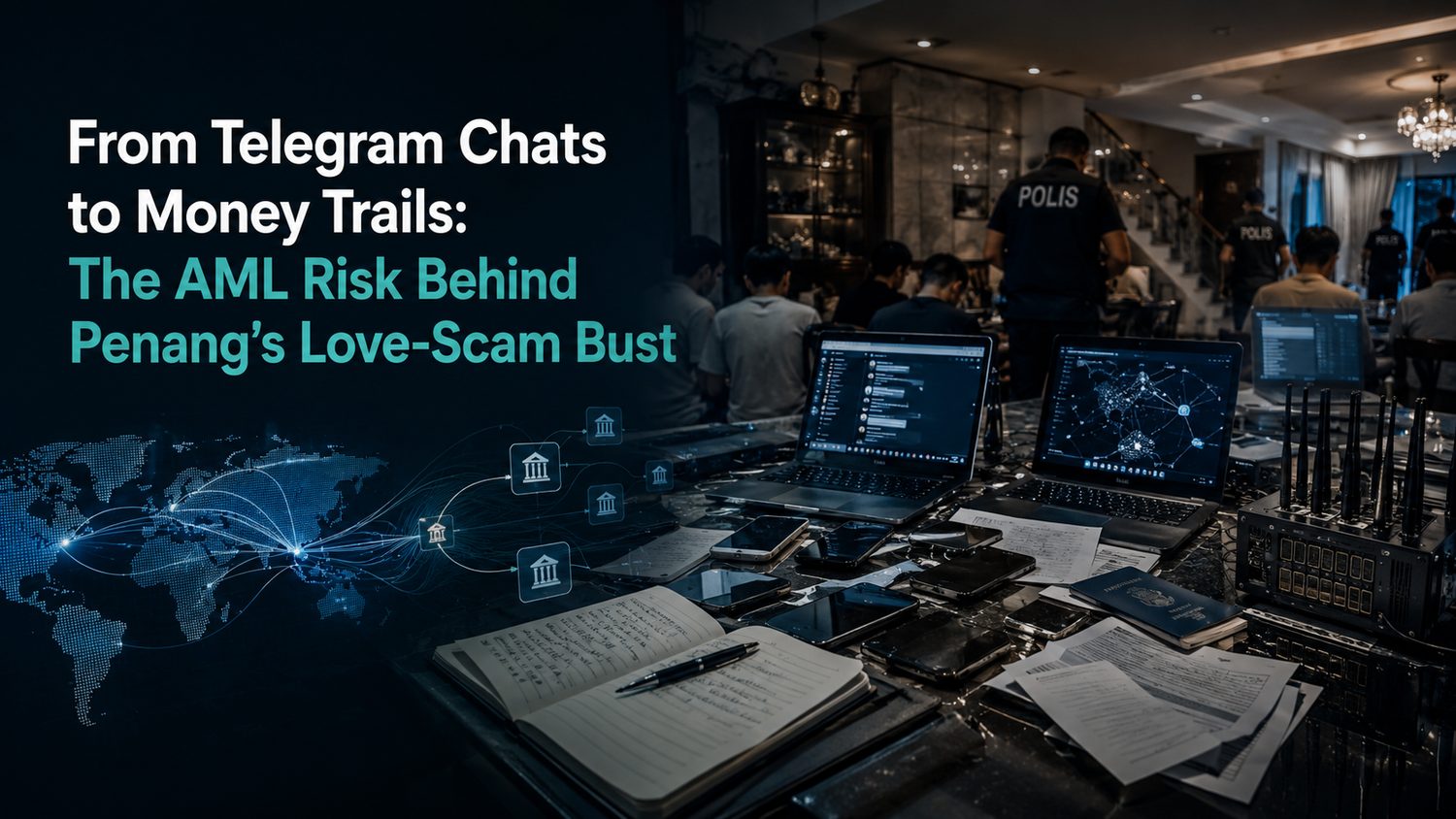
That is the lesson from the recent Batu Ferringhi case in Penang, where police arrested 20 foreign men after raiding a house suspected of being used as an online love-scam call centre. According to The Star, the suspects, aged 19 to 41, were arrested during a 7.05pm raid on 23 August 2026 by the Commercial Crime Investigation Division and Batu Ferringhi police. Initial investigations found that the syndicate allegedly targeted victims in China using Telegram, while police seized mobile phones, laptops, notebooks and telecommunications equipment. The case is being investigated under Sections 420 and 120B of the Penal Code, and the suspects were remanded until 27 August 2026.
At first glance, this is a digital romance scam. But for banks, wallets, payment firms and compliance teams, the deeper question is financial: once a victim sends money, who receives it, how does it move, and where does it go next?
The scam may begin on Telegram.
The AML risk appears in accounts, wallets, cash-outs, mule networks and cross-border flows.

What Happened in Batu Ferringhi?
Police said the suspected syndicate operated from a house in Batu Ferringhi and allegedly used Telegram to target victims in China. During the raid, authorities seized phones, laptops, notebooks and telecommunications equipment.
Those details matter. Scam operations are rarely limited to one conversation or one device. They often depend on digital infrastructure: messaging apps, multiple phones, scripts, contact lists, SIM cards, laptops and coordination tools. This allows scammers to manage several victims, switch identities and keep conversations running across borders.
The article does not disclose the amount allegedly lost by victims or the exact payment channels used. That is important from a compliance perspective. In many scam cases, the public report first reveals the deception channel, while the financial trail becomes clearer only through bank records, wallet activity, remittance data, complaints and account-link analysis.
For financial institutions, the key question is not only who sent the scam message. It is who received the funds, whether the account behaviour was consistent with the customer profile, and whether the money was quickly withdrawn, transferred or routed through connected parties.
Why This Matters for Financial Institutions
Love scams are difficult to detect because the first payment may look voluntary.
The victim may believe they are helping someone they trust. The payment may be authorised. The beneficiary may be a personal account. The amount may sit below traditional alert thresholds. The transaction reference may not clearly indicate fraud.
But the wider pattern can tell a different story.
A receiving account may collect funds from multiple unrelated individuals. Money may move out quickly after receipt. Several accounts may share phone numbers, devices, beneficiaries or cash-out behaviour. Funds may be routed through remittance channels, wallets or overseas counterparties.
This is why love scams should not be treated only as consumer fraud. Once victim funds are collected, moved or layered, the activity can become an AML risk.
The compliance challenge is to detect when a personal-looking payment is actually part of a wider scam proceeds network.
How Telegram-Enabled Scams Create AML Risk
The Penang case highlights Telegram as the alleged channel used to target victims. Messaging platforms can help scam syndicates scale conversations, reach victims across borders and operate under multiple identities.
From an AML perspective, the app is not the final risk point. It is the starting point.
The laundering risk appears when online manipulation leads to financial movement. A victim may be groomed over time before being asked to transfer funds. Once the money is sent, the receiving account may only act as the first stop. Funds can then be withdrawn, split, moved to associates, routed through wallets or transferred across borders.
This creates several monitoring challenges:
- The victim may not realise immediately that they have been scammed
- The transfer may appear authorised and relationship-based
- The recipient account may not be visibly linked to the Telegram conversation
- Funds may move before a complaint is filed
- Multiple accounts may be used to break the trail
- Victims, suspects and receiving accounts may sit in different jurisdictions
The risk sits in the gap between the digital story and the financial behaviour.
The conversation may happen on Telegram. But the evidence of laundering appears in transactions, beneficiaries, devices, cash-outs and account networks.
Money Mule and Cross-Border Risk
Love-scam syndicates often rely on mule accounts to collect and move victim funds. These accounts may belong to recruited individuals, associates, compromised users or people who allow their accounts to be used in exchange for a fee.
The cross-border element makes the risk harder to trace. In the Penang case, police said the syndicate allegedly targeted victims in China while operating from Malaysia. That means the scam journey may cross borders before the funds even enter the financial system.
For compliance teams, this creates visibility gaps. One institution may see only the sender. Another may see only the beneficiary. A third may see the onward transfer or cash-out. Without network-level analysis, each institution may only see one part of the pattern.
A single incoming transfer may not be suspicious on its own. But repeated funds from unrelated senders, rapid withdrawals, common beneficiaries, linked accounts and unusual overseas movement can indicate that an account is being used to collect or launder scam proceeds.
The mule account may not run the Telegram conversation.
But it may be where the financial crime becomes visible.
Red Flags Banks, Wallets and Payment Firms Should Monitor
Love-scam proceeds can create warning signs across customer behaviour, transaction activity and network connections.
Key red flags may include:
- Personal accounts receiving funds from multiple unrelated individuals
- Sudden inbound activity inconsistent with the customer’s profile, income or occupation
- Funds withdrawn or transferred soon after receipt
- Multiple accounts linked through shared devices, phone numbers, addresses, IP patterns or beneficiaries
- Incoming funds followed by remittance, wallet transfers, cash-outs or overseas movement
- Newly opened or previously dormant accounts receiving victim-like inflows
- Customers unable to explain the source or purpose of funds
- Accounts linked to scam complaints, suspicious keywords or law-enforcement enquiries
- Repeated small-value transfers that appear structured across accounts
Individually, these signals may not prove that an account is part of a love-scam network. Together, they may reveal accounts being used to collect, move or disguise illicit proceeds.
The key is to monitor not only the victim’s payment, but also the beneficiary’s behaviour after the funds arrive.
Why Traditional Monitoring May Miss the Risk
Traditional transaction monitoring can struggle with love-scam cases because the payment often looks legitimate at the point of transfer.
The sender approves it. The beneficiary may be a normal individual account. The amount may not be unusually high. The transaction may not mention fraud, scams or investment. By the time the victim reports the incident, the funds may already have moved.
Rules-based monitoring may detect large or clearly unusual transactions, but miss patterns that become suspicious only when viewed across relationships, accounts, devices and time.
For example, one transfer to an individual may not stand out. But if that individual receives funds from multiple unrelated senders, moves money out quickly, shares beneficiaries with other accounts and connects to similar customer profiles, the risk becomes clearer.
Scam-led laundering requires behavioural and network intelligence. Institutions need to understand the transaction, the customer, the counterparty, the speed of movement and the relationships behind the activity.
In love-scam cases, the strongest signal is often not the first payment.
It is the pattern that forms around it.
Why Fraud, AML and KYC Teams Need a Shared View
Love-scam cases cut across multiple control functions.
Fraud teams may see victim complaints. AML teams may see suspicious fund flows. KYC teams may hold customer profile data. Payments teams may spot unusual beneficiary activity. Investigators may identify shared phone numbers, devices or account links.
If these signals remain separate, the institution may miss the full risk.
A sender-side fraud alert may show that one customer was deceived. But the receiving account may still be collecting funds from other victims. An AML alert may show rapid fund movement, but without the fraud context, it may not be prioritised. A KYC review may show profile inconsistency, but not the wider network.
A shared view helps connect the digital scam journey with the financial trail.
This is especially important when victims, suspects and fund flows span jurisdictions. Cross-border scam activity requires faster escalation, better account-link analysis and stronger collaboration between fraud and AML teams.
What This Means for Compliance Teams
The Batu Ferringhi case reinforces four practical lessons.
First, beneficiary monitoring is critical. Institutions should not focus only on the customer who was deceived. Receiving accounts that collect funds from unrelated individuals, move money quickly or show mule-like behaviour deserve closer review.
Second, scam typologies should be connected to AML controls. A love scam may start as social engineering, but it can produce proceeds that need to be moved, layered or withdrawn.
Third, digital-infrastructure signals matter. Shared devices, phone numbers, IP patterns, beneficiaries and account links can reveal organised activity that may not be visible through transaction rules alone.
Fourth, cross-border context should be built into monitoring. When victims are in one country and suspects operate from another, accounts may act as local collection points for international scam proceeds.
The broader lesson is simple: financial institutions need to look beyond the authorised payment and examine the behaviour around it.
How Tookitaki Helps Financial Institutions Detect These Patterns
Tookitaki helps financial institutions move from isolated alerts to connected financial crime detection.
FinCense brings together customer risk, transaction monitoring, screening, alert management and case investigation so compliance teams can identify suspicious behaviour across customers, accounts, counterparties and networks.
In love-scam cases, risk may appear through a combination of signals: multiple victim-like inflows, rapid withdrawals, mule-account behaviour, cross-border transfers, shared identifiers, linked beneficiaries, device connections and sudden changes in customer activity.
FinCense helps institutions connect these signals, prioritise higher-risk alerts and give investigators a clearer view of the accounts and relationships behind suspicious movement.
Through the AFC Ecosystem, Tookitaki also helps institutions stay closer to emerging scam typologies, including romance scams, mule networks, cross-border laundering, messaging-app-enabled fraud and suspicious beneficiary behaviour.
The aim is not to generate more alerts. It is to detect the right patterns earlier and support faster, more informed investigations.
The Bigger Lesson: The Scam Starts in the Chat, But the Risk Moves Through Accounts
The Penang love-scam case is a reminder that financial crime does not always begin inside the financial system.
It may begin with a message on Telegram. It may grow through emotional manipulation. It may appear personal to the victim. But once money is transferred, the risk enters the financial system.
For banks, wallets, remittance providers and payment firms, the most important questions come after the transfer.
Who received the funds?
How quickly were they moved?
Were other victims involved?
Were connected accounts used?
Did the money cross borders, exit through cash, or move to another layer of the network?
The scam may start with a conversation.
But the AML risk is revealed in the movement of funds.
Experience the most intelligent AML and fraud prevention platform
Experience the most intelligent AML and fraud prevention platform
Experience the most intelligent AML and fraud prevention platform
Top AML Scenarios in ASEAN
The Role of AML Software in Compliance
The Role of AML Software in Compliance