

The Rise of AML Platforms: How Singapore’s Financial Institutions Are Modernising Financial Crime Prevention
.svg)
Financial crime is no longer confined to simple schemes or isolated transactions.
Modern criminal networks operate across borders, financial channels, and digital platforms, exploiting the speed and scale of today’s financial system. From online scams and mule account networks to complex trade-based money laundering operations, financial institutions face a growing range of threats that are increasingly difficult to detect.
For banks and fintech companies in Singapore, this challenge is particularly significant. As one of the world’s most important financial centres, Singapore processes enormous volumes of international transactions every day. The same global connectivity that drives economic growth also creates opportunities for financial crime.
To manage these risks effectively, financial institutions are turning to advanced AML platforms.
Unlike traditional compliance tools that operate as isolated systems, modern AML platforms provide an integrated environment for monitoring transactions, detecting suspicious behaviour, managing investigations, and supporting regulatory reporting.
For Singapore’s financial institutions, AML platforms are becoming the central engine of financial crime prevention.

What Are AML Platforms?
An AML platform is a comprehensive technology system designed to help financial institutions detect, investigate, and prevent money laundering and related financial crimes.
Rather than relying on multiple disconnected tools, AML platforms combine several critical compliance functions within a single ecosystem.
These functions typically include:
- Transaction monitoring
- Customer risk assessment
- Watchlist and sanctions screening
- Case management and investigations
- Suspicious transaction reporting
- Data analytics and behavioural monitoring
By bringing these capabilities together, AML platforms allow compliance teams to monitor financial activity more effectively while improving operational efficiency.
Instead of switching between separate systems, investigators can review alerts, analyse transactions, and document findings within one unified platform.
Why AML Platforms Are Becoming Essential
Financial crime detection has become significantly more complex in recent years.
Digital banking, instant payment systems, and cross-border financial services have increased the speed at which funds move through the global financial system.
Criminal organisations take advantage of this speed by rapidly transferring funds across multiple accounts and jurisdictions.
For financial institutions using outdated compliance infrastructure, this creates several problems.
Legacy systems often generate excessive alerts because they rely on simple rule thresholds. Compliance teams must review thousands of alerts that ultimately prove to be benign.
Fragmented technology environments also create inefficiencies. Transaction monitoring systems, customer databases, and investigation tools often operate independently, forcing analysts to gather information manually.
AML platforms address these challenges by consolidating data, improving detection accuracy, and supporting more efficient investigative workflows.
Key Capabilities of Modern AML Platforms
While different vendors offer different approaches, the most effective AML platforms share several core capabilities.
These capabilities enable financial institutions to detect suspicious behaviour more accurately while managing investigations more efficiently.
Advanced Transaction Monitoring
Transaction monitoring is one of the most important components of any AML platform.
Modern monitoring systems analyse transaction behaviour across accounts, channels, and jurisdictions to identify suspicious activity.
Rather than focusing only on individual transactions, advanced monitoring systems examine behavioural patterns that may indicate money laundering schemes.
This approach allows institutions to detect complex activity such as rapid pass-through transactions, structuring, or cross-border layering.
Artificial Intelligence and Behavioural Analytics
Artificial intelligence is increasingly central to modern AML platforms.
Machine learning models analyse large volumes of transaction data to identify patterns associated with financial crime.
These models can detect relationships between accounts, transactions, and entities that may not be visible through traditional rule-based monitoring.
Over time, AI-driven analytics can also help reduce false positives by improving risk scoring and prioritising alerts more effectively.
Integrated Case Management
Financial crime investigations often require analysts to collect information from multiple sources.
Modern AML platforms include case management tools that consolidate transaction data, customer information, and investigation notes within a single environment.
Investigators can analyse suspicious behaviour, record their findings, and escalate cases for review without leaving the platform.
This improves both investigative speed and documentation quality.
Strong case management tools also ensure that institutions maintain clear audit trails for regulatory review.
Watchlist and Sanctions Screening
Financial institutions must screen customers and transactions against global watchlists, sanctions lists, and politically exposed person databases.
AML platforms automate these screening processes and support continuous monitoring of customer profiles.
Advanced screening tools also use name matching algorithms and risk scoring models to reduce false matches while ensuring that high-risk entities are detected.
Regulatory Reporting Support
Compliance teams must file suspicious transaction reports when they identify potentially illicit activity.
AML platforms streamline this process by linking investigations directly to reporting workflows.
Investigators can compile evidence, generate reports, and submit documentation through the same system used to manage alerts.
This improves reporting efficiency while ensuring consistent documentation standards.
Challenges With Traditional AML Infrastructure
Many financial institutions still operate legacy AML systems that were implemented more than a decade ago.
These systems often struggle to meet the demands of modern financial crime detection.
One common challenge is alert overload. Simple rule-based systems generate high volumes of alerts that require manual review.
Another challenge is limited data integration. Legacy systems often cannot easily combine transaction data, customer information, and external intelligence sources.
Investigators must therefore gather information manually before reaching conclusions.
Legacy infrastructure also lacks flexibility. Updating detection scenarios to address new financial crime typologies can require complex system changes.
AML platforms address these issues by providing more flexible architectures and advanced analytics capabilities.
Regulatory Expectations for AML Platforms in Singapore
The Monetary Authority of Singapore requires financial institutions to maintain strong AML controls supported by effective monitoring systems.
Regulators expect institutions to adopt a risk-based approach to financial crime detection.
This means monitoring systems should prioritise high-risk activity and continuously adapt to emerging financial crime threats.
AML platforms help institutions meet these expectations by providing:
- Behavioural monitoring tools
- Risk scoring frameworks
- Comprehensive audit trails
- Flexible scenario management
- Continuous monitoring of customer activity
By implementing advanced AML platforms, financial institutions demonstrate that they are investing in technology capable of supporting evolving regulatory requirements.
The Role of Typology Driven Detection
Financial crime schemes often follow identifiable behavioural patterns.
Transaction monitoring typologies describe these patterns and translate them into detection scenarios.
Examples of common typologies include:
- Rapid movement of funds through multiple accounts
- Structuring deposits to avoid reporting thresholds
- Cross-border layering transactions
- Use of shell companies to disguise ownership
AML platforms increasingly incorporate typology libraries based on real financial crime cases.
By embedding these typologies into monitoring systems, institutions can detect suspicious behaviour earlier and more accurately.
This approach ensures that monitoring frameworks reflect real-world financial crime risks rather than theoretical thresholds.

The Importance of Collaboration in Financial Crime Detection
Financial crime networks often operate across multiple institutions and jurisdictions.
No single institution has complete visibility into these networks.
As a result, collaboration is becoming an important element of modern financial crime prevention.
Some AML platforms now incorporate collaborative intelligence models that allow institutions to share anonymised insights about emerging financial crime typologies.
This shared intelligence helps institutions detect new threats earlier and strengthen monitoring frameworks across the financial ecosystem.
For global financial centres like Singapore, collaborative approaches can significantly improve the effectiveness of AML programmes.
Tookitaki’s Approach to AML Platforms
Tookitaki’s FinCense platform represents a modern AML platform designed to address the evolving challenges of financial crime detection.
The platform integrates several key capabilities within a unified architecture.
These capabilities include transaction monitoring, investigation management, risk analytics, and regulatory reporting support.
FinCense combines typology-driven detection with artificial intelligence to improve monitoring accuracy and reduce false alerts.
The platform also supports collaborative intelligence through the AFC Ecosystem, enabling institutions to continuously update detection scenarios based on emerging financial crime patterns.
By integrating advanced analytics with operational workflows, FinCense enables financial institutions to move beyond fragmented compliance systems and adopt a more intelligent approach to financial crime prevention.
The Future of AML Platforms
Financial crime will continue to evolve as criminals adopt new technologies and exploit digital financial channels.
Future AML platforms will likely incorporate several emerging innovations.
Artificial intelligence will become more sophisticated in detecting behavioural anomalies and predicting suspicious activity.
Network analytics will provide deeper insights into relationships between accounts and entities involved in financial crime networks.
Real-time monitoring capabilities will become increasingly important as instant payment systems continue to expand.
AML platforms will also place greater emphasis on automation, enabling investigators to focus on high-risk cases rather than routine alert reviews.
Institutions that invest in modern AML platforms today will be better positioned to manage tomorrow’s financial crime risks.
Conclusion
Financial crime detection has entered a new era.
The complexity of modern financial ecosystems means that traditional compliance tools are no longer sufficient.
AML platforms provide financial institutions with the integrated capabilities needed to monitor transactions, detect suspicious behaviour, manage investigations, and support regulatory reporting.
For Singapore’s banks and fintech companies, adopting advanced AML platforms is not simply about regulatory compliance.
It is about protecting customers, safeguarding financial institutions, and preserving the integrity of one of the world’s most important financial centres.
As financial crime continues to evolve, AML platforms will play an increasingly central role in defending the global financial system.
Experience the most intelligent AML and fraud prevention platform
Experience the most intelligent AML and fraud prevention platform
Experience the most intelligent AML and fraud prevention platform
Top AML Scenarios in ASEAN
The Role of AML Software in Compliance
The Role of AML Software in Compliance
Talk to an Expert
Our Thought Leadership Guides

Customer Risk Scoring in AML: Why Static Models Fail and What Dynamic Scoring Looks Like
Customer risk assessments must remain current as customer circumstances and behaviour change. Learn where static AML risk models fall short and how event-driven, explainable scoring can strengthen ongoing due diligence.
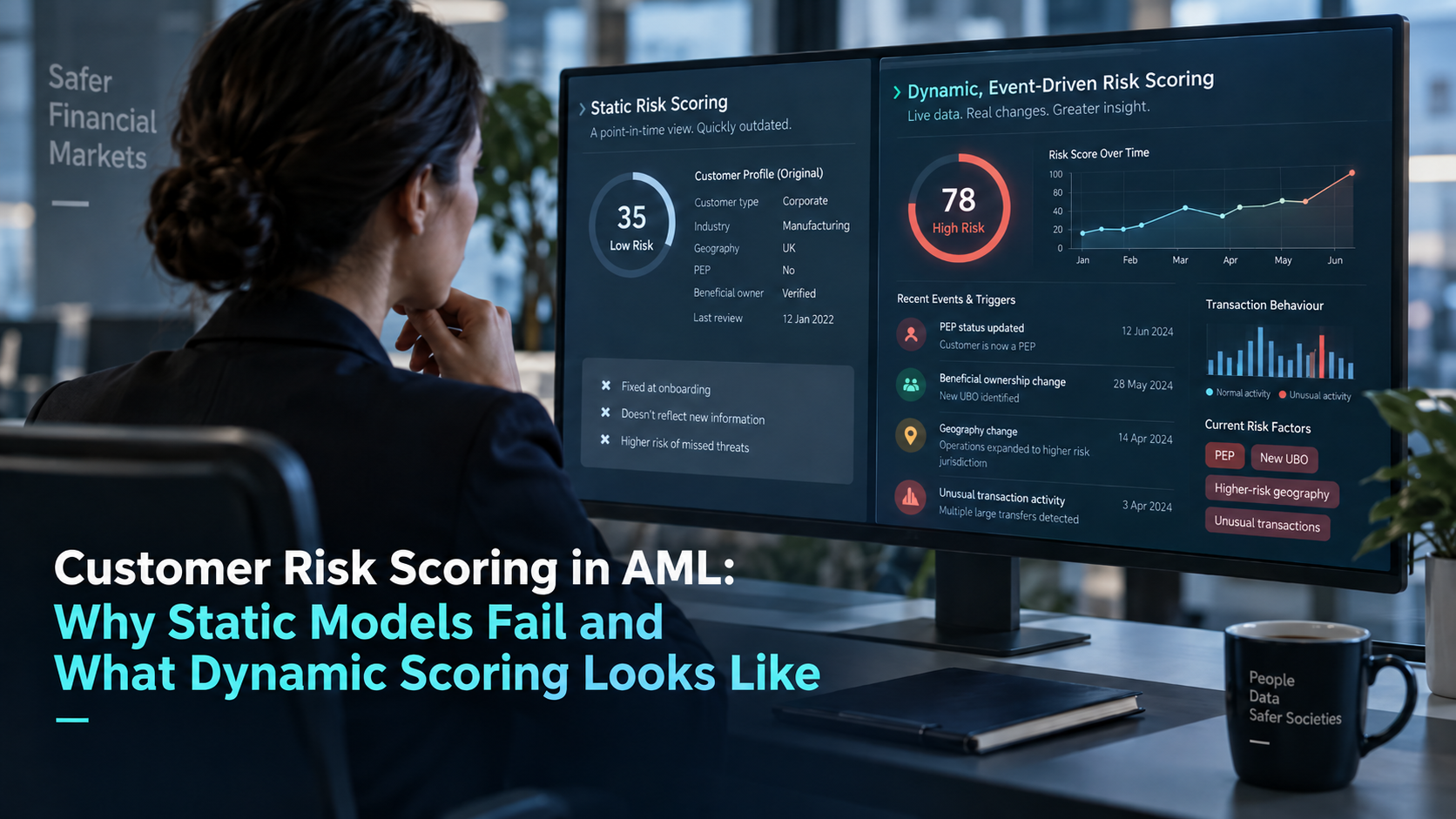
Customer Risk Scoring in AML: Why Static Models Fail and What Dynamic Scoring Looks Like
Customer risk assessments must remain current as customer circumstances and behaviour change. Learn where static AML risk models fall short and how event-driven, explainable scoring can strengthen ongoing due diligence.