Real-Time Transaction Monitoring: Why Speed Matters for Banks in Singapore
.svg)
Introduction: When Every Second Counts, So Does Every Transaction
In a country known for its digital financial leadership, real-time compliance has become the baseline—not the benchmark. Singapore’s banks are now shifting from reactive to proactive defence with real-time transaction monitoring at the core.
The Shift from Post-Transaction Checks to Preemptive Defence
Traditionally, banks reviewed flagged transactions in batches—often hours or even days after they occurred. But that model no longer works. With the rise of instant payments, criminals exploit delays to move illicit funds through a maze of mule accounts, digital wallets, and cross-border corridors.
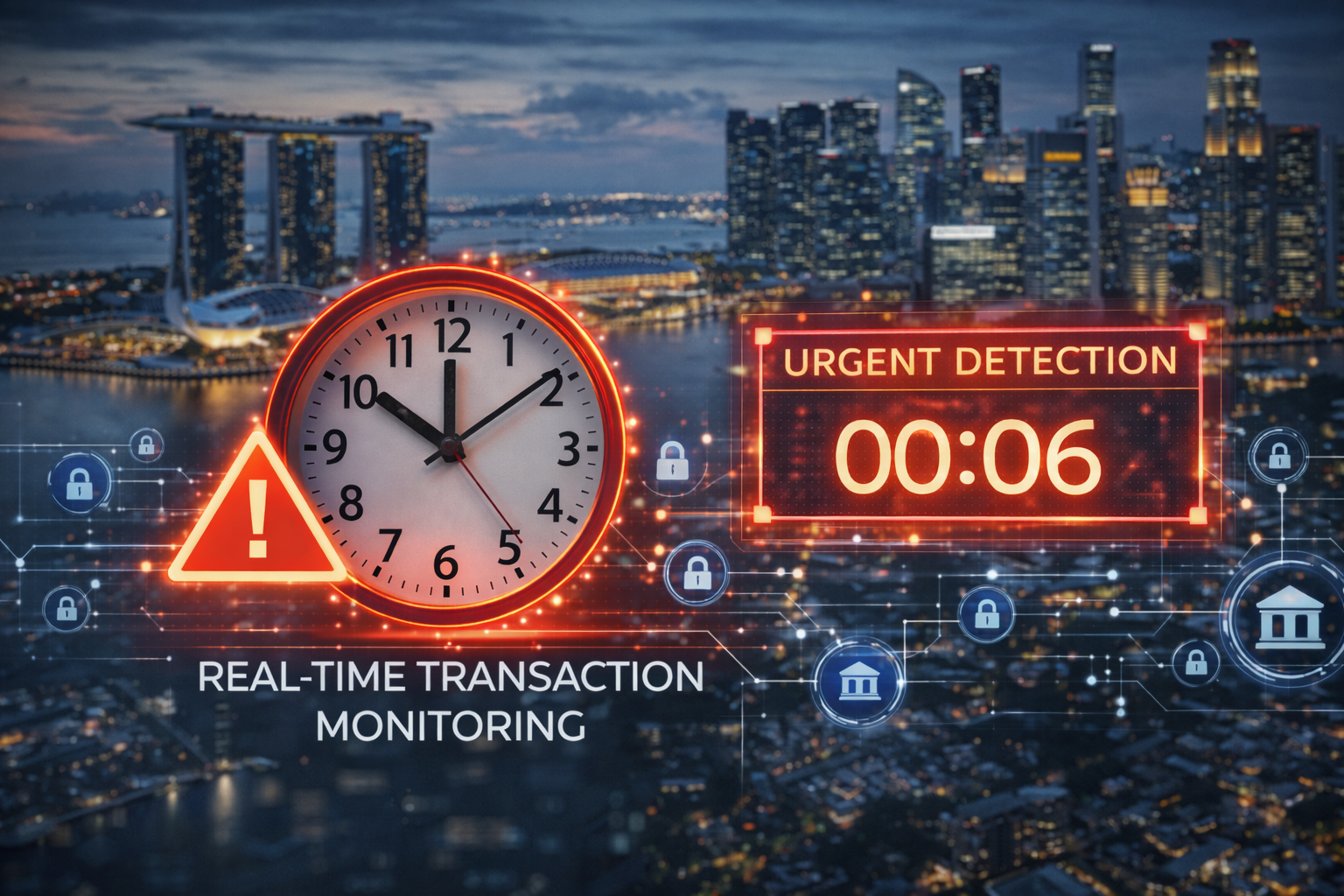
Real-time transaction monitoring closes that gap. Instead of catching red flags after the fact, it allows banks to spot and stop suspicious transactions as they happen.

Why Singapore is a Global Hotspot for Speed-Driven Compliance
Singapore’s financial ecosystem is fast-paced, digitally advanced, and globally connected—ideal conditions for both innovation and exploitation. Consider the following:
- Fast Payments: Services like PayNow, FAST, and instant cross-border transfers are now ubiquitous
- Fintech Integration: Rapid onboarding of users through digital-first platforms
- High Transaction Volume: Singapore processes billions of dollars daily, much of it international
- Regulatory Pressure: The Monetary Authority of Singapore (MAS) expects robust AML/CFT practices across the board
This environment demands compliance systems that are both agile and instantaneous.
What Real-Time Transaction Monitoring Actually Means
It’s not just about speed—it’s about intelligence. A real-time transaction monitoring system typically includes:
- Live Data Processing: Transactions are analysed within milliseconds
- Dynamic Risk Scoring: Risk is calculated on the fly using behaviour, geolocation, velocity, and history
- Real-Time Decisioning: Transactions may be blocked, held, or flagged automatically
- Instant Investigator Alerts: Teams are notified of high-risk events without delay
All of this happens in a matter of seconds—before money moves, not after.
Common Scenarios Where Real-Time Monitoring Makes the Difference
1. Mule Account Detection
Criminals often use unsuspecting individuals or synthetic identities to funnel money through local accounts. Real-time monitoring can flag:
- Rapid pass-through of large sums
- Transactions that deviate from historical patterns
- High-volume transfers across newly created accounts
2. Scam Payments & Social Engineering
Whether it’s investment scams or romance fraud, victims often authorise the transactions themselves. Real-time systems can identify:
- Sudden high-value payments to unknown recipients
- Activity inconsistent with customer behaviour
- Usage of mule accounts linked via device or network identifiers
3. Shell Company Laundering
Singapore’s corporate services sector is sometimes misused to hide ownership and move funds between layered entities. Monitoring helps surface:
- Repeated transactions between connected shell entities
- Cross-border transfers to high-risk jurisdictions
- Funds routed through trade-based layering mechanisms
What Banks Stand to Gain from Real-Time Monitoring
✔ Improved Fraud Prevention
The biggest benefit is obvious: faster detection = less damage. Real-time systems help prevent fraudulent or suspicious transactions before they leave the bank’s environment.
✔ Reduced Compliance Risk
By catching issues early, banks reduce their exposure to regulatory breaches and potential fines, especially in high-risk areas like cross-border payments.
✔ Better Customer Trust
Freezing a suspicious transaction before it empties an account can be the difference between losing a customer and gaining a loyal one.
✔ Operational Efficiency
Fewer false positives mean compliance teams spend less time chasing dead ends and more time investigating real threats.
Building Blocks of an Effective Real-Time Monitoring System
To achieve these outcomes, banks must get five things right:
- Data Infrastructure: Access to clean, structured transaction data in real time
- Dynamic Thresholds: Static rules create noise; dynamic thresholds adapt to context
- Entity Resolution: Being able to connect multiple accounts to a single bad actor
- Typology Detection: Patterns of behaviour matter more than single rule breaches
- Model Explainability: Regulators must understand why an alert was triggered
Common Challenges Banks Face
Despite the benefits, implementing real-time monitoring isn’t plug-and-play. Challenges include:
- High Infrastructure Costs: Especially for smaller or mid-sized banks
- Model Drift: AI models can become outdated without constant retraining
- Alert Volume: Real-time systems can overwhelm teams without smart prioritisation
- Privacy & Fairness: Data must be processed ethically and in line with PDPA
That’s why many banks now turn to intelligent platforms that do the heavy lifting.
How Tookitaki Helps Banks Go Real-Time and Stay Ahead
Tookitaki’s FinCense platform is designed for exactly this environment. Built for scale, speed, and explainability, it offers:
- Real-Time Detection: Instant flagging of suspicious transactions
- Scenario-Based Typologies: Hundreds of real-world laundering and fraud typologies built in
- Federated Learning: Global insight without sharing sensitive customer data
- Simulation Mode: Test thresholds before going live
- Smart Disposition Engine: AI-generated summaries reduce investigator workload
Used by leading banks across Asia-Pacific, FinCense has helped reduce false positives, cut response times, and deliver faster fraud interception.
Future Outlook: What Comes After Real-Time?
Real-time is just the beginning. The future will bring:
- Predictive Compliance: Flagging risk before a transaction even occurs
- Hyper-Personalised Thresholds: Based on granular customer behaviours
- Cross-Institution Intelligence: Real-time alerts shared securely between banks
- AI Agents in Compliance: Virtual investigators assisting teams in real time
Singapore’s digital-forward banking sector is well-positioned to lead this transformation.
Final Thoughts
Real-time transaction monitoring isn’t just a technology upgrade—it’s a mindset shift. For Singapore’s banks, where speed, trust, and global connectivity intersect, the ability to detect and stop risk in milliseconds could define the future of compliance.
If prevention is the new protection, then real-time is the new normal.
Experience the most intelligent AML and fraud prevention platform
Experience the most intelligent AML and fraud prevention platform
Experience the most intelligent AML and fraud prevention platform
Top AML Scenarios in ASEAN
The Role of AML Software in Compliance
The Role of AML Software in Compliance