Anti-money Laundering Using Machine Learning
.svg)
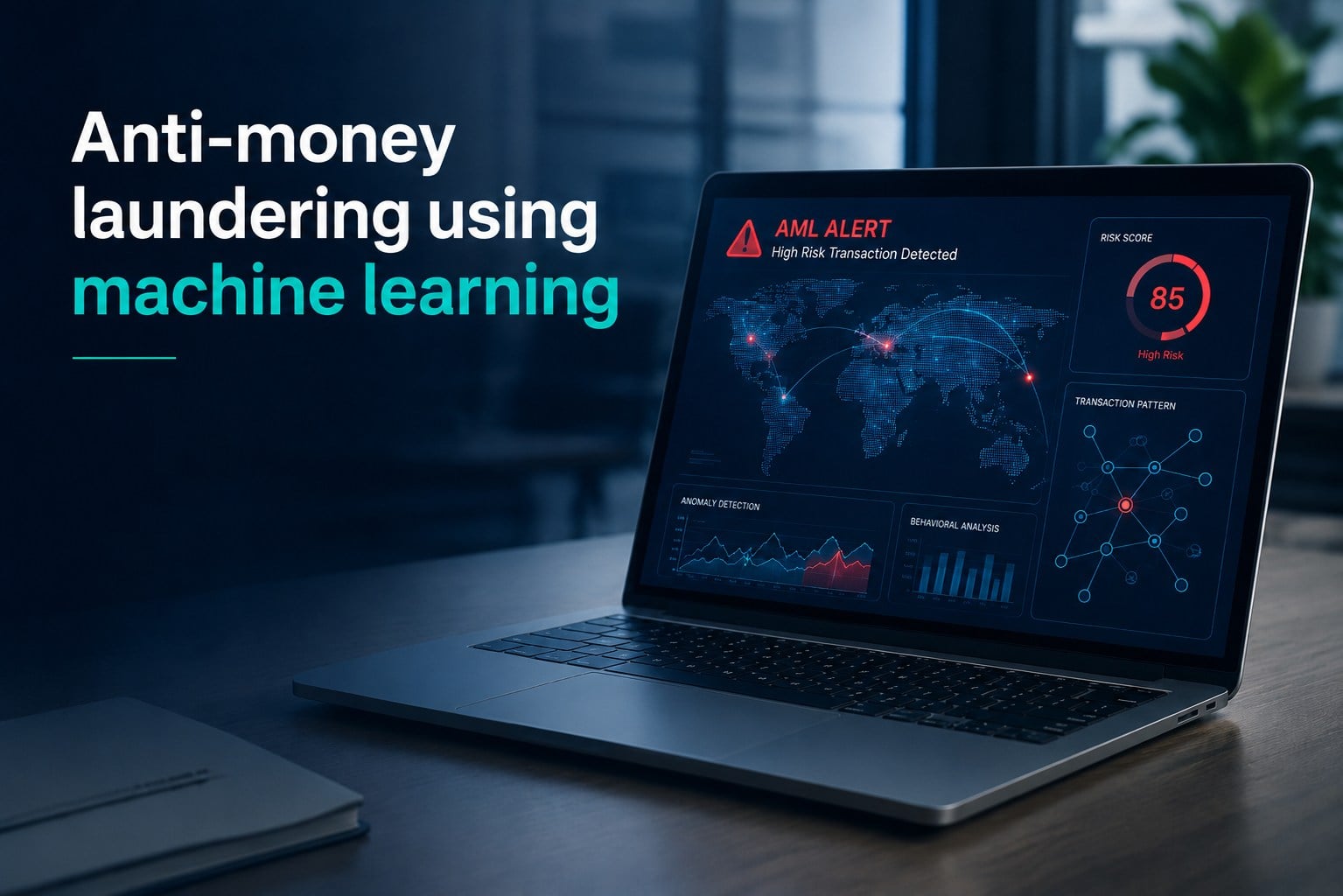
Machine learning is changing how financial institutions detect and prevent illicit activity — with greater speed, precision, and adaptability than rule-based systems can offer.
As financial crime grows more complex, traditional AML systems are no longer keeping pace. Criminal networks exploit layered transaction routes, digital platforms, and cross-border channels. Static detection frameworks struggle to track them because those frameworks only catch what they were originally programmed to find.
By integrating machine learning into AML programmes, institutions can analyse large volumes of transactional data in real time, uncover subtle patterns, and flag suspicious behaviour with greater accuracy. These systems learn continuously, reducing false positives and allowing compliance teams to direct their time toward genuine risks.
With regulators across APAC expecting stronger, technology-enabled defences, machine learning in AML has moved from an exploratory option to an operational standard for institutions that want to stay ahead.

The evolving threat of financial crimes and the role of technology
Financial crimes have grown more complex over the years. Illicit activity crosses borders with ease, creating challenges for regulators and financial institutions that still rely on domestic detection logic.
Technology plays a dual role in this environment. It gives criminals new tools to exploit and gives compliance teams new methods to detect. The volume of financial transactions generated daily means that no manual process can cover the full exposure.
Traditional methods, built on static rules and fixed thresholds, struggle against tactics that change faster than review cycles allow. A rule calibrated against last year's typologies may miss this year's methods entirely. The rigidity of these systems is their primary weakness.
Machine learning takes a different approach. It learns from past data, identifies patterns that static rules would not catch, and adapts as new behaviour emerges. That adaptability is what makes it suited to the rate at which financial crime methods actually change.
Understanding machine learning in anti-money laundering
At its core, machine learning involves training algorithms to recognise patterns by processing large datasets. In AML, these models work through transaction data to identify unusual activity that may indicate money laundering.
Unlike static rule-based systems, machine learning models update continuously. They learn from both confirmed suspicious activity and from false positives that were reviewed and dismissed. That feedback loop improves detection over time without requiring manual rule updates.
The process starts by feeding transaction data into the model. The algorithm identifies potential red flags based on known laundering behaviours and deviations from customer baselines. Anomalies detected can then trigger further investigation.
The limitations of traditional AML systems
Traditional AML systems depend on predefined rules. These approaches are slow to adapt when criminal methods shift and can be exploited once their logic is understood. The high volume of false positives they produce is a consistent operational problem: compliance teams face large alert queues, and genuine threats sit alongside noise.
Static systems also cannot learn from outcomes. Once configured, they detect only what they were designed to find. As money laundering tactics advance, their effectiveness declines without active intervention.
How machine learning improves AML detection
Machine learning improves AML detection by analysing patterns across dimensions that rules cannot express. These models detect complex combinations of behaviour, learn from past outcomes, and adjust as transaction patterns evolve.
A direct consequence is fewer false positives. Refined detection methods lower the number of alerts that do not correspond to suspicious activity, allowing compliance teams to concentrate on cases that warrant investigation.
Machine learning also enables real-time transaction monitoring, replacing periodic batch reviews. Faster detection means earlier intervention and a greater chance of disrupting financial crime before funds move further.
The ability to analyse large datasets also surfaces hidden correlations. This helps predict new laundering methods and prepares institutions before those methods appear at scale.
Real-world applications: machine learning in AML
Machine learning is applied across several functions in AML operations.
Transaction monitoring is the most direct application. Algorithms work through financial transactions in real time, identifying patterns associated with laundering activity. This analysis runs at volumes and speeds that manual review cannot match.
Machine learning also maps networks involved in laundering schemes. These models trace connections across accounts and institutions, surfacing relationships that isolated transaction analysis would miss.
Customer due diligence benefits from machine learning through more accurate risk assessment. By drawing on multiple data sources, models assign risk levels that reflect actual customer behaviour rather than static onboarding classifications.
Fraud detection has also improved substantially. Algorithms identify unusual activity faster than traditional methods and generate alerts before funds have moved to the next stage of a laundering sequence.
Case studies of successful implementations
United Overseas Bank (UOB) is a leading bank in Asia, with a network of more than 500 offices across Asia Pacific, Europe, and North America. With a strong focus on risk management, UOB identified an opportunity to bring machine learning into its AML surveillance systems to address high transaction volumes, excessive false positives, and slow alert closure processes.
After testing multiple systems without finding a sustainable solution, UOB partnered with Tookitaki to integrate machine learning into its AML programme. The collaboration centred on a community-driven compliance model and the deployment of FinCense for transaction monitoring and name screening.
FinCense Alert Prioritization AI Agent
Tookitaki implemented the Alert Prioritization AI Agent to overhaul UOB's transaction monitoring and name screening operations. The agent uses supervised and unsupervised machine learning to detect suspicious activity and identify high-risk clients. Implementation included:
- Integration with legacy systems: FinCense uses standardised data schemas and adapters to connect with existing transaction infrastructure without replacing it.
- Risk classification: FinCense handles AML risk classification through L1 to L3 priority buckets, maintaining accuracy above 85%.
- Adaptation to data variability: During the COVID-19 period, alert data showed unusual skew due to elevated defensive reporting. FinCense adapted to this pattern without requiring manual reconfiguration.
- False positive reduction: Alert Prioritization AI Agent reduced false positives by 50 to 70 per cent, bringing alert volumes to a level the compliance team could review without backlog.
The results
UOB's focus on detecting new and unknown suspicious patterns, while prioritising known alerts, produced the following results across its transaction monitoring and name screening modules:
- Transaction monitoring: 5 per cent increase in true positives and 50 per cent reduction in false positives, with less than 1 per cent misclassification
- Name screening: 70 per cent reduction in false positives for individual names and 60 per cent reduction for corporate names
This implementation set a benchmark for other institutions looking to bring machine learning into their AML operations.
Reducing false positives: a machine learning breakthrough
The false positive problem has long been the operational cost of AML compliance. Rule-based systems generate large numbers of alerts, most of which require analyst time to dismiss. This overhead delays identification of genuine threats.
Machine learning reduces false positives by distinguishing genuine anomalies from benign variation in transaction behaviour. This precision means fewer irrelevant alerts and more time available for actual investigation.
As these models process new data, their accuracy improves. This ongoing refinement means that the false positive rate continues to decrease over time rather than remaining fixed at the level established during initial configuration. For a detailed breakdown of the false positive problem and how machine learning addresses it at the threshold level, see our guide to reducing false alerts and improving detection rates.
The impact on transaction monitoring
Transaction monitoring sits at the centre of AML detection. Machine learning improves its performance by processing large data volumes accurately and adapting to changes in laundering tactics.
Machine learning algorithms also identify subtle patterns that standard monitoring would miss. This allows earlier detection of suspicious activity and faster response. Real-time analysis makes alerts both more accurate and more timely, giving institutions a meaningful window to act.
Integrating machine learning into existing AML frameworks
Integrating machine learning into existing AML frameworks gives institutions a way to improve detection without replacing everything that already works. Established frameworks provide a foundation; machine learning adds analytical depth on top of it.
Machine learning models connect to existing transaction data and improve detection accuracy without requiring a full system replacement. Most institutions deploy them alongside current infrastructure, extending capability rather than rebuilding from scratch.
This integration also positions institutions to keep pace with regulatory expectations. APAC regulators increasingly assess whether monitoring programmes are calibrated to an institution's specific risk profile, not just whether a system exists. Machine learning, properly configured, makes that calibration possible.
For a detailed breakdown of how the three-stage ML process works in transaction monitoring — from translating typologies into behavioural risk factors, through automated threshold generation, to risk scoring and alert prioritisation — see our guide to how machine learning works in AML transaction monitoring.
Overcoming integration challenges
Integrating machine learning with legacy systems is not without difficulty. Legacy infrastructure may need updates before it can support the data flows that ML models require. This is an engineering decision that needs early planning.
Data quality is the other common constraint. Machine learning models produce accurate results only when the data they train on is clean, structured, and comprehensive. Institutions that have not invested in data management often find this is the first problem to solve before ML can be deployed effectively.
Both challenges are manageable with the right approach. Involving compliance, IT, and finance teams early ensures that implementation decisions reflect operational requirements, not just technical ones. FinCense's standardised data adapters are designed to reduce the integration burden on legacy infrastructure specifically.
The future of AML: predictive analytics and AI
The next stage of AML technology runs on predictive analytics. Rather than flagging activity after it occurs, predictive models use historical data to identify emerging patterns before they appear in alerts. This forward-looking capability allows institutions to position their defences ahead of new laundering methods.
AI models that learn continuously will extend this advantage further. As they process new transaction data, they refine their understanding of suspicious behaviour. Institutions that maintain well-governed AI systems will be able to adapt their detection programmes without waiting for the next manual rule review.
The direction is toward tighter integration of AI-derived insight into daily compliance operations, so that what the models detect flows directly into the analyst workflow without additional processing steps.
Staying ahead of money launderers with AI
AI's ability to identify complex, cross-border financial transactions is what makes it effective against sophisticated laundering networks. Coordinated activity across multiple institutions and channels is difficult to detect from any single institution's data. Models trained on collective intelligence, such as the AFC Ecosystem's library of validated typologies from 30 or more institutions, surface patterns that no single dataset would reveal.
Faster adaptation to new laundering methods reduces the window between when a new tactic emerges and when it is detectable. That reduction in lag time is where AI makes the most direct difference to AML outcomes.
AI-derived insights also direct human expertise more effectively. Analysts review the cases most likely to be material rather than working through an undifferentiated queue. The combination of AI detection and analyst judgement produces better results than either does independently.
Ethical considerations and regulatory compliance
Deploying machine learning in AML raises questions that compliance and legal teams need to address alongside technical implementation. Privacy is the most direct: ML models process large datasets that often contain sensitive customer information. Data handling practices must protect this information and meet applicable privacy regulations.
Regulatory compliance remains the foundation. As ML models grow more sophisticated, they must align with existing AML regulations. Navigating this requires teams that understand both what the technology does and what the regulatory framework requires of it.
Collaboration between financial institutions and regulators encourages innovation within a governed framework. Institutions that engage with regulators on their ML programmes before examination, rather than after findings, generally have an easier path to approval.
Balancing privacy with prevention
The tension between privacy and detection is managed through transparent data usage policies. Institutions should document clearly how customer data is collected, processed, and stored within the ML programme, and make that documentation available to customers and regulators.
Technical approaches such as differential privacy provide additional protection, allowing meaningful analysis without exposing individual records. FinCense's architecture, including the AFC Ecosystem's federated approach where typology intelligence is shared without sharing raw customer data, is designed with this boundary in mind.
Conclusion: building the trust layer with machine learning in AML
As financial crime grows more complex, traditional rule-based AML systems cannot keep pace with methods that change faster than review cycles allow. Institutions that want to stay ahead need detection programmes that learn, adapt, and produce actionable alerts rather than noise.
FinCense's Alert Prioritization AI Agent brings intelligence, adaptability, and precision into AML compliance operations. By reducing false positives and improving risk classification through continuous learning, it allows compliance teams to respond faster and more accurately to suspicious activity, without adding operational overhead.
Beyond the technology, FinCense is part of a broader objective: building trust. AI-powered decisioning, real-time insights, and collaborative intelligence embedded in AML workflows strengthen both institutional confidence and the broader integrity of the financial system.
Tookitaki enables financial institutions to stay compliant, proactive, and prepared, laying the groundwork for a more secure financial environment.
To see how FinCense handles AML detection and alert prioritisation for your institution, book a demo with our team.
Experience the most intelligent AML and fraud prevention platform
Experience the most intelligent AML and fraud prevention platform
Experience the most intelligent AML and fraud prevention platform
Top AML Scenarios in ASEAN
The Role of AML Software in Compliance
The Role of AML Software in Compliance