

Counting the Cost: How AML Compliance is Reshaping Budgets in Singapore
.svg)
Singapore's financial institutions are spending more than ever to stay compliant — but are they spending smart?
As financial crime grows in sophistication, the regulatory net is tightening. For banks and fintechs in Singapore, Anti-Money Laundering (AML) compliance is no longer a checkbox—it’s a critical function that commands significant investment.
This blog takes a closer look at the real cost of AML compliance in Singapore, why it's rising, and what banks can do to reduce the burden without compromising risk controls.

What is AML Compliance, Really?
AML compliance refers to a financial institution’s obligation to detect, prevent, and report suspicious transactions that may be linked to money laundering or terrorism financing. This includes:
- Customer Due Diligence (CDD)
- Transaction Monitoring
- Screening for Sanctions, PEPs, and Adverse Media
- Suspicious Transaction Reporting (STR)
- Regulatory Recordkeeping
In Singapore, these requirements are enforced by the Monetary Authority of Singapore (MAS) through Notices 626 (for banks) and 824 (for payment institutions), among others.
Why is the Cost of AML Compliance Increasing in Singapore?
AML compliance is expensive—and getting more so. The cost drivers include:
1. Expanding Regulatory Requirements
New MAS guidelines around technology risk, ESG-related AML risks, and digital banking supervision add more obligations to already stretched compliance teams.
2. Explosion in Transaction Volumes
With real-time payments (PayNow, FAST) and cross-border fintech growth, transaction monitoring systems must now scale to process millions of transactions daily.
3. Complex Typologies and Threats
Fraudsters are using social engineering, deepfakes, mule networks, and shell companies, requiring more advanced and layered detection mechanisms.
4. High False Positives
Legacy systems often flag benign transactions as suspicious, leading to investigation overload and inefficient resource allocation.
5. Talent Shortage
Hiring and retaining skilled compliance analysts and investigators in Singapore is costly due to demand outpacing supply.
6. Fines and Enforcement Risks
The reputational and financial risk of non-compliance remains high, pushing institutions to overcompensate with manual checks and expensive audits.
Breaking Down the Cost Elements
The total cost of AML compliance includes both direct and indirect expenses:
Direct Costs:
- Software licensing for AML platforms
- Customer onboarding (KYC/CDD) systems
- Transaction monitoring engines
- Screening databases (sanctions, PEPs, etc.)
- Regulatory reporting infrastructure
- Hiring and training compliance staff
Indirect Costs:
- Operational delays due to manual reviews
- Customer friction due to false positives
- Reputational risks from late filings or missed STRs
- Opportunity cost of delayed product rollouts due to compliance constraints
Hidden Costs: The Compliance Drag on Innovation
One of the less discussed impacts of rising AML costs is the drag on digital transformation. Fintechs and neobanks, which are built for agility, often find themselves slowed down by:
- Lengthy CDD processes
- Rigid compliance architectures
- Manual STR documentation
This can undermine user experience, onboarding speed, and cross-border expansion.
Singapore’s Compliance Spending Compared Globally
While Singapore’s market is smaller than the US or EU, its AML compliance burden is proportionally high due to:
- Its position as an international financial hub
- High exposure to cross-border flows
- Rigorous MAS enforcement standards
According to industry estimates, large banks in Singapore spend between 4 to 7 percent of their operational budgets on compliance, with AML being the single biggest contributor.

Technology as a Cost-Optimiser, Not Just a Cost Centre
Rather than treating AML systems as cost centres, leading institutions in Singapore are now using intelligent technology to reduce costs while enhancing effectiveness. These include:
1. AI-Powered Transaction Monitoring
- Reduces false positives by understanding behavioural patterns
- Automates threshold tuning based on past data
2. Federated Learning Models
- Learn from fraud and laundering typologies across banks without sharing raw data
3. AI Copilots for Investigations
- Tools like Tookitaki’s FinMate surface relevant case context and narrate findings automatically
- Improve investigator productivity by up to 3x
4. Scenario-Based Typologies
- Enable proactive detection of specific threats like mule networks or BEC fraud
Tookitaki’s Approach to Reducing AML Compliance Costs
Tookitaki’s FinCense platform offers a modular, AI-driven compliance suite purpose-built for financial institutions in Singapore and beyond. Here’s how it helps reduce cost while increasing coverage:
- Smart Disposition Engine reduces investigation times through natural language summaries
- Federated AI shares typologies without violating data privacy laws
- Unified platform for AML and fraud lowers integration and training costs
- Plug-and-play scenarios allow quick rollout for new threat types
Real-world impact:
- Up to 72% reduction in false positives
- 3.5x improvement in analyst productivity
- Significant savings in training and STR documentation time
How Regulators View Cost vs. Compliance
While MAS expects full compliance, it also encourages innovation and risk-based approaches. Their FinTech Regulatory Sandbox and support for AI-powered RegTech solutions signal a willingness to:
- Balance oversight with efficiency
- Encourage public-private collaboration
- Support digital-first compliance architectures
This is an opportunity for Singapore’s institutions to move beyond traditional, high-cost models.
Five Strategies to Optimise AML Spend
- Invest in Explainable AI: Improve detection without creating audit blind spots
- Use Federated Typologies: Tap into industry-wide risk intelligence
- Unify AML and Fraud: Eliminate duplication in alerts and investigations
- Adopt Modular Compliance Tools: Scale capabilities as your institution grows
- Train with AI Assistants: Reduce dependency on large teams for investigations
Final Thoughts: From Compliance Cost to Competitive Edge
AML compliance will always involve cost, but the institutions that treat it as a strategic capability rather than a regulatory burden are the ones that will thrive.
With smarter tools, shared intelligence, and a modular approach, Singapore’s financial ecosystem can build a new model—one where compliance is faster, cheaper, and more intelligent.
Experience the most intelligent AML and fraud prevention platform
Experience the most intelligent AML and fraud prevention platform
Experience the most intelligent AML and fraud prevention platform
Top AML Scenarios in ASEAN
The Role of AML Software in Compliance
The Role of AML Software in Compliance
Talk to an Expert
Our Thought Leadership Guides

KYC Requirements for Philippine Banks: AMLA, BSP obligations, and What Compliance Teams Need to Know in 2026
The Philippines was removed from the FATF list of jurisdictions under increased monitoring in February 2025. This guide explains current AMLA and BSP KYC/CDD requirements for banks, including beneficial ownership, digital onboarding, reporting and record retention.
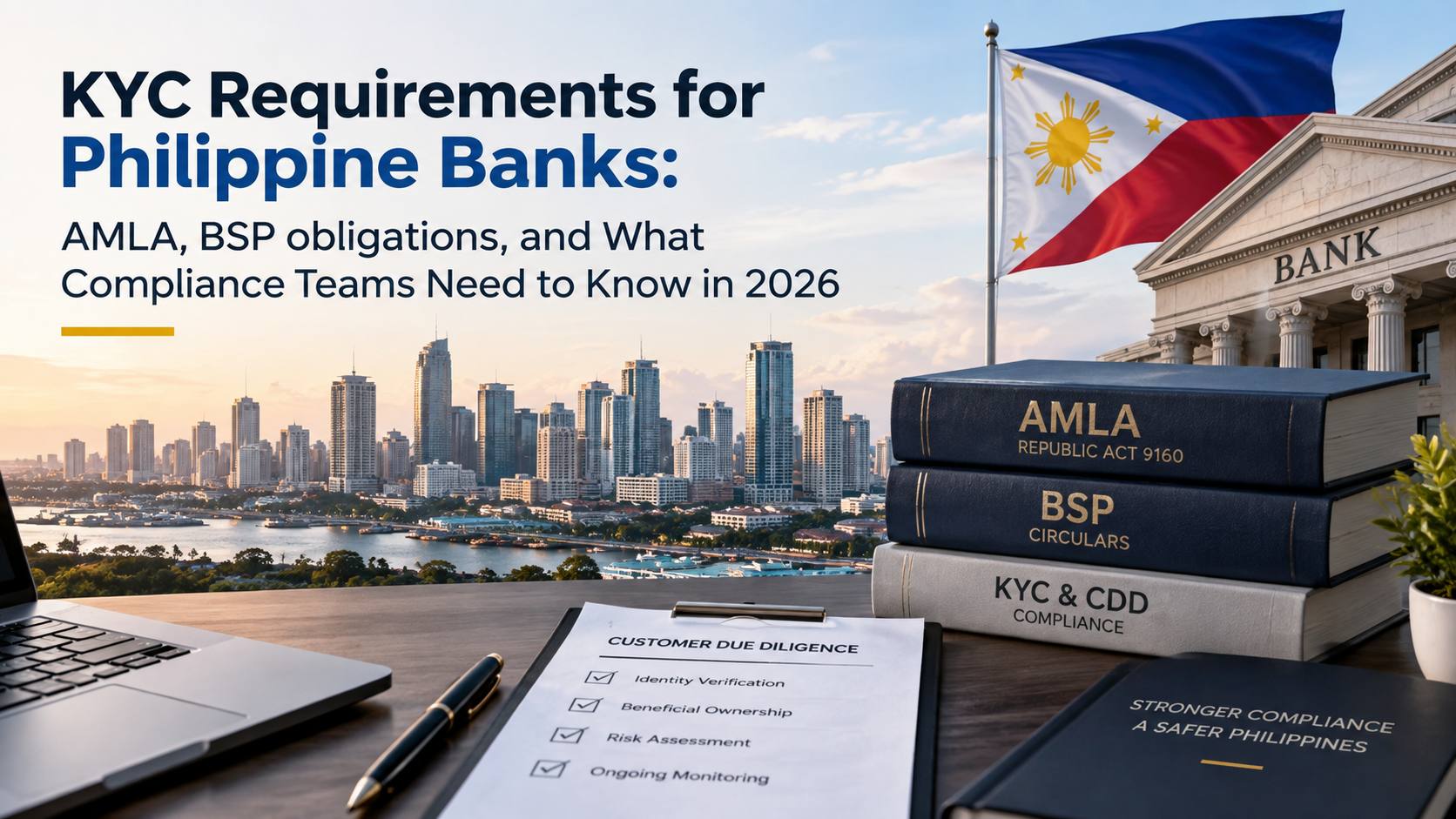
KYC Requirements for Philippine Banks: AMLA, BSP obligations, and What Compliance Teams Need to Know in 2026
The Philippines was removed from the FATF list of jurisdictions under increased monitoring in February 2025. This guide explains current AMLA and BSP KYC/CDD requirements for banks, including beneficial ownership, digital onboarding, reporting and record retention.