Automating Regulatory Reporting in Australian Banks: SMRs, TTRs, and IFTIs Made Smarter
.svg)
AUSTRAC’s compliance standards are rising, and Australian banks are responding by automating regulatory reporting to save time, improve accuracy, and strengthen trust.
Introduction
Regulatory reporting is one of the most critical pillars of Australia’s financial crime compliance framework. Every day, banks must identify, investigate, and report suspicious or high-value transactions to AUSTRAC within strict deadlines.
However, traditional reporting processes rely heavily on manual reviews and fragmented systems, which slow down investigations and increase the risk of human error. As transaction volumes surge through NPP and PayTo, the pressure on compliance teams has never been higher.
The solution lies in automation. By combining intelligent workflows, analytics, and AI, Australian banks can streamline their Suspicious Matter Reports (SMRs), Threshold Transaction Reports (TTRs), and International Funds Transfer Instructions (IFTIs), ensuring accuracy, speed, and regulatory confidence.

Why Regulatory Reporting Matters
Regulatory reporting allows AUSTRAC to identify and disrupt criminal activity such as money laundering, terrorism financing, and large-scale fraud. Each report contributes to Australia’s broader intelligence network, connecting financial data with law enforcement insights.
Failure to file complete or timely reports can lead to:
- Regulatory penalties: AUSTRAC can impose multi-million-dollar fines.
- Reputational damage: Missed or inaccurate reports undermine public trust.
- Operational inefficiencies: Manual processes consume valuable time and resources.
For banks, automation is not just a cost-saving measure. It is essential for maintaining compliance integrity in a real-time financial ecosystem.
Understanding the Three Core Reports
1. Suspicious Matter Reports (SMRs)
Banks must file SMRs when they detect behaviour that may involve money laundering, terrorism financing, tax evasion, or other financial crimes.
Key requirements:
- Must be lodged within 3 business days for suspected terrorism financing or within 10 business days for other suspicions.
- Must include transaction details, parties involved, and reasons for suspicion.
- Requires strong internal escalation procedures.
2. Threshold Transaction Reports (TTRs)
TTRs must be submitted for cash transactions of AUD 10,000 or more (or equivalent in foreign currency).
Key requirements:
- Must be filed within 10 business days.
- Applies to deposits and withdrawals.
- Includes both individuals and business customers.
3. International Funds Transfer Instructions (IFTIs)
IFTIs capture cross-border transactions entering or leaving Australia.
Key requirements:
- Must be reported within 10 business days.
- Applies to both electronic and physical fund transfers.
- Must include sender, receiver, amount, and intermediary details.
Challenges in Traditional Reporting Processes
- Manual Data Gathering
Analysts pull information from multiple systems, increasing the chance of incomplete or inconsistent data. - Delayed Investigations
Manual review of alerts slows down the reporting cycle, risking regulatory breaches. - Human Error
Copy-paste errors or missed fields can trigger report rejections or audits. - Disconnected Systems
Transaction monitoring, case management, and reporting tools often operate in silos. - Growing Transaction Volumes
With instant payments, even small institutions process millions of transactions daily.
These challenges make automation critical for accuracy, timeliness, and scalability.
Why Automation Is the Future of Compliance
1. Speed and Efficiency
Automated systems can prepare and submit SMRs, TTRs, and IFTIs within seconds, ensuring no deadlines are missed.
2. Accuracy and Consistency
AI-driven validation checks reduce data entry errors and enforce regulatory formatting standards automatically.
3. Real-Time Compliance
Automation allows continuous monitoring and instant report generation when suspicious activity is detected.
4. Audit-Ready Transparency
Every automated report includes full audit trails for easy review by compliance officers or regulators.
5. Reduced Workload
Analysts spend more time on complex investigations and less on administrative tasks.
6. Scalable for Growth
As institutions expand or integrate new payment channels, automated systems scale without proportional cost increases.
AUSTRAC’s View on Automation
AUSTRAC has consistently encouraged the adoption of RegTech and SupTech solutions that strengthen compliance. Automation aligns perfectly with AUSTRAC’s objectives:
- Ensuring timely and high-quality reporting.
- Reducing human error and operational delays.
- Encouraging explainable, risk-based use of AI.
- Promoting stronger collaboration between regulators and financial institutions.
Automated reporting systems must still include human oversight, ensuring that final reviews and validations remain accountable and transparent.
How Automated Reporting Works
1. Data Integration
Automation tools connect directly to core banking, transaction monitoring, and customer databases to capture relevant details in real time.
2. Alert Prioritisation
AI models score alerts based on risk level, automatically surfacing the most urgent or complex cases for review.
3. Case Preparation
Structured templates pre-populate SMRs, TTRs, and IFTIs with verified information, minimising manual input.
4. Workflow Automation
Reports move through approval stages automatically, with notifications for compliance officers and auditors.
5. Submission and Acknowledgement
Final reports are securely transmitted to AUSTRAC’s online reporting system, with confirmation logs stored for audit.
6. Continuous Improvement
Feedback from investigators refines model accuracy and improves future report quality.
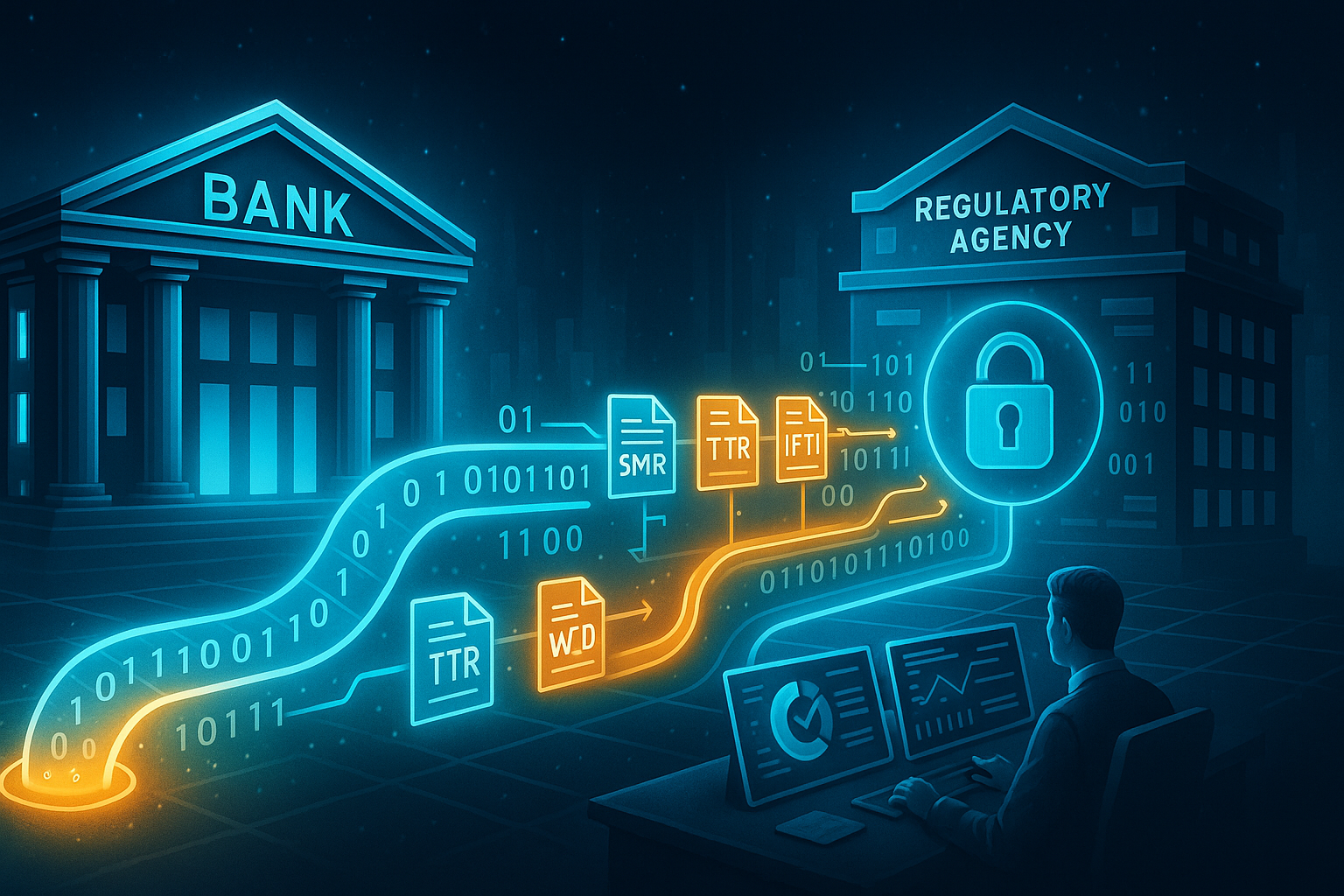
Key Features of Automated Reporting Systems
- End-to-End Integration: Connects data across AML, fraud, onboarding, and KYC systems.
- Risk-Based Prioritisation: Automatically highlights transactions that match high-risk patterns.
- Explainable AI Models: Every decision can be justified to regulators.
- Federated Intelligence: Incorporates typologies shared through networks such as the AFC Ecosystem.
- Audit Trail Management: Tracks every report creation, edit, and submission.
- Real-Time Dashboards: Provide visibility into pending, completed, and overdue reports.
Spotlight: Tookitaki’s FinCense
FinCense, Tookitaki’s AI-powered compliance platform, transforms regulatory reporting for Australian banks.
- Automated Reporting: Prepares and submits SMRs, TTRs, and IFTIs directly to AUSTRAC with zero manual intervention.
- Agentic AI Copilot (FinMate): Generates narrative summaries for each case, helping investigators finalise reports faster.
- Federated Intelligence: Accesses anonymised typologies from the AFC Ecosystem to strengthen detection accuracy.
- Integrated Case Management: Links alerts, investigations, and reports in a single interface.
- Explainable AI: Ensures transparency and auditability across all compliance processes.
- Real-Time Dashboards: Give compliance officers complete visibility into reporting pipelines.
With FinCense, banks can move from reactive compliance to predictive, automated reporting that keeps pace with AUSTRAC’s evolving requirements.
Benefits of Automating Regulatory Reporting
- Zero Missed Deadlines: Reports are filed automatically as soon as suspicious activity is confirmed.
- Fewer Human Errors: Automated validation ensures data integrity.
- Faster Investigations: Case preparation time is reduced by up to 80 percent.
- Better Audit Outcomes: Built-in transparency satisfies regulatory audits.
- Enhanced Collaboration: Teams can focus on decision-making instead of data collection.
- Improved Cost Efficiency: Reduced manual effort cuts operational costs while boosting compliance quality.
Implementation Roadmap for Banks
- Assess Current Reporting Gaps: Identify inefficiencies in existing processes.
- Integrate Systems: Connect AML, transaction monitoring, and KYC data through secure APIs.
- Deploy Automation Tools: Choose platforms that meet AUSTRAC’s technical and regulatory requirements.
- Train Compliance Teams: Ensure staff can review and validate automated outputs confidently.
- Monitor Performance: Regularly review KPIs such as turnaround time, accuracy rate, and report volume.
- Engage Regulators: Maintain open dialogue with AUSTRAC about system design and updates.
Future of Regulatory Reporting in Australia
- AI-Assisted Case Writing: Intelligent copilots will generate entire SMRs automatically.
- Real-Time Reporting: AUSTRAC may move toward live data feeds for continuous oversight.
- Federated Learning Collaboration: Banks will share typologies securely without revealing customer data.
- Predictive Compliance: Systems will identify suspicious activity before transactions settle.
- Global Harmonisation: Automation will support compliance with both AUSTRAC and FATF standards.
Conclusion
Regulatory reporting is no longer a back-office function. It is a frontline defence that protects the integrity of Australia’s financial system.
Automation gives banks the agility to meet AUSTRAC’s demands without compromising accuracy or customer trust.
With Tookitaki’s FinCense, Australian banks can automate reporting end to end, eliminate manual errors, and ensure continuous compliance in a world where speed and precision define success.
Pro tip: The best compliance systems do not just meet deadlines; they build trust by getting it right every single time.
Experience the most intelligent AML and fraud prevention platform
Experience the most intelligent AML and fraud prevention platform
Experience the most intelligent AML and fraud prevention platform
Top AML Scenarios in ASEAN
The Role of AML Software in Compliance
The Role of AML Software in Compliance