

No More Guesswork: Why Automated Name Screening Tools Are Redefining Compliance in Singapore
.svg)
Every customer name carries risk.
In Singapore’s globally connected financial ecosystem, a single missed sanctions match or overlooked politically exposed person can lead to regulatory penalties, reputational damage, and operational fallout.
At the same time, compliance teams face a different challenge. Traditional name screening systems generate overwhelming volumes of false positives, slowing down onboarding and burdening investigators.
This is where the automated name screening tool has become indispensable.
Modern screening solutions are no longer simple list-matching engines. They are intelligent, real-time systems that continuously evaluate customer risk, reduce false positives, and integrate seamlessly into the broader AML compliance architecture.
For banks and fintechs in Singapore, automation is not just improving screening. It is redefining how compliance works.

Why Name Screening Is a Critical Control
Name screening is one of the first and most important controls in financial crime prevention.
Before a customer is onboarded or a transaction is processed, institutions must ensure that individuals and entities are not associated with:
- Sanctions lists
- Politically exposed person databases
- Adverse media sources
- Internal watchlists
- Regulatory enforcement lists
In Singapore, regulators expect screening to occur not only at onboarding but throughout the entire customer lifecycle.
This includes:
- Continuous monitoring of customer profiles
- Screening of transaction counterparties
- Immediate response to watchlist updates
Failure to identify high-risk individuals can have severe consequences. But overly aggressive screening creates operational inefficiencies.
Automation helps strike the balance.
The Problem With Manual and Legacy Screening
Traditional screening systems rely heavily on manual processes and basic matching logic.
These systems typically use:
- Exact or partial string matching
- Fixed similarity thresholds
- Batch-based list updates
- Manual alert reviews
This approach creates several issues.
First, it generates excessive false positives. Common names and regional naming variations often trigger large numbers of irrelevant alerts.
Second, it struggles with multilingual data. Names may appear differently across languages, scripts, and transliterations.
Third, it lacks speed. Batch processing delays risk detection.
Fourth, it operates in isolation. Screening results are often disconnected from customer risk scoring and transaction monitoring systems.
Automated name screening tools address these challenges through intelligence, integration, and continuous monitoring.
What Is an Automated Name Screening Tool?
An automated name screening tool is a system that uses advanced algorithms and real-time processing to identify potential matches between customer data and risk lists.
Unlike traditional systems, automated tools:
- Continuously monitor changes in customer data and watchlists
- Apply intelligent matching logic to reduce false positives
- Trigger alerts automatically when risk conditions are met
- Integrate with broader compliance systems
- Support real-time decision making
Automation eliminates manual bottlenecks while improving detection accuracy.
Key Capabilities of Modern Automated Screening Tools
Intelligent Matching and Name Recognition
Modern tools use advanced matching techniques that go beyond simple string comparison.
These include:
- Phonetic matching
- Transliteration handling
- Alias recognition
- Multi-language support
- Contextual entity analysis
This allows systems to detect true matches even when names appear differently across data sources.
Continuous Screening
Screening does not stop at onboarding.
Automated tools continuously monitor:
- Changes in customer profiles
- Updates to sanctions and watchlists
- New adverse media information
This ensures that risk changes are detected immediately.
Continuous screening is essential in Singapore’s regulatory environment, where institutions are expected to maintain up-to-date risk assessments.
Delta Screening
Delta screening improves efficiency by focusing only on changes.
Instead of re-screening entire databases, systems:
- Re-screen customers when profiles change
- Re-evaluate matches when watchlists update
This targeted approach reduces processing time and improves system performance.
Real-Time Screening
Automated tools can evaluate names instantly.
Real-time screening supports:
- Faster onboarding decisions
- Immediate transaction screening
- Reduced compliance delays
In high-volume environments, real-time capability is critical.
Risk-Based Alerting
Not all matches carry the same risk.
Modern screening tools assign risk scores based on:
- Match confidence
- Customer profile
- Geographic exposure
- Contextual data
This helps compliance teams prioritise alerts effectively.
Integration With AML Systems
An automated name screening tool must work within a broader compliance ecosystem.
Integration with other AML systems enhances its effectiveness.
Key integrations include:
- Transaction monitoring systems
- Customer risk scoring engines
- Case management tools
- Suspicious transaction reporting workflows
When screening alerts feed directly into case management systems, investigators gain full context.
This improves decision making and reduces investigation time.

Reducing False Positives Without Missing Risk
False positives are one of the biggest challenges in name screening.
Too many alerts slow down onboarding and overwhelm compliance teams.
Automated tools reduce false positives by:
- Using advanced matching algorithms
- Applying contextual risk scoring
- Prioritising high-confidence matches
- Consolidating alerts
Reducing false positives improves operational efficiency and enhances customer experience.
Regulatory Expectations in Singapore
The Monetary Authority of Singapore requires financial institutions to maintain effective screening controls.
Key expectations include:
- Screening at onboarding and on an ongoing basis
- Continuous monitoring of watchlist updates
- Timely review of screening alerts
- Clear documentation of decision making
- Strong audit trails
Automated screening tools help institutions meet these requirements by ensuring consistent and timely detection.
Explainability and auditability are also critical. Institutions must be able to justify screening decisions.
Security and Infrastructure Requirements
Name screening systems process sensitive customer data.
Banks in Singapore require systems that meet high security standards.
Key requirements include:
- PCI DSS compliance
- SOC 2 Type II certification
- Secure cloud infrastructure
- Data protection and encryption
- Continuous monitoring for vulnerabilities
Cloud-native screening tools offer scalability while maintaining strong security.
Tookitaki’s Approach to Automated Name Screening
Tookitaki’s FinCense platform integrates automated name screening within a broader AI-native compliance architecture.
The platform combines:
- Sanctions screening
- PEP screening
- Adverse media screening
- Continuous monitoring
- Real-time screening
- Integration with transaction monitoring and case management
FinCense uses advanced matching logic and risk scoring to reduce false positives while maintaining strong detection accuracy.
Through integration with customer risk scoring and transaction monitoring, screening results become part of a 360-degree risk profile.
Collaborative intelligence frameworks allow institutions to continuously update detection scenarios based on emerging financial crime patterns.
This ensures screening remains aligned with evolving risks.
The Future of Automated Screening
Automated name screening will continue to evolve.
Future capabilities may include:
- AI-driven contextual analysis
- Behavioural risk integration
- Real-time global watchlist aggregation
- Enhanced entity resolution
- Integration with network analytics
Screening will become more predictive and less reactive.
Institutions will move from identifying known risks to anticipating emerging threats.
Conclusion
Name screening is a critical component of AML compliance.
In Singapore’s high-speed financial environment, manual and legacy systems are no longer sufficient.
Automated name screening tools provide the speed, accuracy, and scalability required to manage modern financial crime risks.
By combining intelligent matching, continuous monitoring, and system integration, these tools help institutions detect high-risk individuals while reducing operational burden.
For banks and fintechs, investing in automated screening is not just about compliance.
It is about building a more efficient, resilient, and future-ready financial crime prevention framework.
Experience the most intelligent AML and fraud prevention platform
Experience the most intelligent AML and fraud prevention platform
Experience the most intelligent AML and fraud prevention platform
Top AML Scenarios in ASEAN
The Role of AML Software in Compliance
The Role of AML Software in Compliance
Talk to an Expert
Our Thought Leadership Guides

KYC Requirements for Philippine Banks: AMLA, BSP obligations, and What Compliance Teams Need to Know in 2026
The Philippines was removed from the FATF list of jurisdictions under increased monitoring in February 2025. This guide explains current AMLA and BSP KYC/CDD requirements for banks, including beneficial ownership, digital onboarding, reporting and record retention.
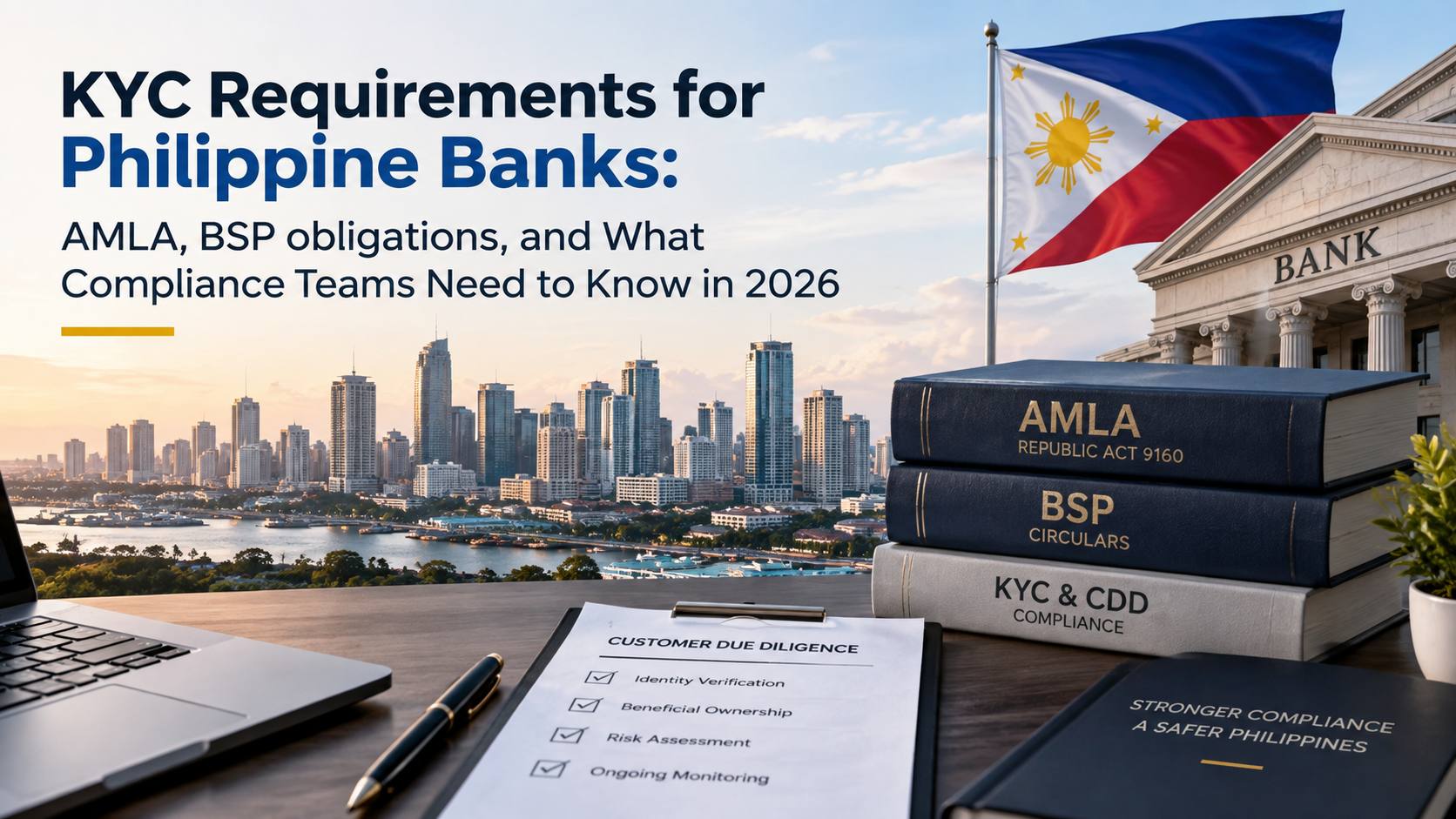
KYC Requirements for Philippine Banks: AMLA, BSP obligations, and What Compliance Teams Need to Know in 2026
The Philippines was removed from the FATF list of jurisdictions under increased monitoring in February 2025. This guide explains current AMLA and BSP KYC/CDD requirements for banks, including beneficial ownership, digital onboarding, reporting and record retention.