

AML Case Management: How AI Reduces Alert Handling Time by 70%
.svg)
The bottleneck in most AML operations is not detection. Alert queues grow not because the detection system is generating too few alerts but because the investigation system cannot work through them fast enough.
A compliance team receiving 2,000 alerts a week from a well-tuned detection system still faces a significant operational problem if each alert takes 45 minutes to investigate. The queue grows. Triage happens by timestamp rather than risk. Cases that have been sitting for three days are reviewed before newer cases that present higher risk. High-value suspicious activity waits behind low-priority noise.
The consequence is not just operational inefficiency. It affects detection quality. When investigators are overloaded, their decisions become less thorough. Documentation becomes thinner. False positives are dismissed quickly to reduce the queue rather than reviewed carefully. True positives that require deeper investigation are processed at the same pace as everything else.
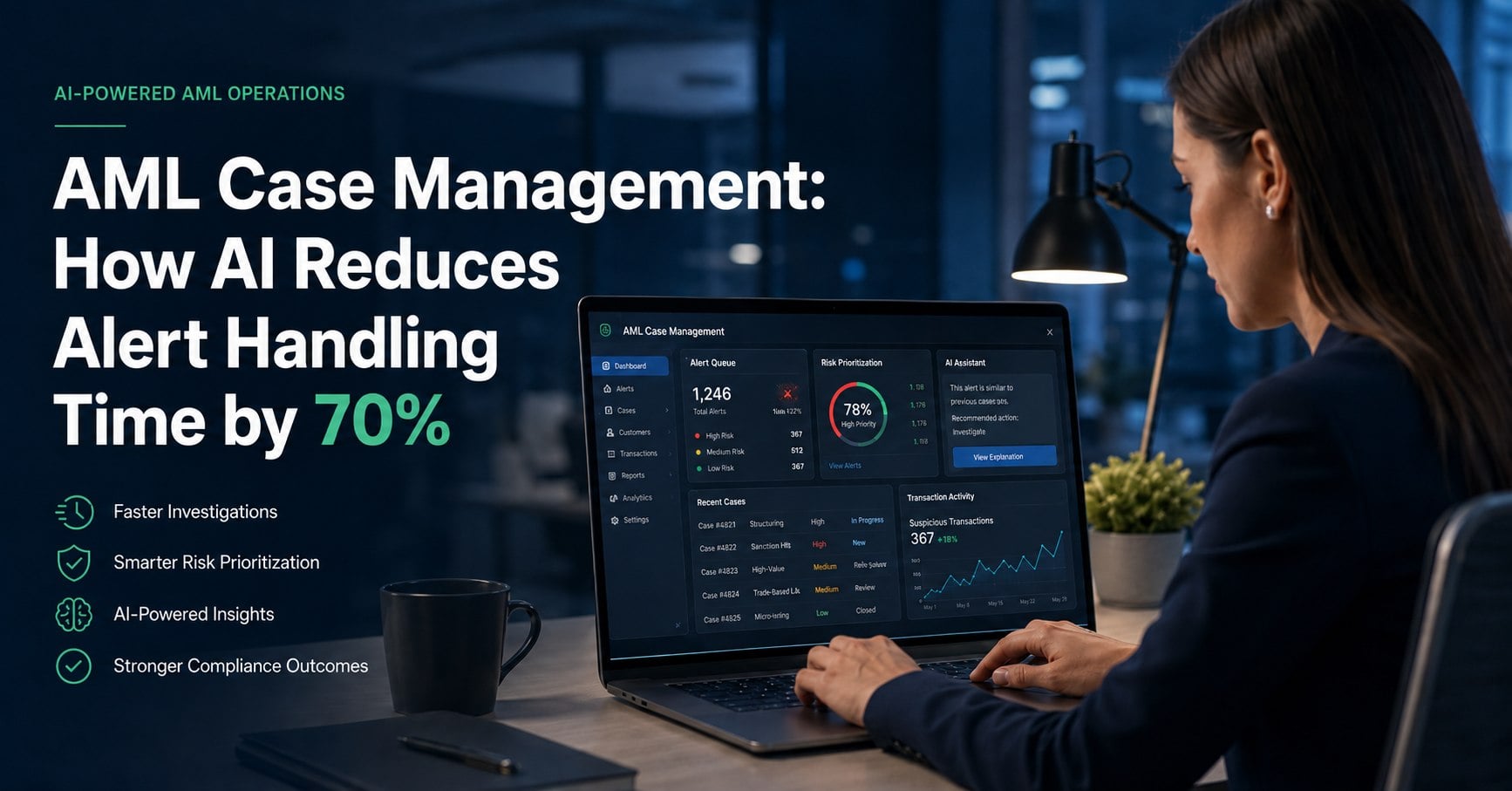
AI-powered case management addresses this by changing what arrives in an investigator's queue and what is in front of them when they open a case. FinCense Case Manager reduces alert handling time by 70 per cent and brings average alert triage time to under four hours for priority cases. This guide explains how each component of that improvement works.

Where traditional case management fails
Traditional AML case management systems are investigation record-keepers, not investigation assistants. They receive an alert, create a case record, assign it to an investigator, and track status. The investigator then opens the case, retrieves transaction data from one system, customer profile information from another, risk score history from a third, and related alerts from wherever those are stored. They assess the evidence, document their reasoning, and close or escalate.
The time in each case is dominated by assembly, not analysis. An investigator who spends 30 minutes on a case may spend 20 of those minutes pulling information from multiple systems. The actual assessment of whether the activity is suspicious takes the remaining 10.
Traditional systems also send alerts to investigators in the order they were generated. There is no automatic prioritisation by risk. A high-risk case generated at noon waits behind low-risk cases generated at 9 AM.
Neither problem is a detection failure. Both are case management failures.
Consolidated investigation view
FinCense Case Manager brings the information an investigator needs into a single environment at the point of case creation.
Customer information, alert history, transaction activity, risk scores, entity relationships, and related cases are assembled automatically when an alert is assigned. The investigator opens one record and sees the full picture: what the customer's profile looked like at onboarding, how their risk score has moved over the last 90 days, which other alerts have been generated for this customer or connected entities, and what the current alert's evidence shows.
This assembly happens before the investigator opens the case, not while they are working through it. The time saved is not trivial. When the information-gathering step is automated, the proportion of case time spent on actual analysis increases from a minority to a majority of the total.
The consolidated view also changes the quality of decisions. An investigator with complete context makes better assessments than one who is working from incomplete information because they ran out of time to gather everything. False positive dismissals are better documented when the investigator can see the full customer history. Escalation decisions are better supported when related alerts and entity connections are visible at the point of review.
Alert prioritisation and the categorised queue
Before alerts reach investigators, FinCense's Alert Prioritization AI Agent ranks and categorises them as high, medium, or low priority based on the risk score deviation from calibrated thresholds.
High-priority alerts represent the cases presenting the greatest risk to the institution and are worked first, regardless of when the alert was generated. Low-priority alerts that fall below a configurable threshold can be set to auto-close against predefined criteria, removing them from the queue without investigator review.
This prioritisation changes the composition of what investigators actually investigate. A queue that was previously dominated by low-risk alerts that happened to be generated earliest is replaced by a queue ordered by risk. The cases at the top of the queue are the ones most likely to require escalation to STR.
In production, this change in queue composition accounts for a significant portion of the handling time reduction. The time spent investigating alerts that will not escalate decreases substantially.
Integrated dashboards provide real-time visibility into alert volumes, case status, ageing, and investigation progress across the team. Supervisors can see where the queue is concentrated, which cases are approaching age thresholds, and how individual investigator workloads are distributed. This operational visibility allows workload to be managed proactively rather than reactively.
Explainable triage at the point of review
Every alert in FinCense Case Manager carries an explanation at the point of triage, not just a priority ranking. The investigator sees the signals that drove the alert, how each signal contributed to the risk score, and a contextual description of the financial crime behaviour those signals represent.
This is the same three-level explainability that operates in FinCense's detection layer: global (what the model learned), local (what drove this alert), and contextual (the financial crime language that maps the evidence to a typology).
The investigator does not need to interpret a score. They read a description of the relevant customer behaviour, the risk indicators that fired, and the typology from the AFC Ecosystem library that the pattern corresponds to. Their decision to escalate or dismiss is made with complete evidence in front of them, and their documented reasoning is specific rather than a reference to a score threshold.
This explainability also supports the audit trail that regulators expect. The evidence frozen onto the alert record at creation is the same evidence the investigator reviews. If a regulator later asks why a particular STR was filed, the case record shows the alert evidence, the investigator's documented reasoning, and the connection to the relevant typology. If they ask why a particular alert was dismissed, the same record shows the basis for that decision and who made it.
Process automation: STR narrative drafting and auto-closure
Two automation capabilities in FinCense Case Manager directly reduce the time investigators spend on administrative tasks.
STR/SAR narrative drafting. When an investigator escalates a case to STR, the Case Manager uses the alert evidence and the investigator's documented reasoning to draft the STR narrative. The investigator reviews and finalises the draft rather than writing it from a blank page. For experienced investigators, this is a moderate time saving. For teams with higher turnover or less experienced analysts working lower-priority cases, the saving is more substantial, and the consistency of STR narratives improves.
Configurable auto-closure. Low-risk alerts that fall below configurable thresholds and match predefined criteria can be set to auto-close without investigator review. The auto-closure criteria are set by compliance leadership, documented, and retained in the audit trail. The alerts that auto-close are not deleted; they are closed with a recorded basis for closure that satisfies the documentation requirement without consuming investigator time.
Together, these two capabilities direct investigator time toward the cases that require human judgement and away from the tasks that are either mechanical or below the risk threshold that warrants manual review.
Connected across the full AML workflow
FinCense Case Manager is not a standalone investigation tool. It is the downstream component of a detection pipeline that begins with the AFC Ecosystem's typology library and runs through transaction monitoring before reaching the investigation queue.
The typologies that the AFC Ecosystem validates inform the detection scenarios active in transaction monitoring. The alerts those scenarios generate then flow into the Case Manager. The case records in Case Manager carry the evidence from detection and the typology context from the ecosystem library, assembled into a single investigation record.
This connection means that the quality of detection directly influences what investigators see. A detection system generating high volumes of noise creates a case management problem that no investigation workflow can fully resolve.
For AML and fraud programmes running on a single engine, Case Manager handles both AML and fraud alerts in the same investigation environment, sharing customer context and entity relationships across both functions. For more on the combined approach, see our FRAML guide.
The operational and regulatory outcome
The 70 per cent reduction in alert handling time is the direct operational outcome of combining consolidated investigation view, explainable triage, and process automation.
The regulatory outcome is a more complete and consistent audit trail. Every alert carries immutable evidence, every dismissal has documented reasoning, every escalation connects to the investigation record, and every STR links to the case evidence. This is the documentation standard that regulators like AUSTRAC, MAS, BNM, and BSP examine when reviewing an institution's AML programme, and it is produced as a byproduct of the normal investigation workflow rather than as a separate documentation exercise.
For how the AI detection architecture that feeds Case Manager works, see our guide to how machine learning works in AML transaction monitoring. For how the full AI-native platform operates, see our guide to what AI-native AML means.
To see how FinCense Case Manager handles AML investigation for your team, book a demo with our team.
Frequently asked questions
What is AML case management software?
AML case management software is the system through which compliance teams investigate alerts generated by transaction monitoring and other detection tools, document their decisions, and file suspicious matter reports. Traditional systems track alert status and investigation records. AI-powered case management systems track alert status and investigation records, consolidate all relevant information at the point of case creation, provide explainable evidence behind each alert, and automate the administrative tasks that dominate investigator time.
How does AI reduce alert handling time in AML case management?
FinCense Case Manager reduces alert handling time by 70 per cent through the following: consolidated investigation view that assembles all relevant information before the investigator opens the case; explainable triage that gives investigators the evidence and context to make decisions quickly without cross-referencing multiple systems; and process automation including STR narrative drafting and configurable auto-closure of low-risk alerts.
What is STR narrative drafting automation?
When an investigator escalates a case to a suspicious matter report, FinCense Case Manager uses the alert evidence and the investigator's documented reasoning to draft the STR narrative. The investigator reviews and finalises the draft. This replaces the process of writing the narrative from a blank page, reducing the time spent on each escalation and improving consistency in how STRs are written across the team.
How does AML case management produce documentation for regulatory examination?
FinCense Case Manager creates an immutable record at alert creation, freezing the evidence that drove the alert. Every subsequent investigator action, including false positive dismissal with documented reasoning, escalation decision, and STR filing, is recorded against the same case. This produces a complete audit trail that regulators can examine: the evidence that existed at alert creation, who reviewed it, what decision was made, and on what basis. For dismissed alerts, the reasoning for dismissal is on record. For escalated alerts, the STR is linked to the investigation evidence.
Can AML and fraud alerts be managed in the same case management environment?
Yes. FinCense Case Manager handles both AML and fraud alerts in the same investigation environment, sharing customer context, entity relationships, and transaction history across both functions. This eliminates the handoff between separate AML and fraud investigation systems and allows analysts to see the complete picture of a customer's risk profile when assessing either type of alert. For more on combined AML and fraud operations, see our FRAML guide.
Experience the most intelligent AML and fraud prevention platform
Experience the most intelligent AML and fraud prevention platform
Experience the most intelligent AML and fraud prevention platform
Top AML Scenarios in ASEAN
The Role of AML Software in Compliance
The Role of AML Software in Compliance
Talk to an Expert
Our Thought Leadership Guides

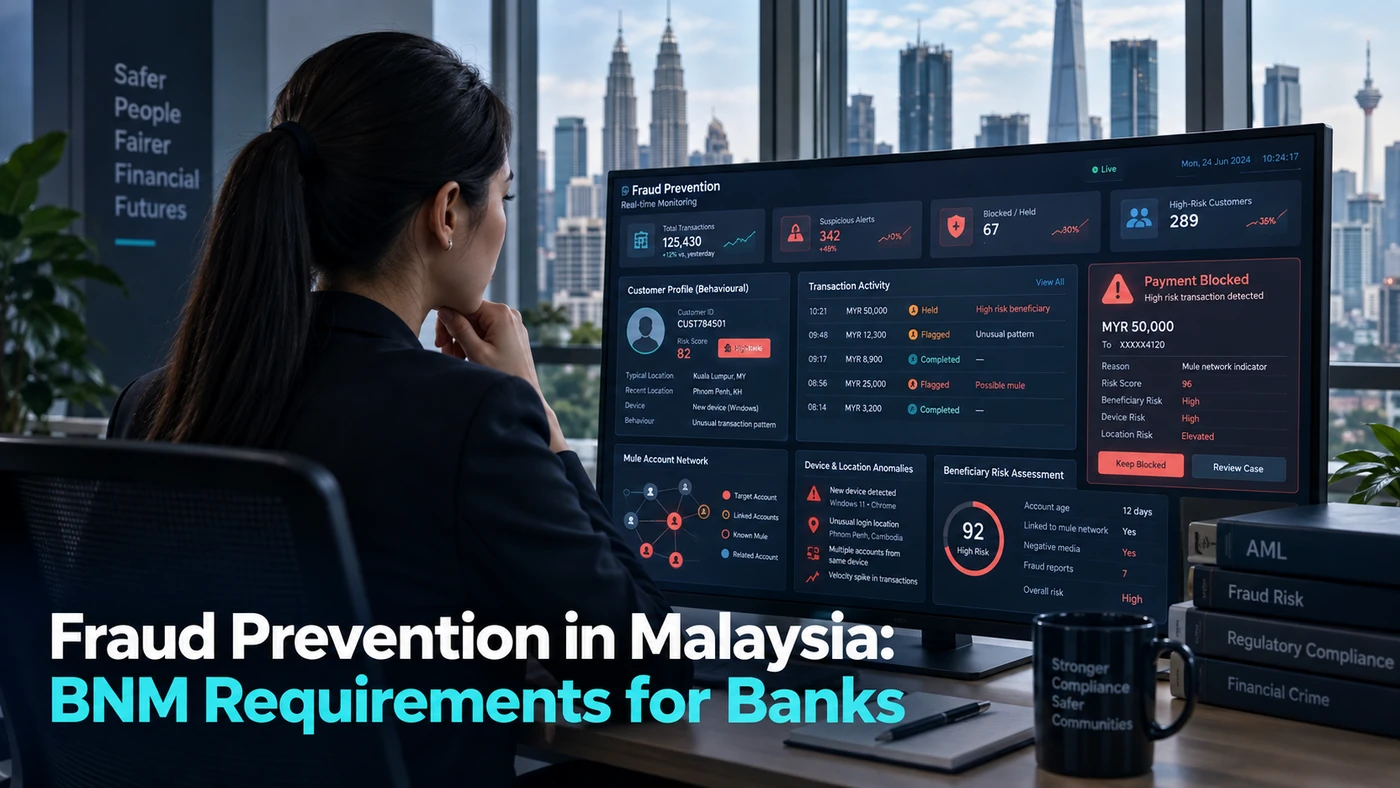
Customer Risk Scoring in AML: Why Static Models Fail and What Dynamic Scoring Looks Like
Customer risk assessments must remain current as customer circumstances and behaviour change. Learn where static AML risk models fall short and how event-driven, explainable scoring can strengthen ongoing due diligence.
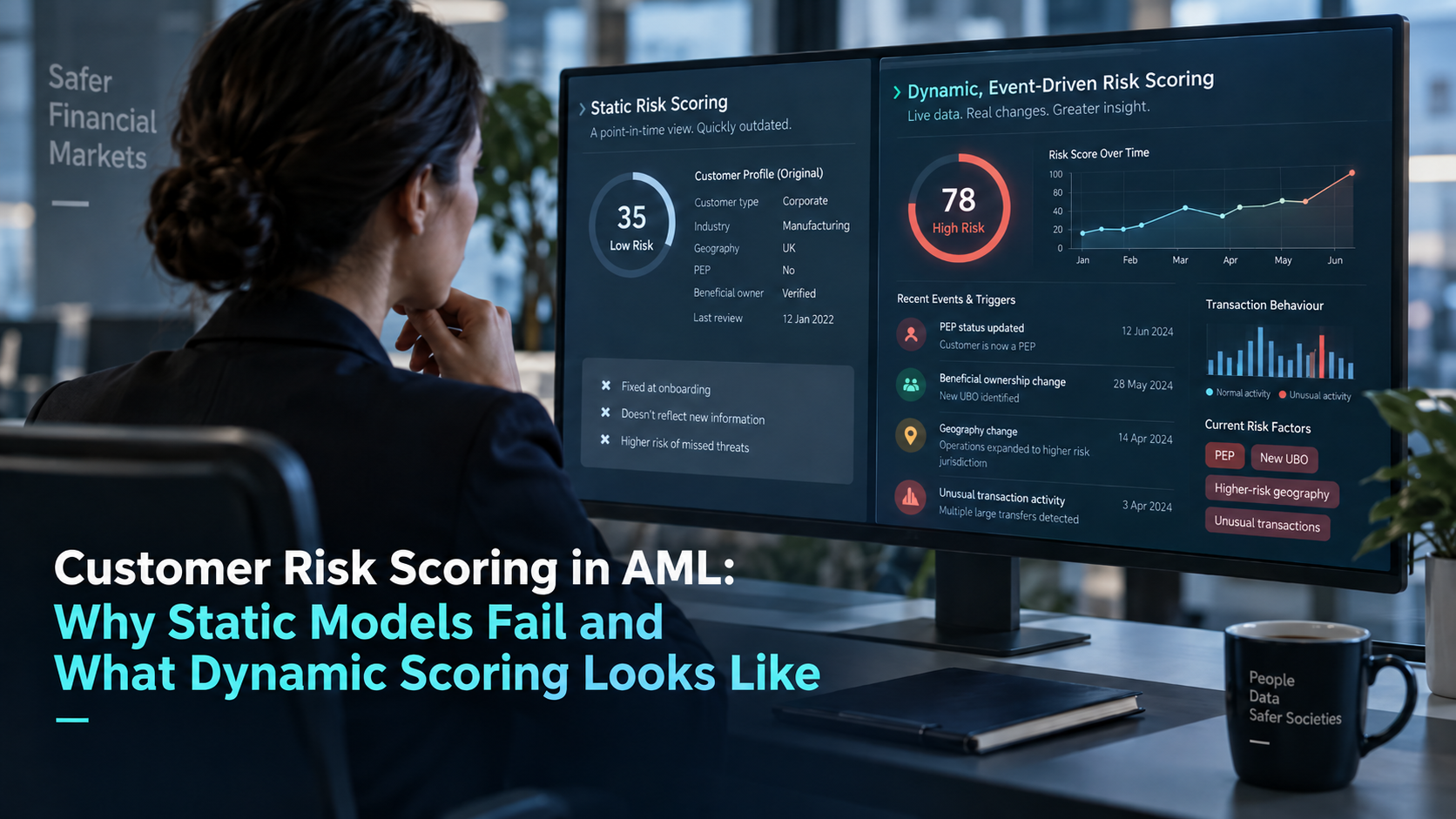
Customer Risk Scoring in AML: Why Static Models Fail and What Dynamic Scoring Looks Like
Customer risk assessments must remain current as customer circumstances and behaviour change. Learn where static AML risk models fall short and how event-driven, explainable scoring can strengthen ongoing due diligence.