

Inside Singapore’s YouTrip Account Takeover Surge
.svg)
1. Introduction to the Scam
In August 2025, Singapore confronted one of its most instructive fraud cases of the year — a fast, coordinated Account Takeover (ATO) campaign targeting YouTrip users. Within weeks, 21 customers lost access to their wallets after receiving what looked like genuine SMS alerts from YouTrip. More than S$16,000 vanished through unauthorised overseas transactions before most victims even realised their accounts had been compromised.
Unlike investment scams or fake job schemes, this wasn’t a long con.
This was precision fraud — rapid credential theft, instant account access, and a streamlined laundering pathway across borders.
The YouTrip case demonstrates an uncomfortable reality for the region:
ATO attacks are no longer exceptional; they are becoming a dominant fraud vector across Singapore’s instant-payment ecosystem.

2. Anatomy of the Scam
Even with Singapore’s strong cybersecurity posture, the mechanics behind this attack were alarmingly simple — and that’s what makes it so dangerous.
Step 1: Fraudsters Spoofed YouTrip’s SMS Sender ID
Victims received messages inside the legitimate YouTrip SMS thread.
This erased suspicion instantly. Criminals used sender-ID spoofing to impersonate official alerts such as:
- “Unusual login detected.”
- “Your account has been temporarily locked.”
- “Verify your identity to continue using the app.”
Step 2: Victims Clicked a Link That Looked Trustworthy
The URLs included familiar cues — “youtrip”, “secure”, “sg” — and closely mirrored the brand’s identity.
Phishing sites were mobile-optimised, giving them a legitimate look and feel.
Step 3: Credentials and OTPs Were Harvested in Real Time
The fake page requested the same details as the real app:
- login email
- password
- one-time password
As soon as victims entered the OTP, scammers intercepted it and logged into the real YouTrip account instantly.
Step 4: Takeover Was Completed in Under a Minute
Upon successful login, fraudsters performed high-risk actions:
- Changed recovery email
- Added their own device
- Modified account security settings
- Removed access for the legitimate user
This locked victims out before they could intervene.
Step 5: Funds Were Drained Through Overseas Transactions
Within minutes, transactions were executed via channels selected for:
- high transaction throughput
- low scrutiny
- regional cash-out networks
By the time victims called YouTrip or the bank, the money was already layered through multiple nodes.
3. Why Victims Fell for It: The Psychology at Play
Contrary to popular belief, victims were not careless — they were outplayed by criminals who understand behavioural sequencing and cognitive biases better than most.
1. Authority Bias
Messages delivered inside an official SMS thread trigger the same psychological authority as a bank officer calling from a registered number.
2. Urgency Override
Terms like “account suspension” or “unauthorised transaction detected” induce panic, shutting down analytical thinking.
3. The Familiarity Heuristic
Humans trust interfaces they recognise.
The cloned YouTrip page exploited this instinct to put victims into autopilot mode.
4. Digital Fatigue
Singaporean users receive dozens of OTPs, login requests, and verification alerts daily.
Criminals exploited this conditioning — when everything looks like routine security, nothing seems suspicious.
5. Multi-Step Confirmation
Phishing sites that request multiple fields (email + password + OTP) feel more legitimate because users equate complexity with authenticity.
ATO scams succeed not because users are uninformed, but because the attacker understands their mental shortcuts.

4. The Laundering Playbook Behind the Scam
What happened after the account takeover was not random — it followed a familiar cross-border laundering blueprint observed in multiple ASEAN cases this year.
1. Rapid Conversion Through High-Risk Overseas Merchants
Instead of direct wallet-to-wallet transfers, funds were routed through:
- offshore digital service providers
- unregulated e-commerce gateways
- grey-market merchant accounts
This first hop breaks the link between victim and beneficiary.
2. Layering Through Micro-Transactions
Stolen balances are split into multiple small payments to evade:
- velocity controls
- threshold triggers
- AML rule-based alerts
These micro-purchases accumulate into large aggregated totals further downstream.
3. Cash-Out Via Mule Networks
Money ends up with low-tier money mules in:
- Malaysia
- Thailand
- Indonesia
- or the Philippines
These cash-out operatives withdraw, convert to crypto, or re-route to additional accounts.
4. Final Integration
Funds reappear as:
- crypto assets
- overseas remittance credits
- merchant settlement payouts
- or legitimate-looking business revenues
Within hours, the fraud becomes laundered value — almost unrecoverable.
The YouTrip case is not an isolated attack, but a reflection of a well-oiled fraud-laundering pipeline.
5. Red Flags for Banks and E-Money Issuers
ATO fraud leaves behind detectable signals — but institutions must be equipped to see them in real time.
A. Pre-Login Red Flags
- Sudden device fingerprint mismatch
- Login attempts from high-risk IP addresses
- Abnormal login timing patterns (late night/early morning bursts)
B. Login Red Flags
- Multiple failed login attempts followed by a quick success
- New browser or device immediately accessing sensitive settings
- Unexpected change to recovery information within minutes of login
C. Transaction Red Flags
- Rapid overseas transactions after login
- Micro-transactions in quick succession
- Transfers to merchants with known risk scores
- New beneficiary added and transacted with instantly
D. Network-Level Red Flags
- Funds routed to known mule clusters
- Transaction patterns matching previously detected laundering typologies
- Repeated use of the same foreign merchant across multiple victims
These signals often appear long before the account is emptied — if institutions have the intelligence to interpret them.
6. How Tookitaki Strengthens Defences
This case illustrates exactly why Tookitaki is building the Trust Layer for financial institutions across ASEAN and beyond.
1. Community-Powered Intelligence (AFC Ecosystem)
ATO and mule typologies contributed by experts across 20+ markets help institutions recognise patterns before they are exploited locally.
Signals from similar scams in Malaysia, Thailand, and the Philippines immediately enrich Singapore’s detection capabilities.
2. FinCense Real-Time Behavioural Analytics
FinCense continuously evaluates:
- login patterns
- device changes
- location mismatches
- velocity anomalies
- transaction behaviour
This means ATO attempts can be flagged even before a fraudulent transfer is executed.
3. Federated Learning for Cross-Border Fraud Signals
Tookitaki’s federated approach enables institutions to detect emerging patterns from shared intelligence without exchanging personal data.
This is critical for attacks like YouTrip ATO, where laundering nodes sit outside Singapore.
4. FinMate — AI Copilot for Investigations
FinMate accelerates analyst action by providing:
- instant summaries
- source-of-funds context
- anomaly explanations
- recommended next steps
ATO investigations that once took hours can now be handled in minutes.
5. Unified Trust Layer
By integrating AML, fraud detection, and mule network intelligence into one adaptive engine, Tookitaki gives institutions a holistic shield against fast-moving, cross-border ATO attacks.
7. Conclusion
The YouTrip account takeover surge is a timely reminder that even well-secured digital wallets can be compromised through simple techniques that exploit human behaviour and real-time payment pathways.
This was not a sophisticated cyberattack.
It was a coordinated exploitation of urgency, routine behaviour, and gaps in behavioural monitoring.
As instant payments continue to dominate Singapore’s financial landscape, ATO attacks will only grow in frequency and complexity.
Institutions that rely solely on rule-based controls or siloed fraud engines will remain vulnerable.
But those that adopt a community-driven, intelligence-rich, and AI-powered fraud defence — the Trust Layer — will move faster than the criminals, protect their customers more effectively, and uphold trust in the digital financial ecosystem.
Experience the most intelligent AML and fraud prevention platform
Experience the most intelligent AML and fraud prevention platform
Experience the most intelligent AML and fraud prevention platform
Top AML Scenarios in ASEAN
The Role of AML Software in Compliance
Talk to an Expert
Our Thought Leadership Guides

Reducing False Alerts and Improving AML Detection Rates with Tookitaki's FinCense
False positives overwhelm AML compliance teams while genuine financial crime goes undetected. Tookitaki addresses this two ways: an Alert Prioritization AI Agent that works on top of any legacy system, and FinCense Transaction Monitoring with scenario-based detection and automated threshold tuning.

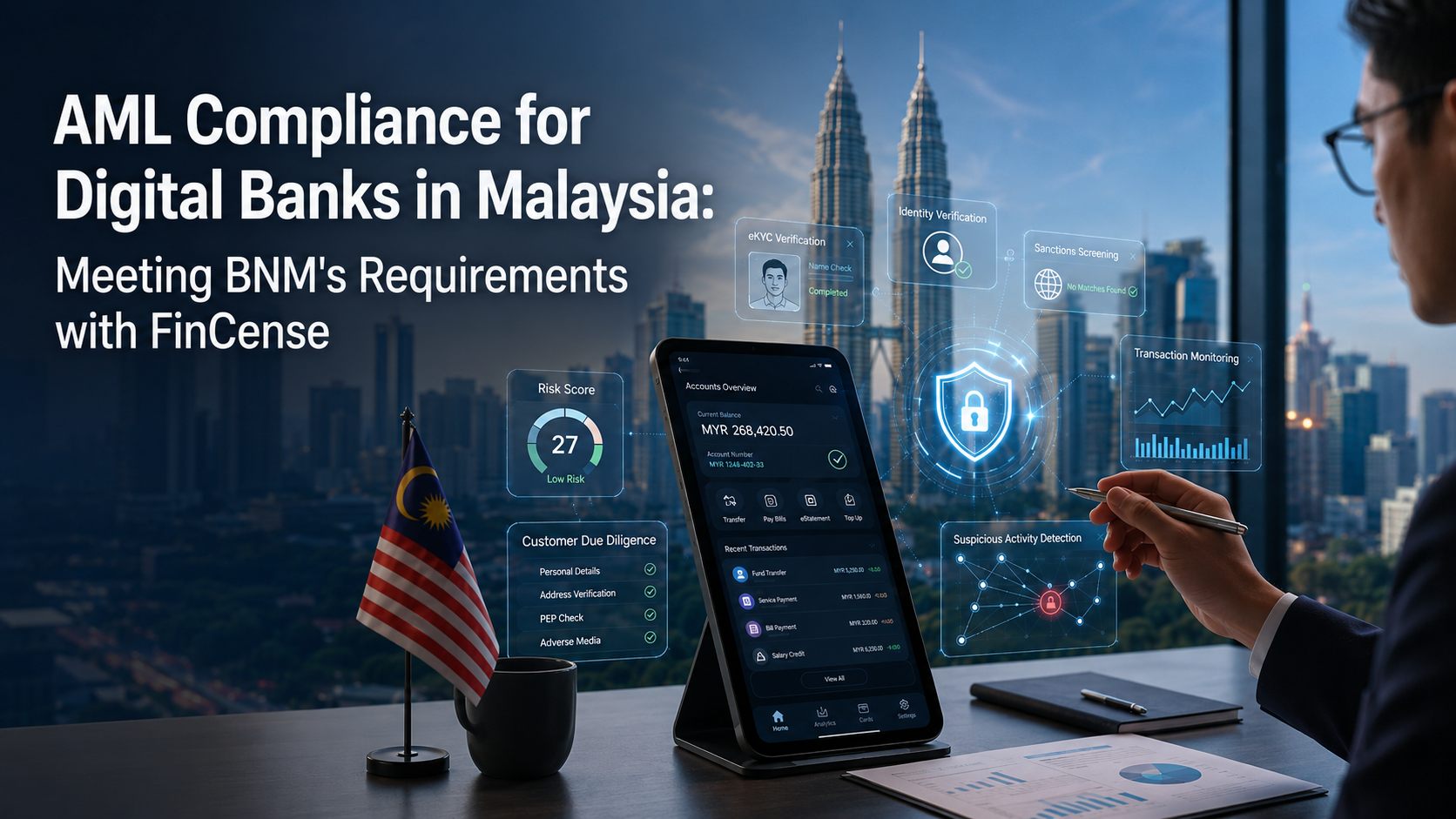
AML Compliance for Digital Banks in Malaysia: Meeting BNM's Requirements with FinCense
Malaysia's digital banks face BNM's 2023 AML/CFT Policy Document, FATF's updated recommendations, and mounting pressure on eKYC and transaction monitoring standards. Here is how FinCense addresses these requirements.

Living Under the STR Clock: The Growing Pressure on AML Investigators
AML investigators face increasing pressure to make Suspicious Transaction Report decisions under tight timelines and growing alert volumes. Explore the challenges behind STR reporting and the shift toward intelligence-led investigations.

