How Tookitaki Helps Australian Banks Meet AUSTRAC Transaction Monitoring Requirements
.svg)
Australia's AML/CTF regime is one of the most actively enforced in the Asia-Pacific region. AUSTRAC has issued enforceable undertakings against major banks, levied penalties exceeding AUD 1.3 billion against a single institution, and in 2024 extended the AML/CTF framework to lawyers, accountants and real estate agents under the AML/CTF Amendment Act. For Australian banks, fintechs and newly covered reporting entities, the transaction monitoring obligation sits at the centre of every examination.
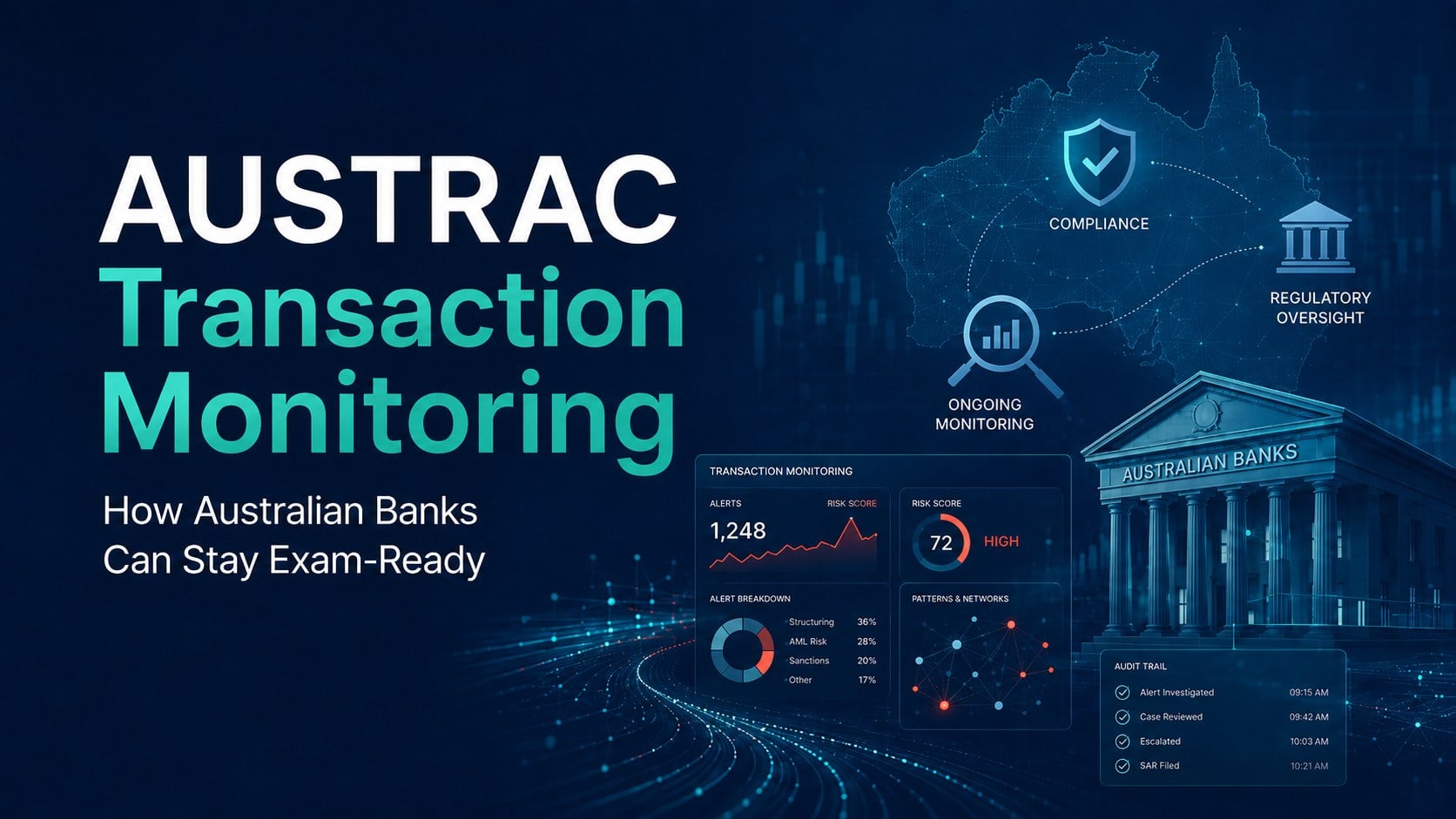
This page covers what AUSTRAC requires from transaction monitoring programmes, where compliance gaps most commonly appear, and how Tookitaki's FinCense platform is configured to meet Australian regulatory expectations.

What AUSTRAC Requires from Transaction Monitoring
Under the AML/CTF Act 2006 and the AML/CTF Rules, Australian reporting entities must maintain an AML/CTF programme that includes ongoing customer due diligence and transaction monitoring designed to detect suspicious activity. The monitoring obligation is not satisfied by deploying a system — it requires documented evidence that:
Monitoring scenarios are derived from the institution's ML/TF risk assessment. AUSTRAC's risk-based approach means that running vendor-default rules without anchoring them to a documented risk assessment is a standalone compliance gap, independent of whether those rules happen to detect anything. Examiners will request the mapping between risk assessment outputs and deployed monitoring scenarios.
Suspicious Matter Reports are filed promptly and accurately. There is no transaction threshold for SMR filing — the obligation arises when there are reasonable grounds for suspicion, regardless of value. AUSTRAC examiners review SMR quality, not just volume. A high alert count with a low SMR rate, or SMRs that contain insufficient transaction narrative, are both examination findings.
Threshold Transaction Reports are filed for all cash transactions of AUD 10,000 or more. TTRs are mandatory and must be submitted to AUSTRAC within 10 business days. Institutions with high cash volumes must ensure their monitoring systems can identify TTR-eligible transactions accurately, including where structuring may be occurring below the threshold.
Annual compliance reporting is supported by documented monitoring data. AUSTRAC's Annual Compliance Report requires reporting entities to certify that their AML/CTF programme is up to date and effective. The monitoring programme — its design, outputs, and review history — must be documentable for this purpose.
Monitoring is calibrated and reviewed. A monitoring programme that was built at implementation and never updated will fail examination. AUSTRAC expects evidence that institutions review monitoring effectiveness, assess false positive rates, and update scenarios when the risk assessment changes or new typologies emerge.
Access the detailed AUSTRAC transaction monitoring requirements here.
Where Australian Institutions Most Commonly Fail
AUSTRAC enforcement actions and industry guidance identify four recurring transaction monitoring failures:
Vendor-default rules with no risk-based customisation. Many institutions implement monitoring systems using out-of-the-box rules without adjusting thresholds, lookback periods or scenario parameters to reflect their specific customer base and risk profile. A rural bank with a predominantly elderly agricultural customer base faces different risks from a Sydney-based fintech handling international remittances — the monitoring programme must reflect that difference.
Alert backlogs that exceed acceptable investigation timeframes. An alert that sits unworked for 30 or 60 days is a compliance failure, not an operational inconvenience. AUSTRAC examiners review alert age at examination. Institutions with case management systems that cannot prioritise, assign and track alerts through to disposition have a structural gap.
SMR quality below regulatory expectation. AUSTRAC does not just count SMRs — it assesses whether they contain sufficient information for law enforcement use. Narrative that says "customer conducted unusual transactions" without describing the transactions, the suspicion indicators and the investigation steps taken does not meet the standard.
Tranche 2 readiness. The AML/CTF Amendment Act 2024 extends monitoring obligations to lawyers, accountants, real estate agents and other designated non-financial businesses from 2026. Institutions that transact with these sectors — providing banking services, credit facilities or payment channels to newly covered entities — need to review how their monitoring programmes account for the extended regulatory perimeter.
How Tookitaki's FinCense Platform Is Built for AUSTRAC Compliance
Risk-Based Scenario Configuration
FinCense is not deployed with generic rules. The implementation process begins with the institution's ML/TF risk assessment — the specific customer segments, products, delivery channels and geographic risks identified in that assessment drive which monitoring scenarios are deployed, what the thresholds are set to, and how alerts are prioritised. AUSTRAC's requirement that monitoring be derived from the risk assessment is built into the implementation methodology, not treated as an afterthought.
The platform includes pre-configured scenarios drawn from AUSTRAC typology guidance and the Financial Action Task Force (FATF) APAC regional risk reports. These scenarios are starting points, not defaults. Each is reviewed and calibrated against the institution's actual transaction data before go-live.
The Anti Financial Crime (AFC) Ecosystem
Tookitaki's Anti Financial Crime (AFC) Ecosystem is a shared intelligence network through which financial institutions across APAC contribute and receive anonymised typology intelligence. When a new structuring pattern emerges in one institution's transaction data, that intelligence — stripped of any identifying information — is available to other network participants within days.
For Australian institutions, this means that emerging typologies being identified by peer institutions in Singapore, Malaysia or the Philippines become available to Australian monitoring systems before they appear in AUSTRAC typology guidance. The network does not replace AUSTRAC-specific calibration, but it accelerates the institution's ability to detect novel patterns.
SMR and TTR Workflow Management
FinCense includes native case management that tracks every alert from generation through investigation and disposition. When an investigation concludes that an SMR should be filed, the case management system:
- Captures the full investigation trail — transaction data reviewed, analyst notes, escalation decisions
- Pre-populates AUSTRAC's SMR fields from the case record, reducing manual data entry and the risk of incomplete reports
- Records the filing date and AUSTRAC acknowledgment for audit purposes
- Flags TTR-eligible transactions automatically against the AUD 10,000 threshold, with structuring detection for transactions designed to avoid it
The audit trail produced by this workflow is the documentation AUSTRAC examiners review. Every alert, every investigation decision, and every report is recorded with timestamps, analyst identifiers and case notes.
Annual Calibration and Review Documentation
FinCense produces monitoring programme review reports that document: which scenarios were active during the period, alert volumes and false positive rates by scenario, scenario performance against detection objectives, and recommended adjustments. This output is designed to support the institution's annual compliance certification and to provide the documented evidence of review that AUSTRAC expects.
When a scenario is adjusted — threshold changed, lookback period modified, new typology added — the change is logged with the rationale and the date and is accessible during examination.
Tranche 2 Readiness
For institutions assessing how the AML/CTF Amendment Act 2024 affects their monitoring obligations — either because they are a newly covered entity or because they provide financial services to sectors that are — FinCense includes scenario coverage for the transaction types associated with Tranche 2 sectors and these scenarios can be quickly activated without a full system reconfiguration. For more on what Tranche 2 means for your monitoring programme, see our Tranche 2 AML Reforms Australia guide.
What Australian Institutions Should Assess Before Their Next Examination
Before AUSTRAC conducts an examination or requests documentation for a targeted review, compliance teams should be able to answer:
- Is every active monitoring scenario traceable to a specific risk identified in the institution's current ML/TF risk assessment?
- What is the average age of unresolved alerts in the case management system?
- When was the last monitoring calibration review conducted, and is it documented?
- What is the SMR narrative quality standard, and is it consistently applied across all analysts?
- For institutions affected by Tranche 2 — have monitoring scenarios been reviewed to cover the transaction types associated with newly regulated sectors?
If any of these questions cannot be answered from documented programme records, the gap is not just an examination risk — it is a programme design issue that requires attention.
For a full evaluation of what to look for in a transaction monitoring system built for AUSTRAC compliance, see our Transaction Monitoring Software Buyer's Guide.
To see how FinCense addresses these requirements in an Australian regulatory context, book a demo with Tookitaki's APAC compliance team.
Experience the most intelligent AML and fraud prevention platform
Experience the most intelligent AML and fraud prevention platform
Experience the most intelligent AML and fraud prevention platform
Top AML Scenarios in ASEAN
The Role of AML Software in Compliance
The Role of AML Software in Compliance