

The Investigator’s Command Center: AML Case Management Software for Malaysian Banks
.svg)
Financial crime investigations are becoming more complex. Modern AML case management software is emerging as the control centre that helps banks manage alerts, investigations, and regulatory reporting efficiently.
Malaysia’s financial system is rapidly evolving. Digital banking, fintech innovation, and cross-border financial flows are transforming how money moves across the economy.
While this transformation improves efficiency and financial inclusion, it also increases exposure to financial crime risks. Criminal networks today exploit digital payment channels, mule accounts, shell companies, and cross-border transfers to launder illicit proceeds.
For banks and financial institutions in Malaysia, identifying suspicious activity is only the first step. The real challenge lies in investigating alerts quickly, coordinating across compliance teams, and filing accurate regulatory reports.
This is where AML case management software becomes critical.

The Growing Complexity of AML Investigations
Anti-money laundering compliance has traditionally focused on detecting suspicious transactions.
However, detection alone does not stop financial crime. Once suspicious activity is flagged, compliance teams must investigate alerts, analyse transaction histories, review customer profiles, and determine whether the activity requires escalation or reporting.
These investigation workflows are becoming increasingly complex.
Modern financial crime cases often involve:
- Multiple accounts across institutions
- Cross-border transactions
- Layered fund movements across payment channels
- Networks of mule accounts and shell companies
- Fraud proceeds flowing through legitimate systems
As a result, compliance teams must process large volumes of alerts while maintaining strict regulatory standards.
Without efficient case management systems, investigations can become slow, fragmented, and resource-intensive.
Why Traditional Investigation Workflows Are Inefficient
Many financial institutions still rely on fragmented investigation workflows.
Alerts generated by transaction monitoring systems are often exported into spreadsheets or separate investigation tools. Investigators then manually analyse transactions, collect supporting information, and prepare case reports.
This approach creates several operational challenges.
Fragmented Investigation Data
Transaction monitoring, screening systems, and customer data often exist in separate platforms.
Investigators must manually collect and consolidate information from multiple systems before completing an investigation.
High Alert Volumes
Legacy monitoring systems frequently generate large numbers of alerts. Many of these alerts are false positives that still require manual review.
This increases operational pressure on compliance teams.
Slow Investigation Processes
Manual data gathering and documentation significantly increase investigation timelines.
When investigators manage dozens or even hundreds of alerts per day, efficiency becomes critical.
Reporting Challenges
Regulatory reporting requires clear documentation of investigation outcomes.
Without structured workflows, preparing Suspicious Transaction Reports (STRs) or Suspicious Activity Reports (SARs) becomes time-consuming.
AML case management software addresses these operational challenges by centralising investigations and automating key workflows.
What Is AML Case Management Software?
AML case management software is a specialised platform designed to help financial institutions manage the lifecycle of financial crime investigations.
It acts as the operational hub for compliance teams, enabling them to:
- Consolidate alerts from multiple systems
- Prioritise high-risk cases
- Analyse transaction activity
- Collaborate on investigations
- Document findings
- Generate regulatory reports
Instead of managing investigations across disconnected tools, investigators work within a unified platform.
This improves efficiency, transparency, and regulatory compliance.
The Role of Case Management in the AML Lifecycle
AML case management sits at the centre of the financial crime compliance workflow.
The investigation lifecycle typically follows several stages:
- Alert generation from transaction monitoring or screening systems
- Alert triage and prioritisation based on risk indicators
- Investigation and analysis of transaction behaviour and customer activity
- Case documentation and decision-making
- Regulatory reporting, such as STR or SAR filing
Case management software integrates these steps into a structured workflow.
This allows investigators to manage cases efficiently while maintaining complete audit trails.
Key Capabilities of Modern AML Case Management Platforms
Modern AML case management systems go far beyond simple investigation tracking.
They incorporate advanced capabilities that improve investigation accuracy and operational efficiency.
Centralised Alert Management
One of the most important functions of case management software is consolidating alerts from multiple systems.
Alerts from transaction monitoring, sanctions screening, fraud detection, and other systems can be aggregated into a single investigation platform.
This enables investigators to view all relevant alerts within one interface.
According to the Tookitaki platform architecture, the case manager consolidates alerts from all systems to streamline investigations and disposition workflows.
Intelligent Alert Prioritisation
Investigators often face overwhelming volumes of alerts.
Advanced case management systems use intelligent prioritisation techniques to identify high-risk alerts first.
Machine learning models and risk scoring mechanisms evaluate factors such as:
- Transaction behaviour
- Customer risk profile
- Network relationships
- Geographic exposure
This ensures investigators focus on the alerts that pose the greatest financial crime risk.
Investigation Workflows and Collaboration
AML investigations often require collaboration between multiple compliance analysts, investigators, and supervisors.
Case management platforms enable structured investigation workflows that allow teams to:
- Assign cases to investigators
- Track investigation progress
- Review evidence and transaction histories
- Escalate high-risk cases
This collaborative approach improves investigation efficiency while ensuring consistent compliance standards.
Automated STR and SAR Reporting
Regulatory reporting is one of the most critical outcomes of AML investigations.
Case management systems simplify this process by enabling investigators to generate Suspicious Transaction Reports directly within the platform.
Modern platforms support automated reporting workflows, including:
- Report drafting
- Supervisor approvals
- Audit trails
- Submission tracking
Some platforms also automate the creation of STR reports based on investigation outcomes and supporting evidence.

Reducing Investigation Backlogs
Compliance teams worldwide face growing alert volumes.
Without efficient investigation tools, institutions risk building large backlogs of unresolved alerts.
AML case management software reduces investigation bottlenecks through automation and workflow optimisation.
Benefits include:
- Faster alert triage
- Automated data aggregation
- Structured investigation templates
- Real-time case tracking
These capabilities significantly improve compliance productivity.
Enhancing Auditability and Regulatory Compliance
Financial institutions must demonstrate strong governance in their AML investigations.
Regulators expect institutions to maintain detailed records of investigation processes and decisions.
AML case management software provides structured audit trails that document:
- Alert generation
- Investigator actions
- Case notes and supporting evidence
- Escalation decisions
- Regulatory reporting outcomes
This level of transparency ensures institutions can demonstrate compliance during regulatory audits.
The Role of AI in AML Case Management
Artificial intelligence is increasingly transforming AML investigations.
AI-driven case management platforms can analyse large volumes of financial data and identify patterns that may indicate suspicious behaviour.
Key AI capabilities include:
- Automated alert prioritisation
- Pattern detection in transaction behaviour
- Network analysis of financial crime relationships
- Intelligent case recommendations
AI-powered systems can also help investigators by highlighting key risk indicators and summarising investigation findings.
This allows compliance teams to focus on higher-value analytical work.
The Strategic Value of AML Case Management
AML case management software is no longer just an operational tool.
It has become a strategic capability for financial institutions.
By improving investigation efficiency and risk visibility, case management platforms help institutions:
- Detect financial crime faster
- Reduce operational costs
- Improve compliance productivity
- Strengthen regulatory reporting
- Protect institutional reputation
In a digital financial ecosystem, these capabilities are essential.
The Future of AML Investigations
Financial crime techniques will continue evolving as criminals exploit new technologies and payment channels.
Future AML investigation platforms will increasingly rely on:
- AI-driven investigation support
- Real-time alert analysis
- Advanced network analytics
- Integrated fraud and AML detection
- Collaborative intelligence across institutions
Case management platforms will remain the operational backbone that connects these technologies.
They will enable investigators to manage financial crime risks with greater speed, accuracy, and efficiency.
How Tookitaki FinCense Strengthens AML Case Management
As financial crime investigations grow more complex, banks need platforms that unify detection, investigation, and reporting.
Tookitaki’s FinCense platform provides this through its AI-native financial crime compliance architecture. At the centre is the FinCense Case Manager, which consolidates alerts from transaction monitoring, screening, and fraud systems into a single investigation workspace.
Compliance teams can review alerts, analyse suspicious behaviour, document findings, and manage escalation workflows within one interface. The platform also applies AI-driven alert prioritisation, helping investigators focus on high-risk alerts first.
FinCense further simplifies compliance with structured STR reporting workflows, including editing, approvals, and full audit trails.
By combining case management, monitoring, screening, and reporting capabilities in one platform, FinCense helps banks streamline investigations, reduce operational friction, and strengthen financial crime detection.
Conclusion
Financial crime investigations are becoming more complex as digital financial ecosystems expand.
For Malaysian banks, the ability to manage investigations efficiently is critical to maintaining strong AML compliance.
AML case management software provides the operational foundation that enables investigators to analyse alerts, coordinate investigations, and generate regulatory reports within a structured platform.
By centralising investigation workflows and integrating advanced analytics, modern case management systems significantly improve compliance efficiency.
As financial crime risks continue to evolve, institutions that invest in intelligent AML case management platforms will be better equipped to protect their customers, meet regulatory expectations, and safeguard the integrity of Malaysia’s financial system.
Experience the most intelligent AML and fraud prevention platform
Experience the most intelligent AML and fraud prevention platform
Experience the most intelligent AML and fraud prevention platform
Top AML Scenarios in ASEAN
The Role of AML Software in Compliance
The Role of AML Software in Compliance
Talk to an Expert
Our Thought Leadership Guides

Customer Risk Scoring in AML: Why Static Models Fail and What Dynamic Scoring Looks Like
Customer risk assessments must remain current as customer circumstances and behaviour change. Learn where static AML risk models fall short and how event-driven, explainable scoring can strengthen ongoing due diligence.
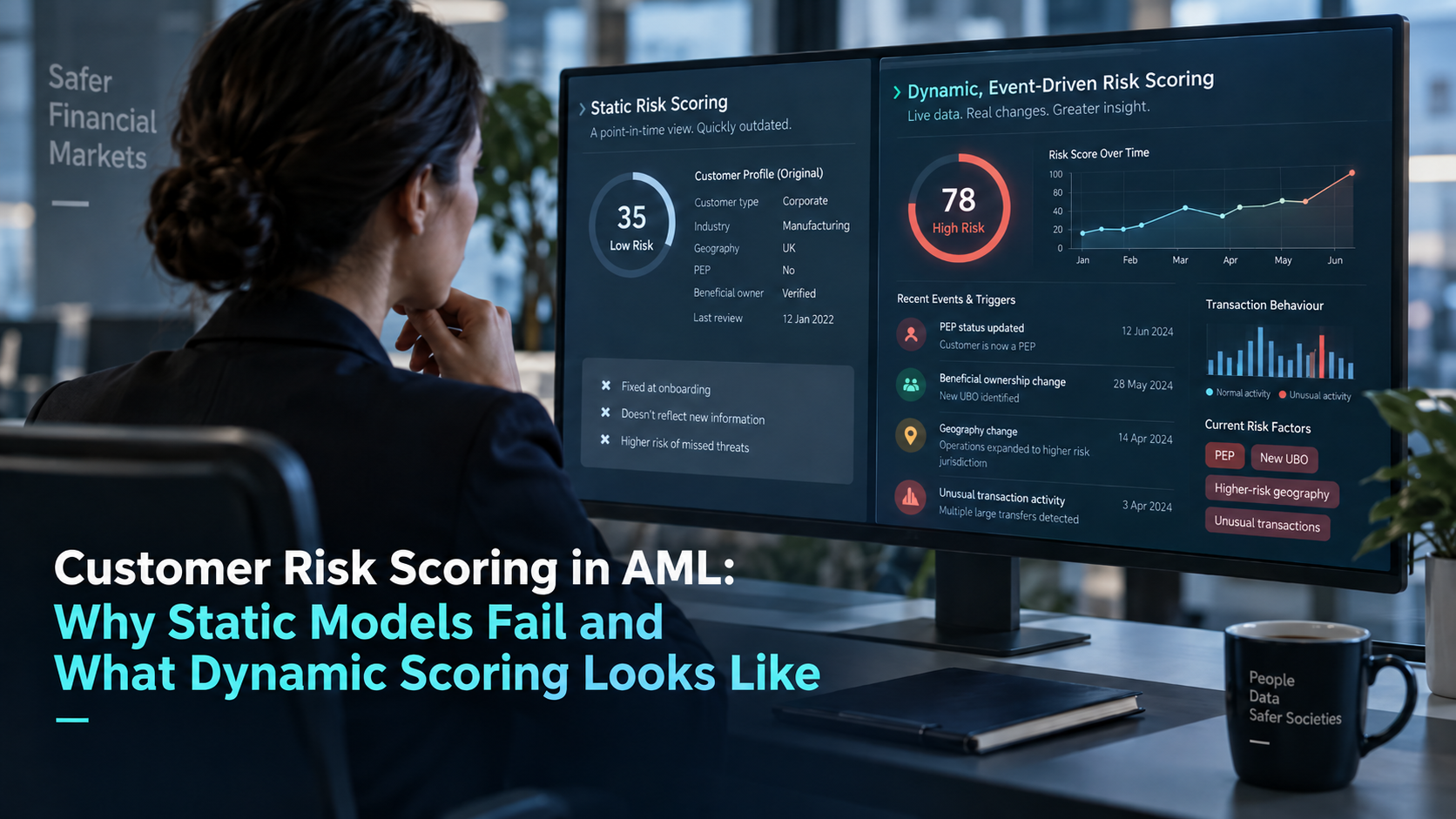
Customer Risk Scoring in AML: Why Static Models Fail and What Dynamic Scoring Looks Like
Customer risk assessments must remain current as customer circumstances and behaviour change. Learn where static AML risk models fall short and how event-driven, explainable scoring can strengthen ongoing due diligence.