Behind 3,000 Phones: Inside Zamboanga Sibugay’s Massive Scam Hub Bust
.svg)
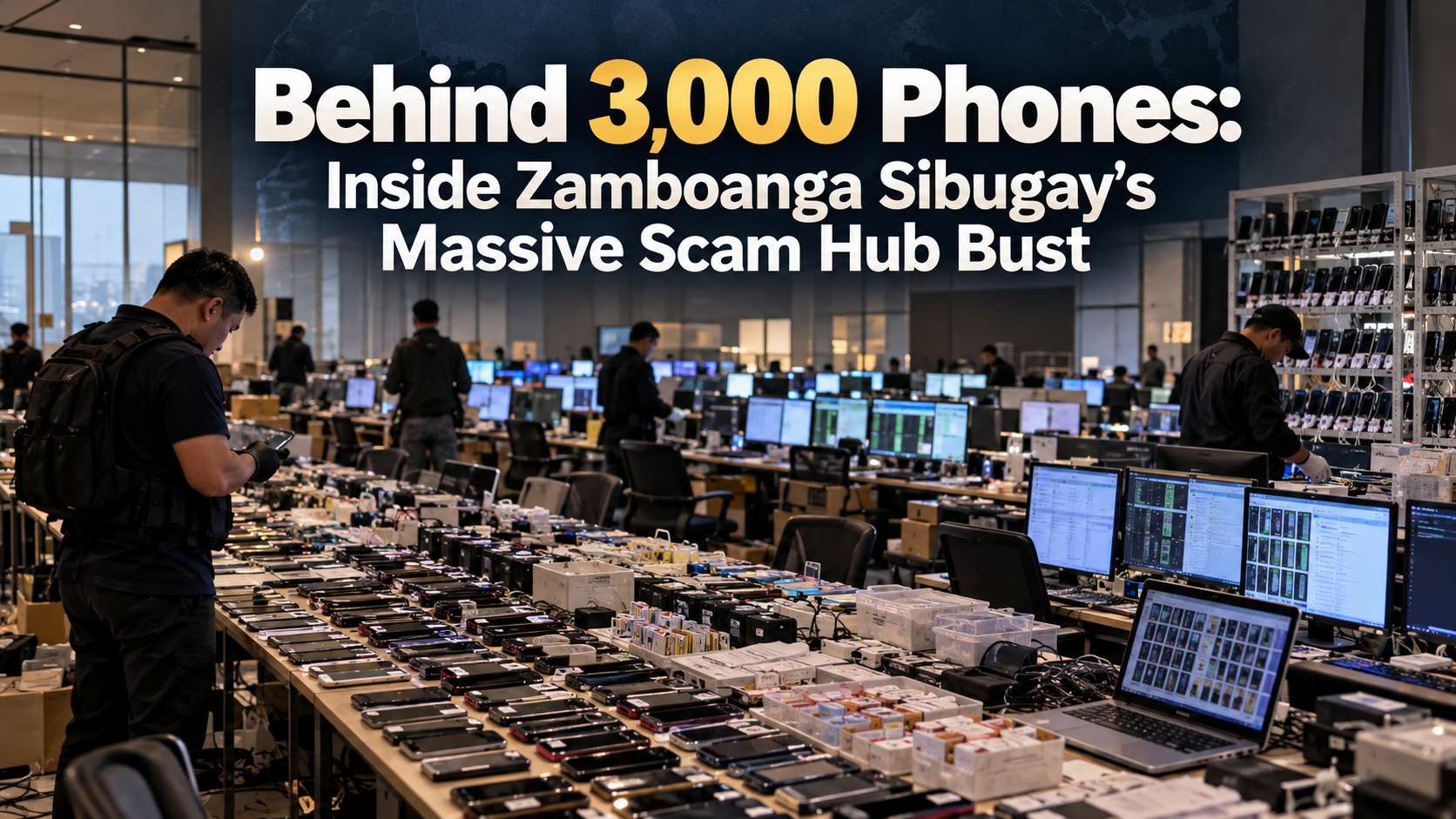
An organised scam operation does not always look like a criminal hideout. Sometimes, it looks like an office filled with computers, mobile phones and people working behind screens.
That is what Philippine authorities say they uncovered in Zamboanga Sibugay, where 244 foreign nationals were apprehended across two suspected illegal offshore-gaming operations in what the Bureau of Immigration described as its largest POGO-related bust of 2026.
At one compound alone, authorities recovered around 3,000 mobile phones, 78 computer monitors, laptops, SIM cards and other equipment believed to have supported online activities. Investigators are also examining possible human-trafficking and other criminal offences linked to the sites.
For financial institutions, the significance goes beyond the size of the raid. Hundreds of operators and thousands of devices can support deception at a scale far beyond that of an individual fraudster.
When scam infrastructure scales, the financial infrastructure behind it has to scale too.

What Happened in Zamboanga Sibugay?
Authorities carried out coordinated operations at suspected illegal offshore-gaming sites in Siay and Alicia, Zamboanga Sibugay.
A total of 244 foreign nationals were apprehended across the two locations, with authorities investigating alleged immigration violations and possible involvement in illegal online activities.
The equipment recovered provided another indication of the scale. Thousands of mobile phones were found alongside computers, laptops, SIM cards and other technology capable of supporting large volumes of online communication.
Subsequent investigations have also examined possible links to online scams, including love-scam activity, as well as potential human-trafficking and other offences.
The available reporting does not establish confirmed victim losses, specific payment methods or exactly how illicit proceeds were moved. But the scale of the infrastructure raises an important AML question: what financial network is needed to monetise an operation capable of reaching large numbers of potential victims?
From Scam Infrastructure to Financial Infrastructure
Thousands of phones are more than evidence of technological capacity. They can enable operators to manage large numbers of identities, conversations and potential victims simultaneously.
But successful scams eventually reach the same point: money has to move.
That creates a need for financial infrastructure capable of receiving, distributing and ultimately extracting the proceeds. Depending on the scam model, that can involve beneficiary accounts, money mules, payment wallets or other intermediaries.
For financial institutions, these accounts may not initially look connected.
One beneficiary might receive transfers from several unrelated individuals. Another account might quickly move incoming funds elsewhere. Multiple customers may share devices, phone numbers, counterparties or transaction patterns without an obvious relationship on paper.
Viewed individually, each account can appear ordinary.
Viewed as a network, the activity can reveal something far more organised.
This is why large-scale scam operations create a different monitoring challenge. Institutions need to identify not just suspicious payments, but the financial collection network sitting behind them.
Red Flags Banks and Payment Firms Should Watch
The financial footprint of an organised scam operation may appear through combinations of customer behaviour, transaction activity and network connections.
Relevant indicators can include personal or newly opened accounts receiving payments from multiple unrelated individuals without a clear economic purpose, particularly when those funds are quickly withdrawn or moved onwards.
Financial institutions should also watch for sudden increases in inbound payments, repeated transfers into connected beneficiaries, multiple accounts displaying similar cash-out behaviour and common devices, contact details or counterparties across apparently unrelated customers.
Accounts associated with multiple scam complaints deserve particular attention, as do transaction patterns involving rapid movement through several intermediaries shortly after funds are received.
None of these indicators proves involvement in a scam network on its own. The stronger signal emerges when institutions connect who is sending the money, who is receiving it, how quickly it moves and which accounts or identifiers appear repeatedly across the network.
What This Means for Financial Institutions
The Zamboanga Sibugay case highlights why scam detection increasingly needs to move beyond account-by-account monitoring.
Large scam operations can distribute different roles across different people. One operator may communicate with victims, another account may receive the payment, another person may control the mule account, and yet another intermediary may move the proceeds onwards.
That separation can make each individual interaction appear disconnected from the wider operation.
Banks and payment firms therefore need stronger visibility across customers, beneficiaries, devices and transaction networks. Repeated connections between apparently unrelated accounts can sometimes be more revealing than the size of any single transaction.
Fraud and AML teams also need to connect their intelligence. A customer's report of an online scam may begin as a fraud case, while the beneficiary account receiving the proceeds could provide the starting point for identifying a wider mule or laundering network.
As scam operations become more organised, financial institutions need to move from asking “Is this transaction suspicious?” to asking “What wider network does this transaction belong to?”
How Tookitaki Helps Detect Scam and Mule Networks
Tookitaki helps financial institutions connect risk signals that may appear unrelated when viewed separately.
FinCense brings together customer risk, transaction monitoring, screening, alert management and investigations, enabling teams to analyse activity across customers, accounts, beneficiaries and connected networks.
In organised scam cases, risk can emerge through combinations of unusual third-party inflows, rapid onward movement, mule-account behaviour, shared identifiers and common beneficiaries. Connecting those signals can help investigators identify clusters that transaction-level rules alone may miss.
Through the AFC Ecosystem, financial institutions can also stay closer to emerging typologies involving social engineering, scam proceeds and mule networks as criminal operating models evolve.
The goal is not simply to detect another suspicious payment. It is to identify the financial infrastructure that allows organised scams to turn deception into proceeds.
The Bigger Lesson: Scam Hubs Leave Financial Footprints
The Zamboanga Sibugay raids show what organised online fraud infrastructure can look like at physical scale: 244 people across two suspected operations and thousands of devices capable of supporting online activity.
For financial institutions, the equivalent structure may be hidden inside transaction data.
Large numbers of scam conversations can produce multiple victim payments. Those payments may flow into different beneficiaries before converging across a smaller network of mule accounts, intermediaries or common endpoints.
A bank may only see one customer, one beneficiary or one transaction at a time. The wider pattern appears when those pieces are connected.
Scam hubs may operate behind thousands of screens. The financial trail emerges when institutions connect the network behind the money.
Experience the most intelligent AML and fraud prevention platform
Experience the most intelligent AML and fraud prevention platform
Experience the most intelligent AML and fraud prevention platform
Top AML Scenarios in ASEAN
The Role of AML Software in Compliance
The Role of AML Software in Compliance