From Pampanga Arrests to Mule Accounts: The AML Risk Behind Illegal Gambling in the Philippines
.svg)
The arrests happened in Pampanga.
But for banks, fintechs, e-wallets, payment service providers, and remittance operators, the bigger issue is not only who was arrested.
It is how the money may have moved.
A recent Bureau of Immigration operation in Clark, Pampanga led to the arrest of three South Korean nationals wanted in their home country for alleged offences linked to illegal gambling, fraud, and other transnational crimes.
For Philippine financial institutions, this case is a reminder that illegal gambling is rarely just a gambling offence. It is also a financial crime risk that depends on accounts, wallets, payment channels, mule networks, and cash-out routes.
The betting site may be the headline.
But the accounts tell the story.

What Happened in Pampanga?
The case centres on the arrest of three South Korean nationals in Clark, Pampanga, by the Bureau of Immigration’s Fugitive Search Unit, in coordination with Korean authorities and local law enforcement partners.
According to the Bureau of Immigration, one of the arrested individuals was wanted in South Korea for alleged involvement in large-scale illegal online sports betting operations. Authorities said the network handled around KRW 205.3 billion, or approximately USD 135 million, in deposits, with proceeds allegedly laundered through multiple accounts.
The case also involved fraud-related allegations. In a separate allegation linked to one of the arrested individuals, investigators cited the illegal transfer of bank account access credentials used in financial crimes, as well as a fake collateral scheme.
That detail is important.
This was not only about illegal gambling activity. It points to a wider financial crime pattern involving account misuse, fund movement, possible mule account activity, and the abuse of banking access credentials.
In simple terms, the arrests happened at the law enforcement level. But the financial crime risk sits in the accounts, wallets, and payment channels used to receive, move, and disguise the proceeds.
Why This Case Matters for the Philippines
The Philippines is one of Southeast Asia’s most active digital finance markets. Digital banks, e-wallets, payment platforms, and remittance providers now move funds at high speed and high volume.
That creates convenience for customers.
It also creates opportunity for criminal networks.
Illegal gambling proceeds can enter the financial system through accounts that appear ordinary at first glance. Funds may arrive as peer-to-peer transfers, wallet top-ups, bank deposits, merchant payments, or remittance-linked flows. In isolation, each transaction may look small, routine, or commercially plausible.
The risk becomes clearer when those movements are connected.
A personal account receiving funds from many unrelated senders may be acting as a collection account. Several accounts transferring to the same beneficiary may suggest pooling. Rapid movement after funds arrive may indicate layering. Repeated transfers across wallets, bank accounts, and remittance channels may point to an organised network rather than normal customer activity.
For Philippine compliance teams, this has direct AML relevance. Banks, fintechs, PSPs, e-money issuers, and remittance operators must be able to detect suspicious activity, investigate unusual patterns, and support timely reporting expectations under AMLC and BSP-supervised compliance frameworks.
The challenge is not just to detect one suspicious transaction.
It is to identify the network behind it.
How Illegal Gambling Proceeds Move
Illegal gambling networks need financial infrastructure to function.
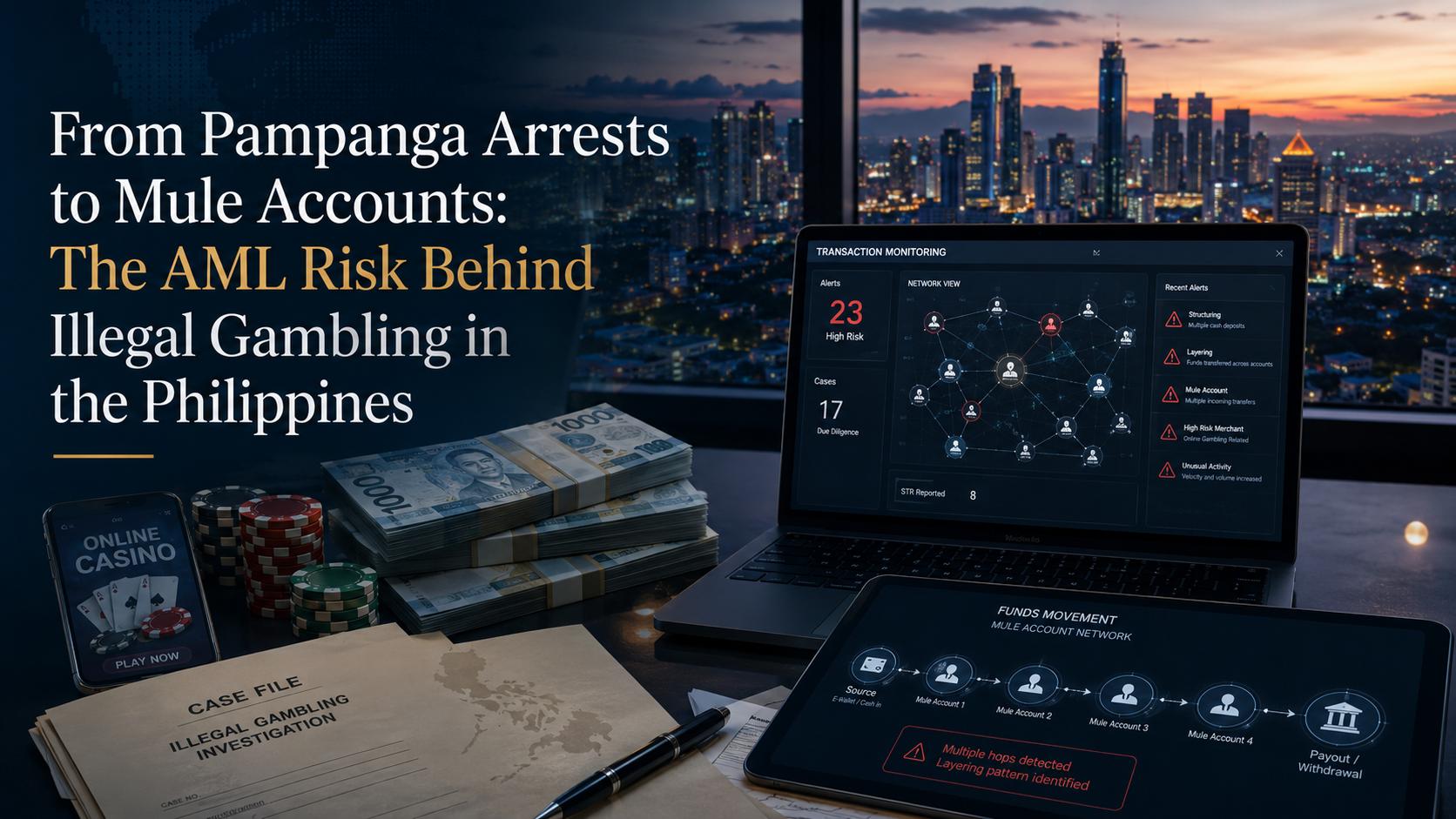
They need accounts to receive deposits. They need wallets to move funds quickly. They need payment channels to disguise activity. They need mule accounts to absorb risk. And when the amounts become large, they need layering.
A typical laundering pattern may look like this:
- Players or intermediaries send funds into accounts linked to the gambling network.
- The money is pooled across multiple personal, business, or wallet accounts.
- Funds are split and transferred across mule accounts or payment channels.
- Some funds are withdrawn, converted, or moved through remittance routes.
- The remaining proceeds are consolidated into accounts controlled by organisers or facilitators.
This movement is designed to make illegal gambling proceeds look like ordinary financial activity.
The amounts may be broken up. The accounts may be newly opened. The transfers may move quickly. The beneficiaries may appear unrelated. The activity may stop before a traditional review cycle begins.
That is why static rules and simple thresholds are often not enough.
The Mule Account Problem
Mule accounts sit at the centre of many illegal gambling and fraud-linked laundering schemes.
Some mule accounts may be opened directly by recruited individuals. Others may be controlled using compromised credentials. Some may be existing accounts that are rented, sold, or misused.
The allegation involving the transfer of bank account access credentials is important because account credentials can turn a normal account into a laundering tool.
Once criminals control an account, they can receive funds, move money, create distance from the original source, and abandon the account once suspicion rises.
For banks and fintechs, mule activity can appear in different forms:
- Newly opened accounts receiving unusual inbound activity
- Dormant accounts suddenly becoming active
- Personal accounts receiving funds from many unrelated senders
- Rapid transfers after incoming credits
- Multiple accounts linked by the same device, IP address, phone number, or beneficiary
- Accounts with weak economic rationale for the volume or pattern of transactions
- Repeated movement between wallets, bank accounts, and remittance channels
The problem is not always one account.
It is the network behaviour across accounts.
Red Flags Banks, Fintechs and PSPs Should Monitor
Illegal gambling and fraud-linked laundering can generate warning signs across onboarding, transaction monitoring, account access, and investigations.
Key red flags include:
- Sudden spikes in inbound transfers from unrelated parties
- Multiple low or mid-value deposits followed by rapid onward transfers
- Several accounts sending funds to the same beneficiary or cluster of beneficiaries
- Newly opened accounts showing high transaction velocity shortly after onboarding
- Dormant or low-activity accounts suddenly receiving frequent credits
- Personal accounts showing activity inconsistent with the customer’s occupation or profile
- Wallet-to-bank or bank-to-wallet cycling with no clear economic purpose
- Frequent transfers between accounts linked by shared device, IP, address, or phone number
- Cross-border remittance activity inconsistent with the customer’s known profile
- Repeated failed logins, new-device access, or unusual account access behaviour
- Fund movement patterns that suggest pooling, splitting, layering, or cash-out
These indicators become more powerful when viewed together.
A single low-value transfer may not be suspicious. But hundreds of low-value transfers into related accounts, followed by rapid withdrawals or transfers to common beneficiaries, tell a different story.
Why AML and Fraud Teams Need a Shared View
This type of case sits at the intersection of fraud and AML.
The fraud indicators may include suspicious account access, credential misuse, mule onboarding, unusual device behaviour, or compromised account control.
The AML indicators may include structuring, layering, rapid fund movement, unusual counterparties, and cross-border transfers.
If fraud and AML teams work in separate systems, each team may only see part of the picture.
Fraud teams may see unusual account access.
AML teams may see suspicious fund movement.
Payments teams may see abnormal transaction velocity.
But the full risk only becomes clear when these signals are connected.
That is why financial institutions need a unified view of customers, accounts, counterparties, transactions, devices, beneficiaries, and behavioural history.
Illegal gambling networks do not separate fraud from money laundering.
Monitoring systems should not either.
What This Means for Philippine Compliance Teams
For Philippine financial institutions, the Pampanga case highlights three practical lessons.
First, illegal gambling risk does not sit only with gambling platforms. It can surface inside banks, e-wallets, payment firms, and remittance channels through the accounts used to receive and move proceeds.
Second, mule account detection must go beyond onboarding checks. A clean account at onboarding can become suspicious after behavioural changes, unusual inflows, shared device links, or rapid onward transfers.
Third, transaction monitoring must be network-aware. The strongest signal may not be the size of one transaction but the relationship between multiple accounts, senders, beneficiaries, devices, and movement patterns.
In a fast-moving payments environment, waiting for manual review may be too slow.
By the time one account is investigated, the funds may have already moved through several others.
How Tookitaki Helps Detect These Patterns
Tookitaki’s FinCense platform helps financial institutions detect financial crime patterns that cut across fraud, AML, mule accounts, and payment abuse.
For illegal gambling and fraud-linked laundering risks, FinCense can help identify:
- Mule account behaviour
- Rapid movement of funds after credit
- High-velocity transfers across connected accounts
- Sender and beneficiary clustering
- Structuring and layering patterns
- Dormant account reactivation
- Shared device, IP, or identity indicators
- Cross-border movement of suspicious proceeds
- Links between fraud indicators and AML typologies
FinCense also leverages the Anti Financial Crime Ecosystem, a shared typology intelligence network that helps institutions stay updated on emerging financial crime patterns. This is especially important in cases where criminal networks adapt quickly and exploit gaps between fraud controls, AML monitoring, and payment systems.
With unified case management, investigators can review customer risk, transaction history, related entities, alert context, and red flags in one place. This helps teams move faster, improve investigation quality, and support stronger suspicious transaction reporting.
The Bigger Lesson
The Pampanga arrests are not just a law enforcement story.
They are a reminder that illegal gambling networks depend on financial infrastructure.
They need accounts.
They need payment channels.
They need mule networks.
They need ways to move, split, and disguise proceeds.
For banks, fintechs, e-wallets, PSPs, and remittance operators in the Philippines, the question is simple:
Can your monitoring system see the money trail before it disappears?
Because in cases like this, the gambling site may make the news.
But the money trail reveals the risk.
Experience the most intelligent AML and fraud prevention platform
Experience the most intelligent AML and fraud prevention platform
Experience the most intelligent AML and fraud prevention platform
Top AML Scenarios in ASEAN
The Role of AML Software in Compliance
The Role of AML Software in Compliance