Maximising AML Compliance Efficiency and Effectiveness with Tookitaki
Anti-money laundering (AML) compliance is a critical function for financial institutions of all sizes. It's not just a regulatory requirement, but a necessary step to protect against financial crime and maintain the integrity of the financial system. However, with the ever-changing landscape of financial crime, it can be challenging for financial institutions to keep up with the latest techniques and regulations while also managing the cost and resources required for compliance.
This is where Tookitaki comes in. Our platform is designed to help financial institutions maximize efficiency and effectiveness in their AML compliance efforts, so they can protect against financial crime while also reducing costs and improving operational efficiency. In this blog, we'll explore how Tookitaki's platform can help financial institutions achieve this goal.
Challenges in AML Compliance: Addressing the Status Quo in Financial Institutions
Many financial institutions, both large-scale banks and emerging fintech companies, struggle with inefficiency and ineffectiveness in their AML compliance efforts. The main reasons for inefficiencies are:
- Inadequate legacy systems leading to large volumes of false positives
- Difficulty in identifying and prioritizing high-risk alerts
- High costs of compliance and manpower needed for alert management
- Lack of AML standards and technology expertise for expanding into new markets
- Difficulty in maintaining expected compliance standards throughout the consumer lifecycle
As regulatory pressure continues to increase, financial institutions must find ways to improve their AML compliance efforts to stay ahead of the curve.
Tookitaki's AML Solutions and their Impact on Financial Crime Prevention
Tookitaki was founded in 2015 with a mission to tackle the root cause of money laundering. Having identified that criminals are taking advantage of silos that existed in the traditional anti-money laundering systems, Tookitaki came up with the idea of creating a network of experts - specialists in the varying aspects of financial crime - who collaborate to create an exhaustive library of typologies. This ‘collective intelligence’ serves as the foundation for seeking out the diverse range of criminal activity.
Tookitaki's AML software, the Anti-Money Laundering Suite or AMLS, is Tookitaki’s answer to the industry-standard, siloed nature of combating financial crime. It is a true end-to-end workflow that enables users to review and manage alerts from all AML stages in one place. The AMLS provides a suite of four modules that are optimized for Intelligent Alert Detection (IAD), and Smart Alert Management (SAM). The SAM version of AMLS is meant for large traditional banks, while the IAD version is meant for fintech companies, including digital banks, e-wallets and payment services companies.
Read More: Understanding the Benefits of AML Platforms
Maximizing Efficiency with Tookitaki's Smart Alert Management (SAM) for Large Banks
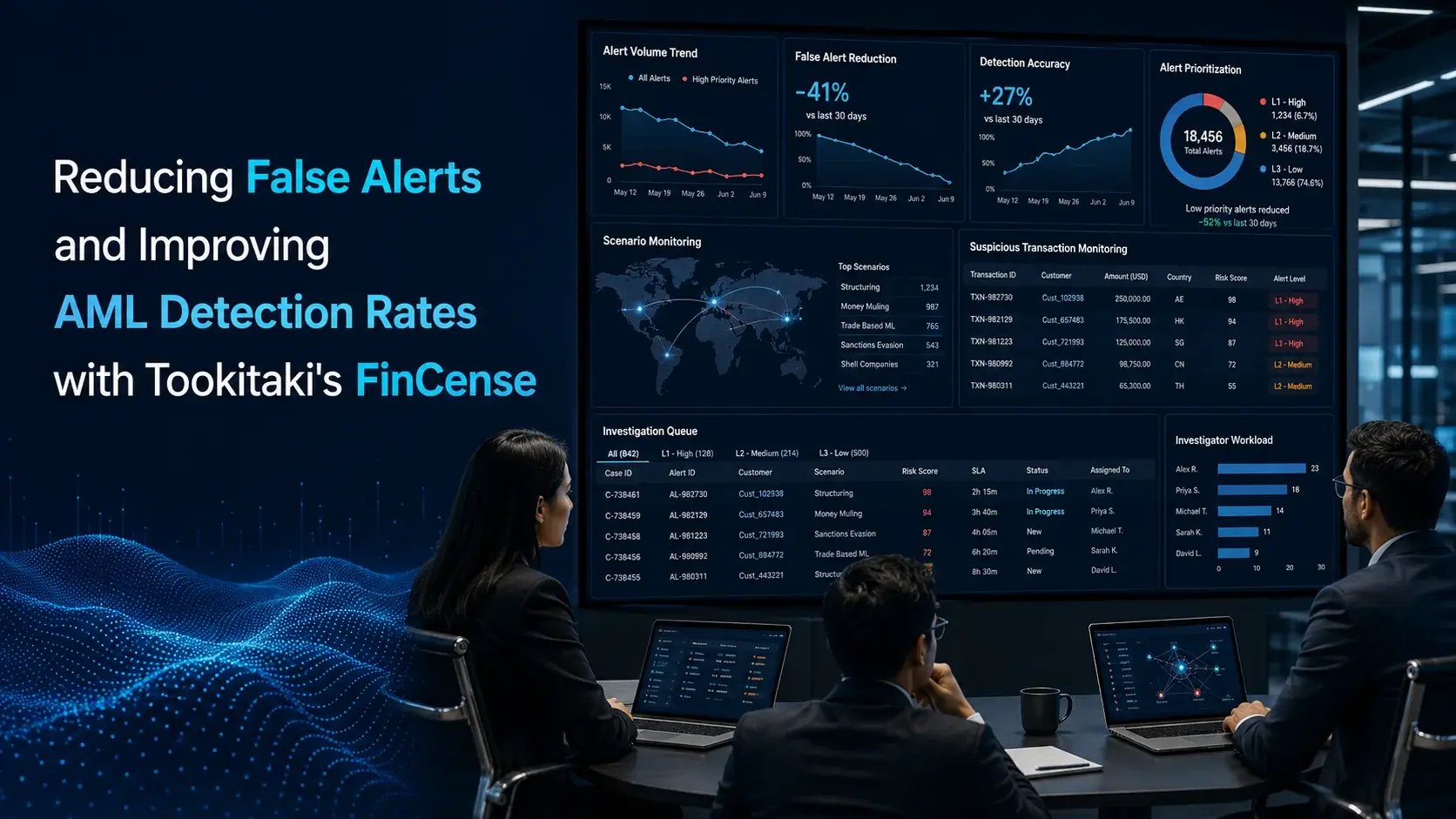
Maximizing efficiency in AML compliance is a constant challenge for large traditional banks. The high volume of false alerts generated by legacy systems can be a major manpower issue, and compliance teams are often overwhelmed by the sheer number of alerts they need to review. AMLS’ Smart Alert Management (SAM) version is specifically designed to address this issue. By prioritizing high-risk alerts and de-prioritizing lower-risked alerts, SAM can reduce the cost of compliance for banks by decreasing over 50% of generated false positives. In addition, SAM also provides treatment strategies that further reduce the cost of compliance. A case study with a global bank revealed that, after deploying SAM, every one in six alerts became a suspicious report, a 600% improvement in operational effectiveness, and a 53% increase in productivity.
In another case study with a tier 1 bank in Singapore, AMLS SAM achieved the following:
- 70% reduction in false positives for individual names and 60% reduction in false positives for corporate names through our Name Screening module.
- 50% reduction in false positives, 5% increase in true positives (file-able SARs) and an overall true positive prediction rate of 96% in the high-priority category through our Transaction Monitoring module.
For this client, the benefits they derived include:
- Increased effectiveness in identifying suspicious activities
- A sharper focus on data anomalies rather than depending on threshold-triggering
- Easier customisation of data features to target specific risks accurately
- Ability to enable longer look-back periods to detect complex scenarios
AMLS went through multiple rounds of testing and validation and our machine learning models have been proven to provide stable results and remain agile to the cause in dynamic situations. At the same time, it could effectively explain the decision-making process of machine learning models in a comprehensive yet simple manner.
Ready to take the next step in financial crime prevention?
Are you ready to take your AML compliance to the next level? Tookitaki's AML Solutions can help you achieve this with our community approach, maximizing efficiency, and unlocking growth opportunities. Request a demo today and see how our platform can benefit your financial institution.
Experience the most intelligent AML and fraud prevention platform
Top AML Scenarios in ASEAN
The Role of AML Software in Compliance
The Role of AML Software in Compliance


We’ve received your details and our team will be in touch shortly.
Ready to Streamline Your Anti-Financial Crime Compliance?
Our Thought Leadership Guides
When Every Second Counts: Rethinking Bank Transaction Fraud Detection
Singapore’s banks are in a race, not just against time, but against tech-savvy fraudsters.
In today’s digital-first banking world, fraud no longer looks like it used to. It doesn’t arrive as forged cheques or shady visits to the branch. It slips in quietly through real-time transfers, fake identities, and unsuspecting mule accounts.
As financial crime becomes more sophisticated, traditional rule-based systems struggle to keep up. And that’s where next-generation bank transaction fraud detection comes in.
This blog explores how Singapore’s banks can shift from reactive to real-time fraud prevention using smarter tools, scenario-based intelligence, and a community-led approach.

The Growing Threat: Real-Time, Real-Risk
Instant payment systems like FAST and PayNow have transformed convenience for consumers. But they’ve also created perfect conditions for fraud:
- Funds move instantly, leaving little time to intervene.
- Fraud rings test systems for weaknesses.
- Mules and synthetic identities blend in with legitimate users.
In Singapore, the number of scam cases surged past 50,000 in 2025 alone. Many of these begin with social engineering and end with rapid fund movements that outpace traditional detection tools.
What Is Bank Transaction Fraud Detection?
Bank transaction fraud detection refers to the use of software and intelligence systems to:
- Analyse transaction patterns in real-time
- Identify suspicious behaviours (like rapid movement of funds, unusual login locations, or account hopping)
- Trigger alerts before fraudulent funds leave the system
But not all fraud detection tools are created equal.
Beyond Rules: Why Behavioural Intelligence Matters
Most legacy systems rely heavily on static rules:
- More than X amount = Alert
- Transfer to high-risk country = Alert
- Login from new device = Alert
While helpful, these rules often generate high false positives and fail to detect fraud that evolves over time.
Modern fraud detection uses behavioural analytics to build dynamic profiles:
- What’s normal for this customer?
- How do their patterns compare to their peer group?
- Is this transaction typical for this day, time, device, or network?
This intelligence-led approach helps Singapore’s banks catch subtle deviations that indicate fraud without overloading investigators.
Common Transaction Fraud Tactics in Singapore
Here are some fraud tactics that banks should watch for:
1. Account Takeover (ATO):
Fraudsters use stolen credentials to log in and drain accounts via multiple small transactions.
2. Business Email Compromise (BEC):
Corporate accounts are manipulated into wiring money to fraudulent beneficiaries posing as vendors.
3. Romance & Investment Scams:
Victims willingly send money to fraudsters under false emotional or financial pretences.
4. Mule Networks:
Illicit funds are routed through a series of personal or dormant accounts to obscure the origin.
5. ATM Cash-Outs:
Rapid withdrawals across multiple locations following fraudulent deposits.
Each scenario requires context-aware detection—something traditional rules alone can’t deliver.

How Singapore’s Banks Are Adapting
Forward-thinking institutions are shifting to:
- Real-time monitoring: Systems scan every transaction as it happens.
- Scenario-based detection: Intelligence is built around real fraud typologies.
- Federated learning: Institutions share anonymised risk insights to detect emerging threats.
- AI and ML models: These continuously learn from past patterns to improve accuracy.
This new generation of tools prioritises precision, speed, and adaptability.
The Tookitaki Approach: Smarter Detection, Stronger Defences
Tookitaki’s FinCense platform is redefining how fraud is detected across APAC. Here’s how it supports Singaporean banks:
✅ Real-time Detection
Every transaction is analysed instantly using a combination of AI models, red flag indicators, and peer profiling.
✅ Community-Driven Typologies
Through the AFC Ecosystem, banks access and contribute to real-world fraud scenarios—from mule accounts to utility scam layering techniques.
✅ Federated Intelligence
Instead of relying only on internal data, banks using FinCense tap into anonymised, collective intelligence without compromising data privacy.
✅ Precision Tuning
Simulation features allow teams to test new detection rules and fine-tune thresholds to reduce false positives.
✅ Seamless Case Integration
When a suspicious pattern is flagged, it’s directly pushed into the case management system with contextual details for fast triage.
This ecosystem-powered approach offers banks a smarter, faster path to fraud prevention.
What to Look for in a Transaction Fraud Detection Solution
When evaluating solutions, Singaporean banks should ask:
- Does the tool operate in real-time across all payment channels?
- Can it adapt to new typologies without full retraining?
- Does it reduce false positives while improving true positive rates?
- Can it integrate into your existing compliance stack?
- Is the vendor proactive in fraud intelligence updates?
Red Flags That Signal a Need to Upgrade
If you’re noticing any of the following, it may be time to rethink your detection systems:
- Your fraud losses are rising despite existing controls.
- Investigators are buried under low-value alerts.
- You’re slow to detect new scams until after damage is done.
- Your system relies only on historical transaction patterns.
Future Outlook: From Reactive to Proactive Fraud Defence
The future of bank transaction fraud detection lies in:
- Proactive threat hunting using AI models
- Crowdsourced intelligence from ecosystems like AFC
- Shared risk libraries updated in real-time
- Cross-border fraud detection powered by network-level insights
As Singapore continues its Smart Nation push and expands its digital economy, the ability to protect payments will define institutional trust.
Conclusion: A Smarter Way Forward
Fraud is fast. Detection must be faster. And smarter.
By moving beyond traditional rule sets and embracing intelligent, collaborative fraud detection systems, banks in Singapore can stay ahead of evolving threats while keeping customer trust intact.
Transaction fraud isn’t just a compliance issue—it’s a business continuity one.

AML Software Companies: How to Evaluate Them Beyond Feature Lists
Choosing an AML software company is not about who has the longest feature list. It is about who can stand up to real risk, real regulators, and real operational pressure.
Introduction
Search for AML software companies and you will find hundreds of articles promising rankings, comparisons, and “top vendor” lists. Most of them look strikingly similar. Feature tables. Buzzwords. Claims of accuracy and automation.
What they rarely explain is why so many banks still struggle with alert overload, inconsistent investigations, and regulatory remediation even after investing heavily in AML technology.
The uncomfortable truth is this. Most institutions do not fail because they chose a weak AML tool. They struggle because they chose the wrong kind of AML software company.
This blog takes a different approach. Instead of listing vendors, it explains how banks should evaluate AML software companies based on how they actually operate, how they think about risk, and how they behave after implementation. Because the real differences between AML software companies only appear once the system is live.

Why Feature Comparisons Fail
Feature comparisons feel safe. They are tangible, measurable, and easy to present to stakeholders. But in AML, they are also deeply misleading.
Two AML software companies can offer:
- Transaction monitoring
- Risk scoring
- Case management
- Regulatory reporting
- Analytics and dashboards
Yet produce radically different outcomes.
Why?
Because AML effectiveness is not defined by what features exist. It is defined by how those features behave together under pressure.
Banks do not experience AML software as modules. They experience it as:
- Alert volumes at 9am
- Analyst queues at month end
- Regulator questions six months later
- Investigation backlogs during scam waves
Feature lists do not capture this reality.
What Banks Actually Experience After Go Live
Once an AML platform is live, banks stop asking what the software can do and start asking different questions.
- Why are we seeing so many alerts
- Why do similar cases get different outcomes
- Why does tuning feel so fragile
- Why is it hard to explain decisions clearly
- Why are analysts burning out
These questions are not about missing features. They are about design philosophy, intelligence depth, and operating model.
This is where AML software companies truly differ.
The Hidden Dimensions That Separate AML Software Companies
To evaluate AML software companies properly, banks need to look beyond surface capabilities and understand deeper distinctions.
1. How the company thinks about risk
Some AML software companies treat risk as a compliance variable. Their systems focus on meeting regulatory minimums through predefined rules and thresholds.
Others treat risk as a dynamic behaviour problem. Their platforms are built to understand how customers, transactions, and networks evolve over time.
This difference matters.
Risk focused on static attributes produces static controls. Risk focused on behaviour produces adaptive detection.
Banks should ask:
- Does this platform understand behaviour or just transactions
- How does it adapt when typologies change
2. Intelligence depth versus surface automation
Many AML software companies advertise automation. Fewer can explain what sits underneath it.
Surface automation accelerates existing processes without improving their quality. Intelligence driven automation changes which alerts are generated in the first place.
Key questions include:
- Does automation reduce noise or just speed up clearance
- Can the system explain why it prioritised one case over another
True intelligence reduces workload before analysts ever see an alert.
3. Operating model fit
AML software companies often design platforms around an idealised operating model. Banks rarely operate that way.
Strong vendors design for:
- Lean teams
- High turnover
- Knowledge transfer challenges
- Regulatory scrutiny
- Inconsistent data quality
Weaker vendors assume:
- Perfect processes
- Highly specialised analysts
- Constant tuning resources
Banks should evaluate whether a platform fits how their teams actually work, not how a process diagram looks.
4. Explainability as a core principle
Explainability is not a reporting feature. It is a design choice.
Some AML software companies bolt explainability on later. Others embed it into detection, scoring, and investigation workflows.
Explainability determines:
- How quickly analysts understand cases
- How confidently decisions are made
- How defensible outcomes are during audits
If analysts cannot explain alerts easily, regulators eventually will ask harder questions.
5. Evolution philosophy
Financial crime does not stand still. Neither should AML platforms.
Some AML software companies release periodic upgrades that require heavy reconfiguration. Others design systems that evolve continuously through intelligence updates and typology refinement.
Banks should ask:
- How does this platform stay current with emerging risks
- What effort is required to adapt detection logic
- Who owns typology evolution
The answer reveals whether the vendor is a technology provider or a long term risk partner.

Why Vendor Mindset Matters More Than Market Position
Two AML software companies can sit in the same analyst quadrant and deliver very different experiences.
This is because analyst reports evaluate market presence and functionality breadth. Banks experience:
- Implementation reality
- Tuning effort
- Analyst productivity
- Regulatory defensibility
The mindset of an AML software company shapes all of this.
Some vendors optimise for:
- Speed of sale
- Feature parity
- Broad market coverage
Others optimise for:
- Depth of intelligence
- Operational outcomes
- Long term effectiveness
The latter may not always appear louder in the market, but they tend to perform better over time.
Common Mistakes Banks Make When Choosing AML Software Companies
Several patterns appear repeatedly across institutions.
Choosing familiarity over fit
Legacy vendors feel safe, even when systems struggle operationally.
Overvaluing configurability
Extreme flexibility often leads to fragility and dependency on specialist knowledge.
Underestimating change management
The best technology fails if teams cannot adopt it easily.
Ignoring investigation workflows
Detection quality means little if investigations remain inconsistent or slow.
Avoiding these mistakes requires stepping back from feature checklists and focusing on outcomes.
How Strong AML Software Companies Support Better Compliance Outcomes
When banks partner with the right AML software company, the benefits compound.
They see:
- Lower false positives
- More consistent investigations
- Stronger audit trails
- Better regulator confidence
- Improved analyst morale
- Greater adaptability to new risks
This is not about perfection. It is about resilience.
Australia Specific Considerations When Evaluating AML Software Companies
In Australia, AML software companies must support institutions operating in a demanding environment.
Key factors include:
- Real time payments and fast fund movement
- Scam driven activity involving victims rather than criminals
- High expectations for risk based controls
- Lean compliance teams
- Strong emphasis on explainability
For community owned institutions such as Regional Australia Bank, these pressures are felt even more acutely. The right AML software company must deliver efficiency without sacrificing rigour.
What Due Diligence Should Actually Focus On
Instead of asking for feature demonstrations alone, banks should ask AML software companies to show:
- How alerts reduce over time
- How typologies are updated
- How analysts are supported day to day
- How decisions are explained months later
- How the platform performs under volume spikes
These questions reveal far more than marketing claims.
Where Tookitaki Fits in the AML Software Company Landscape
Tookitaki positions itself differently from traditional AML software companies by focusing on intelligence depth and real world applicability.
Through the FinCense platform, institutions benefit from:
- Behaviour driven detection rather than static thresholds
- Continuously evolving typologies informed by expert insight
- Reduced false positives
- Explainable alerts and investigations
- Strong alignment between operational AML and compliance needs
This approach helps banks move beyond feature parity toward meaningful, sustainable outcomes.
The Future Direction of AML Software Companies
AML software companies are at an inflection point.
Future differentiation will come from:
- Intelligence rather than configuration
- Outcomes rather than alert volume
- Explainability rather than opacity
- Partnership rather than product delivery
Banks that evaluate vendors through this lens will be better positioned to manage both regulatory expectations and real financial crime risk.
Conclusion
AML software companies are not interchangeable, even when their feature lists look similar. The real differences lie in how they think about risk, design for operations, support judgement, and evolve alongside financial crime.
Banks that evaluate AML software companies beyond surface features gain clarity, resilience, and long term effectiveness. Those that do not often discover the gaps only after implementation, when change becomes expensive.
In an environment shaped by fast payments, evolving scams, and rising scrutiny, choosing the right AML software company is no longer a procurement exercise. It is a strategic decision that shapes compliance outcomes for years to come.

First Impressions Matter: How AML Onboarding Software Sets the Tone for Compliance
n financial compliance, how you start often defines how well you succeed.
As financial institutions across Singapore continue to digitise, one of the most critical stages in the customer lifecycle is also one of the most overlooked: onboarding. In a world of rising financial crime, increasingly complex regulatory expectations, and growing customer expectations for speed and simplicity—getting onboarding right is a compliance and business imperative.
AML onboarding software helps institutions walk this tightrope, balancing user experience with regulatory rigour. This blog explores what AML onboarding software is, why it matters in Singapore, and what features to look for when choosing the right solution.

Why Onboarding is a High-Risk Stage for Financial Crime
The onboarding phase is where risk enters the institution. Criminals often use fake identities, straw accounts, or mule accounts to gain access to the financial system. If these bad actors slip through during onboarding, they become much harder to detect downstream.
At the same time, overly rigid processes can lead to drop-offs or customer dissatisfaction—especially in a competitive market like Singapore where fintech players offer quick and seamless onboarding experiences.
This is where AML onboarding software plays a key role.
What is AML Onboarding Software?
AML onboarding software is designed to automate and enhance the customer due diligence (CDD) and Know Your Customer (KYC) processes during the initial stages of client engagement. It combines data collection, risk scoring, screening, and workflow automation to help financial institutions:
- Verify identities
- Assess customer risk
- Detect suspicious behaviour early
- Comply with MAS and FATF regulations
- Ensure auditability and reporting readiness
This software acts as a digital gatekeeper, helping teams detect red flags before a single transaction takes place.
Key Features of an Effective AML Onboarding Solution
Here’s what the best AML onboarding platforms bring to the table:
1. Dynamic Risk Profiling
Customers are assigned risk scores based on multiple factors—geographic exposure, occupation, product usage, and more. This helps tailor ongoing due diligence requirements.
2. Seamless Integration with Screening Tools
The onboarding software should be able to screen applicants in real-time against sanctions lists, politically exposed person (PEP) lists, and adverse media.
3. Intelligent Document Verification
Advanced systems offer biometric matching, liveness detection, and AI-based document parsing to reduce fraud and manual work.
4. Straight-Through Processing
Low-risk applicants should move through the system quickly with minimal friction, while high-risk cases are routed for enhanced due diligence.
5. Centralised Audit Trails
Every decision—approval, escalation, or rejection—should be logged for compliance and future investigations.
6. Local Regulatory Alignment
In Singapore, onboarding systems must comply with MAS AML Notices (e.g., Notice 626, PSN01), including requirements for non-face-to-face verification, ID recordkeeping, and high-risk country checks.
Common Onboarding Pitfalls to Avoid
Even the most promising compliance programmes can be derailed by poor onboarding. Here are a few common traps:
- Over-reliance on manual checks leading to delays
- Lack of integration between risk scoring and screening tools
- No visibility into onboarding drop-off points
- Inability to adapt due diligence levels based on real-time risk
The right AML onboarding software helps mitigate these issues from day one.

Use Case: Strengthening Digital Onboarding in a Singaporean Digital Bank
A mid-sized digital bank in Singapore faced challenges in balancing fast customer onboarding with the risk of synthetic identities and mule accounts. They implemented an AML onboarding solution that offered:
- Real-time screening against global watchlists
- Adaptive risk scoring based on customer behaviour
- Biometric ID checks for non-face-to-face verification
- Integration with their transaction monitoring system
The outcome? A 40% reduction in onboarding time, 60% fewer false positives during initial checks, and stronger regulatory audit readiness.
How Tookitaki Enhances the AML Onboarding Lifecycle
Tookitaki’s FinCense platform powers seamless onboarding with intelligent compliance baked in from the start.
While not a KYC identity verification tool, FinCense supports onboarding teams by:
- Providing a dynamic risk profile that connects to transaction behaviour
- Ingesting typologies and red flags from the AFC Ecosystem to detect unusual patterns early
- Enabling real-time alerting if onboarding-linked accounts behave abnormally in the first days of activity
- Strengthening case management with cross-functional visibility across onboarding and monitoring
This approach ensures that high-risk profiles are not only flagged early but also monitored in context post-onboarding.
Best Practices When Selecting AML Onboarding Software
- Choose a vendor that offers local support and understands MAS regulatory requirements.
- Prioritise explainability—your team should understand why a customer was flagged.
- Ensure seamless integration with other AML systems like transaction monitoring, case management, and reporting.
- Look for scalability so the system can grow with your business and adapt to new typologies.
Future Outlook: The Onboarding Battleground
As Singapore continues its push for digitalisation, from e-wallets to neobanks, the onboarding experience is becoming a competitive differentiator. Yet compliance cannot be compromised.
The future of AML onboarding lies in:
- Greater use of AI to detect synthetic identities
- Network-level intelligence to prevent mule account onboarding
- Real-time fraud and AML orchestration from day one
Institutions that invest in smart onboarding software today will be better equipped to fight financial crime tomorrow.
Conclusion: First Impressions That Last
Onboarding is no longer just a formality—it’s your first line of defence. With the right AML onboarding software, Singapore’s financial institutions can deliver frictionless user experiences while staying fully compliant.
It’s not about choosing between speed and security—it’s about choosing both.

When Every Second Counts: Rethinking Bank Transaction Fraud Detection
Singapore’s banks are in a race, not just against time, but against tech-savvy fraudsters.
In today’s digital-first banking world, fraud no longer looks like it used to. It doesn’t arrive as forged cheques or shady visits to the branch. It slips in quietly through real-time transfers, fake identities, and unsuspecting mule accounts.
As financial crime becomes more sophisticated, traditional rule-based systems struggle to keep up. And that’s where next-generation bank transaction fraud detection comes in.
This blog explores how Singapore’s banks can shift from reactive to real-time fraud prevention using smarter tools, scenario-based intelligence, and a community-led approach.

The Growing Threat: Real-Time, Real-Risk
Instant payment systems like FAST and PayNow have transformed convenience for consumers. But they’ve also created perfect conditions for fraud:
- Funds move instantly, leaving little time to intervene.
- Fraud rings test systems for weaknesses.
- Mules and synthetic identities blend in with legitimate users.
In Singapore, the number of scam cases surged past 50,000 in 2025 alone. Many of these begin with social engineering and end with rapid fund movements that outpace traditional detection tools.
What Is Bank Transaction Fraud Detection?
Bank transaction fraud detection refers to the use of software and intelligence systems to:
- Analyse transaction patterns in real-time
- Identify suspicious behaviours (like rapid movement of funds, unusual login locations, or account hopping)
- Trigger alerts before fraudulent funds leave the system
But not all fraud detection tools are created equal.
Beyond Rules: Why Behavioural Intelligence Matters
Most legacy systems rely heavily on static rules:
- More than X amount = Alert
- Transfer to high-risk country = Alert
- Login from new device = Alert
While helpful, these rules often generate high false positives and fail to detect fraud that evolves over time.
Modern fraud detection uses behavioural analytics to build dynamic profiles:
- What’s normal for this customer?
- How do their patterns compare to their peer group?
- Is this transaction typical for this day, time, device, or network?
This intelligence-led approach helps Singapore’s banks catch subtle deviations that indicate fraud without overloading investigators.
Common Transaction Fraud Tactics in Singapore
Here are some fraud tactics that banks should watch for:
1. Account Takeover (ATO):
Fraudsters use stolen credentials to log in and drain accounts via multiple small transactions.
2. Business Email Compromise (BEC):
Corporate accounts are manipulated into wiring money to fraudulent beneficiaries posing as vendors.
3. Romance & Investment Scams:
Victims willingly send money to fraudsters under false emotional or financial pretences.
4. Mule Networks:
Illicit funds are routed through a series of personal or dormant accounts to obscure the origin.
5. ATM Cash-Outs:
Rapid withdrawals across multiple locations following fraudulent deposits.
Each scenario requires context-aware detection—something traditional rules alone can’t deliver.

How Singapore’s Banks Are Adapting
Forward-thinking institutions are shifting to:
- Real-time monitoring: Systems scan every transaction as it happens.
- Scenario-based detection: Intelligence is built around real fraud typologies.
- Federated learning: Institutions share anonymised risk insights to detect emerging threats.
- AI and ML models: These continuously learn from past patterns to improve accuracy.
This new generation of tools prioritises precision, speed, and adaptability.
The Tookitaki Approach: Smarter Detection, Stronger Defences
Tookitaki’s FinCense platform is redefining how fraud is detected across APAC. Here’s how it supports Singaporean banks:
✅ Real-time Detection
Every transaction is analysed instantly using a combination of AI models, red flag indicators, and peer profiling.
✅ Community-Driven Typologies
Through the AFC Ecosystem, banks access and contribute to real-world fraud scenarios—from mule accounts to utility scam layering techniques.
✅ Federated Intelligence
Instead of relying only on internal data, banks using FinCense tap into anonymised, collective intelligence without compromising data privacy.
✅ Precision Tuning
Simulation features allow teams to test new detection rules and fine-tune thresholds to reduce false positives.
✅ Seamless Case Integration
When a suspicious pattern is flagged, it’s directly pushed into the case management system with contextual details for fast triage.
This ecosystem-powered approach offers banks a smarter, faster path to fraud prevention.
What to Look for in a Transaction Fraud Detection Solution
When evaluating solutions, Singaporean banks should ask:
- Does the tool operate in real-time across all payment channels?
- Can it adapt to new typologies without full retraining?
- Does it reduce false positives while improving true positive rates?
- Can it integrate into your existing compliance stack?
- Is the vendor proactive in fraud intelligence updates?
Red Flags That Signal a Need to Upgrade
If you’re noticing any of the following, it may be time to rethink your detection systems:
- Your fraud losses are rising despite existing controls.
- Investigators are buried under low-value alerts.
- You’re slow to detect new scams until after damage is done.
- Your system relies only on historical transaction patterns.
Future Outlook: From Reactive to Proactive Fraud Defence
The future of bank transaction fraud detection lies in:
- Proactive threat hunting using AI models
- Crowdsourced intelligence from ecosystems like AFC
- Shared risk libraries updated in real-time
- Cross-border fraud detection powered by network-level insights
As Singapore continues its Smart Nation push and expands its digital economy, the ability to protect payments will define institutional trust.
Conclusion: A Smarter Way Forward
Fraud is fast. Detection must be faster. And smarter.
By moving beyond traditional rule sets and embracing intelligent, collaborative fraud detection systems, banks in Singapore can stay ahead of evolving threats while keeping customer trust intact.
Transaction fraud isn’t just a compliance issue—it’s a business continuity one.

AML Software Companies: How to Evaluate Them Beyond Feature Lists
Choosing an AML software company is not about who has the longest feature list. It is about who can stand up to real risk, real regulators, and real operational pressure.
Introduction
Search for AML software companies and you will find hundreds of articles promising rankings, comparisons, and “top vendor” lists. Most of them look strikingly similar. Feature tables. Buzzwords. Claims of accuracy and automation.
What they rarely explain is why so many banks still struggle with alert overload, inconsistent investigations, and regulatory remediation even after investing heavily in AML technology.
The uncomfortable truth is this. Most institutions do not fail because they chose a weak AML tool. They struggle because they chose the wrong kind of AML software company.
This blog takes a different approach. Instead of listing vendors, it explains how banks should evaluate AML software companies based on how they actually operate, how they think about risk, and how they behave after implementation. Because the real differences between AML software companies only appear once the system is live.

Why Feature Comparisons Fail
Feature comparisons feel safe. They are tangible, measurable, and easy to present to stakeholders. But in AML, they are also deeply misleading.
Two AML software companies can offer:
- Transaction monitoring
- Risk scoring
- Case management
- Regulatory reporting
- Analytics and dashboards
Yet produce radically different outcomes.
Why?
Because AML effectiveness is not defined by what features exist. It is defined by how those features behave together under pressure.
Banks do not experience AML software as modules. They experience it as:
- Alert volumes at 9am
- Analyst queues at month end
- Regulator questions six months later
- Investigation backlogs during scam waves
Feature lists do not capture this reality.
What Banks Actually Experience After Go Live
Once an AML platform is live, banks stop asking what the software can do and start asking different questions.
- Why are we seeing so many alerts
- Why do similar cases get different outcomes
- Why does tuning feel so fragile
- Why is it hard to explain decisions clearly
- Why are analysts burning out
These questions are not about missing features. They are about design philosophy, intelligence depth, and operating model.
This is where AML software companies truly differ.
The Hidden Dimensions That Separate AML Software Companies
To evaluate AML software companies properly, banks need to look beyond surface capabilities and understand deeper distinctions.
1. How the company thinks about risk
Some AML software companies treat risk as a compliance variable. Their systems focus on meeting regulatory minimums through predefined rules and thresholds.
Others treat risk as a dynamic behaviour problem. Their platforms are built to understand how customers, transactions, and networks evolve over time.
This difference matters.
Risk focused on static attributes produces static controls. Risk focused on behaviour produces adaptive detection.
Banks should ask:
- Does this platform understand behaviour or just transactions
- How does it adapt when typologies change
2. Intelligence depth versus surface automation
Many AML software companies advertise automation. Fewer can explain what sits underneath it.
Surface automation accelerates existing processes without improving their quality. Intelligence driven automation changes which alerts are generated in the first place.
Key questions include:
- Does automation reduce noise or just speed up clearance
- Can the system explain why it prioritised one case over another
True intelligence reduces workload before analysts ever see an alert.
3. Operating model fit
AML software companies often design platforms around an idealised operating model. Banks rarely operate that way.
Strong vendors design for:
- Lean teams
- High turnover
- Knowledge transfer challenges
- Regulatory scrutiny
- Inconsistent data quality
Weaker vendors assume:
- Perfect processes
- Highly specialised analysts
- Constant tuning resources
Banks should evaluate whether a platform fits how their teams actually work, not how a process diagram looks.
4. Explainability as a core principle
Explainability is not a reporting feature. It is a design choice.
Some AML software companies bolt explainability on later. Others embed it into detection, scoring, and investigation workflows.
Explainability determines:
- How quickly analysts understand cases
- How confidently decisions are made
- How defensible outcomes are during audits
If analysts cannot explain alerts easily, regulators eventually will ask harder questions.
5. Evolution philosophy
Financial crime does not stand still. Neither should AML platforms.
Some AML software companies release periodic upgrades that require heavy reconfiguration. Others design systems that evolve continuously through intelligence updates and typology refinement.
Banks should ask:
- How does this platform stay current with emerging risks
- What effort is required to adapt detection logic
- Who owns typology evolution
The answer reveals whether the vendor is a technology provider or a long term risk partner.

Why Vendor Mindset Matters More Than Market Position
Two AML software companies can sit in the same analyst quadrant and deliver very different experiences.
This is because analyst reports evaluate market presence and functionality breadth. Banks experience:
- Implementation reality
- Tuning effort
- Analyst productivity
- Regulatory defensibility
The mindset of an AML software company shapes all of this.
Some vendors optimise for:
- Speed of sale
- Feature parity
- Broad market coverage
Others optimise for:
- Depth of intelligence
- Operational outcomes
- Long term effectiveness
The latter may not always appear louder in the market, but they tend to perform better over time.
Common Mistakes Banks Make When Choosing AML Software Companies
Several patterns appear repeatedly across institutions.
Choosing familiarity over fit
Legacy vendors feel safe, even when systems struggle operationally.
Overvaluing configurability
Extreme flexibility often leads to fragility and dependency on specialist knowledge.
Underestimating change management
The best technology fails if teams cannot adopt it easily.
Ignoring investigation workflows
Detection quality means little if investigations remain inconsistent or slow.
Avoiding these mistakes requires stepping back from feature checklists and focusing on outcomes.
How Strong AML Software Companies Support Better Compliance Outcomes
When banks partner with the right AML software company, the benefits compound.
They see:
- Lower false positives
- More consistent investigations
- Stronger audit trails
- Better regulator confidence
- Improved analyst morale
- Greater adaptability to new risks
This is not about perfection. It is about resilience.
Australia Specific Considerations When Evaluating AML Software Companies
In Australia, AML software companies must support institutions operating in a demanding environment.
Key factors include:
- Real time payments and fast fund movement
- Scam driven activity involving victims rather than criminals
- High expectations for risk based controls
- Lean compliance teams
- Strong emphasis on explainability
For community owned institutions such as Regional Australia Bank, these pressures are felt even more acutely. The right AML software company must deliver efficiency without sacrificing rigour.
What Due Diligence Should Actually Focus On
Instead of asking for feature demonstrations alone, banks should ask AML software companies to show:
- How alerts reduce over time
- How typologies are updated
- How analysts are supported day to day
- How decisions are explained months later
- How the platform performs under volume spikes
These questions reveal far more than marketing claims.
Where Tookitaki Fits in the AML Software Company Landscape
Tookitaki positions itself differently from traditional AML software companies by focusing on intelligence depth and real world applicability.
Through the FinCense platform, institutions benefit from:
- Behaviour driven detection rather than static thresholds
- Continuously evolving typologies informed by expert insight
- Reduced false positives
- Explainable alerts and investigations
- Strong alignment between operational AML and compliance needs
This approach helps banks move beyond feature parity toward meaningful, sustainable outcomes.
The Future Direction of AML Software Companies
AML software companies are at an inflection point.
Future differentiation will come from:
- Intelligence rather than configuration
- Outcomes rather than alert volume
- Explainability rather than opacity
- Partnership rather than product delivery
Banks that evaluate vendors through this lens will be better positioned to manage both regulatory expectations and real financial crime risk.
Conclusion
AML software companies are not interchangeable, even when their feature lists look similar. The real differences lie in how they think about risk, design for operations, support judgement, and evolve alongside financial crime.
Banks that evaluate AML software companies beyond surface features gain clarity, resilience, and long term effectiveness. Those that do not often discover the gaps only after implementation, when change becomes expensive.
In an environment shaped by fast payments, evolving scams, and rising scrutiny, choosing the right AML software company is no longer a procurement exercise. It is a strategic decision that shapes compliance outcomes for years to come.

First Impressions Matter: How AML Onboarding Software Sets the Tone for Compliance
n financial compliance, how you start often defines how well you succeed.
As financial institutions across Singapore continue to digitise, one of the most critical stages in the customer lifecycle is also one of the most overlooked: onboarding. In a world of rising financial crime, increasingly complex regulatory expectations, and growing customer expectations for speed and simplicity—getting onboarding right is a compliance and business imperative.
AML onboarding software helps institutions walk this tightrope, balancing user experience with regulatory rigour. This blog explores what AML onboarding software is, why it matters in Singapore, and what features to look for when choosing the right solution.

Why Onboarding is a High-Risk Stage for Financial Crime
The onboarding phase is where risk enters the institution. Criminals often use fake identities, straw accounts, or mule accounts to gain access to the financial system. If these bad actors slip through during onboarding, they become much harder to detect downstream.
At the same time, overly rigid processes can lead to drop-offs or customer dissatisfaction—especially in a competitive market like Singapore where fintech players offer quick and seamless onboarding experiences.
This is where AML onboarding software plays a key role.
What is AML Onboarding Software?
AML onboarding software is designed to automate and enhance the customer due diligence (CDD) and Know Your Customer (KYC) processes during the initial stages of client engagement. It combines data collection, risk scoring, screening, and workflow automation to help financial institutions:
- Verify identities
- Assess customer risk
- Detect suspicious behaviour early
- Comply with MAS and FATF regulations
- Ensure auditability and reporting readiness
This software acts as a digital gatekeeper, helping teams detect red flags before a single transaction takes place.
Key Features of an Effective AML Onboarding Solution
Here’s what the best AML onboarding platforms bring to the table:
1. Dynamic Risk Profiling
Customers are assigned risk scores based on multiple factors—geographic exposure, occupation, product usage, and more. This helps tailor ongoing due diligence requirements.
2. Seamless Integration with Screening Tools
The onboarding software should be able to screen applicants in real-time against sanctions lists, politically exposed person (PEP) lists, and adverse media.
3. Intelligent Document Verification
Advanced systems offer biometric matching, liveness detection, and AI-based document parsing to reduce fraud and manual work.
4. Straight-Through Processing
Low-risk applicants should move through the system quickly with minimal friction, while high-risk cases are routed for enhanced due diligence.
5. Centralised Audit Trails
Every decision—approval, escalation, or rejection—should be logged for compliance and future investigations.
6. Local Regulatory Alignment
In Singapore, onboarding systems must comply with MAS AML Notices (e.g., Notice 626, PSN01), including requirements for non-face-to-face verification, ID recordkeeping, and high-risk country checks.
Common Onboarding Pitfalls to Avoid
Even the most promising compliance programmes can be derailed by poor onboarding. Here are a few common traps:
- Over-reliance on manual checks leading to delays
- Lack of integration between risk scoring and screening tools
- No visibility into onboarding drop-off points
- Inability to adapt due diligence levels based on real-time risk
The right AML onboarding software helps mitigate these issues from day one.

Use Case: Strengthening Digital Onboarding in a Singaporean Digital Bank
A mid-sized digital bank in Singapore faced challenges in balancing fast customer onboarding with the risk of synthetic identities and mule accounts. They implemented an AML onboarding solution that offered:
- Real-time screening against global watchlists
- Adaptive risk scoring based on customer behaviour
- Biometric ID checks for non-face-to-face verification
- Integration with their transaction monitoring system
The outcome? A 40% reduction in onboarding time, 60% fewer false positives during initial checks, and stronger regulatory audit readiness.
How Tookitaki Enhances the AML Onboarding Lifecycle
Tookitaki’s FinCense platform powers seamless onboarding with intelligent compliance baked in from the start.
While not a KYC identity verification tool, FinCense supports onboarding teams by:
- Providing a dynamic risk profile that connects to transaction behaviour
- Ingesting typologies and red flags from the AFC Ecosystem to detect unusual patterns early
- Enabling real-time alerting if onboarding-linked accounts behave abnormally in the first days of activity
- Strengthening case management with cross-functional visibility across onboarding and monitoring
This approach ensures that high-risk profiles are not only flagged early but also monitored in context post-onboarding.
Best Practices When Selecting AML Onboarding Software
- Choose a vendor that offers local support and understands MAS regulatory requirements.
- Prioritise explainability—your team should understand why a customer was flagged.
- Ensure seamless integration with other AML systems like transaction monitoring, case management, and reporting.
- Look for scalability so the system can grow with your business and adapt to new typologies.
Future Outlook: The Onboarding Battleground
As Singapore continues its push for digitalisation, from e-wallets to neobanks, the onboarding experience is becoming a competitive differentiator. Yet compliance cannot be compromised.
The future of AML onboarding lies in:
- Greater use of AI to detect synthetic identities
- Network-level intelligence to prevent mule account onboarding
- Real-time fraud and AML orchestration from day one
Institutions that invest in smart onboarding software today will be better equipped to fight financial crime tomorrow.
Conclusion: First Impressions That Last
Onboarding is no longer just a formality—it’s your first line of defence. With the right AML onboarding software, Singapore’s financial institutions can deliver frictionless user experiences while staying fully compliant.
It’s not about choosing between speed and security—it’s about choosing both.