

From a Kuala Lumpur Luxury Condo to Mule Accounts: The AML Risk Behind Investment Scams in Malaysia
.svg)
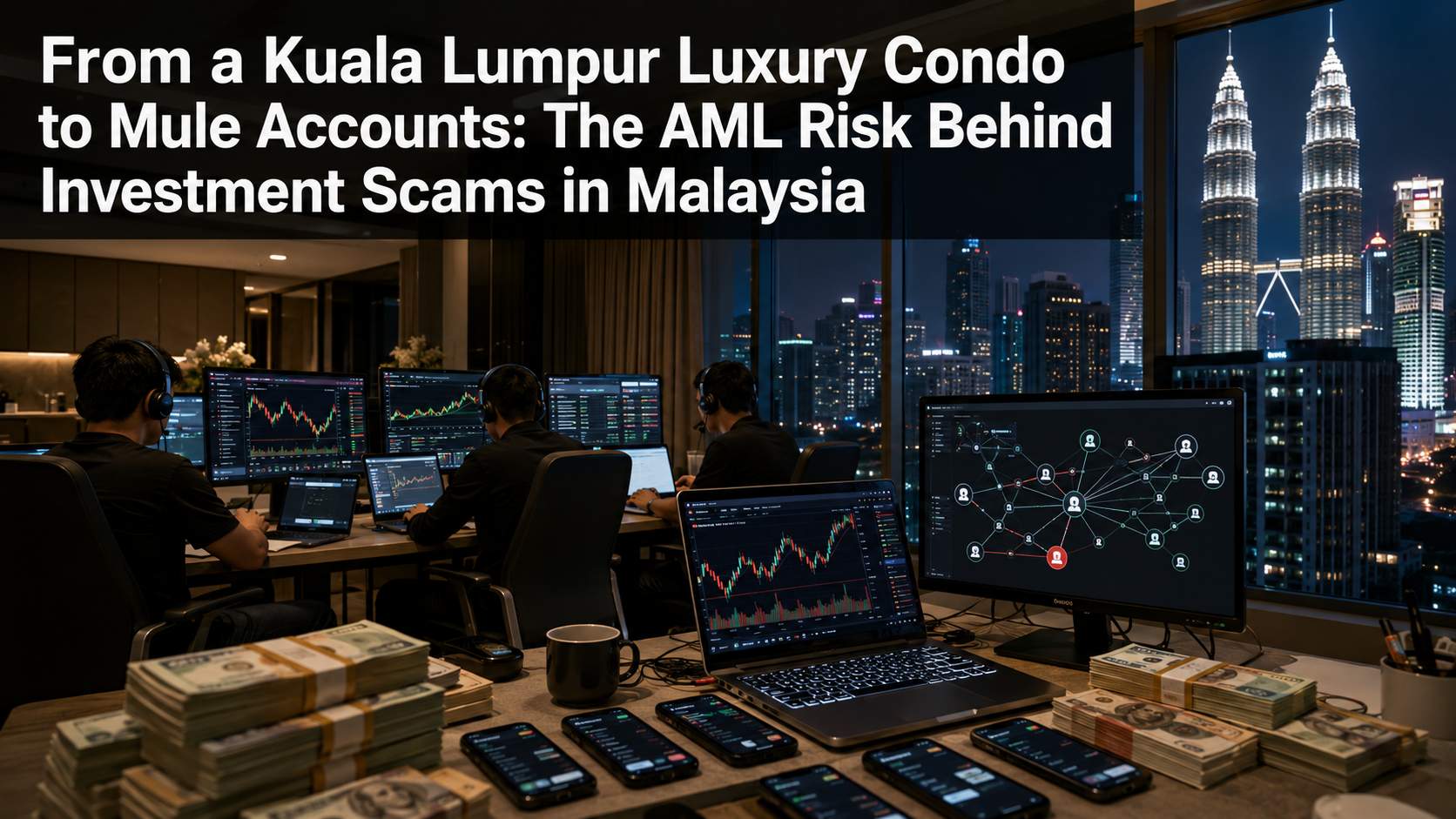
The scam operation was hidden inside a luxury condominium in Kuala Lumpur.
But for banks, fintechs, e-wallets, payment firms, and remittance operators in Malaysia, the bigger question is not only where the call centre was located.
It is where the money may have gone.
Malaysian police recently busted a suspected online investment scam syndicate operating from a condominium unit in Wangsa Maju. The group was allegedly involved in a fake foreign-exchange investment scheme targeting victims overseas. Authorities reportedly detained ten suspects and seized laptops and mobile phones from a room believed to have been converted into a scam call centre.
For compliance teams, this case is a reminder that investment scams are not only a customer deception problem.
They are also a financial crime problem.
Behind every fake investment scheme is a money trail. Victims are persuaded to transfer funds. Receiving accounts collect the money. Mule accounts help disguise the source. Funds may then be split, layered, withdrawn, or moved across borders before victims realise the investment never existed.
The call centre may be the visible operation.
But the accounts reveal the AML risk.

What Happened in Wangsa Maju?
The case centres on a police raid at a luxury condominium unit in Wangsa Maju, Kuala Lumpur.
According to reports, police acted on public tip-offs and intelligence before raiding the unit. Inside, investigators found laptops and mobile phones in a room believed to have been used as a call centre.
Early investigations indicated that the suspects were allegedly involved in a fake foreign-exchange investment scheme targeting victims in China. The operation was believed to have been active since early May.
Police detained nine Chinese nationals and one Malaysian man. The foreign suspects were reportedly staying inside the unit and avoiding unnecessary movement to prevent drawing attention from residents. The Malaysian suspect was believed to have delivered food and daily necessities to them.
This detail matters because it shows how modern scam operations can be physically based in one country while targeting victims in another.
For Malaysian financial institutions, the risk does not end with the call centre. If scam proceeds touch Malaysian accounts, wallets, payment firms, money services businesses, or remittance channels, the exposure becomes an AML/CFT monitoring and reporting issue.
Why This Case Matters for Malaysia
Malaysia’s digital finance ecosystem has grown rapidly. Online banking, instant transfers, e-wallets, remittance services, and fintech payment channels make it easier for customers and businesses to move money quickly.
The same infrastructure can be misused by scam syndicates.
Investment scams are especially difficult to detect because they often look legitimate in the early stages. Victims may believe they are transferring money into a trading account, foreign-exchange platform, investment wallet, or broker-linked account. The first few payments may be small. Some victims may even receive fake returns to build trust before being encouraged to invest larger amounts.
From a financial institution’s perspective, these payments may initially appear to be ordinary customer transfers.
The risk becomes clearer when patterns are connected.
Multiple unrelated senders transfer funds to the same recipient. Newly opened accounts receive sudden inflows. Funds move out quickly after receipt. Accounts show no clear economic purpose for the transaction volume. Payment references may mention investment, forex, trading, platform top-up, commission, tax, or withdrawal fees.
In isolation, each transaction may not look suspicious.
Together, they may reveal a scam collection network.
The BNM and AML/CFT Relevance
For compliance and regulatory teams in Malaysia, cases like this matter because scam proceeds can create obligations beyond fraud investigation.
Where a bank, e-wallet, remittance provider, payment firm, or other reporting institution identifies suspicious activity linked to scam proceeds, mule accounts, unusual fund movement, or suspected layering, the institution needs to assess whether the activity should be escalated through its AML/CFT process.
This includes the ability to:
- detect unusual transaction patterns
- identify mule or collection account behaviour
- assess whether customer activity matches the stated profile
- investigate suspicious inflows and rapid onward transfers
- document the investigation rationale
- decide whether a suspicious transaction report should be filed
- maintain an audit trail of alert review, escalation, and disposition
For regulators and auditors, the question is not only whether a suspicious account was detected. It is whether the institution can demonstrate how the risk was identified, investigated, escalated, and resolved.
That makes transaction monitoring, case management, and investigation documentation central to the compliance response.
How Fake Investment Scam Proceeds Move
A typical investment scam laundering flow may look like this:
- Victims are contacted through calls, messaging apps, social media, or fake investment platforms.
- They are persuaded to invest in a foreign-exchange, cryptocurrency, stock, or high-return scheme.
- Victims transfer money to bank accounts, wallets, or payment accounts provided by the scam network.
- Funds are pooled in collection accounts or mule accounts.
- The money is split across multiple accounts to reduce visibility.
- Funds are withdrawn, converted, moved through remittance channels, or transferred cross-border.
- The scam platform disappears or blocks withdrawals once the victim tries to recover the money.
The laundering objective is simple: separate the criminal proceeds from the original victim payment.
This is why mule accounts are central to investment scam operations.
The scam may be run by a call centre. The victim may be overseas. But the proceeds need financial infrastructure to move. That infrastructure can include personal accounts, corporate accounts, e-wallets, payment accounts, remittance channels, and intermediaries.
The Mule Account Risk
Investment scam syndicates often rely on mule accounts to receive and move victim funds.
Some mule accounts may be opened by recruited individuals. Others may be controlled by organised networks. Some may belong to individuals who were promised commissions for receiving money. Others may be compromised, rented, or misused by third parties.
These accounts may not appear suspicious at onboarding.
The risk emerges through behaviour.
A personal account may suddenly receive repeated transfers from unrelated senders. A dormant account may become active after months of low usage. A new account may start moving funds at high velocity shortly after opening. A customer with a modest profile may receive transaction volumes that do not match their occupation, income, or stated account purpose.
Once funds arrive, mule accounts often move the money quickly.
That speed matters.
By the time a victim reports the scam, the first receiving account may already be empty.
Red Flags Banks, Fintechs and Payment Firms Should Monitor
Fake foreign-exchange and investment scam activity can generate warning signs across onboarding, transaction monitoring, account behaviour, and investigations.
Key red flags include:
- Multiple inbound transfers from unrelated individuals into the same account
- Payment references mentioning forex, trading, investment, platform top-up, commission, tax, or withdrawal fee
- Newly opened accounts receiving high transaction volumes soon after onboarding
- Dormant or low-activity accounts suddenly receiving frequent credits
- Rapid onward transfers shortly after incoming funds are received
- Funds split across multiple accounts after receipt
- Transfers to beneficiaries with no clear relationship to the sender
- Account activity inconsistent with customer profile, occupation, income, or declared purpose
- Use of personal accounts for activity that resembles investment collection
- Repeated transactions involving high-risk, unusual, or unrelated jurisdictions
- Shared device, IP address, phone number, address, or beneficiary patterns across accounts
- Customer complaints or scam reports linked to the same receiving account
- Multiple accounts showing similar inflow and cash-out behaviour within the same period
The strongest signal is rarely a single transaction.
It is the pattern across customers, accounts, devices, counterparties, and beneficiaries.
Why Traditional Monitoring May Miss the Risk
Traditional transaction monitoring systems may struggle with investment scams because the early transactions can look normal.
The victim willingly sends the money.
The payment may be described as an investment.
The receiving account may have no prior risk history.
The transaction amount may sit below standard thresholds.
But the wider behaviour can reveal the scam.
An account receiving one investment-related transfer may not be suspicious. But an account receiving repeated investment-linked payments from unrelated senders, followed by rapid transfers to other accounts, deserves closer review.
This is where monitoring needs to go beyond fixed rules.
Financial institutions need to connect:
- sender diversity
- payment references
- account age
- transaction velocity
- customer profile mismatch
- beneficiary clustering
- device and IP linkages
- fund movement after receipt
- cross-border transfer patterns
- scam complaint history
When these signals are viewed together, the laundering pattern becomes clearer.
Why Fraud and AML Teams Need a Shared View
Investment scams sit at the intersection of fraud and AML.
The fraud team may see victim complaints, suspicious onboarding, fake investment narratives, or social engineering indicators.
The AML team may see rapid fund movement, layering, unusual counterparties, and suspicious account behaviour.
The payments team may see abnormal transfer velocity or repeated payments to the same beneficiary.
If these signals remain in separate systems, the institution may miss the full network.
A scam call centre does not separate fraud from money laundering.
The victim deception, mule account activity, and laundering flow are part of the same financial crime chain.
This is why financial institutions need a unified view of customer behaviour, transaction activity, account relationships, devices, counterparties, and investigation history.
A shared view helps teams identify whether an account is involved in one suspicious transfer or part of a wider scam proceeds network.
What This Means for Malaysian Compliance Teams
For banks, fintechs, e-wallets, payment firms, and remittance operators in Malaysia, this case highlights four practical lessons.
First, investment scam monitoring must look beyond individual victim payments. The risk is often visible in repeated inbound flows, beneficiary clustering, rapid onward movement, and customer profile mismatch.
Second, mule account detection must continue after onboarding. A clean account at onboarding can later become a collection account for scam proceeds.
Third, fraud and AML teams need to connect their signals. Scam proceeds may start as a fraud issue, but once funds are received, layered, moved, or transferred cross-border, they become an AML concern as well.
Fourth, investigation documentation matters. Compliance teams must be able to show why an alert was escalated, what evidence was reviewed, how the conclusion was reached, and whether suspicious transaction reporting was considered.
In a fast-moving digital payment environment, manual review alone may be too slow.
By the time one account is investigated, the funds may already have moved through several others.
How Tookitaki Helps Detect These Patterns
Tookitaki’s FinCense platform helps financial institutions detect financial crime patterns that cut across fraud, AML, mule accounts, and payment abuse.
For fake investment scams and foreign-exchange fraud typologies, FinCense can help identify:
- mule account behaviour
- multiple victim payments into common beneficiaries
- rapid movement of funds after credit
- high-velocity transfers across connected accounts
- sender and beneficiary clustering
- dormant account reactivation
- suspicious payment reference patterns
- customer profile and transaction behaviour mismatch
- cross-border movement of suspicious proceeds
- links between fraud complaints and AML typologies
FinCense also leverages the Anti Financial Crime Ecosystem, a shared typology intelligence network that helps institutions stay updated on emerging scam and laundering patterns across markets.
With unified case management, investigators can review customer risk, transaction history, related entities, alert context, red flags, and investigation notes in one place. This helps teams move faster, improve investigation quality, and support stronger suspicious transaction reporting.
The Bigger Lesson
The Kuala Lumpur luxury condo case is not only a story about a scam call centre.
It is a reminder that investment scam networks depend on financial infrastructure.
They need accounts.
They need payment channels.
They need mule networks.
They need ways to receive, split, and move victim funds.
For Malaysian financial institutions, the question is simple:
Can your monitoring system detect the money trail behind the scam?
Because in cases like this, the call centre may be hidden behind closed doors.
But the money trail is visible in the accounts.
Experience the most intelligent AML and fraud prevention platform
Experience the most intelligent AML and fraud prevention platform
Experience the most intelligent AML and fraud prevention platform
Top AML Scenarios in ASEAN
The Role of AML Software in Compliance
The Role of AML Software in Compliance
Talk to an Expert
Our Thought Leadership Guides


KYC Requirements for Philippine Banks: AMLA, BSP obligations, and What Compliance Teams Need to Know in 2026
The Philippines was removed from the FATF list of jurisdictions under increased monitoring in February 2025. This guide explains current AMLA and BSP KYC/CDD requirements for banks, including beneficial ownership, digital onboarding, reporting and record retention.
KYC Requirements for Philippine Banks: AMLA, BSP obligations, and What Compliance Teams Need to Know in 2026
The Philippines was removed from the FATF list of jurisdictions under increased monitoring in February 2025. This guide explains current AMLA and BSP KYC/CDD requirements for banks, including beneficial ownership, digital onboarding, reporting and record retention.