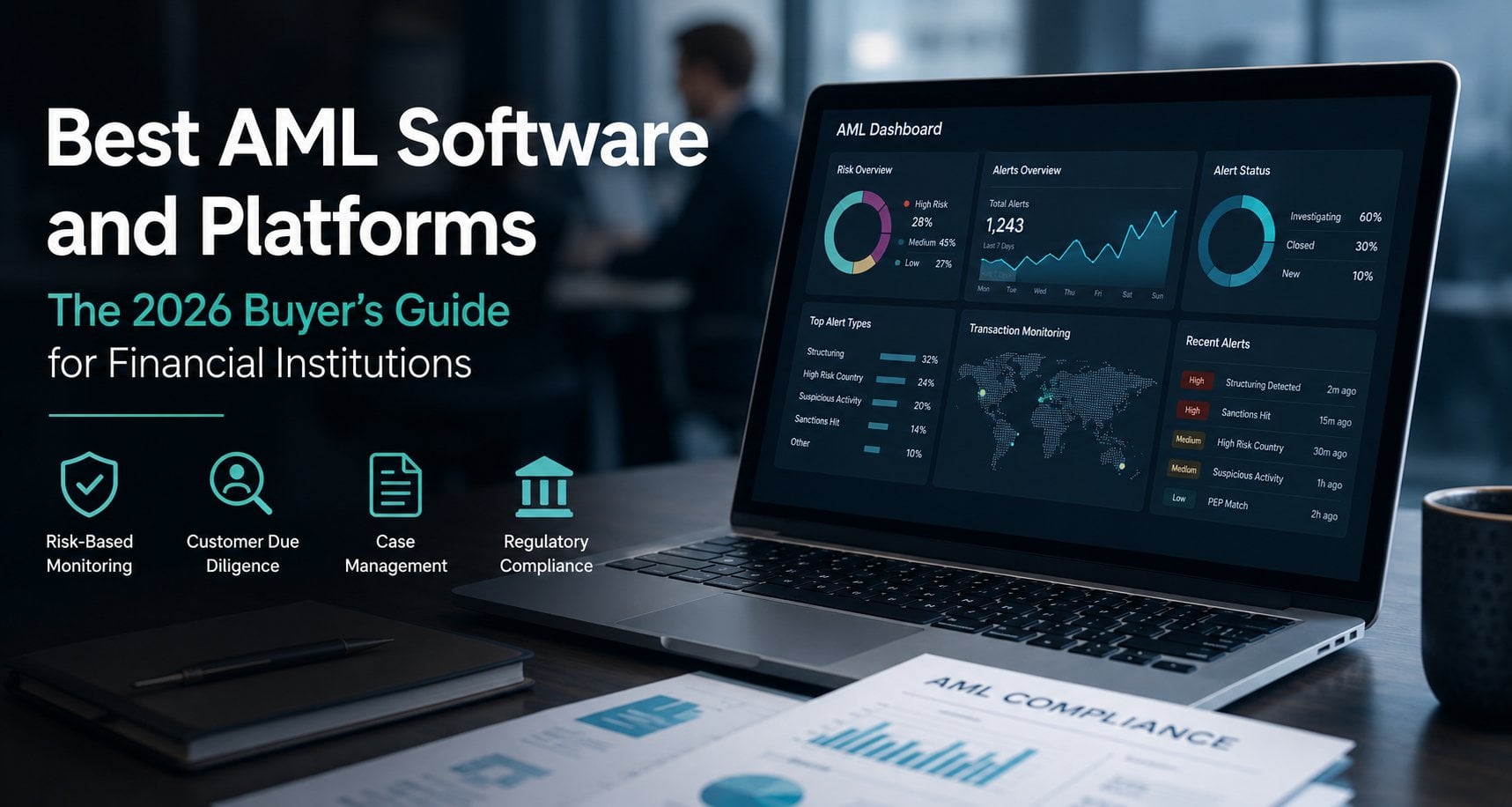
Anti-Money Laundering (AML) regulations are becoming increasingly stringent, and businesses are under more pressure than ever to comply. With the rise of financial crimes and the need for transparency, AML software has become a crucial tool for businesses to detect and prevent money laundering activities.
But with so many AML software options available, how do you choose the right one for your business? In this article, we’ll explore the key factors to consider when selecting AML software and provide tips for finding the best fit for your business.
Why Is AML Software Important?
Money laundering is a serious issue that can have severe consequences for businesses. Not only can it result in financial losses, but it can also damage a company’s reputation and lead to legal repercussions.
AML software helps businesses comply with regulations and identify suspicious activities that may indicate money laundering. It automates the process of monitoring transactions and customer data, making it easier for businesses to identify and report suspicious activities.
AML Compliance
AML software is essential for businesses to comply with regulations set by governing bodies such as the Financial Action Task Force (FATF) and the Financial Crimes Enforcement Network (FinCEN). These regulations require businesses to have robust AML programs in place to prevent money laundering and terrorist financing.
By implementing AML software, businesses can ensure they are meeting compliance requirements and avoid hefty fines and penalties.
Detecting Suspicious Activities
AML software uses advanced algorithms and machine learning to analyze customer data and transaction patterns. This allows businesses to identify suspicious activities that may indicate money laundering, such as large cash deposits, frequent transactions between unrelated parties, and transactions involving high-risk countries.
By detecting these activities, businesses can take action to prevent money laundering and protect their reputation and financial stability.
Streamlining AML Processes
Manual AML processes can be time-consuming and prone to human error. AML software automates these processes, making them more efficient and accurate. This saves businesses time and resources, allowing them to focus on other critical tasks.
{{cta-first}}
Key Factors to Consider When Choosing AML Software
When selecting AML software for your business, there are several key factors to consider. These include:
Compliance Requirements
Different industries and businesses have varying compliance requirements, and it’s essential to choose AML software that meets your specific needs. For example, if you’re an accountant, you may need AML software that is tailored to your industry and can integrate with your existing accounting software.
Before choosing AML software, make sure to research the compliance requirements for your industry and ensure the software you choose meets those requirements.
Features and Functionality
AML software can vary in features and functionality, so it’s crucial to consider what your business needs. Some essential features to look for include transaction monitoring, customer due diligence, and case management.
Additionally, consider if the software offers automation and integration capabilities, as well as reporting and analytics features. These can help streamline processes and provide valuable insights into your AML program’s effectiveness.
User-Friendliness
The AML software you choose should be user-friendly and easy to navigate. This is especially important if you have multiple employees using the software, as it should be accessible to all team members.
Consider doing a demo or trial of the software before committing to ensure it is user-friendly and meets your business’s needs.
Cost
The cost of AML software can vary significantly, so it’s essential to consider your budget when choosing a solution. Some software may have a one-time fee, while others may require a monthly or annual subscription.
Be sure to research the pricing options for different AML software and choose one that fits within your budget while still meeting your business’s needs.
Customer Support
In case you encounter any issues or have questions about the software, it’s crucial to have reliable customer support. Look for AML software providers that offer 24/7 support and have a good reputation for responding to customer inquiries promptly.
Tips for Finding the Right AML Software for Your Business
Now that you know the key factors to consider when choosing AML software, here are some tips to help you find the right fit for your business:
Research Different Providers
There are many AML software providers on the market, and it’s essential to research and compare different options. Look for providers that have experience in your industry and have a good reputation for providing reliable and effective AML solutions.
Read Reviews and Ask for Recommendations
Reading reviews from other businesses can provide valuable insights into the effectiveness and user-friendliness of different AML software. Additionally, ask for recommendations from other businesses in your industry to see what software they use and if they have had success with it.
Consider Scalability
As your business grows, your AML needs may change. It’s essential to choose AML software that can scale with your business and accommodate any future needs. This will save you from having to switch to a new software in the future and go through the selection process again.
Take Advantage of Demos and Trials
Many AML software providers offer demos or trials of their software, allowing you to test it out before committing. Take advantage of these opportunities to ensure the software meets your business’s needs and is user-friendly.
{{cta-ebook}}
Wrapping Up
Choosing the right AML software for your business is crucial for complying with regulations and preventing financial crimes. Tookitaki's FinCense stands out as the best option for banks and fintech companies, offering collective intelligence, comprehensive risk coverage, scalability, best-in-class technology, sharper alerts, and unified workflow management.
Financial institutions looking to enhance their AML program should definitely consider talking to Tookitaki's experts to learn more about FinCense and how it can benefit their business. By choosing the right AML software, businesses can streamline processes, detect suspicious activities, and ensure compliance with regulations, ultimately safeguarding their reputation and financial stability.
Experience the most intelligent AML and fraud prevention platform
Top AML Scenarios in ASEAN
The Role of AML Software in Compliance
The Role of AML Software in Compliance

We’ve received your details and our team will be in touch shortly.
Ready to Streamline Your Anti-Financial Crime Compliance?
Our Thought Leadership Guides
First Impressions Matter: How AML Onboarding Software Sets the Tone for Compliance
n financial compliance, how you start often defines how well you succeed.
As financial institutions across Singapore continue to digitise, one of the most critical stages in the customer lifecycle is also one of the most overlooked: onboarding. In a world of rising financial crime, increasingly complex regulatory expectations, and growing customer expectations for speed and simplicity—getting onboarding right is a compliance and business imperative.
AML onboarding software helps institutions walk this tightrope, balancing user experience with regulatory rigour. This blog explores what AML onboarding software is, why it matters in Singapore, and what features to look for when choosing the right solution.

Why Onboarding is a High-Risk Stage for Financial Crime
The onboarding phase is where risk enters the institution. Criminals often use fake identities, straw accounts, or mule accounts to gain access to the financial system. If these bad actors slip through during onboarding, they become much harder to detect downstream.
At the same time, overly rigid processes can lead to drop-offs or customer dissatisfaction—especially in a competitive market like Singapore where fintech players offer quick and seamless onboarding experiences.
This is where AML onboarding software plays a key role.
What is AML Onboarding Software?
AML onboarding software is designed to automate and enhance the customer due diligence (CDD) and Know Your Customer (KYC) processes during the initial stages of client engagement. It combines data collection, risk scoring, screening, and workflow automation to help financial institutions:
- Verify identities
- Assess customer risk
- Detect suspicious behaviour early
- Comply with MAS and FATF regulations
- Ensure auditability and reporting readiness
This software acts as a digital gatekeeper, helping teams detect red flags before a single transaction takes place.
Key Features of an Effective AML Onboarding Solution
Here’s what the best AML onboarding platforms bring to the table:
1. Dynamic Risk Profiling
Customers are assigned risk scores based on multiple factors—geographic exposure, occupation, product usage, and more. This helps tailor ongoing due diligence requirements.
2. Seamless Integration with Screening Tools
The onboarding software should be able to screen applicants in real-time against sanctions lists, politically exposed person (PEP) lists, and adverse media.
3. Intelligent Document Verification
Advanced systems offer biometric matching, liveness detection, and AI-based document parsing to reduce fraud and manual work.
4. Straight-Through Processing
Low-risk applicants should move through the system quickly with minimal friction, while high-risk cases are routed for enhanced due diligence.
5. Centralised Audit Trails
Every decision—approval, escalation, or rejection—should be logged for compliance and future investigations.
6. Local Regulatory Alignment
In Singapore, onboarding systems must comply with MAS AML Notices (e.g., Notice 626, PSN01), including requirements for non-face-to-face verification, ID recordkeeping, and high-risk country checks.
Common Onboarding Pitfalls to Avoid
Even the most promising compliance programmes can be derailed by poor onboarding. Here are a few common traps:
- Over-reliance on manual checks leading to delays
- Lack of integration between risk scoring and screening tools
- No visibility into onboarding drop-off points
- Inability to adapt due diligence levels based on real-time risk
The right AML onboarding software helps mitigate these issues from day one.

Use Case: Strengthening Digital Onboarding in a Singaporean Digital Bank
A mid-sized digital bank in Singapore faced challenges in balancing fast customer onboarding with the risk of synthetic identities and mule accounts. They implemented an AML onboarding solution that offered:
- Real-time screening against global watchlists
- Adaptive risk scoring based on customer behaviour
- Biometric ID checks for non-face-to-face verification
- Integration with their transaction monitoring system
The outcome? A 40% reduction in onboarding time, 60% fewer false positives during initial checks, and stronger regulatory audit readiness.
How Tookitaki Enhances the AML Onboarding Lifecycle
Tookitaki’s FinCense platform powers seamless onboarding with intelligent compliance baked in from the start.
While not a KYC identity verification tool, FinCense supports onboarding teams by:
- Providing a dynamic risk profile that connects to transaction behaviour
- Ingesting typologies and red flags from the AFC Ecosystem to detect unusual patterns early
- Enabling real-time alerting if onboarding-linked accounts behave abnormally in the first days of activity
- Strengthening case management with cross-functional visibility across onboarding and monitoring
This approach ensures that high-risk profiles are not only flagged early but also monitored in context post-onboarding.
Best Practices When Selecting AML Onboarding Software
- Choose a vendor that offers local support and understands MAS regulatory requirements.
- Prioritise explainability—your team should understand why a customer was flagged.
- Ensure seamless integration with other AML systems like transaction monitoring, case management, and reporting.
- Look for scalability so the system can grow with your business and adapt to new typologies.
Future Outlook: The Onboarding Battleground
As Singapore continues its push for digitalisation, from e-wallets to neobanks, the onboarding experience is becoming a competitive differentiator. Yet compliance cannot be compromised.
The future of AML onboarding lies in:
- Greater use of AI to detect synthetic identities
- Network-level intelligence to prevent mule account onboarding
- Real-time fraud and AML orchestration from day one
Institutions that invest in smart onboarding software today will be better equipped to fight financial crime tomorrow.
Conclusion: First Impressions That Last
Onboarding is no longer just a formality—it’s your first line of defence. With the right AML onboarding software, Singapore’s financial institutions can deliver frictionless user experiences while staying fully compliant.
It’s not about choosing between speed and security—it’s about choosing both.

Anti Money Laundering and Compliance: Why They Are Not the Same Thing
Anti money laundering and compliance are often spoken as one idea, but treating them as the same function is one of the most common mistakes financial institutions make.
Introduction
In boardrooms, audit meetings, and regulatory discussions, the terms anti money laundering and compliance are often used interchangeably. AML compliance. Compliance controls. Regulatory AML. The language blends together so naturally that the distinction is rarely questioned.
Yet inside financial institutions, AML and compliance play different roles, fail in different ways, and require different capabilities to function well.
Understanding the difference between anti money laundering and compliance is not a matter of semantics. It is fundamental to how banks manage financial crime risk, design controls, allocate resources, and respond to regulators. When the two are treated as the same thing, gaps appear. When they are understood as complementary but distinct, institutions gain clarity and control.
This blog breaks down what anti money laundering and compliance each actually mean in practice, where they intersect, where they diverge, and why mature institutions design for both rather than collapsing them into one concept.

Why AML and Compliance Are So Often Confused
There are several reasons why AML and compliance are routinely blended together.
First, anti money laundering obligations are enforced through regulatory compliance. Banks must comply with AML laws, guidance, and supervisory expectations. This naturally links AML activity to the compliance function.
Second, AML teams often sit within compliance departments. Organisational charts reinforce the idea that AML is simply a subset of compliance.
Third, regulatory language frequently refers to AML compliance rather than distinguishing between detection, prevention, governance, and oversight.
While understandable, this conflation creates blind spots.
What Anti Money Laundering Actually Does
Anti money laundering is fundamentally about detecting and disrupting illicit financial activity.
In practice, AML focuses on:
- Identifying suspicious behaviour
- Detecting laundering typologies
- Understanding how illicit funds move
- Investigating unusual activity
- Escalating and reporting genuine risk
AML is operational by nature. It deals with transactions, behaviour, patterns, and decisions made under uncertainty.
An AML function asks questions such as:
- Does this activity make sense given what we know about the customer
- Is this behaviour consistent with known laundering techniques
- Is there a reasonable suspicion that funds are linked to crime
AML is about risk discovery and response.
What Compliance Actually Does
Compliance serves a different purpose.
Compliance is about ensuring the institution operates within regulatory expectations and can demonstrate that fact when required.
In practice, compliance focuses on:
- Policies and procedures
- Governance frameworks
- Control design and documentation
- Oversight and assurance
- Regulatory engagement
- Evidence and auditability
A compliance function asks questions such as:
- Do we have appropriate controls in place
- Are those controls documented and approved
- Are they being followed consistently
- Can we demonstrate this to regulators
Compliance is about control assurance and accountability.
The Core Difference in One Sentence
Anti money laundering is about finding and responding to financial crime risk.
Compliance is about proving that the institution’s controls are appropriate and effective.
They are related, but they are not the same.
Where AML and Compliance Intersect
AML and compliance intersect constantly, which is why alignment matters.
Regulatory obligations
AML laws create compliance requirements. Institutions must show that their AML controls meet regulatory standards.
Suspicious matter reporting
AML teams identify suspicious activity. Compliance frameworks ensure reporting is timely, accurate, and auditable.
Risk based approaches
AML identifies risk. Compliance ensures controls are proportionate to that risk and documented accordingly.
Governance
AML outcomes inform governance discussions. Compliance provides the structure through which governance operates.
When AML and compliance work in harmony, institutions gain both detection strength and regulatory confidence.
Where AML and Compliance Commonly Drift Apart
Problems arise when the distinction between AML and compliance is ignored.
Compliance without effective AML
Some institutions focus heavily on policies, checklists, and documentation while underlying detection quality remains weak. On paper, controls exist. In practice, risk goes unnoticed.
AML without compliance discipline
Other institutions detect risk effectively but struggle to explain decisions, maintain consistency, or satisfy regulatory scrutiny.
Box ticking culture
When AML is treated purely as a compliance obligation, teams focus on satisfying requirements rather than understanding risk.
Operational fatigue
AML analysts overloaded with false positives may meet procedural compliance requirements while missing genuine threats.
These gaps often only surface during regulatory reviews or post incident investigations.

How Misalignment Shows Up in Real Institutions
Misalignment between anti money laundering and compliance often reveals itself through familiar symptoms.
- High alert volumes with low quality outcomes
- Inconsistent investigation decisions
- Difficulty explaining why alerts were triggered
- Weak linkage between risk assessments and controls
- Regulatory findings that reference process failures rather than intent
These issues are rarely caused by lack of effort. They are structural problems.
What Mature Institutions Do Differently
Institutions with strong AML and compliance outcomes treat them as distinct but interconnected capabilities.
Clear role definition
AML teams focus on detection, investigation, and typology understanding. Compliance teams focus on governance, assurance, and regulatory engagement.
Shared language
Risk concepts, thresholds, and rationales are aligned so that AML decisions can be explained within compliance frameworks.
Feedback loops
Compliance findings inform AML improvements. AML insights inform compliance control design.
Technology alignment
Systems support both operational detection and compliance oversight without forcing one to compromise the other.
This balance is difficult to achieve, but essential.
The Role of Technology in Bridging AML and Compliance
Technology often sits at the centre of the AML and compliance relationship.
Poorly designed systems create friction. Strong platforms create alignment.
Effective AML technology helps by:
- Providing explainable detection logic
- Maintaining clear audit trails
- Supporting consistent investigations
- Enabling oversight without slowing operations
- Translating operational decisions into compliance evidence
Technology does not eliminate the need for judgement, but it determines how visible and defensible that judgement becomes.
Why Regulators Care About the Difference
Regulators are not only interested in whether suspicious matters are reported. They are interested in how institutions arrive at decisions.
Regulatory expectations increasingly focus on:
- Risk based reasoning
- Control effectiveness
- Consistency of outcomes
- Governance accountability
When AML and compliance are blurred together, institutions struggle to articulate this reasoning clearly.
Australia Specific Considerations
In Australia, expectations around anti money laundering and compliance continue to evolve.
Institutions are expected to:
- Understand emerging typologies such as scam driven laundering
- Apply proportional controls based on real risk
- Demonstrate clear governance over AML systems
- Maintain strong documentation and oversight
This environment makes alignment between AML and compliance more important than ever.
For community owned institutions such as Regional Australia Bank, the challenge is achieving this alignment with lean teams and limited tolerance for inefficiency.
Common Mistakes to Avoid
Several mistakes repeatedly undermine AML and compliance effectiveness.
Treating AML as paperwork
This weakens detection and creates false confidence.
Treating compliance as an obstacle
This leads to poor documentation and regulatory exposure.
Over engineering controls
Excessive complexity increases failure points.
Ignoring operational feedback
Analyst experience often highlights control weaknesses before audits do.
Avoiding these mistakes requires deliberate design.
How Institutions Can Align AML and Compliance More Effectively
Alignment does not require restructuring overnight. It requires focus.
Start with shared risk understanding
Ensure AML risk assessments genuinely inform compliance controls.
Design controls around real behaviour
Avoid theoretical frameworks disconnected from operational reality.
Prioritise explainability
Decisions should be understandable to analysts, auditors, and regulators alike.
Use technology as an enabler
Systems should connect detection, investigation, and oversight seamlessly.
Review continuously
Alignment is not static. It evolves as risk evolves.
Where Tookitaki Fits in This Conversation
Tookitaki approaches anti money laundering and compliance as complementary capabilities that must work together.
Through its FinCense platform, institutions can:
- Detect behaviour driven risk more effectively
- Maintain clear and explainable decision logic
- Support consistent investigations
- Generate audit ready evidence
- Align operational AML outcomes with compliance expectations
This helps institutions strengthen both detection quality and regulatory defensibility without forcing one to dominate the other.
The Future of Anti Money Laundering and Compliance
The future points toward greater integration, not greater confusion.
Key trends include:
- More intelligence led AML detection
- Stronger emphasis on accountability and explainability
- Technology that supports both operations and oversight
- Closer collaboration between AML and compliance teams
Institutions that recognise the difference between anti money laundering and compliance, and design accordingly, will be better positioned to manage risk and regulatory change.
Conclusion
Anti money laundering and compliance are deeply connected, but they are not the same thing. One discovers risk. The other ensures accountability. One is operational. The other is structural.
When institutions blur the distinction, they weaken both. When they respect it, align it, and design for it, they create stronger controls, clearer decisions, and greater regulatory confidence.
In an increasingly complex financial crime landscape, understanding this difference is no longer optional. It is foundational to sustainable, effective risk management.

Banking Fraud Detection Tools: How Malaysia’s Banks Are Reinventing Financial Protection
As banking goes fully digital, fraud detection tools have become the silent guardians protecting trust across Malaysia’s financial system.
Fraud Is No Longer an Exception in Banking
Malaysia’s banking sector has evolved rapidly. Mobile banking, instant transfers, QR payments, digital wallets, and cross-border transactions are now embedded into everyday life. What once required a branch visit now happens in seconds on a smartphone.
This convenience, however, has reshaped fraud.
Fraud today is not random. It is organised, automated, and engineered to exploit speed. Criminal networks combine social engineering, mule accounts, device manipulation, and real-time payments to move funds before banks can intervene.
Malaysian banks are facing growing exposure to:
- Account takeover attacks
- Scam-driven fund transfers
- Mule assisted fraud
- QR payment abuse
- Fake merchant activity
- Cross-border transaction fraud
- Fraud that quickly converts into money laundering
In this environment, traditional controls are no longer enough. Banks need banking fraud detection tools that operate in real time, understand behaviour, and adapt as threats evolve.

What Are Banking Fraud Detection Tools?
Banking fraud detection tools are technology systems designed to identify, prevent, and respond to fraudulent activity across banking channels.
These tools monitor transactions, customer behaviour, device signals, and contextual data to detect suspicious activity before losses occur.
Modern fraud detection tools typically cover:
- Transaction fraud detection
- Account takeover prevention
- Payment fraud monitoring
- Behavioural analysis
- Device and channel intelligence
- Real-time risk scoring
- Alert investigation and resolution
- Integration with AML systems
Unlike legacy controls that review activity after the fact, modern banking fraud detection tools are built to act during the transaction.
Their purpose is prevention, not just detection.
Why Banking Fraud Detection Tools Matter in Malaysia
Malaysia’s banking environment presents unique challenges that make advanced fraud detection essential.
1. Real-Time Payments Increase Risk Velocity
With instant transfers and QR payments, fraudulent funds can leave the system within seconds. Detection delays are no longer acceptable.
2. Scams Are Driving Banking Fraud
Investment scams, impersonation scams, and social engineering attacks often rely on victims initiating legitimate looking transactions that are actually fraudulent.
3. Mule Networks Enable Scale
Criminals recruit individuals to move funds across multiple accounts, making individual transactions appear low risk while hiding coordinated fraud.
4. Digital Channels Create New Attack Surfaces
Mobile apps, APIs, and online portals are being targeted using device spoofing, credential theft, and session hijacking.
5. Regulatory Expectations Are Rising
Bank Negara Malaysia expects banks to demonstrate effective fraud controls, timely intervention, and strong governance.
Banking fraud detection tools address these challenges by analysing intent, behaviour, and context in real time.
How Banking Fraud Detection Tools Work
Effective fraud detection in banking relies on a layered intelligence approach.
1. Transaction Monitoring
Every transaction is analysed at initiation. Amount, frequency, beneficiary details, timing, and channel are evaluated instantly.
2. Behavioural Profiling
The system builds a behavioural baseline for each customer. Deviations from normal patterns increase risk.
3. Device and Channel Analysis
Device fingerprints, IP addresses, geolocation, and session behaviour provide additional context.
4. Machine Learning Detection
ML models identify anomalies such as unusual velocity, new beneficiaries, or coordinated behaviour across accounts.
5. Risk Scoring and Decisioning
Each event receives a risk score. Based on this score, the system can allow, challenge, or block the transaction.
6. Alert Generation and Investigation
High-risk events generate alerts with supporting evidence for review.
7. Continuous Learning
Investigator decisions feed back into the system, improving accuracy over time.
This real-time loop allows banks to stop fraud before funds are lost.

Why Legacy Banking Fraud Tools Are Failing
Many banks still rely on rule-based or fragmented fraud systems that struggle in today’s environment.
Common weaknesses include:
- Static rules that miss new fraud patterns
- High false positives that disrupt customers
- Manual reviews that slow response
- Limited behavioural intelligence
- Siloed fraud and AML platforms
- Poor visibility into coordinated attacks
Criminals adapt constantly. Fraud detection tools must do the same.
The Role of AI in Modern Banking Fraud Detection
Artificial intelligence has become the foundation of effective fraud detection.
1. Behavioural Intelligence
AI understands how each customer normally behaves and flags subtle deviations that rules cannot detect.
2. Predictive Detection
AI identifies risk patterns early, often before fraud becomes obvious.
3. Real-Time Decisioning
AI enables instant decisions without human delay.
4. Reduced False Positives
Contextual analysis ensures legitimate customers are not unnecessarily blocked.
5. Explainable Outcomes
Modern AI provides clear explanations for each decision, supporting governance and customer communication.
AI driven banking fraud detection tools are now essential for any institution operating in real-time environments.
Tookitaki’s FinCense: Banking Fraud Detection Built for Malaysia
Many fraud tools focus on isolated events. Tookitaki’s FinCense takes a broader, more powerful approach.
FinCense delivers a unified platform that combines banking fraud detection, AML monitoring, onboarding intelligence, and case management into a single system.
This unified approach is especially effective in Malaysia’s fast-moving banking landscape.
Agentic AI for Real-Time Fraud Prevention
FinCense uses Agentic AI to analyse transactions as they happen.
The system:
- Evaluates behavioural context instantly
- Detects coordinated activity across accounts
- Generates clear risk explanations
- Recommends appropriate actions
This allows banks to respond at machine speed without losing control or transparency.
Federated Intelligence Across ASEAN
Fraud patterns often appear in one market before spreading to others.
FinCense connects to the Anti-Financial Crime Ecosystem, allowing banks to benefit from regional intelligence without sharing sensitive data.
Malaysian banks gain early insight into:
- Scam-driven payment fraud
- Mule behaviour observed in neighbouring countries
- QR payment abuse patterns
- Emerging account takeover techniques
This shared intelligence significantly strengthens local defences.
Explainable AI for Governance and Trust
Every fraud decision in FinCense is transparent.
Investigators and regulators can see:
- Which behaviours triggered the alert
- How risk was assessed
- Why a transaction was blocked or allowed
This supports strong governance and regulatory alignment.
Integrated Fraud and AML Protection
Fraud and money laundering are deeply connected.
FinCense links fraud events to downstream AML monitoring, enabling banks to:
- Detect mule assisted fraud early
- Track fraud proceeds across transactions
- Prevent laundering before escalation
This holistic view disrupts organised crime rather than isolated incidents.
Scenario Example: Stopping a Scam-Driven Transfer
A Malaysian customer initiates a large transfer after receiving investment advice through messaging apps.
The transaction looks legitimate on the surface.
FinCense detects the risk in real time:
- Behavioural analysis flags an unusual transfer amount.
- The beneficiary account shows patterns linked to mule activity.
- Transaction timing matches known scam typologies from regional intelligence.
- Agentic AI generates a risk explanation instantly.
- The transaction is blocked and escalated for review.
The customer is protected and funds remain secure.
Benefits of Banking Fraud Detection Tools for Malaysian Banks
Advanced fraud detection tools deliver measurable impact.
- Reduced fraud losses
- Faster response to emerging threats
- Lower false positives
- Improved customer experience
- Stronger regulatory confidence
- Better visibility into fraud networks
- Seamless integration with AML controls
Fraud prevention becomes a strategic advantage rather than a cost centre.
What Banks Should Look for in Fraud Detection Tools
When evaluating banking fraud detection tools, Malaysian banks should prioritise:
Real-Time Capability
Fraud must be stopped before money moves.
Behavioural Intelligence
Understanding customer behaviour is critical.
Explainability
Every decision must be transparent and defensible.
Integration
Fraud detection must connect with AML and case management.
Regional Intelligence
ASEAN-specific patterns must be incorporated.
Scalability
Systems must perform under high transaction volumes.
FinCense delivers all these capabilities within a single platform.
The Future of Banking Fraud Detection in Malaysia
Fraud detection will continue to evolve alongside digital banking.
Future developments include:
- Wider use of behavioural biometrics
- Real-time scam intervention workflows
- Greater cross-institution intelligence sharing
- Deeper convergence of fraud and AML platforms
- Responsible AI governance frameworks
Malaysia’s strong regulatory focus and digital adoption position it well to lead in next-generation fraud protection.
Conclusion
Banking fraud is no longer a side risk. It is a core threat to trust in Malaysia’s financial system.
Banking fraud detection tools must operate in real time, understand behaviour, and adapt continuously.
Tookitaki’s FinCense delivers this capability. By combining Agentic AI, federated intelligence, explainable decisioning, and unified fraud and AML protection, FinCense empowers Malaysian banks to stay ahead of fast-evolving fraud.
In a digital banking world, protection must move at the speed of trust.

First Impressions Matter: How AML Onboarding Software Sets the Tone for Compliance
n financial compliance, how you start often defines how well you succeed.
As financial institutions across Singapore continue to digitise, one of the most critical stages in the customer lifecycle is also one of the most overlooked: onboarding. In a world of rising financial crime, increasingly complex regulatory expectations, and growing customer expectations for speed and simplicity—getting onboarding right is a compliance and business imperative.
AML onboarding software helps institutions walk this tightrope, balancing user experience with regulatory rigour. This blog explores what AML onboarding software is, why it matters in Singapore, and what features to look for when choosing the right solution.

Why Onboarding is a High-Risk Stage for Financial Crime
The onboarding phase is where risk enters the institution. Criminals often use fake identities, straw accounts, or mule accounts to gain access to the financial system. If these bad actors slip through during onboarding, they become much harder to detect downstream.
At the same time, overly rigid processes can lead to drop-offs or customer dissatisfaction—especially in a competitive market like Singapore where fintech players offer quick and seamless onboarding experiences.
This is where AML onboarding software plays a key role.
What is AML Onboarding Software?
AML onboarding software is designed to automate and enhance the customer due diligence (CDD) and Know Your Customer (KYC) processes during the initial stages of client engagement. It combines data collection, risk scoring, screening, and workflow automation to help financial institutions:
- Verify identities
- Assess customer risk
- Detect suspicious behaviour early
- Comply with MAS and FATF regulations
- Ensure auditability and reporting readiness
This software acts as a digital gatekeeper, helping teams detect red flags before a single transaction takes place.
Key Features of an Effective AML Onboarding Solution
Here’s what the best AML onboarding platforms bring to the table:
1. Dynamic Risk Profiling
Customers are assigned risk scores based on multiple factors—geographic exposure, occupation, product usage, and more. This helps tailor ongoing due diligence requirements.
2. Seamless Integration with Screening Tools
The onboarding software should be able to screen applicants in real-time against sanctions lists, politically exposed person (PEP) lists, and adverse media.
3. Intelligent Document Verification
Advanced systems offer biometric matching, liveness detection, and AI-based document parsing to reduce fraud and manual work.
4. Straight-Through Processing
Low-risk applicants should move through the system quickly with minimal friction, while high-risk cases are routed for enhanced due diligence.
5. Centralised Audit Trails
Every decision—approval, escalation, or rejection—should be logged for compliance and future investigations.
6. Local Regulatory Alignment
In Singapore, onboarding systems must comply with MAS AML Notices (e.g., Notice 626, PSN01), including requirements for non-face-to-face verification, ID recordkeeping, and high-risk country checks.
Common Onboarding Pitfalls to Avoid
Even the most promising compliance programmes can be derailed by poor onboarding. Here are a few common traps:
- Over-reliance on manual checks leading to delays
- Lack of integration between risk scoring and screening tools
- No visibility into onboarding drop-off points
- Inability to adapt due diligence levels based on real-time risk
The right AML onboarding software helps mitigate these issues from day one.

Use Case: Strengthening Digital Onboarding in a Singaporean Digital Bank
A mid-sized digital bank in Singapore faced challenges in balancing fast customer onboarding with the risk of synthetic identities and mule accounts. They implemented an AML onboarding solution that offered:
- Real-time screening against global watchlists
- Adaptive risk scoring based on customer behaviour
- Biometric ID checks for non-face-to-face verification
- Integration with their transaction monitoring system
The outcome? A 40% reduction in onboarding time, 60% fewer false positives during initial checks, and stronger regulatory audit readiness.
How Tookitaki Enhances the AML Onboarding Lifecycle
Tookitaki’s FinCense platform powers seamless onboarding with intelligent compliance baked in from the start.
While not a KYC identity verification tool, FinCense supports onboarding teams by:
- Providing a dynamic risk profile that connects to transaction behaviour
- Ingesting typologies and red flags from the AFC Ecosystem to detect unusual patterns early
- Enabling real-time alerting if onboarding-linked accounts behave abnormally in the first days of activity
- Strengthening case management with cross-functional visibility across onboarding and monitoring
This approach ensures that high-risk profiles are not only flagged early but also monitored in context post-onboarding.
Best Practices When Selecting AML Onboarding Software
- Choose a vendor that offers local support and understands MAS regulatory requirements.
- Prioritise explainability—your team should understand why a customer was flagged.
- Ensure seamless integration with other AML systems like transaction monitoring, case management, and reporting.
- Look for scalability so the system can grow with your business and adapt to new typologies.
Future Outlook: The Onboarding Battleground
As Singapore continues its push for digitalisation, from e-wallets to neobanks, the onboarding experience is becoming a competitive differentiator. Yet compliance cannot be compromised.
The future of AML onboarding lies in:
- Greater use of AI to detect synthetic identities
- Network-level intelligence to prevent mule account onboarding
- Real-time fraud and AML orchestration from day one
Institutions that invest in smart onboarding software today will be better equipped to fight financial crime tomorrow.
Conclusion: First Impressions That Last
Onboarding is no longer just a formality—it’s your first line of defence. With the right AML onboarding software, Singapore’s financial institutions can deliver frictionless user experiences while staying fully compliant.
It’s not about choosing between speed and security—it’s about choosing both.

Anti Money Laundering and Compliance: Why They Are Not the Same Thing
Anti money laundering and compliance are often spoken as one idea, but treating them as the same function is one of the most common mistakes financial institutions make.
Introduction
In boardrooms, audit meetings, and regulatory discussions, the terms anti money laundering and compliance are often used interchangeably. AML compliance. Compliance controls. Regulatory AML. The language blends together so naturally that the distinction is rarely questioned.
Yet inside financial institutions, AML and compliance play different roles, fail in different ways, and require different capabilities to function well.
Understanding the difference between anti money laundering and compliance is not a matter of semantics. It is fundamental to how banks manage financial crime risk, design controls, allocate resources, and respond to regulators. When the two are treated as the same thing, gaps appear. When they are understood as complementary but distinct, institutions gain clarity and control.
This blog breaks down what anti money laundering and compliance each actually mean in practice, where they intersect, where they diverge, and why mature institutions design for both rather than collapsing them into one concept.

Why AML and Compliance Are So Often Confused
There are several reasons why AML and compliance are routinely blended together.
First, anti money laundering obligations are enforced through regulatory compliance. Banks must comply with AML laws, guidance, and supervisory expectations. This naturally links AML activity to the compliance function.
Second, AML teams often sit within compliance departments. Organisational charts reinforce the idea that AML is simply a subset of compliance.
Third, regulatory language frequently refers to AML compliance rather than distinguishing between detection, prevention, governance, and oversight.
While understandable, this conflation creates blind spots.
What Anti Money Laundering Actually Does
Anti money laundering is fundamentally about detecting and disrupting illicit financial activity.
In practice, AML focuses on:
- Identifying suspicious behaviour
- Detecting laundering typologies
- Understanding how illicit funds move
- Investigating unusual activity
- Escalating and reporting genuine risk
AML is operational by nature. It deals with transactions, behaviour, patterns, and decisions made under uncertainty.
An AML function asks questions such as:
- Does this activity make sense given what we know about the customer
- Is this behaviour consistent with known laundering techniques
- Is there a reasonable suspicion that funds are linked to crime
AML is about risk discovery and response.
What Compliance Actually Does
Compliance serves a different purpose.
Compliance is about ensuring the institution operates within regulatory expectations and can demonstrate that fact when required.
In practice, compliance focuses on:
- Policies and procedures
- Governance frameworks
- Control design and documentation
- Oversight and assurance
- Regulatory engagement
- Evidence and auditability
A compliance function asks questions such as:
- Do we have appropriate controls in place
- Are those controls documented and approved
- Are they being followed consistently
- Can we demonstrate this to regulators
Compliance is about control assurance and accountability.
The Core Difference in One Sentence
Anti money laundering is about finding and responding to financial crime risk.
Compliance is about proving that the institution’s controls are appropriate and effective.
They are related, but they are not the same.
Where AML and Compliance Intersect
AML and compliance intersect constantly, which is why alignment matters.
Regulatory obligations
AML laws create compliance requirements. Institutions must show that their AML controls meet regulatory standards.
Suspicious matter reporting
AML teams identify suspicious activity. Compliance frameworks ensure reporting is timely, accurate, and auditable.
Risk based approaches
AML identifies risk. Compliance ensures controls are proportionate to that risk and documented accordingly.
Governance
AML outcomes inform governance discussions. Compliance provides the structure through which governance operates.
When AML and compliance work in harmony, institutions gain both detection strength and regulatory confidence.
Where AML and Compliance Commonly Drift Apart
Problems arise when the distinction between AML and compliance is ignored.
Compliance without effective AML
Some institutions focus heavily on policies, checklists, and documentation while underlying detection quality remains weak. On paper, controls exist. In practice, risk goes unnoticed.
AML without compliance discipline
Other institutions detect risk effectively but struggle to explain decisions, maintain consistency, or satisfy regulatory scrutiny.
Box ticking culture
When AML is treated purely as a compliance obligation, teams focus on satisfying requirements rather than understanding risk.
Operational fatigue
AML analysts overloaded with false positives may meet procedural compliance requirements while missing genuine threats.
These gaps often only surface during regulatory reviews or post incident investigations.

How Misalignment Shows Up in Real Institutions
Misalignment between anti money laundering and compliance often reveals itself through familiar symptoms.
- High alert volumes with low quality outcomes
- Inconsistent investigation decisions
- Difficulty explaining why alerts were triggered
- Weak linkage between risk assessments and controls
- Regulatory findings that reference process failures rather than intent
These issues are rarely caused by lack of effort. They are structural problems.
What Mature Institutions Do Differently
Institutions with strong AML and compliance outcomes treat them as distinct but interconnected capabilities.
Clear role definition
AML teams focus on detection, investigation, and typology understanding. Compliance teams focus on governance, assurance, and regulatory engagement.
Shared language
Risk concepts, thresholds, and rationales are aligned so that AML decisions can be explained within compliance frameworks.
Feedback loops
Compliance findings inform AML improvements. AML insights inform compliance control design.
Technology alignment
Systems support both operational detection and compliance oversight without forcing one to compromise the other.
This balance is difficult to achieve, but essential.
The Role of Technology in Bridging AML and Compliance
Technology often sits at the centre of the AML and compliance relationship.
Poorly designed systems create friction. Strong platforms create alignment.
Effective AML technology helps by:
- Providing explainable detection logic
- Maintaining clear audit trails
- Supporting consistent investigations
- Enabling oversight without slowing operations
- Translating operational decisions into compliance evidence
Technology does not eliminate the need for judgement, but it determines how visible and defensible that judgement becomes.
Why Regulators Care About the Difference
Regulators are not only interested in whether suspicious matters are reported. They are interested in how institutions arrive at decisions.
Regulatory expectations increasingly focus on:
- Risk based reasoning
- Control effectiveness
- Consistency of outcomes
- Governance accountability
When AML and compliance are blurred together, institutions struggle to articulate this reasoning clearly.
Australia Specific Considerations
In Australia, expectations around anti money laundering and compliance continue to evolve.
Institutions are expected to:
- Understand emerging typologies such as scam driven laundering
- Apply proportional controls based on real risk
- Demonstrate clear governance over AML systems
- Maintain strong documentation and oversight
This environment makes alignment between AML and compliance more important than ever.
For community owned institutions such as Regional Australia Bank, the challenge is achieving this alignment with lean teams and limited tolerance for inefficiency.
Common Mistakes to Avoid
Several mistakes repeatedly undermine AML and compliance effectiveness.
Treating AML as paperwork
This weakens detection and creates false confidence.
Treating compliance as an obstacle
This leads to poor documentation and regulatory exposure.
Over engineering controls
Excessive complexity increases failure points.
Ignoring operational feedback
Analyst experience often highlights control weaknesses before audits do.
Avoiding these mistakes requires deliberate design.
How Institutions Can Align AML and Compliance More Effectively
Alignment does not require restructuring overnight. It requires focus.
Start with shared risk understanding
Ensure AML risk assessments genuinely inform compliance controls.
Design controls around real behaviour
Avoid theoretical frameworks disconnected from operational reality.
Prioritise explainability
Decisions should be understandable to analysts, auditors, and regulators alike.
Use technology as an enabler
Systems should connect detection, investigation, and oversight seamlessly.
Review continuously
Alignment is not static. It evolves as risk evolves.
Where Tookitaki Fits in This Conversation
Tookitaki approaches anti money laundering and compliance as complementary capabilities that must work together.
Through its FinCense platform, institutions can:
- Detect behaviour driven risk more effectively
- Maintain clear and explainable decision logic
- Support consistent investigations
- Generate audit ready evidence
- Align operational AML outcomes with compliance expectations
This helps institutions strengthen both detection quality and regulatory defensibility without forcing one to dominate the other.
The Future of Anti Money Laundering and Compliance
The future points toward greater integration, not greater confusion.
Key trends include:
- More intelligence led AML detection
- Stronger emphasis on accountability and explainability
- Technology that supports both operations and oversight
- Closer collaboration between AML and compliance teams
Institutions that recognise the difference between anti money laundering and compliance, and design accordingly, will be better positioned to manage risk and regulatory change.
Conclusion
Anti money laundering and compliance are deeply connected, but they are not the same thing. One discovers risk. The other ensures accountability. One is operational. The other is structural.
When institutions blur the distinction, they weaken both. When they respect it, align it, and design for it, they create stronger controls, clearer decisions, and greater regulatory confidence.
In an increasingly complex financial crime landscape, understanding this difference is no longer optional. It is foundational to sustainable, effective risk management.

Banking Fraud Detection Tools: How Malaysia’s Banks Are Reinventing Financial Protection
As banking goes fully digital, fraud detection tools have become the silent guardians protecting trust across Malaysia’s financial system.
Fraud Is No Longer an Exception in Banking
Malaysia’s banking sector has evolved rapidly. Mobile banking, instant transfers, QR payments, digital wallets, and cross-border transactions are now embedded into everyday life. What once required a branch visit now happens in seconds on a smartphone.
This convenience, however, has reshaped fraud.
Fraud today is not random. It is organised, automated, and engineered to exploit speed. Criminal networks combine social engineering, mule accounts, device manipulation, and real-time payments to move funds before banks can intervene.
Malaysian banks are facing growing exposure to:
- Account takeover attacks
- Scam-driven fund transfers
- Mule assisted fraud
- QR payment abuse
- Fake merchant activity
- Cross-border transaction fraud
- Fraud that quickly converts into money laundering
In this environment, traditional controls are no longer enough. Banks need banking fraud detection tools that operate in real time, understand behaviour, and adapt as threats evolve.

What Are Banking Fraud Detection Tools?
Banking fraud detection tools are technology systems designed to identify, prevent, and respond to fraudulent activity across banking channels.
These tools monitor transactions, customer behaviour, device signals, and contextual data to detect suspicious activity before losses occur.
Modern fraud detection tools typically cover:
- Transaction fraud detection
- Account takeover prevention
- Payment fraud monitoring
- Behavioural analysis
- Device and channel intelligence
- Real-time risk scoring
- Alert investigation and resolution
- Integration with AML systems
Unlike legacy controls that review activity after the fact, modern banking fraud detection tools are built to act during the transaction.
Their purpose is prevention, not just detection.
Why Banking Fraud Detection Tools Matter in Malaysia
Malaysia’s banking environment presents unique challenges that make advanced fraud detection essential.
1. Real-Time Payments Increase Risk Velocity
With instant transfers and QR payments, fraudulent funds can leave the system within seconds. Detection delays are no longer acceptable.
2. Scams Are Driving Banking Fraud
Investment scams, impersonation scams, and social engineering attacks often rely on victims initiating legitimate looking transactions that are actually fraudulent.
3. Mule Networks Enable Scale
Criminals recruit individuals to move funds across multiple accounts, making individual transactions appear low risk while hiding coordinated fraud.
4. Digital Channels Create New Attack Surfaces
Mobile apps, APIs, and online portals are being targeted using device spoofing, credential theft, and session hijacking.
5. Regulatory Expectations Are Rising
Bank Negara Malaysia expects banks to demonstrate effective fraud controls, timely intervention, and strong governance.
Banking fraud detection tools address these challenges by analysing intent, behaviour, and context in real time.
How Banking Fraud Detection Tools Work
Effective fraud detection in banking relies on a layered intelligence approach.
1. Transaction Monitoring
Every transaction is analysed at initiation. Amount, frequency, beneficiary details, timing, and channel are evaluated instantly.
2. Behavioural Profiling
The system builds a behavioural baseline for each customer. Deviations from normal patterns increase risk.
3. Device and Channel Analysis
Device fingerprints, IP addresses, geolocation, and session behaviour provide additional context.
4. Machine Learning Detection
ML models identify anomalies such as unusual velocity, new beneficiaries, or coordinated behaviour across accounts.
5. Risk Scoring and Decisioning
Each event receives a risk score. Based on this score, the system can allow, challenge, or block the transaction.
6. Alert Generation and Investigation
High-risk events generate alerts with supporting evidence for review.
7. Continuous Learning
Investigator decisions feed back into the system, improving accuracy over time.
This real-time loop allows banks to stop fraud before funds are lost.

Why Legacy Banking Fraud Tools Are Failing
Many banks still rely on rule-based or fragmented fraud systems that struggle in today’s environment.
Common weaknesses include:
- Static rules that miss new fraud patterns
- High false positives that disrupt customers
- Manual reviews that slow response
- Limited behavioural intelligence
- Siloed fraud and AML platforms
- Poor visibility into coordinated attacks
Criminals adapt constantly. Fraud detection tools must do the same.
The Role of AI in Modern Banking Fraud Detection
Artificial intelligence has become the foundation of effective fraud detection.
1. Behavioural Intelligence
AI understands how each customer normally behaves and flags subtle deviations that rules cannot detect.
2. Predictive Detection
AI identifies risk patterns early, often before fraud becomes obvious.
3. Real-Time Decisioning
AI enables instant decisions without human delay.
4. Reduced False Positives
Contextual analysis ensures legitimate customers are not unnecessarily blocked.
5. Explainable Outcomes
Modern AI provides clear explanations for each decision, supporting governance and customer communication.
AI driven banking fraud detection tools are now essential for any institution operating in real-time environments.
Tookitaki’s FinCense: Banking Fraud Detection Built for Malaysia
Many fraud tools focus on isolated events. Tookitaki’s FinCense takes a broader, more powerful approach.
FinCense delivers a unified platform that combines banking fraud detection, AML monitoring, onboarding intelligence, and case management into a single system.
This unified approach is especially effective in Malaysia’s fast-moving banking landscape.
Agentic AI for Real-Time Fraud Prevention
FinCense uses Agentic AI to analyse transactions as they happen.
The system:
- Evaluates behavioural context instantly
- Detects coordinated activity across accounts
- Generates clear risk explanations
- Recommends appropriate actions
This allows banks to respond at machine speed without losing control or transparency.
Federated Intelligence Across ASEAN
Fraud patterns often appear in one market before spreading to others.
FinCense connects to the Anti-Financial Crime Ecosystem, allowing banks to benefit from regional intelligence without sharing sensitive data.
Malaysian banks gain early insight into:
- Scam-driven payment fraud
- Mule behaviour observed in neighbouring countries
- QR payment abuse patterns
- Emerging account takeover techniques
This shared intelligence significantly strengthens local defences.
Explainable AI for Governance and Trust
Every fraud decision in FinCense is transparent.
Investigators and regulators can see:
- Which behaviours triggered the alert
- How risk was assessed
- Why a transaction was blocked or allowed
This supports strong governance and regulatory alignment.
Integrated Fraud and AML Protection
Fraud and money laundering are deeply connected.
FinCense links fraud events to downstream AML monitoring, enabling banks to:
- Detect mule assisted fraud early
- Track fraud proceeds across transactions
- Prevent laundering before escalation
This holistic view disrupts organised crime rather than isolated incidents.
Scenario Example: Stopping a Scam-Driven Transfer
A Malaysian customer initiates a large transfer after receiving investment advice through messaging apps.
The transaction looks legitimate on the surface.
FinCense detects the risk in real time:
- Behavioural analysis flags an unusual transfer amount.
- The beneficiary account shows patterns linked to mule activity.
- Transaction timing matches known scam typologies from regional intelligence.
- Agentic AI generates a risk explanation instantly.
- The transaction is blocked and escalated for review.
The customer is protected and funds remain secure.
Benefits of Banking Fraud Detection Tools for Malaysian Banks
Advanced fraud detection tools deliver measurable impact.
- Reduced fraud losses
- Faster response to emerging threats
- Lower false positives
- Improved customer experience
- Stronger regulatory confidence
- Better visibility into fraud networks
- Seamless integration with AML controls
Fraud prevention becomes a strategic advantage rather than a cost centre.
What Banks Should Look for in Fraud Detection Tools
When evaluating banking fraud detection tools, Malaysian banks should prioritise:
Real-Time Capability
Fraud must be stopped before money moves.
Behavioural Intelligence
Understanding customer behaviour is critical.
Explainability
Every decision must be transparent and defensible.
Integration
Fraud detection must connect with AML and case management.
Regional Intelligence
ASEAN-specific patterns must be incorporated.
Scalability
Systems must perform under high transaction volumes.
FinCense delivers all these capabilities within a single platform.
The Future of Banking Fraud Detection in Malaysia
Fraud detection will continue to evolve alongside digital banking.
Future developments include:
- Wider use of behavioural biometrics
- Real-time scam intervention workflows
- Greater cross-institution intelligence sharing
- Deeper convergence of fraud and AML platforms
- Responsible AI governance frameworks
Malaysia’s strong regulatory focus and digital adoption position it well to lead in next-generation fraud protection.
Conclusion
Banking fraud is no longer a side risk. It is a core threat to trust in Malaysia’s financial system.
Banking fraud detection tools must operate in real time, understand behaviour, and adapt continuously.
Tookitaki’s FinCense delivers this capability. By combining Agentic AI, federated intelligence, explainable decisioning, and unified fraud and AML protection, FinCense empowers Malaysian banks to stay ahead of fast-evolving fraud.
In a digital banking world, protection must move at the speed of trust.