

Inside the AML Stack: Tools Banks Use to Stop Dirty Money
.svg)
Dirty money does not move randomly. It moves through systems.
Every day, banks in Singapore process millions of transactions across accounts, borders, currencies, and digital channels. Hidden within this volume are sophisticated money laundering attempts designed to blend into normal financial activity.
Stopping these schemes requires more than manual reviews or basic monitoring rules. Banks rely on a carefully layered technology stack built specifically to detect suspicious behaviour, assess risk, and support investigations.
These AML tools used by banks form the backbone of modern financial crime prevention. From transaction monitoring and name screening to behavioural analytics and case management, each tool plays a specific role in identifying and stopping illicit activity.
Understanding how these tools work together provides insight into how banks detect money laundering, reduce operational risk, and meet Singapore’s strict regulatory expectations.

Why Banks Need a Full AML Stack
Money laundering rarely happens in a single step. Criminals typically move funds through multiple stages designed to obscure the origin of illicit proceeds.
These stages may include:
- Placement of illicit funds into accounts
- Layering through multiple transactions
- Movement across jurisdictions
- Integration into legitimate assets
Because each stage looks different, banks rely on multiple AML tools working together.
A single monitoring system cannot detect every type of suspicious behaviour. Instead, banks deploy a layered AML stack that includes monitoring, screening, risk scoring, analytics, and investigation tools.
This layered approach improves detection accuracy while reducing false positives.
Transaction Monitoring Systems
Transaction monitoring remains the foundation of AML tools used by banks.
These systems analyse financial activity to detect patterns associated with money laundering. Monitoring engines evaluate factors such as transaction size, frequency, counterparties, and geographic exposure.
Common capabilities include:
- Detection of rapid movement of funds
- Structuring pattern identification
- Cross-border transfer monitoring
- Unusual behavioural pattern detection
- Typology-based monitoring
Modern transaction monitoring tools also incorporate behavioural analytics to identify activity inconsistent with customer profiles.
This helps banks detect complex schemes such as mule account networks and layering activity.
Name Screening and Watchlist Tools
Screening tools help banks identify high-risk customers and counterparties.
These systems compare names against:
- Sanctions lists
- Politically exposed person databases
- Adverse media sources
- Internal watchlists
- Regulatory lists
Screening occurs during onboarding and throughout the customer lifecycle.
Continuous screening ensures that risk changes are identified promptly.
Advanced name screening tools use fuzzy matching and multilingual logic to reduce false positives while maintaining detection accuracy.
Customer Risk Scoring Tools
Customer risk scoring tools help banks prioritise monitoring efforts.
These tools assess risk using factors such as:
- Customer profile
- Geographic exposure
- Transaction behaviour
- Product usage
- Screening results
Each factor contributes to a dynamic risk score.
High-risk customers may be subject to enhanced due diligence and tighter monitoring.
Dynamic scoring ensures that risk levels update automatically when behaviour changes.
Case Management and Investigation Tools
When alerts are generated, investigators must analyse them efficiently.
Case management tools allow analysts to:
- Review alerts
- Access transaction history
- Document findings
- Attach supporting evidence
- Escalate cases
- Track investigation status
Integrated case management systems improve investigative efficiency and maintain strong audit trails.
These tools are essential for regulatory compliance.
Network Analytics Tools
Money laundering often involves networks of accounts.
Network analytics tools help detect relationships between customers and transactions.
These tools identify patterns such as:
- Shared beneficiaries
- Circular transaction flows
- Mule account networks
- Linked entities
- Rapid pass-through behaviour
Graph analytics provides investigators with a broader view of suspicious activity.
This improves detection of organised financial crime.
Real Time Monitoring Tools
Instant payment systems have increased the need for real time monitoring.
Real time tools analyse transactions before completion.
These systems help banks:
- Detect suspicious transfers instantly
- Block high-risk payments
- Trigger additional verification
- Prevent fraud-related laundering
In Singapore’s fast payment ecosystem, real time monitoring is becoming essential.
Typology and Scenario Management Tools
Typology-driven detection is increasingly important.
Typology libraries include patterns such as:
- Structuring transactions
- Rapid pass-through activity
- Cross-border layering
- Shell company flows
Scenario management tools allow banks to:
- Deploy typologies
- Adjust thresholds
- Test performance
- Refine monitoring rules
These tools ensure monitoring systems evolve with emerging risks.
Artificial Intelligence and Analytics Tools
AI-powered AML tools improve detection accuracy.
Machine learning models help:
- Reduce false positives
- Detect anomalies
- Prioritise alerts
- Identify hidden relationships
- Improve risk scoring
AI enhances traditional monitoring rather than replacing it.
Together, AI and rules-based logic create stronger detection frameworks.
The Shift Toward Integrated AML Platforms
Many banks operate multiple AML tools that are not fully integrated.
This creates challenges such as:
- Fragmented investigations
- Data silos
- Alert duplication
- Manual workflows
- Operational inefficiencies
Modern AML platforms integrate multiple tools into a single architecture.
This improves visibility and investigative efficiency.
Integrated platforms allow banks to detect suspicious activity faster and manage alerts more effectively.

Tookitaki’s Approach to the AML Stack
Tookitaki’s FinCense platform brings together the key AML tools used by banks into a unified AI-driven architecture designed for modern financial crime detection.
The platform integrates transaction monitoring, name screening, customer risk scoring, typology-driven detection, and case management workflows within a single environment. This eliminates data silos and improves investigative efficiency.
FinCense also incorporates collaborative intelligence through the AFC Ecosystem, enabling institutions to continuously update typologies and detection scenarios based on emerging financial crime patterns. Machine learning models enhance detection accuracy while intelligent alert prioritisation reduces operational noise.
By combining multiple AML tools into a single platform, FinCense helps banks strengthen compliance, improve detection quality, and accelerate investigations across the entire customer lifecycle.
The Future of AML Tools Used by Banks
AML tools will continue to evolve as financial crime becomes more sophisticated.
Future capabilities will likely include:
- Predictive risk modelling
- Real time behavioural analytics
- Collaborative intelligence networks
- Advanced graph analytics
- AI-driven investigator assistance
Banks that modernise their AML stack will be better positioned to detect emerging risks.
Conclusion
Stopping money laundering requires more than a single system.
Banks rely on a layered AML stack that includes transaction monitoring, screening, risk scoring, analytics, and investigation tools.
These AML tools used by banks work together to detect suspicious activity, reduce risk, and support compliance.
As financial crime evolves, integrated AML platforms are becoming the preferred approach.
By combining multiple tools within a unified architecture, banks can improve detection accuracy, reduce false positives, and strengthen compliance.
In Singapore’s fast-moving financial ecosystem, a strong AML stack is essential to stopping dirty money.
Experience the most intelligent AML and fraud prevention platform
Experience the most intelligent AML and fraud prevention platform
Experience the most intelligent AML and fraud prevention platform
Top AML Scenarios in ASEAN
The Role of AML Software in Compliance
The Role of AML Software in Compliance
Talk to an Expert
Our Thought Leadership Guides

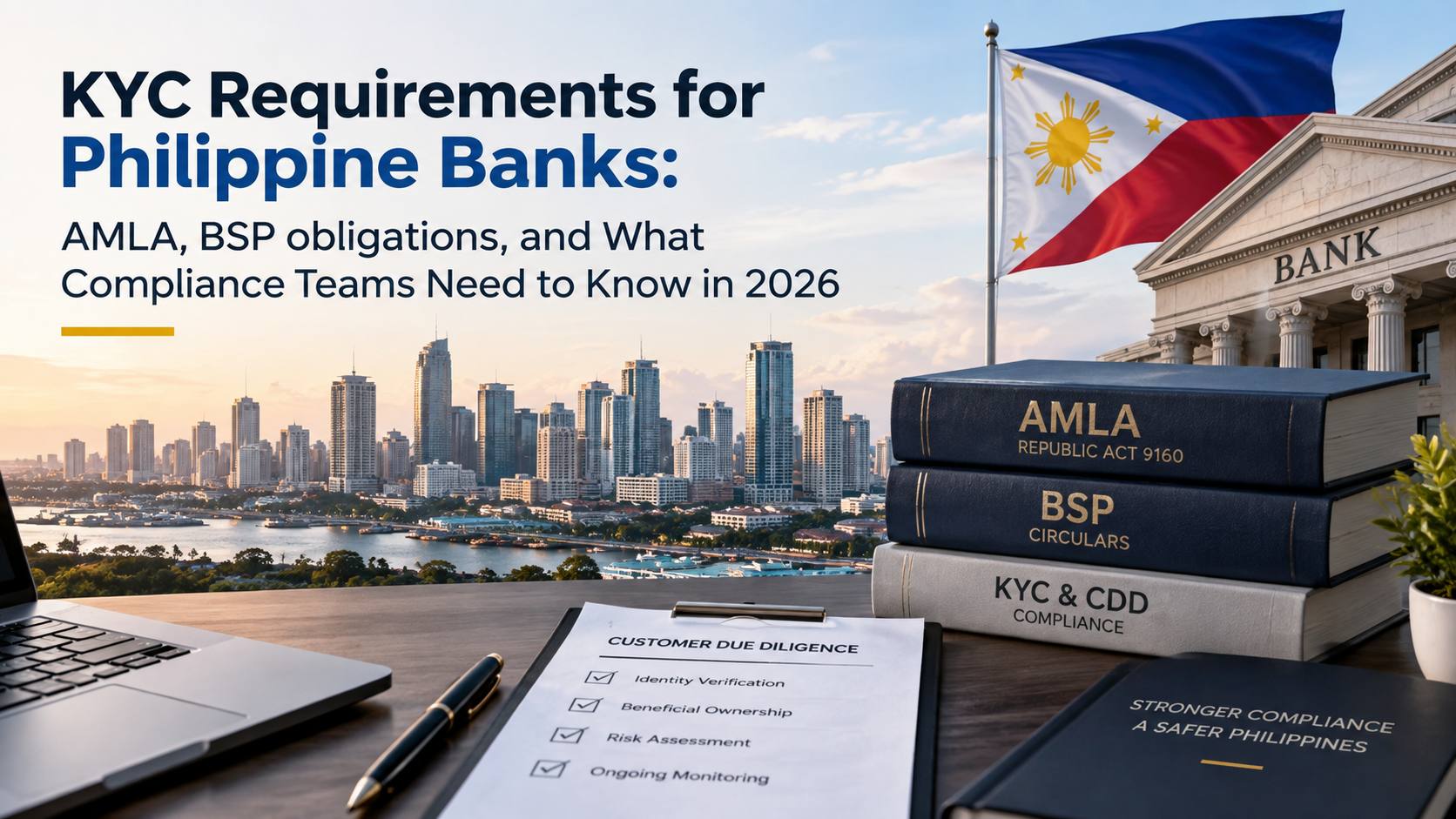
KYC Requirements for Philippine Banks: AMLA, BSP obligations, and What Compliance Teams Need to Know in 2026
The Philippines was removed from the FATF list of jurisdictions under increased monitoring in February 2025. This guide explains current AMLA and BSP KYC/CDD requirements for banks, including beneficial ownership, digital onboarding, reporting and record retention.
KYC Requirements for Philippine Banks: AMLA, BSP obligations, and What Compliance Teams Need to Know in 2026
The Philippines was removed from the FATF list of jurisdictions under increased monitoring in February 2025. This guide explains current AMLA and BSP KYC/CDD requirements for banks, including beneficial ownership, digital onboarding, reporting and record retention.