Rethinking Risk: How AML Risk Assessment Software Is Transforming Compliance in the Philippines
.svg)
Every strong AML programme begins with one thing — understanding risk with clarity.
Introduction
Risk is the foundation of every compliance decision. It determines how customers are classified, which products require enhancement, how controls are deployed, and how regulators evaluate governance standards. For financial institutions in the Philippines, the stakes have never been higher. Rapid digital adoption, increased cross-border flows, and more complex financial crime typologies have reshaped the risk landscape entirely.
Yet many institutions still rely on annual, manual AML risk assessments built on spreadsheets and subjective scoring. These assessments often lag behind fast-changing threats, leaving institutions exposed.
This is where AML risk assessment software is reshaping the future. Instead of treating risk assessment as a once-a-year compliance exercise, modern platforms transform it into a dynamic intelligence function that evolves with customer behaviour, regulatory requirements, and emerging threats. Institutions that modernise their approach today gain not only stronger compliance outcomes but a significantly deeper understanding of where real risk resides.

Why the Old Approach to AML Risk Assessment No Longer Works
Traditional AML risk assessments were designed for a different era — one where risks remained relatively stable and criminal techniques evolved slowly. Today, that world no longer exists.
1. Annual assessments are too slow for modern financial crime
A risk assessment completed in January may already be outdated by March. Threats evolve weekly, and institutions must adapt just as quickly. Static reports cannot keep up.
2. Manual scoring leads to inconsistency and blind spots
Spreadsheets and fragmented documentation create errors and subjectivity. Scoring decisions vary between analysts, and critical risk factors may be overlooked or misinterpreted.
3. Siloed teams distort the risk picture
AML, fraud, operational risk, and cybersecurity teams often use different tools and frameworks. Without a unified risk view, the institution’s overall risk posture becomes fragmented, leading to inaccurate enterprise risk ratings.
4. Behavioural indicators are often ignored
Customer risk classifications frequently rely on attributes such as occupation, geography, and product usage. However, behavioural patterns — the strongest indicators of emerging risk — are rarely incorporated. This results in outdated segmentation.
5. New typologies rarely make it into assessments on time
Scams, mule networks, deepfake-enabled fraud, and cyber-enabled laundering evolve rapidly. In manual systems, these insights take months to reflect in formal assessments, leaving institutions exposed.
The conclusion is clear: modern risk assessment requires a shift from static documentation to dynamic, data-driven risk intelligence.
What Modern AML Risk Assessment Software Really Does
Modern AML risk assessment software transforms risk assessment into a continuous, intelligence-driven capability rather than a periodic exercise. The focus is not on filling in templates but on orchestrating risk in real time.
1. Comprehensive Risk Factor Mapping
The software maps risk across products, customer segments, delivery channels, geographies, and intermediaries — aligning each with inherent and residual risk scores supported by data rather than subjective interpretation.
2. Control Effectiveness Evaluation
Instead of simply checking whether controls exist, modern systems assess how well they perform and whether they are reducing risk as intended. This gives management accurate visibility into control gaps.
3. Automated Evidence Collection
Data such as transaction patterns, alert trends, screening results, customer behaviours, and exposure shifts are automatically collected and incorporated into the assessment. This eliminates manual consolidation and ensures consistency.
4. Dynamic Risk Scoring
Risk scores evolve continuously based on live data. Behavioural anomalies, new scenarios, changes in customer profiles, or shifts in typologies automatically update institutional and customer risk levels.
5. Scenario and Typology Alignment
Emerging threats are automatically mapped to relevant risk factors. This ensures assessments reflect real and current risks, not outdated assumptions.
6. Regulator-Ready Reporting
The system generates complete, structured reports — including risk matrices, heatmaps, inherent and residual risk comparisons, and documented control effectiveness — all aligned with BSP and AMLC expectations.
Modern AML risk assessment is no longer about compiling data; it is about interpreting it with precision.
What BSP and AMLC Expect Today
Supervisory expectations in the Philippines have evolved significantly. Institutions must now demonstrate maturity in their risk-based approach rather than simply complying with documentation requirements.
1. A more mature risk-based approach
Regulators now assess how institutions identify, quantify, and manage risk — not just whether they have a risk assessment document.
2. Continuous monitoring of risk
Annual assessments alone are not sufficient. Institutions must show ongoing risk evaluation as conditions change.
3. Integration of AML, fraud, and operational risk
A holistic view of risk is now expected. Siloed assessments no longer meet supervisory standards.
4. Strong documentation and traceability
Regulators expect evidence-based scoring and clear justification for risk classifications. Statements such as “risk increased” must be supported by real data.
5. Explainability in AI-driven methodologies
If risk scoring involves AI or ML logic, institutions must explain how the model works, what data influences decisions, and how outcomes are validated.
AML risk assessment software directly supports these expectations by enabling transparency, accuracy, and continuous monitoring.
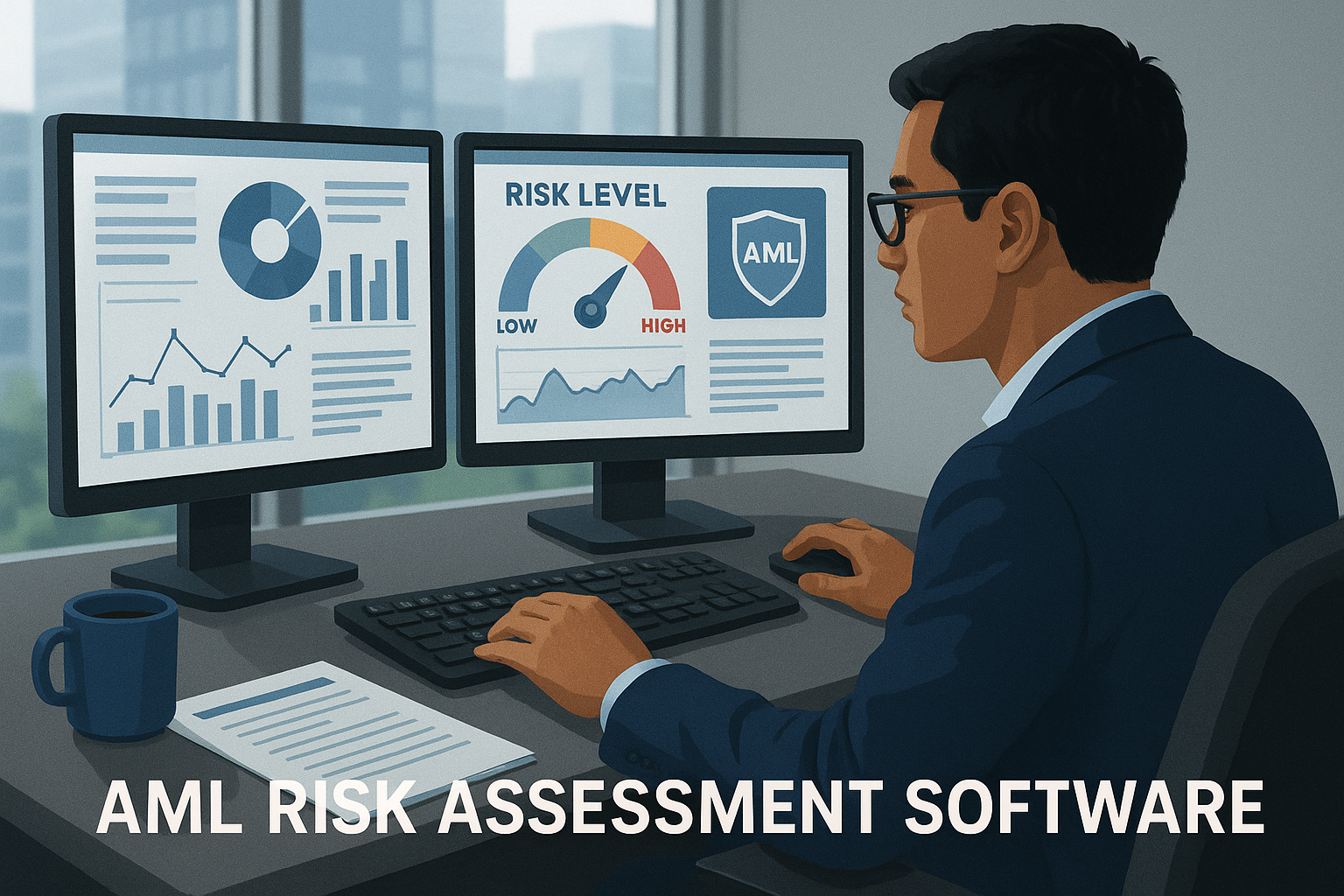
Core Capabilities of Next-Generation AML Risk Assessment Software
Next-generation platforms bring capabilities that fundamentally change how institutions understand and manage risk.
1. Dynamic Enterprise Risk Modelling
Instead of producing one assessment per year, the software updates institutional risk levels continuously based on activity, behaviours, alerts, and environmental factors. Management sees a real-time risk picture, not a historical snapshot.
2. Behavioural Risk Intelligence
Behavioural analysis helps detect risk that traditional frameworks miss. Sudden changes in customer velocity, counterparties, or financial patterns directly influence risk ratings.
3. Federated Typology Intelligence
Tookitaki’s AFC Ecosystem provides emerging red flags, typologies, and expert insights from across the region. These insights feed directly into risk scoring, allowing institutions to adapt faster than criminals.
4. Unified Customer and Entity Risk
The system aggregates data from onboarding, monitoring, screening, and case investigations to provide a single, accurate risk score for each customer or entity. This prevents fragmented risk classification across products or channels.
5. Real-Time Dashboards and Heatmaps
Boards and compliance leaders can instantly visualise risk exposure by customer segment, product type, geography, or threat category. This strengthens governance and strategic decision-making.
6. Embedded Explainability
Every risk score is supported by traceable logic, contributing data sources, and documented rationale. This level of transparency is essential for audit and regulatory review.
7. Automated Documentation
Risk assessments — which once required months of manual effort — can now be generated quickly with consistent formatting, reliable inputs, and complete audit trails.
Tookitaki’s Approach to AML Risk Assessment: Building the Trust Layer
Tookitaki approaches risk assessment as a holistic intelligence function that underpins the institution’s ability to build and maintain trust.
FinCense as a Continuous Risk Intelligence Engine
FinCense collects and interprets data from monitoring alerts, screening hits, customer behaviour changes, typology matches, and control effectiveness indicators. It builds a constantly updated picture of institutional and customer-level risk.
FinMate — The Agentic AI Copilot for Risk Teams
FinMate enhances risk assessments by providing context, explanations, and insights. It can summarise enterprise risk posture, identify control gaps, recommend mitigations, and answer natural-language questions such as:
“Which areas are driving our increase in residual risk this quarter?”
FinMate turns risk interpretation from a manual task into an assisted analytical process.
AFC Ecosystem as a Living Source of Emerging Risk Intelligence
Scenarios, red flags, and typologies contributed by experts across Asia feed directly into FinCense. This gives institutions real-world, regional intelligence that continuously enhances risk scoring.
Together, these capabilities form a trust layer that strengthens governance and regulatory confidence.
Case Scenario: A Philippine Bank Reinvents Its Risk Framework
A Philippine mid-sized bank faced several challenges:
- risk assessments performed once a year
- highly subjective customer and product risk scoring
- inconsistent documentation
- difficulty linking typologies to inherent risk
- limited visibility into behavioural indicators
After adopting Tookitaki’s AML risk assessment capabilities, the bank redesigned its entire risk approach.
Results included:
- dynamic risk scoring replaced subjective manual ratings
- enterprise risk heatmaps updated automatically
- new typologies integrated seamlessly from the AFC Ecosystem
- board reporting improved significantly
- FinMate summarised risk insights and identified emerging patterns
- supervisory inspections improved due to stronger documentation and traceability
Risk assessment shifted from a compliance reporting exercise into a continuous intelligence function.
Benefits of Advanced AML Risk Assessment Software
1. Stronger Risk-Based Decision-Making
Teams allocate resources based on real-time exposure rather than outdated reports.
2. Faster and More Accurate Reporting
Documents that previously required weeks of consolidation are now generated in minutes.
3. Better Audit and Regulatory Outcomes
Explainability and traceability build regulator confidence.
4. Proactive Improvement of Controls
Institutions identify control weaknesses early and implement remediation faster.
5. Clear Visibility for Senior Management
Boards gain clarity on institutional risk without sifting through hundreds of pages of documentation.
6. Lower Compliance Costs
Automation reduces manual effort and human error.
7. Real-Time Enterprise Risk View
Institutions stay ahead of emerging risks rather than reacting to them after the fact.
The Future of AML Risk Assessment in the Philippines
Risk assessment will continue evolving in several important ways:
1. Continuous Risk Monitoring as the Standard
Annual assessments will become obsolete.
2. Predictive Risk Intelligence
AI models will forecast future threats and risk trends before they materialise.
3. Integrated Fraud and AML Risk Frameworks
Institutions will adopt unified enterprise risk scoring models.
4. Automated Governance Dashboards
Executives will receive real-time updates on risk drivers and exposure.
5. National-Level Typology Sharing
Federated intelligence sharing across institutions will strengthen the overall ecosystem.
6. AI Copilots Supporting Risk Analysts
Agentic AI will interpret risk drivers, highlight vulnerabilities, and provide decision support.
Institutions that adopt these capabilities early will be well positioned to lead the next generation of compliant and resilient financial operations.
Conclusion
AML risk assessment is no longer merely a regulatory requirement; it is the intelligence engine that shapes how financial institutions operate and protect their customers.
Modern AML risk assessment software transforms outdated, manual processes into continuous, data-driven governance frameworks that deliver clarity, precision, and resilience.
With Tookitaki’s FinCense, FinMate, and the AFC Ecosystem, institutions gain a dynamic, transparent, and explainable risk capability that aligns with the complexity of today’s financial landscape.
The future of risk management belongs to institutions that treat risk assessment not as paperwork — but as a continuous strategic advantage.
Experience the most intelligent AML and fraud prevention platform
Experience the most intelligent AML and fraud prevention platform
Experience the most intelligent AML and fraud prevention platform
Top AML Scenarios in ASEAN
The Role of AML Software in Compliance
The Role of AML Software in Compliance