


CRS that’s easier to govern, easier to explain, and easier to defend
Compliance teams don’t just need a risk score - they need to trust it, explain it, and prove it during reviews and audits. This month’s release strengthens Customer Risk Scoring (CRS) in three practical ways:
- Admins can configure complex scoring logic with stronger governance.
- Investigators get clearer “why this score” explainability (even for complex rules).
- Cross-border operations get smoother access without depending on one geography.
Example scenario: an auditor asks "Why did this customer get this score?"
A reviewer opens a high-risk customer profile and needs to justify the outcome quickly:
- Was this score driven by a mandatory override?
- Which risk indicators contributed the most?
- Has the customer’s risk changed since the last review, and if so, what changed exactly?
Until now, this kind of explanation could require manual interpretation, screenshots, or digging through configurations. This product update changes that.
Enterprise-Grade CRS Rule Governance – complex logic without complex operations

CRS configuration has been modernised so that administrators can manage scoring logic cleanly, even when rules are nested and priorities matter.

- Set up a global mandatory override layer that takes precedence over everything else (useful for “absolute” risk policies).
- Build complex rules with nested groups and AND/OR/NOR logic in a modern rule builder.
- Manage configurations with a clearer Rules Configuration experience and standardised actions.
{{product-cta-1}}
Clearer Score Explainability – faster investigations and more defensible audits
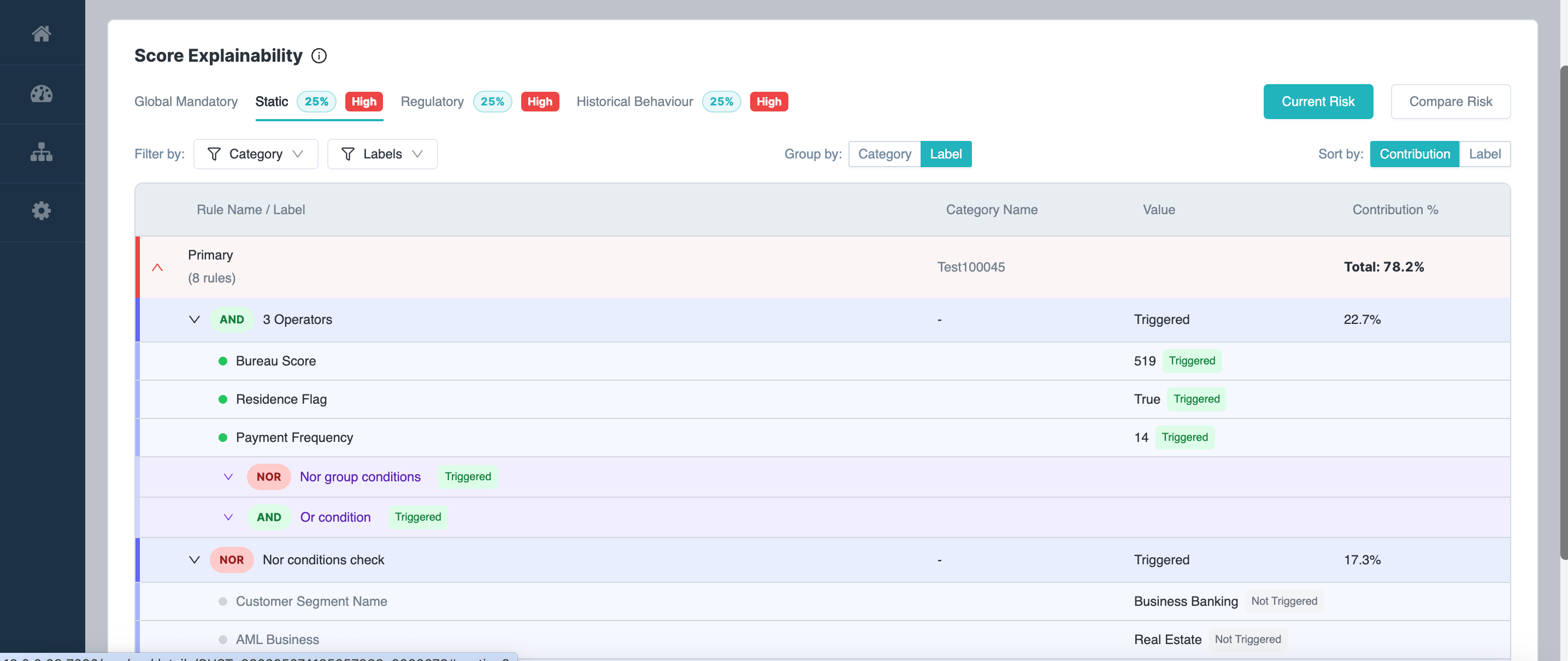
Investigators can now interpret risk outcomes faster, with explainability that clarifies whether the score came from mandatory overrides or from rules-based scoring, and what contributed the most.

- Mandatory overrides are now visible and structured
- A clear “Override Active” vs “No Override” summary shows whether a mandatory rule determined the score.
- Priority groups (P1…Pn) and triggered rules are displayed in a structured manner.
- Disabled rules are clearly marked (so teams don’t misinterpret them).

- Complex rules are now readable (even when nested)
- Complex/compound rules are displayed in an expandable format so investigators can understand them without decoding configuration logic.

- Compare Risk mode is more useful for reviews and monitoring.
- Compare mode now makes it easier to see how risk changed across snapshots – values, contributions, and labels.
{{product-cta-2}}
Cross-Domain Access Enablement – seamless operations across regions

As financial institutions operate across multiple regions and environments, consistent and secure access becomes critical. This release introduces cross-domain access enablement, allowing users to authenticate and access FinCense across different operational domains while maintaining the same role-based permissions and security controls. This capability ensures that distributed teams can work seamlessly across environments without relying on a single access pattern or location-specific setup.
{{product-cta-3}}